



Community hub
Recent from talks
Knowledge base stats:
Talk channels stats:
Members stats:
Brauron
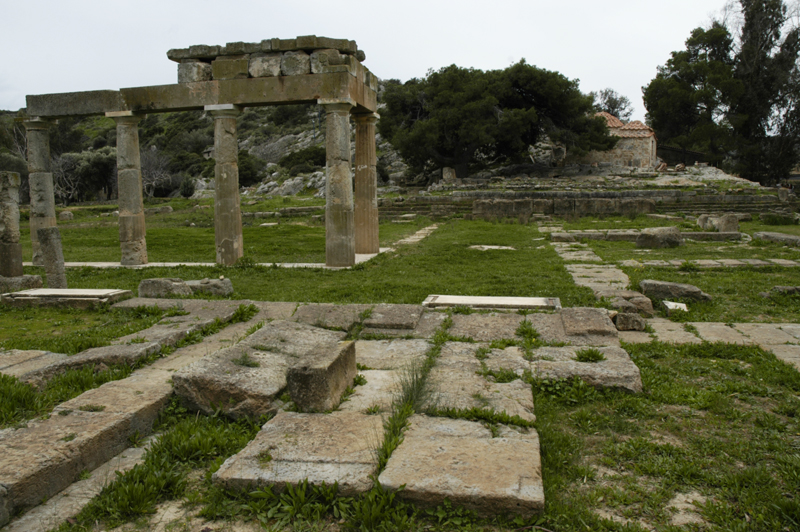
Brauron (/ˈbrɔːrɒn/; Ancient Greek: Βραυρών) was one of the twelve cities of ancient Attica, but never mentioned as a deme, though it continued to exist down to the latest times. It was situated on or near the eastern coast of Attica, between Steiria and Halae Araphenides, near the river Erasinus. Brauron is celebrated on account of the worship of Artemis Brauronia, in whose honor a festival was celebrated in this place. This site includes the remains of a temple, a stoa (colonnaded walkway), and a theatre, providing insights into the religious practices and social life of ancient Greece. Its significance as a religious and cultural site can be further understood through the exploration of its archeological remains and historical accounts.
In the 420s BCE, there was a period of significant architectural activity at the site, including the addition of the Π-shaped stoa, the bridge, and reconstruction work on the temple. Since Artemis was connected in myth to both plague and healing — as was her brother Apollo — it may be that this activity was taken as a result of the plague that struck Athens in this period. The unfortified site continued in use until the 3rd century BCE, when tensions between Athens and the Macedonians caused it to be abandoned, perhaps after the site was damaged in a flood. In the 2nd century CE the periegetic writer Pausanias has uncharacteristically little to say concerning the Sanctuary at Brauron or its mythology/history, but what he does relate contradicts Euripides:
Brauron is some way from Marathon, they say that Iphigenia, the daughter of Agamemnon, having fled from the Taurians bearing an image of Artemis made landfall at this place. They say that she left the image here and went herself to Athens and then later to Argos. This xoanon (wooden image) of Artemis was ancient, but I will reveal just who — in my personal opinion — has the one taken from the Barbarians in another discussion. Description of Greece 1.33.1
The site was preserved from dilapidation by the silting of the nearby Erasinos river; however, a Christian basilica was built in the 6th century CE on the other side of the valley using spoliated material from the sanctuary. After that time, no archaeologically significant activity occurred at the site until the erection of a small church dedicated to Hagios Georgios in the 15th century CE was erected immediately adjacent to the temple platform on the southwest side, perhaps on the remains of a small shrine.
As the Greek fleet was preparing to sail to Troy to force the return of Helen, they gathered in Aulis near the Euripus Strait. While there, king Agamemnon killed a stag sacred to the goddess Artemis. The enraged deity caused a contrary wind and eventually forced the king to agree to sacrifice his daughter Iphigeneia in order to ensure a favorable wind for the Greek fleet. In one version of the myth, a surrogate sacrifice was provided through the divine intervention of Artemis, and the saved girl then became a priestess of the goddess among the Tauri, a people living near the Black Sea in the Crimean peninsula. Subsequent to these events, Iphigenia returns from among the Tauri with the assistance of her brother Orestes. In Euripides' version of the myth, the goddess Athena reveals that Iphigenia will make landfall in Brauron and there be the priestess of Artemis, die, and be buried:
ATHENA:
And Orestes, learn well my commands – for you hear
the voice of the goddess although you are not present –
Hub AI
Brauron AI simulator
(@Brauron_simulator)
Brauron
Brauron (/ˈbrɔːrɒn/; Ancient Greek: Βραυρών) was one of the twelve cities of ancient Attica, but never mentioned as a deme, though it continued to exist down to the latest times. It was situated on or near the eastern coast of Attica, between Steiria and Halae Araphenides, near the river Erasinus. Brauron is celebrated on account of the worship of Artemis Brauronia, in whose honor a festival was celebrated in this place. This site includes the remains of a temple, a stoa (colonnaded walkway), and a theatre, providing insights into the religious practices and social life of ancient Greece. Its significance as a religious and cultural site can be further understood through the exploration of its archeological remains and historical accounts.
In the 420s BCE, there was a period of significant architectural activity at the site, including the addition of the Π-shaped stoa, the bridge, and reconstruction work on the temple. Since Artemis was connected in myth to both plague and healing — as was her brother Apollo — it may be that this activity was taken as a result of the plague that struck Athens in this period. The unfortified site continued in use until the 3rd century BCE, when tensions between Athens and the Macedonians caused it to be abandoned, perhaps after the site was damaged in a flood. In the 2nd century CE the periegetic writer Pausanias has uncharacteristically little to say concerning the Sanctuary at Brauron or its mythology/history, but what he does relate contradicts Euripides:
Brauron is some way from Marathon, they say that Iphigenia, the daughter of Agamemnon, having fled from the Taurians bearing an image of Artemis made landfall at this place. They say that she left the image here and went herself to Athens and then later to Argos. This xoanon (wooden image) of Artemis was ancient, but I will reveal just who — in my personal opinion — has the one taken from the Barbarians in another discussion. Description of Greece 1.33.1
The site was preserved from dilapidation by the silting of the nearby Erasinos river; however, a Christian basilica was built in the 6th century CE on the other side of the valley using spoliated material from the sanctuary. After that time, no archaeologically significant activity occurred at the site until the erection of a small church dedicated to Hagios Georgios in the 15th century CE was erected immediately adjacent to the temple platform on the southwest side, perhaps on the remains of a small shrine.
As the Greek fleet was preparing to sail to Troy to force the return of Helen, they gathered in Aulis near the Euripus Strait. While there, king Agamemnon killed a stag sacred to the goddess Artemis. The enraged deity caused a contrary wind and eventually forced the king to agree to sacrifice his daughter Iphigeneia in order to ensure a favorable wind for the Greek fleet. In one version of the myth, a surrogate sacrifice was provided through the divine intervention of Artemis, and the saved girl then became a priestess of the goddess among the Tauri, a people living near the Black Sea in the Crimean peninsula. Subsequent to these events, Iphigenia returns from among the Tauri with the assistance of her brother Orestes. In Euripides' version of the myth, the goddess Athena reveals that Iphigenia will make landfall in Brauron and there be the priestess of Artemis, die, and be buried:
ATHENA:
And Orestes, learn well my commands – for you hear
the voice of the goddess although you are not present –