Hubbry Logo
search
logo
Brauron
Brauron
current hub
1904320

Brauron

logo
Community Hub0 Subscribers
Read side by side
from Wikipedia

Brauron (/ˈbrɔːrɒn/; Ancient Greek: Βραυρών) was one of the twelve cities of ancient Attica, but never mentioned as a deme, though it continued to exist down to the latest times. It was situated on or near the eastern coast of Attica, between Steiria and Halae Araphenides, near the river Erasinus. Brauron is celebrated on account of the worship of Artemis Brauronia, in whose honor a festival was celebrated in this place. This site includes the remains of a temple, a stoa (colonnaded walkway), and a theatre, providing insights into the religious practices and social life of ancient Greece. Its significance as a religious and cultural site can be further understood through the exploration of its archeological remains and historical accounts.

Key Information

History

[edit]
Erasinos River near the Temple of Artemis Brauronia

In the 420s BCE, there was a period of significant architectural activity at the site, including the addition of the Π-shaped stoa, the bridge, and reconstruction work on the temple. Since Artemis was connected in myth to both plague and healing — as was her brother Apollo — it may be that this activity was taken as a result of the plague that struck Athens in this period. The unfortified site continued in use until the 3rd century BCE, when tensions between Athens and the Macedonians caused it to be abandoned, perhaps after the site was damaged in a flood. In the 2nd century CE the periegetic writer Pausanias has uncharacteristically little to say concerning the Sanctuary at Brauron or its mythology/history, but what he does relate contradicts Euripides:

Brauron is some way from Marathon, they say that Iphigenia, the daughter of Agamemnon, having fled from the Taurians bearing an image of Artemis made landfall at this place. They say that she left the image here and went herself to Athens and then later to Argos. This xoanon (wooden image) of Artemis was ancient, but I will reveal just who — in my personal opinion — has the one taken from the Barbarians in another discussion. Description of Greece 1.33.1

The site was preserved from dilapidation by the silting of the nearby Erasinos river; however, a Christian basilica was built in the 6th century CE on the other side of the valley using spoliated material from the sanctuary. After that time, no archaeologically significant activity occurred at the site until the erection of a small church dedicated to Hagios Georgios in the 15th century CE was erected immediately adjacent to the temple platform on the southwest side, perhaps on the remains of a small shrine.

Mythology

[edit]

As the Greek fleet was preparing to sail to Troy to force the return of Helen, they gathered in Aulis near the Euripus Strait. While there, king Agamemnon killed a stag sacred to the goddess Artemis. The enraged deity caused a contrary wind and eventually forced the king to agree to sacrifice his daughter Iphigeneia in order to ensure a favorable wind for the Greek fleet. In one version of the myth, a surrogate sacrifice was provided through the divine intervention of Artemis, and the saved girl then became a priestess of the goddess among the Tauri, a people living near the Black Sea in the Crimean peninsula. Subsequent to these events, Iphigenia returns from among the Tauri with the assistance of her brother Orestes. In Euripides' version of the myth, the goddess Athena reveals that Iphigenia will make landfall in Brauron and there be the priestess of Artemis, die, and be buried:

ATHENA:

And Orestes, learn well my commands – for you hear

the voice of the goddess although you are not present –

set forth taking the (sacred) image and your sister,

and when you reach god-built Athens,

there is a place on the outermost borders

of Attica, a neighbor of the Karustia ridge,

sacred, and my people name it Halai.

Build a temple there and set up the wooden image

– named for the Tauric land and for your struggles,

which you endured wandering through Greece

due to the goads of the Furies. And in the future mortals

shall sing hymns to the goddess Artemis Tauropolos.

And set up this law: whenever the people keep the festival

as a payment of your sacrifice, hold a sword

at a man's throat and draw blood,

so that by this the goddess may have her holy honors.

And you, Iphigenia, beside the holy stairs

of Brauron you must hold the keys for the goddess herself:

where you will die and be buried, and – as a delight for you –

they will dedicate the finely woven material of woven cloth

which by chance women having lost their lives in childbirth

abandon in their homes. I command you to send forth

these Greek women from this land

due to their correct intentions.

Euripides, Iphigeneia in Tauris 1446–1468.

The poet asserts a close connection between the nearby sanctuary of Artemis Tauropolos at Halai (modern day Loutsa) and the Sanctuary at Brauron, where Iphigenia is to receive honors in the cult of Artemis. As is often the case, there were multiple competing versions of the relevant myths, but the mythical connection between the three coastal sanctuaries of Artemis is clear. Halai Araphenides (the Salt Fields of Araphen, modern Rafina) was the ancient name of modern Loutsa, a beach resort half-way between Rafina and Vravrona, where the ruins of a small temple to Artemis Tauropolos have been excavated from underneath the sand dunes originally covering the area.

Sanctuary of Artemis at Brauron

[edit]

The sanctuary of Artemis at Brauron (Modern Greek: Βραυρώνα - Vravrona) is an early sacred site on the eastern coast of Attica near the Aegean Sea in a small inlet. The inlet has silted up since ancient times, pushing the current shoreline farther from the site. A nearby hill, c. 24 m high and 220 m to the southeast, was inhabited during the Neolithic era, c. 2000 BCE, and flourished particularly from Middle Helladic to early Mycenaean times (2000–1600 BCE) as a fortified site (acropolis). Occupation ceased in the LHIIIb period, and the acropolis was never significantly resettled after this time. This gap in the occupation of the site lasted from LHIIIb (13th century) until the 8th century BCE. Brauron was one of the twelve ancient settlements of Attica prior to the synoikismos of Theseus, who unified them with Athens.

The following of Artemis Brauronia connected the coastal (rural) sanctuary at Brauron with another (urban) sanctuary on the acropolis in Athens, the Brauroneion, from which there was a procession every four years during the Arkteia festival. The tyrant Pisistratus was Brauronian by birth, and he is credited with transferring the cult to the Acropolis, thus establishing it on the statewide rather than local level. The sanctuary contained a small temple of Artemis, a unique stone bridge, cave shrines, a sacred spring, and a pi-shaped (Π) stoa that included dining rooms for ritual feasting. The unfortified site continued in use until tensions between the Athenians and the Macedonians the 3rd century BCE caused it to be abandoned. After that time, no archaeologically significant activity occurred at the site until the erection of a small church in the 6th century CE.

Votive dedications at the sanctuary include a number of statues of young children of both sexes, as well as many items pertaining to feminine life, such as jewelry boxes and mirrors. Large numbers of miniature kraters (krateriskoi) have been recovered from the site, many depicting young girls — either nude or clothed — racing or dancing. The Archaeological Museum of Brauron — located around a small hill 330 m to the ESE — contains an extensive and important collection of finds from the site throughout its period of use.

Archaeology of the sanctuary

[edit]
Labelled plan of the Sanctuary of Artemis at Brauron

In 1948, John Papadimitriou began excavating this site; he continued, with interruptions, until his death in 1963.[1] Charalambos Bouras continued the restoration during the 1950s to 1962. Among the fifth-century monuments are the Π-shaped stoa around the interior courtyard, opening toward the temple of Artemis; the small temple (perhaps a heroon of Iphigeneia); and the stone bridge over the Erasinos River. Building repair inscriptions from the site list many more structures than have been recovered to this point, including a palaestra and a gymnasion.[2]

Temple of Artemis

[edit]
The Π-shaped stoa

The first known temple at the sanctuary — dating to the late 6th century BCE — rests on a low rock spur south of the river and is aligned toward the east on a foundation measuring c. 11 by 20 m. Little is preserved beyond partial lower courses and cuttings in the bedrock for the same. There are a few remains of the architecture that allow a certain identification of the temple as being of the Doric order. The Persians destroyed the sanctuary structures in 480 BCE and took the cult statue back to Susa. The temple was reconstructed in the 420s BCE. Although the temple is poorly preserved, it can be reconstructed to have had four columns in the cella and an adyton at the rear of the cella. The presence of an adyton is asserted for the temple of Artemis at Loutsa (Artemida) 6.1 km to the north and the temple of Artemis at Aulis 67 km northwest. This feature may also be shared by the 6th century BCE Temple of Aphaea on Aigina. Schwandner links the shared feature of an adyton with a common, regional practice in the cult of Artemis. There is disagreement on the question of the temple having been hexastyle-prostyle (six columns across the front only) or distyle in antis (two columns between projecting walls) in plan. There is a stepped retaining wall on the northern side of the temple platform, which may be the steps mentioned by Euripides.[3]

Π-shaped stoa

[edit]
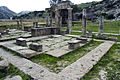
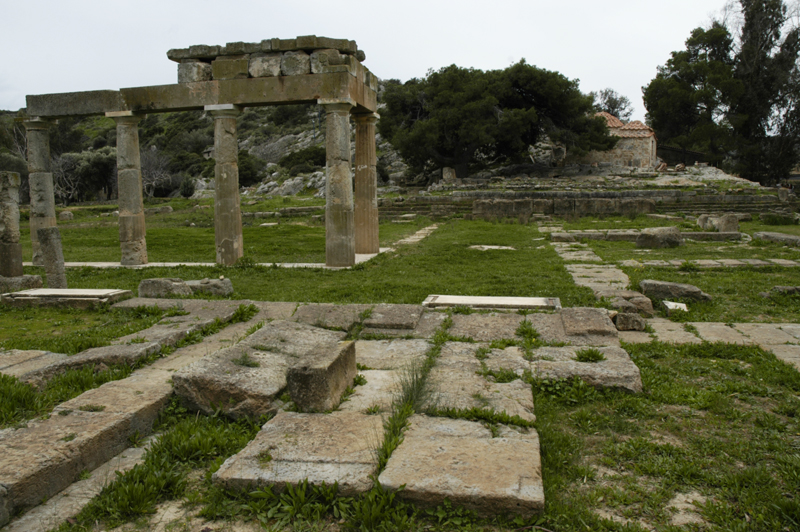
Π-shaped stoa, facing south toward the Temple of Artemis Brauronia
Doric frieze of the stoa showing marble metopes

The Doric stoa wrapped around three sides of a central courtyard (20 by 27 m) and faced south toward the temple of Artemis. The foundations extend along the west wing for 38 m, the north wing for 48 m, and the east wing for 63 m. Only the north colonnade of the stoa (11 columns) and one column of each of the two wings were completed. Behind the colonnade, there was a passageway containing many votive stelae (some with votive statues of children at top) and doorways into nine roughly square rooms (c. 5.5 by 5.5 m) on the north and west sides of the structure.[4]

These doorways were off-center relative to the rooms, each of which had raised platforms extending from all sides. On these platforms are many cuttings (some still containing lead) designed to hold dining couches — eleven couches for each dining room. Some of the rooms preserve small stone tables situated in front of the location of the couches. These structures are among the most paradigmatic examples of Greek dining rooms known. The walls of these rooms were constructed of a single course of massive limestone ashlar blocks that have no cuttings on their upper surfaces. The walls were thus completed in mud brick to the level of the roof. On the western side of the stoa there was an entrance with wheel ruts worn into the stone floor and in line with the Classical bridge.

The stoa was built of local limestone covered in marble stucco, except for the Doric capitals, the metopes, the lintels, and the thresholds, which were produced from marble. A highly atypical feature of this design was the use of two triglyphs in the inter-columnar interval as opposed to the typical single triglyph. This was done to lower the total height of the entablature while allowing the metopes to remain square in form. In addition, the returning angles of the frieze demanded the architectural accommodation of corner expansion (as opposed to the corner contraction seen on many temples) to harmonize the intervals of the triglyphs, which could not be placed dead center over the corner column.

Immediately north of the stoa and sharing a common wall was a structure of unknown function with elaborate entrances on both west and east sides. On its long axis it measured 48 m (equivalent to the stoa) and was c. 11 m wide. Along the northern wall of this structure there was a series of slotted bases for narrow (perhaps wooden) planks; these planks are hypothesized to have held the garments dedicated to Iphegenia, as discussed by Euripides.

Stone bridge

[edit]
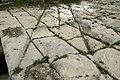
The classical period stone bridge with wheel ruts

This stone bridge is the only known example of a Classical period bridge in Greece. It uses the standard post and lintel construction of its time, rather than arches as later bridges do. It measured c. 9 m wide with a span of c. 8 m that consisted of four rows of lintel blocks resting on five rows of posts (the two end points and three intermediate supports). Wheel ruts are cut into the stones of the bridge at an oblique angle toward a simple entrance on the west side of the stoa; these cuttings do not go toward the elaborate propylon (monumental entranceway) of the structure north of the stoa as might seem more likely. This bridge introduced a new type of construction wherein horizontal stone slabs are supported by a series of walls parallel to the stream, which flows through the narrow channels between the walls.[5]

Sacred spring

[edit]
The stoa and the sacred spring from the southwest

A spring emerged from the northwest end of the rock spur running down from the acropolis hill to the southeast of the site. This spring was the focus of cult activity from the 8th century BCE forward. The first activity on the site known after the Bronze Age is thus linked to cultic practice at this spring. Dedications were made by throwing objects into this sacred spring, which was located immediately northwest of the later temple platform.[6]

Small shrine

[edit]

About 12 m southeast of the Temple of Artemis a small shrine (Μικρὸν ἱερόν) of c. 5.5 by 8 m was built into the space between the face of the rock spur and a mass of fallen rock measuring 25 m in length. The c. 6 m wide space between the face of the rock spur and the fallen rock is densely packed with structural remains of uncertain function. This area has been associated with the propitiation of Iphigenia, perhaps in the form of a heroon. It is probable that some of these structures were in place before the rock fall, and it is possible that the small shrine replaced a cult site (perhaps for Iphigenia) destroyed by the collapse of the rock overhang under which it was built. The area between the face of the rock spur and the fallen rock has been termed a “cave” in some publications. There is another cave higher on the rock, approximately over the entrance to the archaeological site. This was converted into a makeshift chapel of St. George, possibly several centuries ago.[7]

Additional images of the Sanctuary of Artemis at Brauron

[edit]


Cult of Artemis Brauronia

[edit]

Cult activity is known from the 8th century BCE forward from dedications in the sacred spring, and a temple was built in the 6th century BCE.

The Arkteia festival was celebrated every four years and involved a procession from the shrine of Artemis Brauronia on the acropolis of Athens, 24.5 km WNW of the sanctuary.[8] At the isolated sanctuary of Artemis at Brauron, young Athenian girls approaching marriageable age formed groups consecrated for a time to Artemis as arktoi, she-bears,[9] and spent their time in sacred dances, wearing honey-colored saffron robes,[10] running races and making sacrifice. Vase paintings show that cultic nudity was an element in these preparations for womanhood.[11] An epigram in the Anthologia Graeca concerns the offerings of childish playthings a nubile young girl dedicates to Artemis on the eve of marriage; many such tokens have been recovered from the spring at Brauron. There may have been joint worship of Iphegenia associated with a cult site, or heroon that may have been located in the “cave” between the face of the rock spur and the fallen rock. The goddess Artemis was a danger to be propitiated by women during child-birth and of the newborn: to her were dedicated the clothes of women who had successfully borne a child.[12] The garments of women who died in childbirth were dedicated to Iphigeneia at Brauron.[13]

Brauron

[edit]

Brauron Signal Tower

[edit]
Vravrona Signal Tower, one of the few fortification works remaining from the Frankish rule in the Mesogeia region

The tower was within optical range of other similar towers used for signalling with smoke during the day and fire during the night. Messages could be relayed very quickly and it is said that a message could be transferred from the shores of Asia to the shores of Europe within an hour. The towers of Vravron as well as Liada were also used to signal the appearance of pirates to the residents of the region. Local lore suggests that the tower was of Venetian origin between 1394 and 1405, but archeological investigations show that it was probably built by the Burgundian Dukes De La Roche (1204–1311) at least one hundred years earlier.

Modern Brauron

[edit]

The modern Brauron, known as Vravrona, is a tiny settlement of Markopoulo located nearly 1 km southeast of the archaeological site. It contains dozens of homes; the population in 2011 was 195. The urban area lies about 200 m northward and is linked with a road between Markopoulo and Artemis (Loutsa). The town never grew because the adjacent gulf of Vravrona is rocky and not suited to swimming. The area, amply watered by the seasonal Erasinos river, was once famous for its tomatoes and figs. The locally grown batala tomato varietal is considered the best in Greece: it is sweet, very flavorful, very large and fleshy, and consequently very heavy. This spelled the varietal's commercial doom, as the fruit cannot be stored at all because it collapses under its own weight within a few days after picking. It was only sold at roadside stands by local farmers. Nowadays batala tomatoes are found only in home gardens. The Vravrona or "royal" figs are also very large, sweet, with a thin, light green skin even when fully ripe. They are also practically impossible to store, and furthermore they grow so large that, as soon as they are perfectly ripe, their underside starts bursting apart. This means they are commercially non-viable and their cultivation is restricted to home orchards.

Nearby places

[edit]

Archaeological museum

[edit]

The museum is about a 5-minute walk from the archaeological site. It was renovated in 2009 and the exhibits were rearranged.

See also

[edit]

Notes

[edit]

Bibliography

[edit]
[edit]
Revisions and contributorsEdit on WikipediaRead on Wikipedia
from Grokipedia
Brauron is an ancient archaeological site and sanctuary in eastern Attica, Greece, approximately 38 kilometers southeast of Athens, dedicated to the goddess Artemis Brauronia and renowned for its role in rituals involving young girls known as the arkteia.[1][2][3] The sanctuary's origins trace back to at least the 8th century BCE, with evidence of continuous worship through the Classical period, peaking between 450 and 300 BCE before abandonment around 300 BCE, though Mycenaean traces suggest earlier occupation from the Bronze Age.[1][4] Excavations began in 1948 under Ioannis Papadimitriou and continued until 1963, uncovering structures that illuminate ancient Greek religious and social practices, particularly those tied to female life stages and fertility.[2][4][5] Key architectural features include a Doric temple to Artemis constructed in the 5th century BCE, whose foundations and cult statue base remain visible, and a distinctive Π-shaped Doric stoa from 425–420 BCE, the oldest known example in Greece, which housed over 200 marble votive statues of young girls (korai) and served as a dining area for ritual feasts.[1][2][6] Other notable elements comprise a Classical bridge spanning the Erasinos River, rock-cut terraces, a sacred spring, and remnants of a theater, all contributing to the site's layout as a rural cult center.[1][6] The cult of Artemis Brauronia emphasized the goddess's aspects as protector of women in childbirth and transition to adulthood, most famously through the arkteia ritual, where pre-pubescent girls aged 5–10 (and sometimes boys) dressed in saffron crocotos garments and "played the bear" (arktos) in a symbolic act of purification and initiation, possibly commemorating a mythological bear sacrifice.[7][3][8] This rite, linked to myths involving Iphigenia and a sacred bear, connected Brauron to Athenian practices, with a related shrine (Brauronion) on the Acropolis housing transferred votives after the site's decline.[1][8][9] Artifacts from the site, displayed in the adjacent Brauron Archaeological Museum established in 1962 and refurbished in 2009, span the Early Bronze Age to Roman era and include terracotta krateriskoi depicting the arkteia, bronze mirrors, jewelry dedicated by women post-childbirth, and marble statues of arktoi, offering evidence of the sanctuary's enduring role in gender-specific worship.[4][10][11]

Location and Geography

Ancient Setting

Brauron occupied a strategic position in eastern Attica, approximately 38 kilometers southeast of Athens, along the Aegean coastline at the mouth of the Erasinos River.[12] This coastal location placed it between the demes of Steiria to the north and Halae Araphenides to the south, facilitating maritime access while embedding it within the broader network of Attic settlements. As one of the twelve ancient cities of Attica prior to the synoecism under Theseus, Brauron served as a coastal settlement without formal designation as a deme, supporting local economies through fishing in the nearby bay and agriculture in the surrounding fertile lowlands.[13] The natural landscape surrounding Brauron consisted of marshy plains and a lush valley shaped by the Erasinos River, which flowed from inland springs into a narrow, often waterlogged bay.[14] This riverine environment not only enriched the soil for cultivation but also featured prominently in fertility myths tied to the cult of Artemis, symbolizing renewal and abundance in the region's religious traditions.[15] Proximity to Mount Hymettus, approximately 20 kilometers to the west, provided access to Hymettian marble quarries, a fine-grained stone employed in Attic constructions for its durability and aesthetic qualities.[16] Environmental challenges, particularly the recurrent flooding from the Erasinos River, profoundly influenced the site's development and required adaptive engineering measures.[17] Seasonal inundations turned parts of the plain into wetlands, prompting the construction of a robust stone bridge—measuring about 9 meters wide and spanning an 8-meter gap—to connect the sanctuary area across the river and mitigate access disruptions.[18] These hydrological dynamics underscored Brauron's integration with its watery terrain, enhancing the mystical aura of the nearby Sanctuary of Artemis while dictating practical spatial arrangements.[19]

Modern Vravrona

Vravrona, the modern successor to ancient Brauron, is a small coastal village in East Attica, Greece, with a population of approximately 268 residents as of the 2021 census.[20] Situated about 31 kilometers southeast of Athens, it has evolved from its ancient marshy setting into a quiet settlement centered on tourism drawn to the nearby archaeological site and local agriculture, including vineyards, olive groves, and dairy production.[21][22] The village's economy relies on these sectors, with family-run farms producing cheeses from fresh milk and cultivating crops amid the rolling countryside. Recent archaeological surveys, such as the Bays of East Attica Regional Survey (BEARS) project's final season in 2024, continue to explore the area's landscape and history.[23][24][25] A prominent modern landmark is the Brauron Signal Tower, a 13th-century Byzantine-era watchtower constructed during the Frankish rule under the Burgundian Dukes de la Roche (1204–1311).[26] This stone structure, one of the few surviving fortifications in the Mesogeia region, served as a signaling point to alert nearby areas of invasions or threats, offering panoramic views of the coast.[27] Today, it stands as a historical monument integrated into the village's landscape, attracting visitors interested in medieval architecture alongside the ancient ruins. Access to Vravrona and the archaeological site is straightforward from Athens, primarily via the road through Markopoulo Mesogeias, a drive of 45–60 minutes by car.[28] Public transport options include bus line 304 from Nomismatokopio Metro Station (Line 3), taking about one hour to reach the village, or transferring from the airport via bus X97 to Markopoulo and then a local bus.[29] The site lies near Porto Rafti, a popular beach area just a few kilometers away, enhancing its appeal for combined cultural and seaside visits.[4] Environmental challenges in Vravrona include ongoing coastal erosion, which threatens the beach and adjacent archaeological structures, such as the Stoa of Artemis, where deep landslides have caused material decay.[30] Preservation efforts by Greek authorities focus on stabilizing the shoreline and protecting the site through geomorphological studies and erosion mitigation measures to safeguard the cultural heritage amid broader climate impacts on Attica's coast.[31][32]

Historical Development

Early Settlement and Archaic Period

Archaeological investigations reveal evidence of human activity at Brauron dating back to the Late Bronze Age, with the site serving as an occupied coastal location during the Mycenaean period (ca. 1600–1100 BCE), likely involving fortified settlements and chamber tombs on nearby hills that suggest a dense population engaged in maritime-related pursuits.[1][33] The discovery of Mycenaean pottery and structural remains indicates early coastal activity, possibly tied to fishing and trade, though the settlement was largely abandoned in the subsequent Submycenaean and Protogeometric periods (ca. 1100–900 BCE), marking a hiatus in continuous habitation.[34][1] By the 8th century BCE, Brauron reemerged as a dependency within the Attic city-state network, one of the twelve ancient townships integrated into the proto-Athenian polity through processes akin to the legendary synoikism attributed to Theseus, reflecting broader patterns of regional consolidation in early Iron Age Attica.[33] This period saw the initial foundations of the sanctuary to Artemis, with the earliest cult evidence appearing in the Late Geometric II phase (ca. 735–700 BCE), including terracotta figurines and pyre deposits that point to the establishment of worship around 700 BCE, rooted in local Attic traditions of fertility and youth protection rites.[34][33] The site's socio-economic role as a coastal outpost is underscored by its position near the Erasinos River and the sea, facilitating fishing, small-scale trade, and votive exchanges, as evidenced by Geometric-period deposits of pottery, jewelry, and animal figurines dedicated to the emerging cult of Artemis.[35][1] During the Archaic period (ca. 700–508 BCE), the sanctuary developed further with the construction of initial stone structures, including a poros terrace and early temple foundations in the 7th and 6th centuries BCE, signaling growing devotion to Artemis as a protector of transitions in female life cycles, such as childbirth and maturation.[34][35] Votive offerings from this era, including horse-led chariots, loom weights, and protomai, highlight Brauron's integration into Attic religious networks, with the cult potentially evolving from earlier hero-shrine practices associated with figures like Iphigeneia.[33] These foundations laid the groundwork for later Classical expansions, including more monumental architecture post-500 BCE.[34]

Classical and Later Periods

The sanctuary of Artemis at Brauron flourished during the 5th century BCE, a period of intense Athenian patronage following the Persian destruction of 480 BCE. The temple was promptly rebuilt, and significant architectural enhancements, including the large Π-shaped stoa constructed around 430–420 BCE and a well-preserved stone bridge spanning the Erasinos River, reflected the broader Periclean building initiatives that emphasized Attic religious sites under democratic Athens.[36][37] These developments underscored Brauron's integration into the Athenian cultural sphere, paralleled by the renovation of the linked Brauronion sanctuary on the Acropolis, originally founded in the 6th century BCE but finalized amid Pericles' era of monumental construction funded by Delian League tribute.[38][39] The Peloponnesian War (431–404 BCE) marked a turning point, straining resources and leading to a noticeable decline in votive dedications at the sanctuary, as metals and wealth were redirected toward military needs amid Athens' prolonged conflict with Sparta.[39] Despite this, the site maintained some activity into the 4th century BCE, with inscriptions recording garment offerings, before Hellenistic tensions, including Macedonian incursions, further diminished its prominence.[40] Roman occupation from the 2nd century BCE onward brought limited continuity, evidenced by sparse artifacts suggesting occasional use, though the sanctuary never regained its classical vitality.[12] By the 3rd century BCE, flooding from the Erasinos River had inundated parts of the site, accelerating silting that gradually shifted the coastline eastward and isolated the area economically as regional trade routes evolved.[17] Christianization in the 4th century CE, under emperors like Theodosius I, prompted the formal suppression of pagan cults, leading to the sanctuary's abandonment by late antiquity.[17] In the early Byzantine era, around the 6th century CE, an Early Christian basilica was erected approximately 500 meters west, incorporating spolia from the ancient structures.[17] Sporadic medieval reuse occurred, notably with the construction of a Frankish signal tower in the 13th century atop ancient remains, signaling intermittent strategic interest amid broader regional decline.[26]

Mythology

Artemis Brauronia

Artemis Brauronia, a localized aspect of the goddess Artemis worshipped at Brauron in Attica, served primarily as a protector of young girls, emphasizing themes of chastity and the transition to womanhood, while retaining her broader associations with hunting and the wilderness.[41] In this role, she guided girls through the liminal phase of adolescence, safeguarding their purity and preparing them for adult responsibilities such as marriage and motherhood, distinct from her more generalized functions as a huntress in other cults.[41] This protective dimension aligned with her dominion over untamed nature, where she embodied the wild independence of youth before societal integration.[11] Local iconography at Brauron portrayed Artemis Brauronia as a kourotrophos, or child-nurturer, often depicted alongside bears and deer, symbols of her nurturing yet fierce wilderness domain.[41] These representations emphasized her role in fostering growth and protection, contrasting sharply with her Ephesian form, which highlighted fertility and abundance through multi-breasted imagery, or her Taurian variant, associated with more severe sacrificial rites.[41] The bear, in particular, underscored her ties to primal forces and the maturation process, while deer evoked her graceful, elusive huntress persona.[42] The epithet "Brauronia" likely derives from the name of the Brauron site itself, possibly linked to the local river or associations with bears (arktoi in Greek), reflecting the cult's emphasis on animal symbolism.[41] Earliest literary references to Artemis appear in the Homeric Hymns of the 8th century BCE, such as Hymn 27, which invoke her as a revered virgin and mistress of animals, laying foundational elements for her Brauronian cult despite not specifying the epithet.[43] This cult exerted significant influence on Athenian state religion, integrating local Brauronian worship into civic practices through a dedicated shrine on the Acropolis, established around the 6th century BCE under Pisistratus, which housed cult inventories and facilitated processions to Brauron.[44][43] The Acropolis sanctuary elevated Artemis Brauronia's status, making her a patron of Athenian women's life stages within the broader religious framework.[44] Her mythology also intersected briefly with the legend of Iphigenia, who was said to serve as her priestess at Brauron.[43]

Iphigenia Legend

In Greek mythology, the legend of Iphigenia is closely intertwined with the sanctuary of Artemis at Brauron, where she is depicted as establishing the cult through her divine rescue and relocation. According to Euripides' tragedy Iphigenia in Tauris (c. 414 BCE), Iphigenia, daughter of Agamemnon and Clytemnestra, was spared from sacrificial death at Aulis by Artemis, who substituted a deer in her place and transported her to Tauris to serve as priestess of the goddess's temple there. Later in the play, Athena prophesies that Iphigenia will return to Greece and become the priestess of Artemis at Brauron until her death, after which she will receive heroic honors, including burial at the site where women who die in childbirth dedicate their garments. This narrative positions Iphigenia as the eternal priestess, linking her personal salvation to the foundation of Brauron's cult practices for female transitions.[45] Alternate versions of the myth vary in their details of Iphigenia's fate and her connection to Brauron. In one account preserved in the scholia to Aristophanes' Lysistrata (lines 645a–b) and the Hellenistic poet Euphorion, Brauron serves as the cenotaph (empty tomb) of Iphigenia, implying that Agamemnon intended to sacrifice her there rather than at Aulis, but a bear was offered in her stead to appease Artemis.[46] Another variant, recorded by Pausanias in the 2nd century CE, describes Iphigenia fleeing from the Tauri with the cult statue (xoanon) of Artemis, landing at Brauron and depositing the image there, thus transferring the sacred object and initiating the local worship. These traditions, drawn from scholia on Aristophanes and later commentators, suggest Iphigenia as a bear-maiden figure whose interrupted sacrifice inspired the arkteia rite, though archaeological evidence for her hero-cult remains elusive.[47] The Iphigenia legend integrates deeply with Brauron's local lore, particularly through symbols of the sacred spring and bear, which are said to originate from her story. The spring at the sanctuary, a focal point of early worship, was associated with Iphigeneia's hero-cult and served as a source of ritual cleansing in the cult.[34] Bear symbolism, central to Brauron's identity, stems from the alternate myth where Iphigenia's near-sacrifice is averted by substituting a bear, establishing her as an archetypal maiden whose eternal priesthood ensures Artemis's protection over young girls and women in childbirth.[46] These elements, referenced across Euripides (5th century BCE), Pausanias (2nd century CE), and scholia on Aristophanes, underscore Iphigenia's foundational role in the sanctuary's mythological framework.[45]

Sanctuary of Artemis

Overall Layout and Excavations

The sanctuary of Artemis at Brauron occupies a marshy valley along the eastern Attic coast, near the mouth of the Erasinos River, which historically bounded the site to the south and contributed to its periodic flooding. The central temple precinct forms the focal point, oriented northwest-southeast and encompassing an Archaic temple rebuilt in the Classical period, surrounded by a complex of structures including a sacred spring to the northwest, a cave complex to the southeast, and a large Pi-shaped stoa with dining rooms to the north. Processional paths connected these elements, facilitating movement from the riverine approach to ritual areas, while the marshy terrain—often identified as a "sacred lake"—lay adjacent to the precinct, serving as a liminal space for ceremonies linked to the site's watery environment.[47][2] Archaeological work at Brauron began with preliminary explorations by the Greek Archaeological Society in the late 19th and early 20th centuries, but systematic excavations commenced in 1948 under the direction of Ioannis (John) Papadimitriou, continuing intermittently until his death in 1963. These campaigns, sponsored by the Society, uncovered the site's core layout and revealed phased development: an initial Archaic temple of stone constructed around the late 6th century BCE, possibly preceded by a simpler wooden structure, was replaced by a larger Classical marble temple after the Persian destruction of 480 BCE, with Hellenistic expansions including the stoa built ca. 420 BCE for communal dining and votive displays. Key discoveries included numerous votive statues and fragments, including around 77 depicting children, in terracotta, bronze, and marble, which highlight the sanctuary's focus on female dedicants.[48][47][49] Inscriptions recovered during these digs, such as inventories from the 4th century BCE detailing priestess responsibilities for managing offerings, provided crucial evidence for administrative practices, while pottery and figurines from the spring and cave dated activities back to the 8th century BCE. Post-1963, conservation efforts have been overseen by the Ephorate of Antiquities of East Attica, focusing on flood mitigation through drainage improvements and structural stabilization, with no major new excavations reported after 2020 as of 2025 but ongoing monitoring to protect the vulnerable riverine setting.[50]

Major Structures and Features

The Temple of Artemis stands as the central architectural feature of the sanctuary, constructed as a Doric temple in the late 5th century BCE on the foundations of an earlier Archaic structure destroyed during the Persian invasion of 480 BCE.[1] The building measures approximately 10 by 18 meters and includes a pronaos at the entrance, with an interior adyton housing the base for the cult statue of the goddess.[2] Only the foundations remain visible today, underscoring the temple's role in housing sacred rituals dedicated to Artemis Brauronia. North of the temple lies the prominent Π-shaped stoa, a Doric colonnade initiated in the late 5th century BCE (ca. 425–420 BCE) and possibly extended during the Hellenistic period into the 3rd century BCE, enclosing a central courtyard measuring 20 by 27 meters.[1][51] This structure features walled sections with approximately 10 rooms along its wings, designed for banqueting, ritual dining, and the storage of votive dedications, with the colonnade facing south toward the temple to facilitate processional views.[52][53] The stoa's innovative pi-shaped plan provided sheltered space for communal activities, reflecting the sanctuary's expansion to accommodate growing cult participation. To the west of the main sanctuary area, a stone bridge spans the Erasinos River, representing early engineering feats from the Archaic period with enhancements in the Classical 5th century BCE, measuring 9 meters wide and bridging an 8-meter span.[1] This structure facilitated access and processions to the site, integrating the natural riverine landscape into the sacred topography while enduring as one of the best-preserved features of the complex.[54] Adjacent to the temple foundations, the sacred spring emerges as a natural water source vital to the site's early cult activity, dating back to at least the 8th century BCE, with a constructed basin added in the 6th century BCE to channel its flow.[1] Nearby stands a small rock-cut shrine, interpreted as a heroon-like structure associated with the worship of Iphigenia, featuring internal rooms and dating to the 6th century BCE, which complemented the spring's role in fertility and transitional rites.[55] Remnants of a small theater, dating to the 4th century BCE, lie to the southeast and were likely used for performances during festivals.[1]

Cult Practices

Arkteia Ritual

The Arkteia ritual, central to the cult of Artemis at Brauron, involved pre-pubescent girls aged approximately 5 to 10 serving as "little bears" (arktoi) for a period of one year, during which they performed ritual duties including processions, dances, and foot races in honor of the goddess.[56] These activities, often depicted on small terracotta vases known as krateriskoi, showed the girls carrying garlands or torches, sometimes racing nude or in short chitons, and participating near an altar and sacred palm tree.[8] Upon completion, the girls dedicated offerings and were considered ritually pure, allowing them to marry without incurring divine wrath.[57] Symbolically, the rite served as atonement for the mythical slaying of a bear sacred to Artemis by Athenian hunters, which provoked a plague resolved only by sending girls to "play the bear" and appease the goddess.[8] It emphasized chastity and the transition from childhood wildness to adult societal roles, mirroring Artemis's domain over virginity and the untamed wilderness, with participants donning a saffron-colored garment (krokotos) to signify their temporary "wild" state before reintegration.[56] This initiation purged the girls' inherent wildness, preparing them for marriage while reinforcing communal purity.[57] Historical evidence for the Arkteia derives primarily from literary references, such as Aristophanes' Lysistrata (lines 641–647), where older women recall serving as arktoi in their youth, wearing the krokotos and avoiding physical contact until the rite's end.[8] Inscriptions from Brauronian inventories record dedications by former arktoi or their families, attesting to the ritual's practice, while numerous krateriskoi fragments from the sanctuary depict saffron-robed girls in ritual poses, providing visual corroboration.[56] The rite occurred as part of the quadrennial Brauronia festival every fourth year, drawing participants from Athens and surrounding areas.[8] Its origins may trace to the Iphigenia legend, where the heroine's near-sacrifice parallels the girls' symbolic offering to Artemis.[56]

Votive Offerings and Festivals

Votive offerings at the Sanctuary of Artemis at Brauron primarily consisted of items dedicated by women seeking divine protection for themselves and their daughters, spanning the 6th to 4th centuries BCE. Mothers commonly offered miniature clothing, known as kore garments, which were hung in the stoa as symbolic representations of their daughters' health and well-being during childhood transitions. These dedications, often accompanied by terracotta figurines of standing or seated girls (over 400 examples from the Archaic and Early Classical periods), underscored themes of fertility, puberty, and family prosperity.[58] Jewelry, including belts and ornaments (at least 50 items recorded), along with abundant pottery such as miniature jugs and krateriskoi depicting ritual scenes, were also prevalent, reflecting personal gratitude and social status among female dedicators from Attic demes.[58] Bronze mirrors, though fewer in number (seven total from Late Archaic/Early Classical and Classical phases), served as intimate offerings tied to beauty and protection.[58] The festival calendar at Brauron featured annual rites centered on communal devotion to Artemis, including processions from Athens, animal sacrifices, and shared feasts that reinforced social bonds among participants.[59] These events involved elite Athenian families, who traveled to the sanctuary to honor the goddess through offerings and ceremonies, with historical records noting priestesses overseeing aspects of the cult in the 5th century BCE.[8] The major quadrennial Brauronia festival amplified these activities, incorporating athletic contests for girls, such as running races, alongside music, dancing, and equestrian events, all aimed at celebrating female maturation and divine favor.[59][56] These gatherings highlighted the sanctuary's role in Athenian religious life, blending ritual dedication with communal festivity. The sanctuary was largely abandoned in the 3rd century BCE due to repeated flooding and political disturbances from Macedonian conflicts. The cult of Artemis Brauronia continued at the related Brauronion shrine on the Athenian Acropolis.[60]

Archaeological Museum

Exhibits and Artifacts

The Archaeological Museum of Brauron features numerous votive statues of girls in the kore style, dating primarily to the 5th and 4th centuries BCE, with many depicting draped figures in a series often called the "Brauron Girls."[61] These marble and terracotta figures, dedicated by families, represent young participants in the sanctuary's rituals and provide insight into ancient Attic ideals of maidenhood and devotion to Artemis.[62] Other key artifacts include fragments of the cult statue of Artemis Brauronia, recovered from the sanctuary site and illustrating the goddess's archaic iconography.[9] Inscriptions on marble stelai detail ritual regulations and inventories of offerings, such as dedications of clothing and other items linked to the arkteia ceremony.[63] Additionally, Bronze Age pottery shards from the site's early settlement layers highlight pre-sanctuary occupation, including Mycenaean-era vessels.[64] Thematic displays organize artifacts around cult practices, with a dedicated section on the arkteia ritual.[52] Another room presents architectural models reconstructing the Doric temple and pi-shaped stoa, allowing visitors to visualize the sanctuary's layout based on excavation data.[40] Conservation efforts in the museum address the site's marshy environment by protecting artifacts from high humidity through climate-controlled cases and storage.[65]

Museum History and Access

The Archaeological Museum of Brauron was constructed in 1962 and inaugurated in 1969 to display artifacts primarily from the excavations of the Sanctuary of Artemis conducted by archaeologist John Papademetriou between 1948 and 1963.[66][40] The building underwent significant renovation in preparation for the 2004 Athens Olympic Games, followed by a redesign of its exhibitions from 2007 to 2009 to enhance presentation and accessibility.[66] The museum's layout features three main exhibition rooms: an introductory space providing context on the site's history, a dedicated area for sculptures and votive reliefs, and a section illustrating aspects of ancient daily life through pottery and personal items.[67] Contemporary enhancements include audio guides in multiple languages and space for temporary exhibits exploring regional cults, such as those of Artemis.[68] It operates year-round with hours from 8:30 a.m. to 3:30 p.m. daily, except Tuesdays and major holidays including January 1, March 25, May 1, Easter Sunday, and December 25–26.[69] Admission costs €5 for full tickets and €3 for reduced rates (available to EU seniors over 65 from October 1 to May 31), with free entry for EU citizens up to 25 years old and on select dates like March 6 and May 18.[69] The museum is situated adjacent to the Brauron archaeological site in Vravrona, East Attica, approximately 40 km southeast of Athens, and offers on-site parking for visitors.[28]

Nearby Sites

Ramnous, located approximately 33 km north of Brauron along the northeastern Attic coast, served as a fortified deme center with significant military and religious importance in the classical period.[70] The site featured a robust fortress overlooking the Euboean Gulf, protecting against invasions, and included prominent sanctuaries dedicated to the goddesses Nemesis and Themis, with the Doric Temple of Nemesis dating to around 430 BCE and housing a renowned cult statue by the sculptor Agorakritos.[71] Hellenistic theaters at Ramnous, part of the broader Attic deme infrastructure, facilitated communal gatherings and performances, reflecting the site's integration into regional networks of local governance and cultural exchange.[72] Thorikos, situated about 15 km south of Brauron near the mining district of Lavreotiki, emerged as a key industrial and religious hub in ancient Attica from the Archaic period onward.[73] As a mining town exploiting silver and lead deposits, it supported Athens' economy while hosting a well-preserved ancient theater—one of the earliest in Greece—and a sanctuary to Demeter, where rituals likely emphasized agricultural fertility amid the metallurgical landscape.[74] Archaeological evidence reveals shared Archaic pottery styles between Thorikos and Brauron, including black-figure vessels and local variants, indicating cultural and trade links across southeastern Attica during the 6th century BCE.[33] These sites, including Brauron's sanctuary of Artemis, were interconnected through Attic deme participation in major festivals like the Panathenaea, where representatives from demes such as Ramnous and Thorikos contributed to processions and sacrifices honoring Athena, fostering a sense of unified civic identity.[75] Inscriptions and votive deposits suggest elite travel among these locations for cultic purposes, as high-status individuals from Athenian families patronized multiple sanctuaries, exchanging offerings and participating in interconnected rituals across the region.[76] In the vicinity of Markopoulo, ancient quarries provided Hymettus marble essential for constructing Brauron's temple and other structures, with extraction sites active from the Archaic through Classical periods supplying fine-grained stone for Doric architecture in southeastern Attica.[77] These quarries, documented through epigraphic and lithological analysis, highlight the logistical ties binding Brauron to local resource networks that sustained its monumental development.[78]

Modern Surroundings

Porto Rafti, a vibrant coastal town approximately 5 km south of the Brauron archaeological site, functions as a convenient base for visitors to the area. Known for its sandy beaches like Avlaki and Erotas, the town offers relaxation opportunities amid the Euboean Gulf, with numerous tavernas specializing in fresh seafood such as grilled octopus and local fish dishes. Boat trips depart from the port, allowing excursions to nearby coves and islands, enhancing the modern visitor experience with maritime activities tied to the region's seafaring heritage.[79][80] The Vravrona Wetland, a protected natural area along the Erasinos River estuary near the site, provides recreational pursuits including birdwatching and leisurely strolls through coastal forests and olive groves, offering a serene contrast to the marshy environment of ancient times. Approximately 30 km northwest, areas around Marathon feature artificial reservoirs that support regional water management and outdoor activities like picnicking, though direct access is limited. These natural features promote eco-tourism, with paths tracing the river's course for easy exploration.[81][29] Hiking trails in the vicinity follow the Erasinos River toward the Mavros Vrachos (Black Rock), a low hill providing panoramic views of the wetlands and gulf, while broader networks extend toward Mount Hymettus to the west, blending modern eco-tourism with echoes of ancient pathways. The local economy revolves around agriculture, particularly olive groves that dot the fertile Attica landscape and produce high-quality olive oil, alongside fishing and seafood harvesting that sustain coastal communities like Porto Rafti. Seasonal cultural events in East Attica, including harvest festivals, occasionally incorporate themes inspired by the site's mythological heritage, fostering community ties and tourism.[82][83][84]

References

User Avatar
No comments yet.