



Community hub
Recent from talks
Contribute something to knowledge base
Content stats: 0 posts, 0 articles, 1 media, 0 notes
Members stats: 0 subscribers, 0 contributors, 0 moderators, 0 supporters
Subscribers
Supporters
Contributors
Moderators
Hub AI
Bertolt Brecht AI simulator
(@Bertolt Brecht_simulator)
Hub AI
Bertolt Brecht AI simulator
(@Bertolt Brecht_simulator)
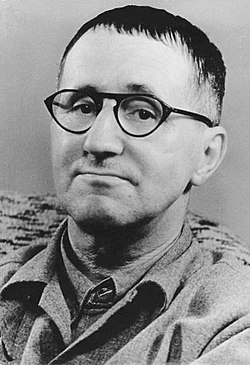
Bertolt Brecht
Eugen Berthold Friedrich Brecht (10 February 1898 – 14 August 1956), known as Bertolt Brecht and Bert Brecht, was a German theatre practitioner, playwright, and poet. Coming of age during the Weimar Republic, he had his first successes as a playwright in Munich and moved to Berlin in 1924, where he wrote The Threepenny Opera with Elisabeth Hauptmann and Kurt Weill and began a life-long collaboration with the composer Hanns Eisler. Immersed in Marxist thought during this period, Brecht wrote didactic Lehrstücke and became a leading theoretician of epic theatre (which he later preferred to call "dialectical theatre") and the Verfremdungseffekt.
When the Nazis came to power in Germany in 1933, Brecht fled his home country, initially to Scandinavia. During World War II he moved to Southern California where he established himself as a screenwriter, while also being surveilled by the FBI. In 1947, he was part of the first group of Hollywood film artists to be subpoenaed by the House Un-American Activities Committee for alleged Communist Party affiliations. The day after testifying, he returned to Europe, eventually settling in East Berlin where he co-founded the theatre company Berliner Ensemble with his wife and long-time collaborator, actress Helene Weigel.
Eugen Berthold Friedrich Brecht (as a child known as Eugen) was born on 10 February 1898 in Augsburg, Germany, the son of Berthold Friedrich Brecht (1869–1939) and his wife Sophie, née Brezing (1871–1920). Brecht's mother was a devout Protestant and his father a Roman Catholic (who had been persuaded to have a Protestant wedding). The modest house where he was born is today preserved as a Brecht Museum. His father worked for a paper mill, becoming its managing director in 1914. At Augsburg, his maternal grandparents lived in the neighbouring house. They were Pietists and his grandmother influenced Bertolt Brecht and his brother Walter considerably during their childhood.
Due to his grandmother's and his mother's influence, Brecht knew the Bible, a familiarity that would have a life-long effect on his writing. From his mother came the "dangerous image of the self-denying woman" that recurs in his drama. Brecht's home life was comfortably middle class, despite what his occasional attempt to claim peasant origins implied. At school in Augsburg he met Caspar Neher, with whom he formed a life-long creative partnership. Neher designed many of the sets for Brecht's dramas and helped to forge the distinctive visual iconography of their epic theatre.
When Brecht was 16, World War I broke out. Initially enthusiastic, Brecht soon changed his mind on seeing his classmates "swallowed by the army". Brecht was nearly expelled from school in 1915 for writing an essay in response to the line Dulce et decorum est pro patria mori from the Roman poet Horace, calling it Zweckpropaganda ("cheap propaganda for a specific purpose") and arguing that only an empty-headed person could be persuaded to die for their country. His expulsion was only prevented by the intervention of Romuald Sauer, a priest who also served as a substitute teacher at Brecht's school.
On his father's recommendation, Brecht sought to avoid being conscripted into the army by exploiting a loophole which allowed for medical students to be deferred. He subsequently registered for a medical course at Munich University, where he enrolled in 1917. There he studied drama with Arthur Kutscher, who inspired in the young Brecht an admiration for the iconoclastic dramatist and cabaret star Frank Wedekind.
From July 1916, Brecht's newspaper articles began appearing under the new name "Bert Brecht" (his first theatre criticism for the Augsburger Volkswille appeared in October 1919). Brecht was drafted into military service in the autumn of 1918, only to be posted back to Augsburg as a medical orderly in a military VD clinic; the war ended a month later.
In July 1919, Brecht and Paula Banholzer (who had begun a relationship in 1917) had a son, Frank. Frank died in 1943, as a Wehrmacht conscript on the Eastern Front. In 1920 Brecht's mother died.
Bertolt Brecht
Eugen Berthold Friedrich Brecht (10 February 1898 – 14 August 1956), known as Bertolt Brecht and Bert Brecht, was a German theatre practitioner, playwright, and poet. Coming of age during the Weimar Republic, he had his first successes as a playwright in Munich and moved to Berlin in 1924, where he wrote The Threepenny Opera with Elisabeth Hauptmann and Kurt Weill and began a life-long collaboration with the composer Hanns Eisler. Immersed in Marxist thought during this period, Brecht wrote didactic Lehrstücke and became a leading theoretician of epic theatre (which he later preferred to call "dialectical theatre") and the Verfremdungseffekt.
When the Nazis came to power in Germany in 1933, Brecht fled his home country, initially to Scandinavia. During World War II he moved to Southern California where he established himself as a screenwriter, while also being surveilled by the FBI. In 1947, he was part of the first group of Hollywood film artists to be subpoenaed by the House Un-American Activities Committee for alleged Communist Party affiliations. The day after testifying, he returned to Europe, eventually settling in East Berlin where he co-founded the theatre company Berliner Ensemble with his wife and long-time collaborator, actress Helene Weigel.
Eugen Berthold Friedrich Brecht (as a child known as Eugen) was born on 10 February 1898 in Augsburg, Germany, the son of Berthold Friedrich Brecht (1869–1939) and his wife Sophie, née Brezing (1871–1920). Brecht's mother was a devout Protestant and his father a Roman Catholic (who had been persuaded to have a Protestant wedding). The modest house where he was born is today preserved as a Brecht Museum. His father worked for a paper mill, becoming its managing director in 1914. At Augsburg, his maternal grandparents lived in the neighbouring house. They were Pietists and his grandmother influenced Bertolt Brecht and his brother Walter considerably during their childhood.
Due to his grandmother's and his mother's influence, Brecht knew the Bible, a familiarity that would have a life-long effect on his writing. From his mother came the "dangerous image of the self-denying woman" that recurs in his drama. Brecht's home life was comfortably middle class, despite what his occasional attempt to claim peasant origins implied. At school in Augsburg he met Caspar Neher, with whom he formed a life-long creative partnership. Neher designed many of the sets for Brecht's dramas and helped to forge the distinctive visual iconography of their epic theatre.
When Brecht was 16, World War I broke out. Initially enthusiastic, Brecht soon changed his mind on seeing his classmates "swallowed by the army". Brecht was nearly expelled from school in 1915 for writing an essay in response to the line Dulce et decorum est pro patria mori from the Roman poet Horace, calling it Zweckpropaganda ("cheap propaganda for a specific purpose") and arguing that only an empty-headed person could be persuaded to die for their country. His expulsion was only prevented by the intervention of Romuald Sauer, a priest who also served as a substitute teacher at Brecht's school.
On his father's recommendation, Brecht sought to avoid being conscripted into the army by exploiting a loophole which allowed for medical students to be deferred. He subsequently registered for a medical course at Munich University, where he enrolled in 1917. There he studied drama with Arthur Kutscher, who inspired in the young Brecht an admiration for the iconoclastic dramatist and cabaret star Frank Wedekind.
From July 1916, Brecht's newspaper articles began appearing under the new name "Bert Brecht" (his first theatre criticism for the Augsburger Volkswille appeared in October 1919). Brecht was drafted into military service in the autumn of 1918, only to be posted back to Augsburg as a medical orderly in a military VD clinic; the war ended a month later.
In July 1919, Brecht and Paula Banholzer (who had begun a relationship in 1917) had a son, Frank. Frank died in 1943, as a Wehrmacht conscript on the Eastern Front. In 1920 Brecht's mother died.
Recent media
Recent media