



Community hub
Recent from talks
Knowledge base stats:
Talk channels stats:
Members stats:
The Threepenny Opera
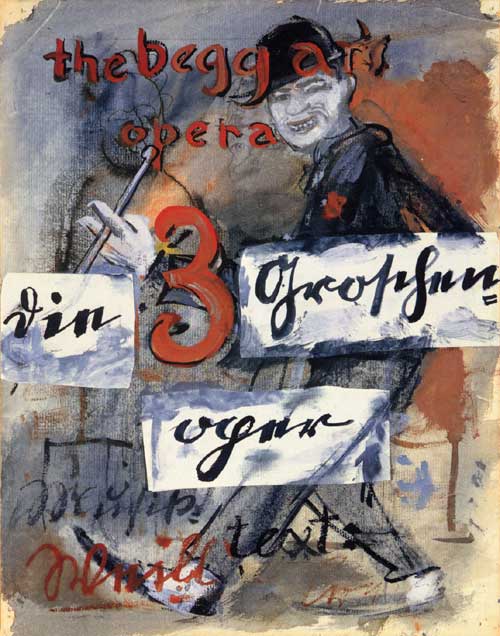
The Threepenny Opera (Die Dreigroschenoper [diː dʁaɪˈɡʁɔʃn̩ˌʔoːpɐ]) is a 1928 German "play with music" by Bertolt Brecht, adapted from a translation by Elisabeth Hauptmann of John Gay's 18th-century English ballad opera, The Beggar's Opera, and four ballads by François Villon, with music by Kurt Weill. Although there is debate as to how much contribution Hauptmann might have made to the libretto, Brecht is usually listed as sole author and Hauptmann as the sole translator, which was probably an unfair oversimplification typical of the time.
The work offers a socialist critique of the capitalist world. It opened on 31 August 1928 at Berlin's Theater am Schiffbauerdamm.
With influences from jazz and German dance music, songs from The Threepenny Opera have been widely covered and become standards, most notably "Die Moritat von Mackie Messer" ("The Ballad of Mack the Knife") and "Seeräuberjenny" ("Pirate Jenny").
The Threepenny Opera has been performed in the United Kingdom, the United States, France, Russia, Italy, and Hungary. It has also been adapted to film and radio. The German-language version from 1928 entered the public domain in the United States in 2024.
In the winter of 1927–28, Elisabeth Hauptmann, Brecht's lover at the time, received a copy of Gay's play from friends in England and, fascinated by the female characters and its critique of the condition of the London poor, began translating it into German. Brecht at first took little interest in her translation project,[citation needed] but in April 1928 he attempted to interest the impresario Ernst Josef Aufricht in a play he was writing called Fleischhacker, which he had, in fact, already promised to another producer. Aufricht was seeking a production to launch his new theatre company at the Theater am Schiffbauerdamm in Berlin, but was not impressed by the sound of Fleischhacker. Brecht immediately proposed a translation of The Beggar's Opera instead, claiming that he himself had been translating it [citation needed]. He delivered Hauptmann's translation to Aufricht, who immediately signed a contract for it. Brecht proposed Weill to write the music, and spent the next four months writing the libretto.
Brecht used four songs by the French poet François Villon. Rather than translate the French himself, he used the translations by K. L. Ammer (Karl Anton Klammer), the same source he had been using since his earliest plays.
The first act of both works begins with the same melody ("Peachum's Morning Chorale"/"An Old Woman Clothed In Gray"), but that is the only material Weill borrowed from the melodies Johann Christoph Pepusch arranged for The Beggar's Opera. The title Die Dreigroschenoper was determined only a week before the opening; it had been previously announced as simply The Beggar's Opera (in English), with the subtitle "Die Luden-Oper" ("The Pimp's Opera").
Writing in 1929, Weill made the political and artistic intents of the work clear:
Hub AI
The Threepenny Opera AI simulator
(@The Threepenny Opera_simulator)
The Threepenny Opera
The Threepenny Opera (Die Dreigroschenoper [diː dʁaɪˈɡʁɔʃn̩ˌʔoːpɐ]) is a 1928 German "play with music" by Bertolt Brecht, adapted from a translation by Elisabeth Hauptmann of John Gay's 18th-century English ballad opera, The Beggar's Opera, and four ballads by François Villon, with music by Kurt Weill. Although there is debate as to how much contribution Hauptmann might have made to the libretto, Brecht is usually listed as sole author and Hauptmann as the sole translator, which was probably an unfair oversimplification typical of the time.
The work offers a socialist critique of the capitalist world. It opened on 31 August 1928 at Berlin's Theater am Schiffbauerdamm.
With influences from jazz and German dance music, songs from The Threepenny Opera have been widely covered and become standards, most notably "Die Moritat von Mackie Messer" ("The Ballad of Mack the Knife") and "Seeräuberjenny" ("Pirate Jenny").
The Threepenny Opera has been performed in the United Kingdom, the United States, France, Russia, Italy, and Hungary. It has also been adapted to film and radio. The German-language version from 1928 entered the public domain in the United States in 2024.
In the winter of 1927–28, Elisabeth Hauptmann, Brecht's lover at the time, received a copy of Gay's play from friends in England and, fascinated by the female characters and its critique of the condition of the London poor, began translating it into German. Brecht at first took little interest in her translation project,[citation needed] but in April 1928 he attempted to interest the impresario Ernst Josef Aufricht in a play he was writing called Fleischhacker, which he had, in fact, already promised to another producer. Aufricht was seeking a production to launch his new theatre company at the Theater am Schiffbauerdamm in Berlin, but was not impressed by the sound of Fleischhacker. Brecht immediately proposed a translation of The Beggar's Opera instead, claiming that he himself had been translating it [citation needed]. He delivered Hauptmann's translation to Aufricht, who immediately signed a contract for it. Brecht proposed Weill to write the music, and spent the next four months writing the libretto.
Brecht used four songs by the French poet François Villon. Rather than translate the French himself, he used the translations by K. L. Ammer (Karl Anton Klammer), the same source he had been using since his earliest plays.
The first act of both works begins with the same melody ("Peachum's Morning Chorale"/"An Old Woman Clothed In Gray"), but that is the only material Weill borrowed from the melodies Johann Christoph Pepusch arranged for The Beggar's Opera. The title Die Dreigroschenoper was determined only a week before the opening; it had been previously announced as simply The Beggar's Opera (in English), with the subtitle "Die Luden-Oper" ("The Pimp's Opera").
Writing in 1929, Weill made the political and artistic intents of the work clear: