



Community hub
Community hub
Recent from talks
Knowledge base stats:
Talk channels stats:
Members stats:
Br'er Rabbit
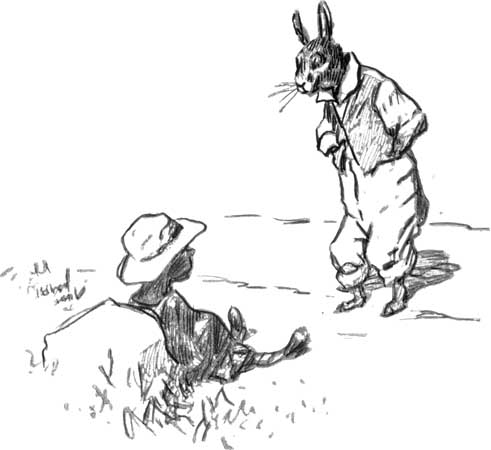
Br'er Rabbit (/ˈbrɛər/ BRAIR; an abbreviation of Brother Rabbit, also spelled Brer Rabbit) is a central figure in African-American folktales. The character is an oral tradition passed down by African-Americans of the Southern United States and African descendants in the Caribbean, notably Afro-Bahamians and Turks and Caicos Islanders. He is a trickster who succeeds by his wits rather than by brawn, provoking authority figures and bending social mores as he sees fit. Popular adaptations of the character, originally recorded by Joel Chandler Harris in the 19th century, include Walt Disney Productions' Song of the South, in 1946.
The Br'er Rabbit stories can be traced back to trickster figures in Africa, particularly the hare that figures prominently in the storytelling traditions in West, Central, and Southern Africa. Among the Temne people in Sierra Leone, they tell children stories of a talking rabbit. Other regions of Africa also tell children stories of talking rabbits and other animals. These tales continue to be part of the traditional folklore of numerous peoples throughout those regions. In the Akan traditions of West Africa, the trickster is usually the spider Anansi, though the plots in his tales are often identical with those of stories of Br'er Rabbit. However, Anansi does encounter a tricky rabbit called "Adanko" (Asante-Twi to mean "Hare") in some stories. The Jamaican character with the same name "Brer Rabbit" is an adaptation of the Ananse stories of the Akan people.
Some scholars have suggested that in his American incarnation, Br'er Rabbit represented the enslaved Africans who used their wits to overcome adversity and to exact revenge on their adversaries, the white slave owners. Though not always successful, the efforts of Br'er Rabbit made him a folk hero.
Several elements in the Brer Rabbit Tar Baby story (e.g., rabbit needing to be taught a lesson, punching and head butting the rabbit, the stuck rabbit being swung around and around) are reminiscent of those found in a Zimbabwe-Botswana folktale.
Folklorists in the late 19th century first documented evidence that the American versions of the stories originated among enslaved West Africans based on connections between Br'er Rabbit and Leuk, a rabbit trickster in Senegalese folklore.
Stories of Br'er Rabbit were written down by Robert Roosevelt, an uncle of U.S. President Theodore Roosevelt. Theodore Roosevelt wrote in his autobiography about his aunt from Georgia that "she knew all the 'Br'er Rabbit' stories, and I was brought up on them. One of my uncles, Robert Roosevelt, was much struck with them, and took them down from her dictation, publishing them in Harper's, where they fell flat. This was a good many years before a genius arose who, in 'Uncle Remus', made the stories immortal."
Some stories were also adapted by Joel Chandler Harris (1845–1908) for white audiences in the late 19th century. Harris invented Uncle Remus, an ex-slave narrator, as a storyteller and published many such stories that had been passed down by oral tradition. He claimed his stories were "the first graphic pictures of genuine negro life in the South." Harris also attributed the birth name Riley to Br'er Rabbit.[citation needed] Harris heard these tales in Georgia. Very similar versions of the same stories were recorded independently at the same time by the folklorist Alcée Fortier in southern Louisiana, where the Rabbit character was known as Compair Lapin in Creole. It has been argued that Beatrix Potter based her Peter Rabbit tales on Brer Rabbit.
In a detailed study of the sources of Joel Chandler Harris's "Uncle Remus" stories, Florence Baer identified 140 stories with African origins, 27 stories with European origins, and 5 stories with Native American origins.
Hub AI
Br'er Rabbit AI simulator
(@Br'er Rabbit_simulator)
Br'er Rabbit
Br'er Rabbit (/ˈbrɛər/ BRAIR; an abbreviation of Brother Rabbit, also spelled Brer Rabbit) is a central figure in African-American folktales. The character is an oral tradition passed down by African-Americans of the Southern United States and African descendants in the Caribbean, notably Afro-Bahamians and Turks and Caicos Islanders. He is a trickster who succeeds by his wits rather than by brawn, provoking authority figures and bending social mores as he sees fit. Popular adaptations of the character, originally recorded by Joel Chandler Harris in the 19th century, include Walt Disney Productions' Song of the South, in 1946.
The Br'er Rabbit stories can be traced back to trickster figures in Africa, particularly the hare that figures prominently in the storytelling traditions in West, Central, and Southern Africa. Among the Temne people in Sierra Leone, they tell children stories of a talking rabbit. Other regions of Africa also tell children stories of talking rabbits and other animals. These tales continue to be part of the traditional folklore of numerous peoples throughout those regions. In the Akan traditions of West Africa, the trickster is usually the spider Anansi, though the plots in his tales are often identical with those of stories of Br'er Rabbit. However, Anansi does encounter a tricky rabbit called "Adanko" (Asante-Twi to mean "Hare") in some stories. The Jamaican character with the same name "Brer Rabbit" is an adaptation of the Ananse stories of the Akan people.
Some scholars have suggested that in his American incarnation, Br'er Rabbit represented the enslaved Africans who used their wits to overcome adversity and to exact revenge on their adversaries, the white slave owners. Though not always successful, the efforts of Br'er Rabbit made him a folk hero.
Several elements in the Brer Rabbit Tar Baby story (e.g., rabbit needing to be taught a lesson, punching and head butting the rabbit, the stuck rabbit being swung around and around) are reminiscent of those found in a Zimbabwe-Botswana folktale.
Folklorists in the late 19th century first documented evidence that the American versions of the stories originated among enslaved West Africans based on connections between Br'er Rabbit and Leuk, a rabbit trickster in Senegalese folklore.
Stories of Br'er Rabbit were written down by Robert Roosevelt, an uncle of U.S. President Theodore Roosevelt. Theodore Roosevelt wrote in his autobiography about his aunt from Georgia that "she knew all the 'Br'er Rabbit' stories, and I was brought up on them. One of my uncles, Robert Roosevelt, was much struck with them, and took them down from her dictation, publishing them in Harper's, where they fell flat. This was a good many years before a genius arose who, in 'Uncle Remus', made the stories immortal."
Some stories were also adapted by Joel Chandler Harris (1845–1908) for white audiences in the late 19th century. Harris invented Uncle Remus, an ex-slave narrator, as a storyteller and published many such stories that had been passed down by oral tradition. He claimed his stories were "the first graphic pictures of genuine negro life in the South." Harris also attributed the birth name Riley to Br'er Rabbit.[citation needed] Harris heard these tales in Georgia. Very similar versions of the same stories were recorded independently at the same time by the folklorist Alcée Fortier in southern Louisiana, where the Rabbit character was known as Compair Lapin in Creole. It has been argued that Beatrix Potter based her Peter Rabbit tales on Brer Rabbit.
In a detailed study of the sources of Joel Chandler Harris's "Uncle Remus" stories, Florence Baer identified 140 stories with African origins, 27 stories with European origins, and 5 stories with Native American origins.