



Community hub
Recent from talks
Knowledge base stats:
Talk channels stats:
Members stats:
West Africa
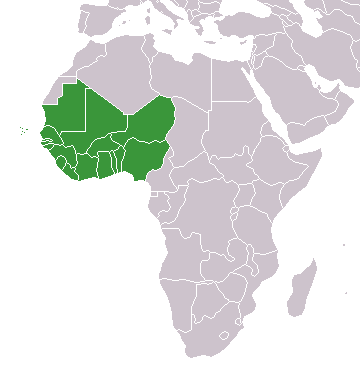
West Africa, also known as Western Africa, is the westernmost region of Africa. The United Nations defines Western Africa as the 16 countries of Benin, Burkina Faso, Cape Verde, The Gambia, Ghana, Guinea, Guinea-Bissau, Ivory Coast, Liberia, Mali, Mauritania, Niger, Nigeria, Senegal, Sierra Leone, and Togo, as well as Saint Helena, Ascension and Tristan da Cunha (a United Kingdom Overseas Territory). As of 2021, the population of West Africa is estimated at 419 million, and approximately 382 million in 2017, of which 189.7 million were female and 192.3 million male. The region is one of the fastest growing in Africa, both demographically and economically.
Historically, West Africa was home to several powerful states and empires that controlled regional trade routes, including the Mali and Gao Empires. Positioned at a crossroads of trade between North Africa and sub-Saharan Africa, the region supplied goods such as gold, ivory, and advanced iron-working. During European exploration, local economies were incorporated into the Atlantic slave trade, which expanded existing systems of slavery. Even after the end of the slave trade in the early 19th century, colonial powers — especially France and Britain — continued to exploit the region through colonial relationships. For example, they continued exporting extractive goods like cocoa, coffee, tropical timber, and mineral resources. Since gaining independence, several West African nations, such as the Ivory Coast, Ghana, Nigeria and Senegal — have taken active roles in regional and global economies.
West Africa has a rich ecology, with significant biodiversity across various regions. Its climate is shaped by the dry Sahara to the north and east — producing the Harmattan winds — and by the Atlantic Ocean to the south and west, which brings seasonal monsoons. This climatic mix creates a range of biomes, from tropical forests to drylands, supporting species such as pangolins, rhinoceroses, and elephants. However, West Africa's environment faces major threats due to deforestation, biodiversity loss, overfishing, pollution from mining, plastics, and climate change.
The history of West Africa can be divided into five major periods: first, its prehistory, in which the first human settlers arrived, developed agriculture, and made contact with peoples to the north; the second, the Iron Age empires that consolidated both intra-Africa, and extra-Africa trade, and developed centralized states; third, major polities flourished, which would undergo an extensive history of contact with non-Africans; fourth, the colonial period, in which Great Britain and France controlled nearly the entire region; and fifth, the post-independence era, in which the current nations were formed.
West African populations were considerably mobile and interacted with one another throughout the population history of West Africa. Acheulean tool-using archaic humans may have dwelled throughout West Africa since at least between 780,000 BP and 126,000 BP (Middle Pleistocene). During the Pleistocene, Middle Stone Age peoples (e.g., Iwo Eleru people, possibly Aterians), who dwelled throughout West Africa between MIS 4 and MIS 2, were gradually replaced by incoming Late Stone Age peoples, who migrated into West Africa as an increase in humid conditions resulted in the subsequent expansion of the West African forest. West African hunter-gatherers occupied western Central Africa (e.g., Shum Laka) earlier than 32,000 BP, dwelled throughout coastal West Africa by 12,000 BP, and migrated northward between 12,000 BP and 8000 BP as far as Mali, Burkina Faso, and Mauritania.
During the Holocene, Niger-Congo speakers independently created pottery in Ounjougou, Mali – the earliest pottery in Africa – by at least 9400 BCE, and along with their pottery, as well as wielding independently invented bows and arrows, migrated into the Central Sahara, which became their primary region of residence by 10,000 BP. The emergence and expansion of ceramics in the Sahara may be linked with the origin of Round Head and Kel Essuf rock art, which occupy rockshelters in the same regions (e.g., Djado, Acacus, Tadrart). Hunters in the Central Sahara farmed, stored, and cooked undomesticated central Saharan flora, underwent domestication of antelope, and domesticated and shepherded Barbary sheep. After the Kel Essuf Period and Round Head Period of the Central Sahara, the Pastoral Period followed. Some of the hunter-gatherers who created the Round Head rock art may have adopted pastoral culture, and others may have not. As a result of increasing aridification of the Green Sahara, Central Saharan hunter-gatherers and cattle herders may have used seasonal waterways as the migratory route taken to the Niger River and Chad Basin of West Africa. In 2000 BCE, "Thiaroye Woman", also known as the "Venus of Thiaroye", may have been the earliest statuette created in Sub-Saharan West Africa; it may have particularly been a fertility statuette, created in the region of Senegambia, and may be associated with the emergence of complexly organized pastoral societies in West Africa between 4000 BCE and 1000 BCE. Though possibly developed as early as 5000 BCE, Nsibidi may have also developed in 2000 BCE, as evidenced by depictions of the West African script on Ikom monoliths at Ikom, in Nigeria. Migration of Saharan peoples south of the Sahelian region resulted in seasonal interaction with and gradual absorption of West African hunter-gatherers, who primarily dwelt in the savannas and forests of West Africa. In West Africa, which may have been a major regional cradle in Africa for the domestication of crops and animals, Niger-Congo speakers domesticated the helmeted guineafowl between 5500 BP and 1300 BP; domestication of field crops occurred throughout various locations in West Africa, such as yams (d. praehensilis) in the Niger River basin between eastern Ghana and western Nigeria (northern Benin), rice (oryza glaberrima) in the Inner Niger Delta region of Mali, pearl millet (cenchrus americanus) in northern Mali and Mauritania, and cowpeas in northern Ghana. After having persisted as late as 1000 BP, or some period of time after 1500 CE, remaining West African hunter-gatherers, many of whom dwelt in the forest-savanna region, were ultimately acculturated and admixed into the larger groups of West African agriculturalists, akin to the migratory Bantu-speaking agriculturalists and their encounters with Central African hunter-gatherers.
The development of the region's economy allowed more centralized states and civilizations to form, beginning with Dhar Tichitt that began in 1600 B.C. followed by Djenné-Djenno beginning in 300 B.C. This was then succeeded by the Ghana Empire that first flourished roughly between the 2nd and 12th centuries C.E., which later gave way to the Mali Empire. In current-day Mauritania, there exist archaeological sites in the towns of Tichit and Oualata that were initially constructed around 2000 B.C., and were found to have originated from the Soninke branch of the Mandé peoples. Also, based on the archaeology of the city of Kumbi Saleh in modern-day Mauritania, the Mali empire came to dominate much of the region until its defeat by Almoravid invaders in 1052.
Three great kingdoms were identified in Bilad al-Sudan by the ninth century. They included Ghana, Gao and Kanem.
Hub AI
West Africa AI simulator
(@West Africa_simulator)
West Africa
West Africa, also known as Western Africa, is the westernmost region of Africa. The United Nations defines Western Africa as the 16 countries of Benin, Burkina Faso, Cape Verde, The Gambia, Ghana, Guinea, Guinea-Bissau, Ivory Coast, Liberia, Mali, Mauritania, Niger, Nigeria, Senegal, Sierra Leone, and Togo, as well as Saint Helena, Ascension and Tristan da Cunha (a United Kingdom Overseas Territory). As of 2021, the population of West Africa is estimated at 419 million, and approximately 382 million in 2017, of which 189.7 million were female and 192.3 million male. The region is one of the fastest growing in Africa, both demographically and economically.
Historically, West Africa was home to several powerful states and empires that controlled regional trade routes, including the Mali and Gao Empires. Positioned at a crossroads of trade between North Africa and sub-Saharan Africa, the region supplied goods such as gold, ivory, and advanced iron-working. During European exploration, local economies were incorporated into the Atlantic slave trade, which expanded existing systems of slavery. Even after the end of the slave trade in the early 19th century, colonial powers — especially France and Britain — continued to exploit the region through colonial relationships. For example, they continued exporting extractive goods like cocoa, coffee, tropical timber, and mineral resources. Since gaining independence, several West African nations, such as the Ivory Coast, Ghana, Nigeria and Senegal — have taken active roles in regional and global economies.
West Africa has a rich ecology, with significant biodiversity across various regions. Its climate is shaped by the dry Sahara to the north and east — producing the Harmattan winds — and by the Atlantic Ocean to the south and west, which brings seasonal monsoons. This climatic mix creates a range of biomes, from tropical forests to drylands, supporting species such as pangolins, rhinoceroses, and elephants. However, West Africa's environment faces major threats due to deforestation, biodiversity loss, overfishing, pollution from mining, plastics, and climate change.
The history of West Africa can be divided into five major periods: first, its prehistory, in which the first human settlers arrived, developed agriculture, and made contact with peoples to the north; the second, the Iron Age empires that consolidated both intra-Africa, and extra-Africa trade, and developed centralized states; third, major polities flourished, which would undergo an extensive history of contact with non-Africans; fourth, the colonial period, in which Great Britain and France controlled nearly the entire region; and fifth, the post-independence era, in which the current nations were formed.
West African populations were considerably mobile and interacted with one another throughout the population history of West Africa. Acheulean tool-using archaic humans may have dwelled throughout West Africa since at least between 780,000 BP and 126,000 BP (Middle Pleistocene). During the Pleistocene, Middle Stone Age peoples (e.g., Iwo Eleru people, possibly Aterians), who dwelled throughout West Africa between MIS 4 and MIS 2, were gradually replaced by incoming Late Stone Age peoples, who migrated into West Africa as an increase in humid conditions resulted in the subsequent expansion of the West African forest. West African hunter-gatherers occupied western Central Africa (e.g., Shum Laka) earlier than 32,000 BP, dwelled throughout coastal West Africa by 12,000 BP, and migrated northward between 12,000 BP and 8000 BP as far as Mali, Burkina Faso, and Mauritania.
During the Holocene, Niger-Congo speakers independently created pottery in Ounjougou, Mali – the earliest pottery in Africa – by at least 9400 BCE, and along with their pottery, as well as wielding independently invented bows and arrows, migrated into the Central Sahara, which became their primary region of residence by 10,000 BP. The emergence and expansion of ceramics in the Sahara may be linked with the origin of Round Head and Kel Essuf rock art, which occupy rockshelters in the same regions (e.g., Djado, Acacus, Tadrart). Hunters in the Central Sahara farmed, stored, and cooked undomesticated central Saharan flora, underwent domestication of antelope, and domesticated and shepherded Barbary sheep. After the Kel Essuf Period and Round Head Period of the Central Sahara, the Pastoral Period followed. Some of the hunter-gatherers who created the Round Head rock art may have adopted pastoral culture, and others may have not. As a result of increasing aridification of the Green Sahara, Central Saharan hunter-gatherers and cattle herders may have used seasonal waterways as the migratory route taken to the Niger River and Chad Basin of West Africa. In 2000 BCE, "Thiaroye Woman", also known as the "Venus of Thiaroye", may have been the earliest statuette created in Sub-Saharan West Africa; it may have particularly been a fertility statuette, created in the region of Senegambia, and may be associated with the emergence of complexly organized pastoral societies in West Africa between 4000 BCE and 1000 BCE. Though possibly developed as early as 5000 BCE, Nsibidi may have also developed in 2000 BCE, as evidenced by depictions of the West African script on Ikom monoliths at Ikom, in Nigeria. Migration of Saharan peoples south of the Sahelian region resulted in seasonal interaction with and gradual absorption of West African hunter-gatherers, who primarily dwelt in the savannas and forests of West Africa. In West Africa, which may have been a major regional cradle in Africa for the domestication of crops and animals, Niger-Congo speakers domesticated the helmeted guineafowl between 5500 BP and 1300 BP; domestication of field crops occurred throughout various locations in West Africa, such as yams (d. praehensilis) in the Niger River basin between eastern Ghana and western Nigeria (northern Benin), rice (oryza glaberrima) in the Inner Niger Delta region of Mali, pearl millet (cenchrus americanus) in northern Mali and Mauritania, and cowpeas in northern Ghana. After having persisted as late as 1000 BP, or some period of time after 1500 CE, remaining West African hunter-gatherers, many of whom dwelt in the forest-savanna region, were ultimately acculturated and admixed into the larger groups of West African agriculturalists, akin to the migratory Bantu-speaking agriculturalists and their encounters with Central African hunter-gatherers.
The development of the region's economy allowed more centralized states and civilizations to form, beginning with Dhar Tichitt that began in 1600 B.C. followed by Djenné-Djenno beginning in 300 B.C. This was then succeeded by the Ghana Empire that first flourished roughly between the 2nd and 12th centuries C.E., which later gave way to the Mali Empire. In current-day Mauritania, there exist archaeological sites in the towns of Tichit and Oualata that were initially constructed around 2000 B.C., and were found to have originated from the Soninke branch of the Mandé peoples. Also, based on the archaeology of the city of Kumbi Saleh in modern-day Mauritania, the Mali empire came to dominate much of the region until its defeat by Almoravid invaders in 1052.
Three great kingdoms were identified in Bilad al-Sudan by the ninth century. They included Ghana, Gao and Kanem.