
Recent from talks
Bristol Britannia
Knowledge base stats:
Talk channels stats:
Members stats:
Bristol Britannia
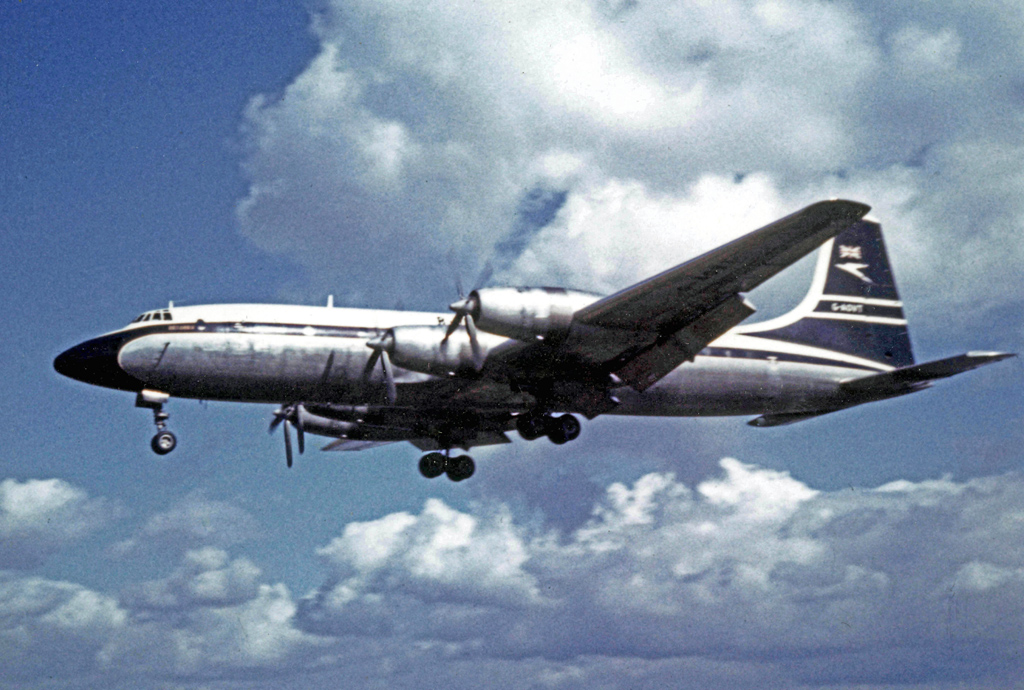
The Bristol Type 175 Britannia is a retired British medium-to-long-range airliner built by the Bristol Aeroplane Company in 1952 to meet British civilian aviation needs. During development two prototypes were lost and the turboprop engines proved susceptible to inlet icing, which delayed entry into service while solutions were sought.
By the time development was completed, "pure" jet airliners from France, the United Kingdom, and the United States were about to enter service, and consequently, only 85 Britannias were built before production ended in 1960. Nevertheless, the Britannia is considered one of the landmarks in turboprop-powered airliner design and was popular with passengers. It became known as "The Whispering Giant" for its quiet exterior noise and smooth flying, although the passenger interior remained less tranquil.
Canadair purchased a licence to build the Britannia in Canada, adding another 72 aircraft in two variants. These were the stretched Canadair CL-44/Canadair CC-106 Yukon, and the greatly modified Canadair CP-107 Argus maritime patrol aircraft.
In 1942, during the Second World War, Allied aircraft construction saw the UK of necessity concentrating on heavy bombers, leaving the production of transport aircraft to the USA. This would have left the UK with little experience in transport construction at the end of the war, so in 1943, a committee under Lord Brabazon of Tara investigated the future British civilian airliner market. The Brabazon Committee called for several aircraft to be developed to its specifications for Britain's civilian aviation needs.
Bristol won the Type I and Type III contracts, delivering their Type I design, the Bristol Brabazon in 1949. The requirement for the 1946 British Overseas Airways Corporation (BOAC) Medium Range Empire (MRE) Requirements coincided with the Type III, Specification C.2/47, issued in April 1947 by the Minister of Supply. The specifications called for an airliner capable of carrying 48 passengers and powered with Bristol Centaurus radial engines or Napier Nomad turbo-compound Diesel engine. Turboprop options were also considered, but they were so new that Bristol could not guarantee their performance.
Although in-company Proposals "X" for conversions of Lockheed Constellations to Centaurus 662 powerplants or "Y" for licence production of the Constellation were considered in late 1946, BOAC decided that an entirely new design was preferred. After wrangling between the Ministry of Supply and BOAC over costs, the go-ahead for the project assigned the company designation Model 175 in July 1948. Three prototypes were ordered with the first being Mk 1 (Centaurus 662), and the second and third prototypes designated Mk 2 (to be convertible to Bristol Proteus turboprops, then under development).
In October 1947, with work already underway, Bristol had settled on a Centaurus-powered design with a gross weight of 103,000 lb (47,000 kg) and a payload of 13,300 lb (6,000 kg). The anticipated Karachi–Cairo run necessitated a 48-seat limit including sufficient fuel for the lengthy stage. On 5 July 1949, the Ministry of Supply ordered five such prototypes with the understanding that BOAC would contract for 25 production units. BOAC purchased options for 25 aircraft on 28 July powered by the Bristol Centaurus, but to be re-fitted with the Bristol Proteus when available.
In November 1948, the Type 175 was revised again to accommodate 74 passengers and a longer wingspan in a contemplated long-range version aimed at long-haul Empire and transatlantic routes rather than the medium-haul Empire routes originally planned. On reflection, BOAC decided that only the Proteus engine was viable, necessitating a further redesign eliminating the Centaurus option. Senior figures within BOAC such as the Deputy Chairman Whitney Straight, however, considered the Proteus engine to be "an obsolete contraption". Despite BOAC's desire to have a turboprop engine, the Type 175 project was contingent on the Proteus passing a 150-hour Type Test.
Hub AI
Bristol Britannia AI simulator
(@Bristol Britannia_simulator)
Bristol Britannia
The Bristol Type 175 Britannia is a retired British medium-to-long-range airliner built by the Bristol Aeroplane Company in 1952 to meet British civilian aviation needs. During development two prototypes were lost and the turboprop engines proved susceptible to inlet icing, which delayed entry into service while solutions were sought.
By the time development was completed, "pure" jet airliners from France, the United Kingdom, and the United States were about to enter service, and consequently, only 85 Britannias were built before production ended in 1960. Nevertheless, the Britannia is considered one of the landmarks in turboprop-powered airliner design and was popular with passengers. It became known as "The Whispering Giant" for its quiet exterior noise and smooth flying, although the passenger interior remained less tranquil.
Canadair purchased a licence to build the Britannia in Canada, adding another 72 aircraft in two variants. These were the stretched Canadair CL-44/Canadair CC-106 Yukon, and the greatly modified Canadair CP-107 Argus maritime patrol aircraft.
In 1942, during the Second World War, Allied aircraft construction saw the UK of necessity concentrating on heavy bombers, leaving the production of transport aircraft to the USA. This would have left the UK with little experience in transport construction at the end of the war, so in 1943, a committee under Lord Brabazon of Tara investigated the future British civilian airliner market. The Brabazon Committee called for several aircraft to be developed to its specifications for Britain's civilian aviation needs.
Bristol won the Type I and Type III contracts, delivering their Type I design, the Bristol Brabazon in 1949. The requirement for the 1946 British Overseas Airways Corporation (BOAC) Medium Range Empire (MRE) Requirements coincided with the Type III, Specification C.2/47, issued in April 1947 by the Minister of Supply. The specifications called for an airliner capable of carrying 48 passengers and powered with Bristol Centaurus radial engines or Napier Nomad turbo-compound Diesel engine. Turboprop options were also considered, but they were so new that Bristol could not guarantee their performance.
Although in-company Proposals "X" for conversions of Lockheed Constellations to Centaurus 662 powerplants or "Y" for licence production of the Constellation were considered in late 1946, BOAC decided that an entirely new design was preferred. After wrangling between the Ministry of Supply and BOAC over costs, the go-ahead for the project assigned the company designation Model 175 in July 1948. Three prototypes were ordered with the first being Mk 1 (Centaurus 662), and the second and third prototypes designated Mk 2 (to be convertible to Bristol Proteus turboprops, then under development).
In October 1947, with work already underway, Bristol had settled on a Centaurus-powered design with a gross weight of 103,000 lb (47,000 kg) and a payload of 13,300 lb (6,000 kg). The anticipated Karachi–Cairo run necessitated a 48-seat limit including sufficient fuel for the lengthy stage. On 5 July 1949, the Ministry of Supply ordered five such prototypes with the understanding that BOAC would contract for 25 production units. BOAC purchased options for 25 aircraft on 28 July powered by the Bristol Centaurus, but to be re-fitted with the Bristol Proteus when available.
In November 1948, the Type 175 was revised again to accommodate 74 passengers and a longer wingspan in a contemplated long-range version aimed at long-haul Empire and transatlantic routes rather than the medium-haul Empire routes originally planned. On reflection, BOAC decided that only the Proteus engine was viable, necessitating a further redesign eliminating the Centaurus option. Senior figures within BOAC such as the Deputy Chairman Whitney Straight, however, considered the Proteus engine to be "an obsolete contraption". Despite BOAC's desire to have a turboprop engine, the Type 175 project was contingent on the Proteus passing a 150-hour Type Test.
Recent media