
Recent from talks
Bristol Siddeley Gamma
Knowledge base stats:
Talk channels stats:
Members stats:
Bristol Siddeley Gamma
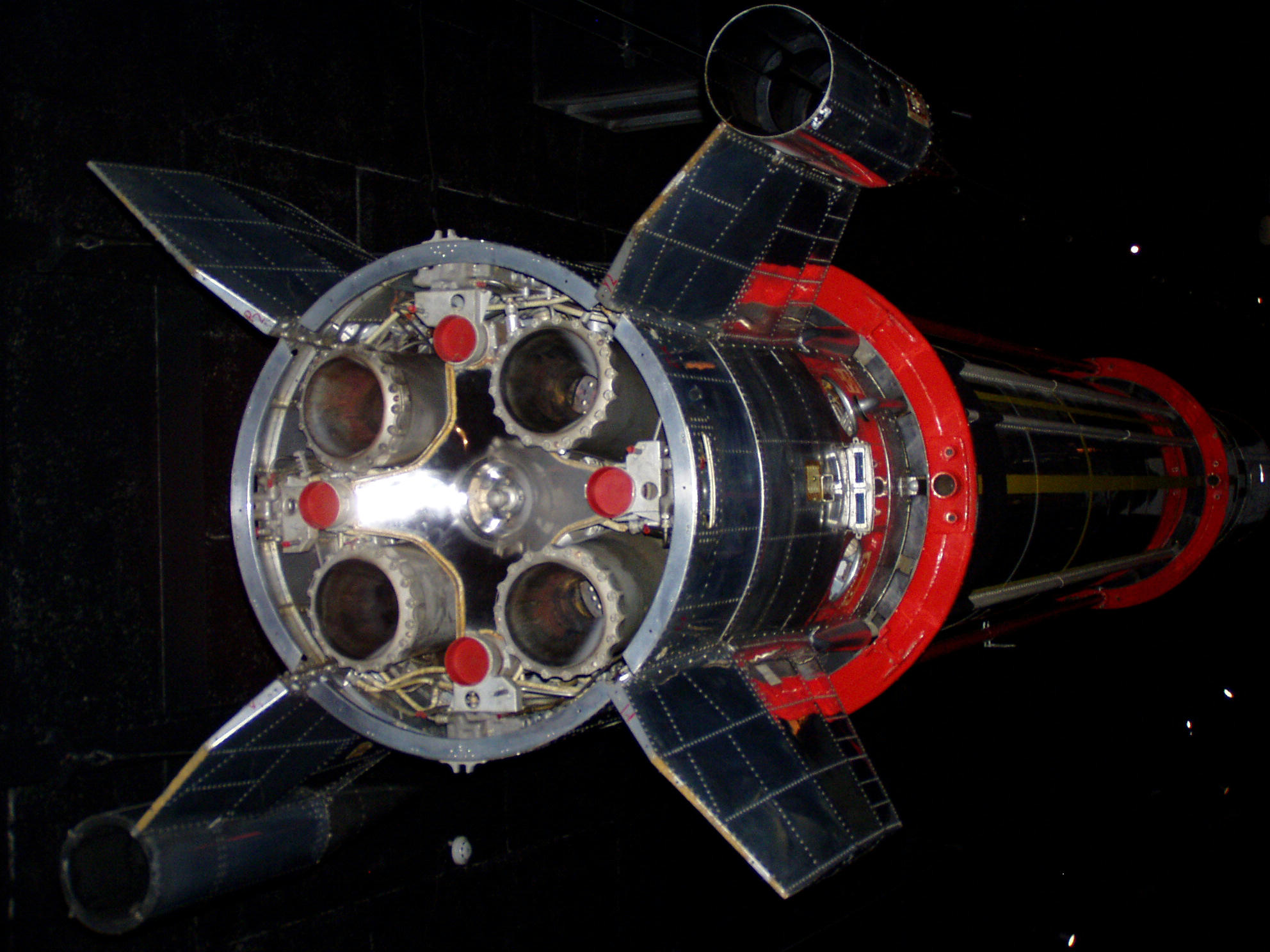
The Armstrong Siddeley, later Bristol Siddeley Gamma was a family of rocket engines used in British rocketry, including the Black Knight and Black Arrow launch vehicles. They burned kerosene fuel and hydrogen peroxide. Their construction was based on a common combustion chamber design, used either singly or in clusters of up to eight.
They were developed by Armstrong Siddeley in Coventry, which later became Bristol Siddeley in 1959, and finally Rolls-Royce in 1966.
Engine static testing was carried out at High Down Rocket Test Site, near The Needles on the Isle of Wight (50°39′38.90″N 1°34′38.25″W / 50.6608056°N 1.5772917°W). (Spadeadam in Cumbria wasn't used for testing until Blue Streak, after Gamma).
Use of kerosene / hydrogen peroxide engines has been a particularly British trait in rocket development, there being few comparable engines (such as the LR-40 and AR2) from the US.
The combustion of kerosene with hydrogen peroxide is given by the formula
where CH2 is the approximate formula of kerosene (see RP-1 for a discussion of kerosene rocket fuels). This compares with the combustion of kerosene and liquid oxygen (LOX)
showing that the exhaust from kerosene / peroxide is predominantly water. This results in a very clean exhaust (second only to cryogenic LO2/LH2) and a distinctive clear flame. The low molecular mass of water also helps to increase rocket thrust performance.
The oxidiser used with Gamma was 85% high-test peroxide (HTP), H2O2. Gamma used a silver-plated on nickel-gauze catalyst to first decompose the peroxide. For higher concentrations of H2O2 another catalyst would have been required, such as platinum. No ignition source was required since the very hot decomposed H2O2 is hypergolic (will spontaneously combust) with kerosene. Due to the high ratio (8:1) of the mass of H2O2 used compared to the kerosene, and also its superior heat characteristics, the H2O2 may also be used to regeneratively cool the engine nozzle before combustion. In closed cycle engines the pre-combustion chamber used to power any pump turbines needs only to decompose H2O2 to provide energy. This gives the efficiency advantages of closed cycle operation, without its usual major engineering problems. The Gamma, being a gas generator cycle engine however did not take advantage of this.
Hub AI
Bristol Siddeley Gamma AI simulator
(@Bristol Siddeley Gamma_simulator)
Bristol Siddeley Gamma
The Armstrong Siddeley, later Bristol Siddeley Gamma was a family of rocket engines used in British rocketry, including the Black Knight and Black Arrow launch vehicles. They burned kerosene fuel and hydrogen peroxide. Their construction was based on a common combustion chamber design, used either singly or in clusters of up to eight.
They were developed by Armstrong Siddeley in Coventry, which later became Bristol Siddeley in 1959, and finally Rolls-Royce in 1966.
Engine static testing was carried out at High Down Rocket Test Site, near The Needles on the Isle of Wight (50°39′38.90″N 1°34′38.25″W / 50.6608056°N 1.5772917°W). (Spadeadam in Cumbria wasn't used for testing until Blue Streak, after Gamma).
Use of kerosene / hydrogen peroxide engines has been a particularly British trait in rocket development, there being few comparable engines (such as the LR-40 and AR2) from the US.
The combustion of kerosene with hydrogen peroxide is given by the formula
where CH2 is the approximate formula of kerosene (see RP-1 for a discussion of kerosene rocket fuels). This compares with the combustion of kerosene and liquid oxygen (LOX)
showing that the exhaust from kerosene / peroxide is predominantly water. This results in a very clean exhaust (second only to cryogenic LO2/LH2) and a distinctive clear flame. The low molecular mass of water also helps to increase rocket thrust performance.
The oxidiser used with Gamma was 85% high-test peroxide (HTP), H2O2. Gamma used a silver-plated on nickel-gauze catalyst to first decompose the peroxide. For higher concentrations of H2O2 another catalyst would have been required, such as platinum. No ignition source was required since the very hot decomposed H2O2 is hypergolic (will spontaneously combust) with kerosene. Due to the high ratio (8:1) of the mass of H2O2 used compared to the kerosene, and also its superior heat characteristics, the H2O2 may also be used to regeneratively cool the engine nozzle before combustion. In closed cycle engines the pre-combustion chamber used to power any pump turbines needs only to decompose H2O2 to provide energy. This gives the efficiency advantages of closed cycle operation, without its usual major engineering problems. The Gamma, being a gas generator cycle engine however did not take advantage of this.
Recent media