
Recent from talks
Britannia-class steamship
Knowledge base stats:
Talk channels stats:
Members stats:
Britannia-class steamship
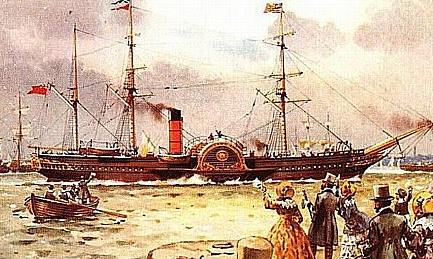
The Britannia class was the Cunard Line's initial fleet of wooden paddlers that established the first year round scheduled Atlantic steamship service in 1840. By 1845, steamships carried half of the transatlantic saloon passengers and Cunard dominated this trade. While the units of the Britannia class were solid performers, they were not superior to many of the other steamers being placed on the Atlantic at that time. What made the Britannia class successful is that it was the first homogeneous class of transatlantic steamships to provide a frequent and uniform service. Britannia, Acadia and Caledonia entered service in 1840 and Columbia in 1841 enabling Cunard to provide the dependable schedule of sailings required under his mail contracts with the Admiralty. It was these mail contracts that enabled Cunard to survive when all of his early competitors failed.
Cunard's ships were reduced versions of Great Western and only carried 115 passengers in conditions that Charles Dickens unfavourably likened to a "gigantic hearse". Mean 1840 – 1841 Liverpool - Halifax times for the quartette were 13 days, 6 hours (7.9 knots, 14.6 km/h, 9.1 mph) westbound and 11 days, 3 hours (9.3 kn, 17.2 km/h, 10.7 mph) eastbound. The initial four units were insufficient to meet the contracted sailings, and an enhanced unit, the Hibernia entered service in 1843. When Columbia was wrecked in 1843 without loss of life, Cambria was ordered to replace her.
In 1849 and 1850, the surviving original units along with Hibernia were sold to foreign navies after completing forty round trips for Cunard. Cambria remained in the Cunard fleet for another decade.
In his initial negotiations with Admiral Parry, Samuel Cunard contemplated a fortnightly service from Liverpool to Halifax and onto Boston using three 800 GRT steamers. This was 40% smaller than Great Western, which had just entered service from Bristol to New York. When completed, Cunard's ships grew to 1,150 GRT but were still 15% smaller than Great Western. The other steamships under construction for Atlantic service at the time were also bigger than Cunard's initial units. Cunard's final contract added a fourth unit to insure that the fortnightly schedule could be maintained ten months a year with sailings during the height of winter reduced to monthly.
Samuel Cunard's major backer was Robert Napier, whose Robert Napier and Sons was the Royal Navy's supplier of steam engines. For the Britannia class, Napier designed a two-cylinder side lever engine that produced 740 indicated horsepower (550 kW), just ten horsepower less than Great Western. Unlike most other Atlantic steamers, Britannia's boilers were located aft of her engines and paddle wheels, resulting in a unique profile. The ships had three masts and full rigging for sails. To speed delivery, construction of the wooden hulls was contracted to three Clyde shipyards.
Cunard's major concern was the delivery of the mail and most of the ship’s space was allocated to engines and coal. The Britannia quartette also carried 115 passengers traveling in a single class along with 225 tons of cargo. The dining room was a long deck house aft of the funnel and the only other public room was a small ladies cabin. A special padded deck house had the ship's cow and overturned boats protected vegetables from the weather. Smoking was limited to the upper deck.
Charles Dickens and his wife crossed from Liverpool to Boston during a January 1842 storm. He wrote:
"Before descending into the bowels of the ship, we had passed from the deck into a long narrow apartment, not unlike a gigantic hearse with windows in the sides; having at the upper end a melancholy stove at which three or four chilly stewards were warming their hands; while on either side, extending down its whole dreary length, was a long, long table over which a rack, fixed to the low roof and stuck full of drinking-glasses and cruet-stands, hinted dismally at rolling seas and heavy weather."
Hub AI
Britannia-class steamship AI simulator
(@Britannia-class steamship_simulator)
Britannia-class steamship
The Britannia class was the Cunard Line's initial fleet of wooden paddlers that established the first year round scheduled Atlantic steamship service in 1840. By 1845, steamships carried half of the transatlantic saloon passengers and Cunard dominated this trade. While the units of the Britannia class were solid performers, they were not superior to many of the other steamers being placed on the Atlantic at that time. What made the Britannia class successful is that it was the first homogeneous class of transatlantic steamships to provide a frequent and uniform service. Britannia, Acadia and Caledonia entered service in 1840 and Columbia in 1841 enabling Cunard to provide the dependable schedule of sailings required under his mail contracts with the Admiralty. It was these mail contracts that enabled Cunard to survive when all of his early competitors failed.
Cunard's ships were reduced versions of Great Western and only carried 115 passengers in conditions that Charles Dickens unfavourably likened to a "gigantic hearse". Mean 1840 – 1841 Liverpool - Halifax times for the quartette were 13 days, 6 hours (7.9 knots, 14.6 km/h, 9.1 mph) westbound and 11 days, 3 hours (9.3 kn, 17.2 km/h, 10.7 mph) eastbound. The initial four units were insufficient to meet the contracted sailings, and an enhanced unit, the Hibernia entered service in 1843. When Columbia was wrecked in 1843 without loss of life, Cambria was ordered to replace her.
In 1849 and 1850, the surviving original units along with Hibernia were sold to foreign navies after completing forty round trips for Cunard. Cambria remained in the Cunard fleet for another decade.
In his initial negotiations with Admiral Parry, Samuel Cunard contemplated a fortnightly service from Liverpool to Halifax and onto Boston using three 800 GRT steamers. This was 40% smaller than Great Western, which had just entered service from Bristol to New York. When completed, Cunard's ships grew to 1,150 GRT but were still 15% smaller than Great Western. The other steamships under construction for Atlantic service at the time were also bigger than Cunard's initial units. Cunard's final contract added a fourth unit to insure that the fortnightly schedule could be maintained ten months a year with sailings during the height of winter reduced to monthly.
Samuel Cunard's major backer was Robert Napier, whose Robert Napier and Sons was the Royal Navy's supplier of steam engines. For the Britannia class, Napier designed a two-cylinder side lever engine that produced 740 indicated horsepower (550 kW), just ten horsepower less than Great Western. Unlike most other Atlantic steamers, Britannia's boilers were located aft of her engines and paddle wheels, resulting in a unique profile. The ships had three masts and full rigging for sails. To speed delivery, construction of the wooden hulls was contracted to three Clyde shipyards.
Cunard's major concern was the delivery of the mail and most of the ship’s space was allocated to engines and coal. The Britannia quartette also carried 115 passengers traveling in a single class along with 225 tons of cargo. The dining room was a long deck house aft of the funnel and the only other public room was a small ladies cabin. A special padded deck house had the ship's cow and overturned boats protected vegetables from the weather. Smoking was limited to the upper deck.
Charles Dickens and his wife crossed from Liverpool to Boston during a January 1842 storm. He wrote:
"Before descending into the bowels of the ship, we had passed from the deck into a long narrow apartment, not unlike a gigantic hearse with windows in the sides; having at the upper end a melancholy stove at which three or four chilly stewards were warming their hands; while on either side, extending down its whole dreary length, was a long, long table over which a rack, fixed to the low roof and stuck full of drinking-glasses and cruet-stands, hinted dismally at rolling seas and heavy weather."
Recent media