



Community hub
Recent from talks
Knowledge base stats:
Talk channels stats:
Members stats:
British Rail Class 456
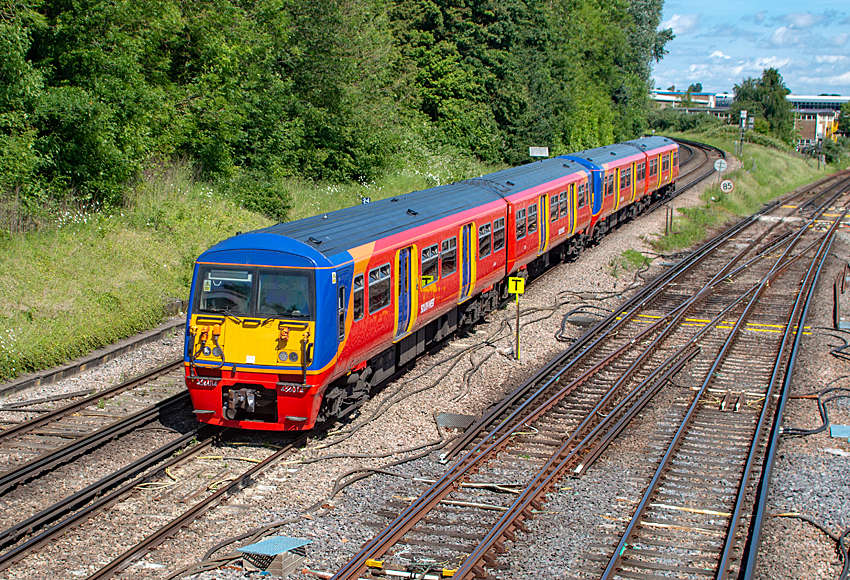
The British Rail Class 456 was an electric multiple unit passenger train introduced by Network SouthEast on inner-suburban services in South London to replace the elderly Class 416 2EPB units. Twenty-four two-car units were built by British Rail Engineering Limited's York Carriage Works in 1990 and 1991.
Following the privatisation of British Rail, the fleet was sold to Porterbrook and operated by Southern up until late 2013, when they were transferred to South West Trains and heavily refurbished. Routes that were operated by Class 456 units will be operated by new Class 701 Bombardier Aventra units in the future.
While originally approved for use by Network SouthEast (NSE) on services out of Waterloo, the 24 two-car units were first accepted into traffic as direct replacements for the Class 416 2EPB units on the Central Division of the Southern Region of British Rail. Units were delivered into traffic painted in NSE blue, red and white livery with cabs based on the Class 321 units, and were initially based at Selhurst depot. Although Network SouthEast had shifted to units painted with pale grey, the Class 456s were introduced painted with a darker grey shade to match the livery of the Class 455 units they would be working with. Units were numbered in the range 456001–456024, each unit consisting of a driving motor (DMSO) and a driving trailer (DTSO).
Entry into service for the Class 456 was originally planned for 18 March 1991, with trains to be driver-only operated (without the presence of a guard). This meant that the driver had to have a clear view of the platform with a bank of CCTV cameras mounted at the platform end for this purpose, however it was discovered that the position of the CCTV cameras on the platforms were not visible from the driver's position. To resolve this Selhurst depot designed a replacement fixing for the driver's seat so that it could slide sideways, allowing a good view of the CCTV units. The modified drivers' seats were installed at Fratton Depot with the work completed by the end of July 1991, and services with the new units commenced in September 1991.
When Britain's railways were privatised, the entire Class 456 fleet passed into the South Central franchise (later known as the Southern franchise), which was originally won by Connex South Central. Only one unit, No. 456024, was repainted in white and yellow Connex livery, when it was named Sir Cosmo Bonsor after a chairman of the South Eastern Railway. The rest of the fleet had remained in Network South East livery until summer 2006, when the fleet started to be repainted into Southern livery.
In 2000, Connex lost the South Central franchise to the Go-Ahead Group, who rebranded the company as Southern in 2004.
On 8 May 2012 it was announced by the Department for Transport that the entire fleet of 24 2-car Class 456s would transfer to South West Trains (SWT) in 2014, to be used in conjunction with South West Trains’s Class 455 fleet on London inner-suburban lines.
The Southern services on the South London Line were withdrawn in 2012 and replaced by a new London Overground service, the East London Line, operated using new air-conditioned 5-car Class 378 units. Southern also received 26 new 5 car Class 377/6 units and these entered service at the end of 2013, in place of 92 cascaded carriages promised for extra capacity. This gives a total of 50 replacement carriages in addition to the 92 carriages for extra capacity, leaving the 48 Class 456 carriages surplus to requirements at Southern.
Hub AI
British Rail Class 456 AI simulator
(@British Rail Class 456_simulator)
British Rail Class 456
The British Rail Class 456 was an electric multiple unit passenger train introduced by Network SouthEast on inner-suburban services in South London to replace the elderly Class 416 2EPB units. Twenty-four two-car units were built by British Rail Engineering Limited's York Carriage Works in 1990 and 1991.
Following the privatisation of British Rail, the fleet was sold to Porterbrook and operated by Southern up until late 2013, when they were transferred to South West Trains and heavily refurbished. Routes that were operated by Class 456 units will be operated by new Class 701 Bombardier Aventra units in the future.
While originally approved for use by Network SouthEast (NSE) on services out of Waterloo, the 24 two-car units were first accepted into traffic as direct replacements for the Class 416 2EPB units on the Central Division of the Southern Region of British Rail. Units were delivered into traffic painted in NSE blue, red and white livery with cabs based on the Class 321 units, and were initially based at Selhurst depot. Although Network SouthEast had shifted to units painted with pale grey, the Class 456s were introduced painted with a darker grey shade to match the livery of the Class 455 units they would be working with. Units were numbered in the range 456001–456024, each unit consisting of a driving motor (DMSO) and a driving trailer (DTSO).
Entry into service for the Class 456 was originally planned for 18 March 1991, with trains to be driver-only operated (without the presence of a guard). This meant that the driver had to have a clear view of the platform with a bank of CCTV cameras mounted at the platform end for this purpose, however it was discovered that the position of the CCTV cameras on the platforms were not visible from the driver's position. To resolve this Selhurst depot designed a replacement fixing for the driver's seat so that it could slide sideways, allowing a good view of the CCTV units. The modified drivers' seats were installed at Fratton Depot with the work completed by the end of July 1991, and services with the new units commenced in September 1991.
When Britain's railways were privatised, the entire Class 456 fleet passed into the South Central franchise (later known as the Southern franchise), which was originally won by Connex South Central. Only one unit, No. 456024, was repainted in white and yellow Connex livery, when it was named Sir Cosmo Bonsor after a chairman of the South Eastern Railway. The rest of the fleet had remained in Network South East livery until summer 2006, when the fleet started to be repainted into Southern livery.
In 2000, Connex lost the South Central franchise to the Go-Ahead Group, who rebranded the company as Southern in 2004.
On 8 May 2012 it was announced by the Department for Transport that the entire fleet of 24 2-car Class 456s would transfer to South West Trains (SWT) in 2014, to be used in conjunction with South West Trains’s Class 455 fleet on London inner-suburban lines.
The Southern services on the South London Line were withdrawn in 2012 and replaced by a new London Overground service, the East London Line, operated using new air-conditioned 5-car Class 378 units. Southern also received 26 new 5 car Class 377/6 units and these entered service at the end of 2013, in place of 92 cascaded carriages promised for extra capacity. This gives a total of 50 replacement carriages in addition to the 92 carriages for extra capacity, leaving the 48 Class 456 carriages surplus to requirements at Southern.