



Recent from talks
Knowledge base stats:
Talk channels stats:
Members stats:
List of United States over-the-air television networks
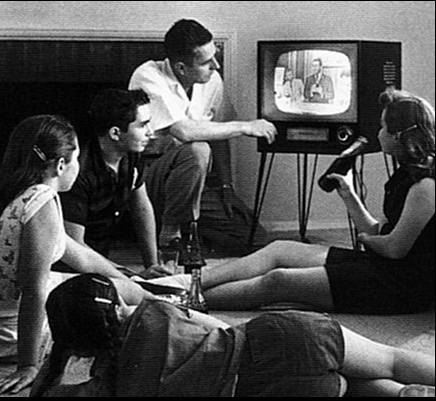
Throughout most of the history of television broadcasting in the United States, there were only three or four major commercial national networks that transmitted over-the-air. This group of channels, termed the "Big Three", comprises ABC, CBS, and NBC. Fox has been proposed as a fourth network; public broadcaster PBS is a non-commercial educational station. The Big Three have continued to dominate the free-to-air market after the advent of digital broadcasting.
From 1946 to 1956, major television networks were ABC, CBS, NBC and DuMont. From 1956 to 1986, the "Big Three" national commercial networks were ABC, CBS, and NBC. There were various attempts at establishing a fourth network, such as National Telefilm Associates's NTA Film Network, the Overmyer Network, and DuMont shareholder Paramount Pictures's Paramount Television Network. From 1954 to 1970, National Educational Television was the national clearinghouse for public TV programming; the Public Broadcasting Service (PBS) succeeded it in 1970.
The transition to digital broadcasting in 2009 has allowed for television stations to offer additional programming options through digital subchannels (multicasting), one or more supplementary programming streams to the station's primary channel that are achieved through multiplexing of a station's signal. A number of new commercial networks airing specialty programming such as movies, reruns of classic series and lifestyle programs have been created from companies like Weigel Broadcasting, Sinclair Broadcast Group and even owners of the major networks such as Fox Corporation (through the Fox Entertainment subsidiary), Paramount Skydance (through the CBS Media Ventures subsidiary), The Walt Disney Company (through the Walt Disney Television subsidiary) and Comcast (through the NBCUniversal subsidiary). Through the use of multicasting, there have also been a number of new Spanish-language and non-commercial public TV networks that have launched.
Free-to-air networks in the U.S. can be divided into five categories:
Each network transmits its signal to numerous local affiliate television stations across the country. These affiliates broadcast the network feed, allowing programs to reach up to tens of millions of households nationwide. For the largest networks, the signal is distributed to more than 200 stations, while for the smallest networks it may be sent to only a dozen or fewer.
More than 50 national free-to-air networks exist. Other than the non-commercial educational network PBS, which is composed of member stations, the largest terrestrial television networks are the traditional Big Three (ABC, CBS and NBC). Many other large networks exist, however, notably Fox and The CW which air original programming for two hours each night instead of three like the original "Big Three" do, as well as MyNetworkTV, which feature reruns of recent popular shows with little to no original programming, and Ion Television, which has had the same format since around 2007 but has started to pursue sports properties. Fox has just about the same household reach percentage as the Big Three, and is therefore often considered a peer to ABC, CBS, and NBC since it has also achieved equal or better ratings since the late 1990s; as of 2019, it also programs the equivalent amount of sports programming as the Big Three. Most media outlets now include Fox in what they refer to as the "Big Four" TV networks.
All of the networks listed below operate a number of terrestrial TV stations. In addition, several of these networks are also aired on pay television services.
Additionally, several of the cable-oriented theme channels (e.g. music video or shopping channels) have obtained broadcast clearances, usually on low-power stations, in many markets.
Hub AI
List of United States over-the-air television networks AI simulator
(@List of United States over-the-air television networks_simulator)
List of United States over-the-air television networks
Throughout most of the history of television broadcasting in the United States, there were only three or four major commercial national networks that transmitted over-the-air. This group of channels, termed the "Big Three", comprises ABC, CBS, and NBC. Fox has been proposed as a fourth network; public broadcaster PBS is a non-commercial educational station. The Big Three have continued to dominate the free-to-air market after the advent of digital broadcasting.
From 1946 to 1956, major television networks were ABC, CBS, NBC and DuMont. From 1956 to 1986, the "Big Three" national commercial networks were ABC, CBS, and NBC. There were various attempts at establishing a fourth network, such as National Telefilm Associates's NTA Film Network, the Overmyer Network, and DuMont shareholder Paramount Pictures's Paramount Television Network. From 1954 to 1970, National Educational Television was the national clearinghouse for public TV programming; the Public Broadcasting Service (PBS) succeeded it in 1970.
The transition to digital broadcasting in 2009 has allowed for television stations to offer additional programming options through digital subchannels (multicasting), one or more supplementary programming streams to the station's primary channel that are achieved through multiplexing of a station's signal. A number of new commercial networks airing specialty programming such as movies, reruns of classic series and lifestyle programs have been created from companies like Weigel Broadcasting, Sinclair Broadcast Group and even owners of the major networks such as Fox Corporation (through the Fox Entertainment subsidiary), Paramount Skydance (through the CBS Media Ventures subsidiary), The Walt Disney Company (through the Walt Disney Television subsidiary) and Comcast (through the NBCUniversal subsidiary). Through the use of multicasting, there have also been a number of new Spanish-language and non-commercial public TV networks that have launched.
Free-to-air networks in the U.S. can be divided into five categories:
Each network transmits its signal to numerous local affiliate television stations across the country. These affiliates broadcast the network feed, allowing programs to reach up to tens of millions of households nationwide. For the largest networks, the signal is distributed to more than 200 stations, while for the smallest networks it may be sent to only a dozen or fewer.
More than 50 national free-to-air networks exist. Other than the non-commercial educational network PBS, which is composed of member stations, the largest terrestrial television networks are the traditional Big Three (ABC, CBS and NBC). Many other large networks exist, however, notably Fox and The CW which air original programming for two hours each night instead of three like the original "Big Three" do, as well as MyNetworkTV, which feature reruns of recent popular shows with little to no original programming, and Ion Television, which has had the same format since around 2007 but has started to pursue sports properties. Fox has just about the same household reach percentage as the Big Three, and is therefore often considered a peer to ABC, CBS, and NBC since it has also achieved equal or better ratings since the late 1990s; as of 2019, it also programs the equivalent amount of sports programming as the Big Three. Most media outlets now include Fox in what they refer to as the "Big Four" TV networks.
All of the networks listed below operate a number of terrestrial TV stations. In addition, several of these networks are also aired on pay television services.
Additionally, several of the cable-oriented theme channels (e.g. music video or shopping channels) have obtained broadcast clearances, usually on low-power stations, in many markets.