


Community hub
Recent from talks
Contribute something
Nothing was collected or created yet.
NBCUniversal
View on Wikipedia | This article may require copy editing for grammar, style, cohesion, tone, or spelling. (October 2025) |
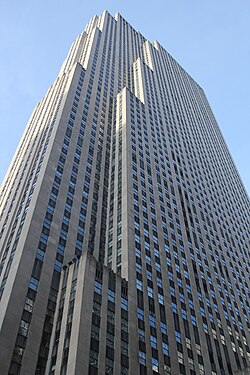
NBCUniversal Media, LLC (abbreviated as NBCU and doing business as NBCUniversal or Comcast NBCUniversal since 2013) is an American multinational mass media and entertainment conglomerate that is a subsidiary of Comcast and headquartered at 30 Rockefeller Plaza in Midtown Manhattan in New York City.[5] It is mostly involved in the media and entertainment industry, named for its two most significant divisions: the National Broadcasting Company (NBC)—one of the United States' Big Three television networks—and Universal Pictures, one of the major Hollywood film studios.
Key Information


It also has a significant presence in broadcasting through a portfolio of domestic and international properties, including USA, Syfy, Bravo, Oxygen, E!, Telemundo, Golf Channel, CNBC, Universo, the streaming service Peacock and ownership stakes in Snap Inc. and Vox Media. Via its Universal Destinations & Experiences division, NBCUniversal is also the third-largest operator of amusement parks in the world.[6]
NBCUniversal was created on May 11, 2004, as NBC Universal, Inc. on November 8, 2004, when Vivendi sold 80% of Universal Pictures to the now-defunct General Electric, NBC's then-owner.[7][8] The sale gave Vivendi a 20% stake in NBC Universal, while GE held the remaining 80%. Comcast attained 51% and thereby control of the newly reformed NBCUniversal in 2011, by acquiring shares from GE, with GE buying out Vivendi's stake. Since 2013, the company has been wholly owned by Comcast, which bought the remaining 49% of the company from GE.[9]
History
[edit]| 1909 | Independent Moving Pictures founded |
|---|---|
| 1912 | Universal Pictures is founded after IMP merged with smaller studios |
| 1926 | NBC is founded |
| 1928 | Walter Lantz Productions is established |
| 1943 | MCA Inc. establishes Revue Studios (later Universal Television) |
| 1963 | American Cable Systems is founded |
| 1964 | Universal Studios Hollywood opens |
| 1968 | American Cable Systems rebrands to Comcast |
| 1975 | Filmworks is founded |
| 1976 | Filmworks becomes Casablanca Record & Filmworks |
| 1980 | PolyGram renames Casablanca Record & Filmworks to PolyGram Pictures MCA Videocassette‚ Inc. (later Universal Pictures Home Entertainment) is established |
| 1983 | PolyGram Pictures closes |
| 1984 | Walter Lantz Productions' assets are sold to Universal Telemundo is founded |
| 1986 | General Electric re-purchases its former subsidiary RCA for $6.4 billion, including NBC and a stake in A&E |
| 1987 | PolyGram Movies is founded |
| 1989 | NBC relaunches Tempo Television as CNBC |
| 1990 | Universal Studios Florida opens PolyGram Movies is renamed PolyGram Filmed Entertainment Sky Television and British Satellite Broadcasting merge to form British Sky Broadcasting Universal Cartoon Studios (later Universal Animation Studios) is established |
| 1994 | DreamWorks Pictures and DreamWorks Animation are founded |
| 1995 | Seagram acquires Universal through its acquisition of MCA NBC and Microsoft replace America's Talking with MSNBC |
| 1998 | Seagram acquires PolyGram Filmed Entertainment Barry Diller purchases Universal's domestic television assets Universal Television is renamed Studios USA Television |
| 1999 | PolyGram Filmed Entertainment is folded into Universal Pictures PolyGram Video is renamed USA Home Entertainment Universal Studios Florida expands to become Universal Orlando Resort |
| 2000 | Seagram is sold to Vivendi and merged with StudioCanal to become Vivendi Universal Entertainment |
| 2001 | Grand opening of Universal Studios Japan Vivendi purchases Studios USA |
| 2002 | NBC acquires Telemundo and Bravo Studios USA assets are folded into Universal Focus Features is formed Comcast acquires AT&T Broadband for $44.5 billion |
| 2004 | GE and Vivendi merge NBC and Universal into NBCUniversal |
| 2005 | Comcast sets up a joint-venture with PBS, Sesame Workshop & HIT Entertainment to form PBS Kids Sprout Comcast & Time Warner Cable jointly acquire Adelphia Cable assets for $17.6 billion |
| 2007 | Illumination is founded |
| 2011 | Vivendi divests interest in NBCU; Comcast buys 51% of NBCU from GE, turning it into a limited liability company NBCUniversal Archives is founded |
| 2012 | NBCUniversal divests its A&E Networks minority stake |
| 2013 | Comcast buys GE's remaining 49% of NBCU Comcast/NBCU assumes full ownership of Sprout |
| 2015 | Amblin Partners is founded |
| 2016 | NBCU acquires DreamWorks Animation |
| 2017 | NBCU acquires a minority stake in Amblin Partners Sprout relaunches as Universal Kids |
| 2018 | Comcast acquires Sky from 21st Century Fox |
| 2020 | NBCU launches Peacock |
| 2024 | NBCU announces the split of its cable networks into Versant |
| 2025 | NBCUniversal announces the closure of Universal Kids Versant spins off from NBCUniversal by 2026 |

Early history
[edit]NBC and Universal Television had a partnership dating back to 1950, when Universal Television's earliest ancestor, Revue Studios, produced a number of shows for NBC, although Revue would have hits on other networks as well. This partnership continued throughout a number of name changes and changes of ownership.
Television
[edit]NBC Universal Television has its modern roots in a series of expansions undertaken by NBC, whose full legal name was National Broadcasting Company, Inc. In the late 1980s, NBC began pursuing a strategy of diversification, including the formation of two NBC-owned cable-television networks: CNBC and America's Talking. NBC also had partial ownership of several regional sports channels and other cable channels such as American Movie Classics and Court TV (until 2007).
In 1995, NBC began operating NBC Desktop Video, a financial news service that delivered live video to personal computers. The following year, NBC announced an agreement with Microsoft to create an all-news cable television channel, MSNBC (using its subscriber base from America's Talking network). A separate joint venture with Microsoft included establishing a news website, MSNBC.com (now NBCNews.com).[10]
In 1998, NBC partnered with Dow Jones & Co.[11] The two companies combined their financial news channels outside the United States. The new networks included NBC Europe, CNBC Europe, NBC Asia, CNBC Asia, NBC Africa, and CNBC Africa.
In 1999, NBC took a 32% stake in the Paxson group, operator of PAX TV. Five years later, NBC decided to sell its interest in PAX TV and end its relationship with PAX owner, Paxson Communications.[12]
In 2001, NBC acquired the US Spanish-language broadcaster Telemundo, which includes the bilingual Mun2 Television for $1.98 billion.[13] That same year NBC acquired the cable channel Bravo.
Combining with Universal
[edit]
In 2004, amid a major financial crisis caused by over-expansion, Universal Studios' parent company, Vivendi Universal Entertainment (a division of the French company Vivendi, which also owned Blizzard Entertainment), decided to sell an 80% stake in itself to NBC's parent company, General Electric (GE). The sale and resulting merger formed NBC Universal. The new company was 80% owned by GE, and 20% owned by Vivendi.[14] The Universal Music Group was not included in the deal and is not part of NBC Universal.[15]
On August 2, 2004, the television divisions of NBC and Universal Television were combined to form NBC Universal Television. Entertainment shows produced by the new group included The Tonight Show with Jay Leno, Late Night with Jimmy Fallon, and Saturday Night Live.
The formation of NBC Universal saw the establishment of NBC Universal Cable, which oversaw the distribution, marketing, and advertisement sales for thirteen channels. It also owned a 50% stake in Canal+ and a 15% stake in A+E Networks until 2012.[16]
Global expansion
[edit]
In the early 1990s, NBC began its expansion throughout Europe by creating CNBC Europe and its long-time successful NBC Europe Superstation by broadcasting NBC Giga throughout Germany and the rest of the European Union. NBC Europe helped to develop the Leipzig-based Games Convention, the largest European video game exposition with more than 100,000 visitors each year.
In 2005, NBC Universal joined HANA, the High-Definition Audio-Video Network Alliance to help establish standards in consumer electronics interoperability. Later that year, NBC Universal announced a partnership with Apple Computer to offer shows from all the NBC Universal TV networks on Apple's iTunes Store.[17]
In January 2006, NBC Universal launched a new cable channel, Sleuth, later rebranded as Cloo.[18][19] One year after Sleuth's debut, NBC Universal announced that the company would launch a horror-themed cable channel, Chiller, on March 1, 2007.
On June 14, 2007, NBC Universal Television Studio was renamed Universal Media Studios. The company explained that the reason for the name change was because "the new name fully describes the company's mission to be the premier content provider for television and digital platforms, spanning all television parts and creative genres."[20]
In August 2007, NBC Universal purchased Sparrowhawk Media Group and renamed it NBC Universal Global Networks.[21] This acquisition gave NBC Universal all Hallmark channels outside the United States, plus the English channels Diva TV, Movies 24, Hallmark Channel and KidsCo.[22] Later that fall, the company also acquired the Oxygen network in a separate $925 million deal.[23] The sale was completed one month later.
In the summer of 2008, NBC Universal, Blackstone Group and Bain Capital announced their intention to buy The Weather Channel from Landmark Communications. The deal closed on September 12, 2008.[24] Shortly after the acquisition was completed, NBC announced that its existing TV weather network, NBC Weather Plus, would be shut down by December 31, 2008.
In July 2008, Universal Cable Productions split off from Universal Media Studios and moved into NBCUniversal's NBCU Cable Entertainment division.[25]
The summer of 2008 marked NBC Universal's first venture into the United Kingdom with the acquisition of English television production company Carnival Films.[26]
On November 12, 2008, NBC Universal acquired 80.1% of Geneon Entertainment from Dentsu in Japan, merging it with Universal Pictures International Entertainment to form a new company,[27] Geneon Universal Entertainment Japan.[28]
On March 16, 2009, NBC Universal-owned cable channel Sci Fi announced that it would be changing its name to Syfy, replacing a generic term with a proprietary brand name that was able to be trademarked.[29] The re-branding and name change took place on July 7, 2009.[29][30]
On August 27, 2009, A&E Television Networks (A&E) merged with Lifetime Entertainment Services (Lifetime),[31][32] giving NBC Universal an equal share of both Lifetime and A&E with The Walt Disney Company and Hearst.
On October 20, 2010, NBC Universal-owned horror/suspense-themed cable channel Chiller announced a major rebranding campaign incorporating a new logo and on-air look that launched on Wednesday, October 27, 2010.[33][34] Syfy and Chiller President Dave Howe said, "We have very ambitious plans to grow this network as a brand."[33][34]
Ownership by Comcast (2011–present)
[edit]

On December 3, 2009, after months of rumors, a deal was formally announced in which Comcast would buy a stake in NBC Universal from GE for $6.5 billion after the spin-off of certain businesses, pending regulatory approval.[35] Under the agreement, NBC Universal would be controlled with a 51% stake by Comcast and GE would retain the remaining 49%. The deal includes a provision under which Comcast must contribute $7.5 billion in programming, including regional sports networks and cable channels such as Golf Channel, Versus, and E! Entertainment Television. GE used some of the funds, $5.8 billion, to buy out Vivendi's 20% minority stake in NBC Universal.[35] Under the terms of the deal, Comcast reserved the right to buy out GE's share at certain times, and GE reserved the right to force the sale of its stake within the first seven years.[35][36] Vivendi completed the initial transaction on September 27, 2010, selling a $2 billion stake to GE (approximately 7.66%).[37]
U.S. regulators approved the proposed sale on January 18, 2011, with conditions. Comcast would have to give up NBC control over online video site Hulu and ensure NBC Universal programming is available to competing cable operators.[38] The company unveiled a new logo designed by Wolff Olins, which replaced a logo featuring the NBC peacock and an invocation of the Universal Pictures globe, with a wordmark. The company also began to stylize its name in CamelCase as "NBCUniversal" rather than "NBC Universal", to reflect the unity of its two main divisions.[39][40]
On January 26, 2011, Vivendi sold the remaining 20% of NBC Universal to GE, giving GE complete control of the company ahead of the completion of the sale of 51% of the company to Comcast on January 28, 2011.[41] Comcast and GE formed the joint venture holding company NBCUniversal, LLC. NBC Universal, Inc. became a unit of Comcast and adopted the name NBCUniversal Media, LLC, on January 29, 2011.[42]
Comcast had planned to buy out GE's 49% stake over the following seven years, but ownership of NBCUniversal remained split at 51–49% for two years, until the announcement on February 12, 2013 that Comcast intended to complete the $16.7 billion purchase ahead of time all immediately. The sale was completed on March 19, 2013.[40][43][9]
The corporation, on July 19, 2012, formed the NBCUniversal News Group with the NBC News, CNBC, and MSNBC divisions.[44] That same year, Comcast sold its stake in A&E Networks to Disney and Hearst, making the company a 50-50 joint venture.
In February 2013, NBCUniversal merged its two cable divisions, NBCUniversal Cable Entertainment & Cable Studios and NBCUniversal Entertainment & Digital Networks and Integrated Media, into one unit while moving out Telemundo and Mun2 to a new division, NBCUniversal Hispanic Enterprises and Content. The move also created the corporate-level position of executive vice president in charge of digital ventures.[45] In July, the company placed NBC TV Stations and Telemundo's O&Os stations into a new division, NBCUniversal Owned Television Stations, with New England Cable News being transferred into NBC TV Stations.[46]
On December 16, 2015, Steven Spielberg, Jeff Skoll of Participant Media, Anil Ambani of Reliance Anil Dhirubhai Ambani Group, and Darren Throop of Entertainment One founded Amblin Partners, which would primarily focus on producing and distributing films and television using the DreamWorks Pictures, Amblin Entertainment, and Participant Media brands.[47] On the same day as the company's formation, Amblin Partners announced that it entered into a five-year distribution deal with Universal Pictures by which the films would be distributed and marketed by either the main Universal banner or its specialty label, Focus Features.[48][49] The Girl on the Train was the first film released under the deal, following the expiration of the former's distribution deal with Walt Disney Studios Motion Pictures with the release of The Light Between Oceans in August 2016.
On April 28, 2016, two days after The Wall Street Journal reported that NBCUniversal's parent-company Comcast was in talks with then-CEO Jeffrey Katzenberg about an acquisition, NBCUniversal officially announced to acquire DreamWorks Animation for $3.8 billion.[50] Universal Pictures took over the distribution for DreamWorks Animation films after its deal with 20th Century Fox expired in 2017, following the release of Captain Underpants: The First Epic Movie. The sale was approved by board members, but was subject to regulatory approval.[51][52] On June 21, 2016, the acquisition was approved by the United States Department of Justice.[53][54] On August 22, 2016, the acquisition was completed with DreamWorks Animation now completely owned by Universal Pictures.[55] That allowed Universal rights to both DreamWorks Animation and Illumination films beginning in 2019. DWA's first film to be distributed by Universal was How to Train Your Dragon: The Hidden World. The company later sold its stake in A&E to Disney and Hearst, making it a 50-50 joint venture.
On February 15, 2017, NBCUniversal acquired a minority stake in Amblin Partners,[56] strengthening the relationship between Universal and Amblin,[57] and reuniting a minority percentage of the live-action DreamWorks Pictures label with its former DreamWorks Animation division.
On February 28, 2017, NBCUniversal announced that it would acquire the remaining 49% stake in the Universal Studios Japan theme park that it did not own.[58]
On May 1, 2017, NBCUniversal announced that Sprout would be relaunched as Universal Kids on September 9, 2017.[59] Universal Kids would later cease operations in 2025.[60]
Attempted buyout of 21st Century Fox assets and subsequent acquisition of Sky
[edit]On November 16, 2017, NBCUniversal's parent company Comcast made a bid to acquire 21st Century Fox's filmed entertainment, cable entertainment, and international assets, ten days after The Walt Disney Company (at the time, owners of rival network ABC, cable sports channel ESPN and theme parks Disneyland and Walt Disney World) was reported to be negotiating with Fox for the same assets. The deal contained key assets such as the 20th Century Fox film and television studios (Universal Pictures and Universal Television's respective rivals), a 30% stake in Hulu, television assets FX Networks, National Geographic Channel, and international television operations such as Star India, while excluding the Fox Broadcasting Company, the Fox News Channel, Fox Television Stations, Fox Business Network, Fox Sports 1 and 2, Fox Deportes, and the Big Ten Network, all of which were spun off into the "New Fox" company (later known as the Fox Corporation) run by the Murdoch family.[61][62]
However, on December 11, 2017, Comcast officially dropped the bid, saying that "We never got the level of engagement needed to make a definitive offer."[63] On December 14, 2017, Disney officially confirmed its acquisition of the most 21st Century Fox assets, which was granted approval from the United States Department of Justice Antitrust Division on June 27, 2018, and approved by stockholders from both companies one month later.[64]
On April 25, 2018, Comcast launched its takeover offer for Sky plc at £12.50 per-share, or approximately £22.1 billion.[65][66] 21st Century Fox owned a significant stake in Sky and was trying to take full control of it itself, ahead of its own acquisition by The Walt Disney Company. NBCUniversal CEO Steve Burke stated that purchasing Sky would roughly double its presence in English-speaking markets, and allow for synergies between the respective networks and studios of NBCUniversal and Sky.[67] On June 5, 2018, Culture Secretary Matt Hancock cleared both 21st Century Fox and Comcast's respective offers to acquire Sky plc. Fox's offer was contingent on the divestiture of Sky News.[68][69] On June 15, 2018, the European Commission gave antitrust clearance to Comcast's offer to purchase Sky, citing that in terms of its current assets in Europe, there would be limited impact on competition. Comcast included a 10-year commitment to the operations and funding of Sky News.[70][71][72] On July 11, 2018, Fox increased its bid for Sky to £14.00 per-share, valuing it at £24.5 billion. Comcast subsequently counterbid just hours later with an offer at £14.75 per-share, valued at £26 billion.[73][74]
On September 20, 2018, the Panel on Takeovers and Mergers ordered that a blind auction be held "in order to provide an orderly framework for the resolution of this competitive situation". In this process, Fox, followed by Comcast, made new cash-only bids for Sky. After these first two rounds of bidding, there would be a third round where both companies could make new offers. However, the third round of bidding would only be binding if both companies make a bid.[75] Comcast won the auction with a bid of £17.28 per-share, beating Fox's bid of £15.67.[76][77] Sky plc had until October 11, 2018, to formally accept this offer.[78]
Following its auction victory, Comcast began to acquire Sky shares from the open market. On September 26, 2018, Fox subsequently announced its intent to sell all of its shares in Sky plc to Comcast for £12 billion.[78][79] On October 4, 2018, Fox completed the sale of its shares, giving Comcast a 76.8% controlling stake at the time.[80] On October 12, 2018, Comcast announced it will compulsorily acquire the rest of Sky after its bid gained acceptances from 95.3% of the broadcaster's shareholders with the company being delisted by early 2019.[81] Sky was delisted on November 7, 2018, after Comcast acquired all remaining shares.[82]
While NBCUniversal and Sky still operate mainly as separate entities within Comcast, following the Sky takeover Comcast has begun the process of integrating some of NBCUniversal's international operations with parts of Sky. Among other moves, NBCUniversal's pay television channels in the United Kingdom will be folded with Sky's, and Sky Deutschland will become the parent company of NBCU's German networks.[83]
Preparation of Peacock streaming service
[edit]On January 14, 2019, NBCUniversal announced that it would launch an over-the-top streaming service to compete with Netflix, CBS All Access, Amazon Prime Video, Hulu, Apple TV+, HBO Max, and Disney+.[84] A reorganization of the major direct reporting division was made. Bonnie Hammer was appointed chairman of NBCUniversal Direct-to-Consumer and Digital Enterprises via the streaming services and the Digital Enterprises unit. Her former unit, NBCUniversal Cable Entertainment Group, was given to Mark Lazarus as chairman, NBCUniversal Broadcast, Cable, Sports and News. Universal Filmed Entertainment Group chairman Jeff Shell added NBC Entertainment, Telemundo and international channels as chairman of NBCUniversal Film and Entertainment.[85] On September 17, 2019, NBCUniversal announced the service would be called Peacock and launched on July 15, 2020.[86][87] In 2025, Comcast executives told investors that Peacock had grown a customer base of more than 41 million paid subscribers.[88]
NBCUniversal Content Studios was formed in October 2019 with Hammer as chairman and George Cheeks as vice chairman, who was co-chairman of NBC Entertainment. This new unit consists of Universal Television and Universal Content Productions. Hammer was replaced as chairman of the Direct-to-Consumer and Digital Enterprises unit by Comcast executive Matt Strauss, while Paul Telegdy would become sole chairman of NBC Entertainment and continue reporting to Shell.[89]
On February 25, 2020, Comcast announced it would purchase Xumo from the Panasonic/Viant joint venture for an undisclosed sum. The acquisition of the service—which will continue to operate as an independent business, albeit within Comcast's cable television division—stems mainly from Xumo's partnerships with smart TV manufacturers (including LG, Panasonic, and Vizio), which would allow Comcast to use Xumo's placement to market or showcase Xfinity and other Comcast services as well as use its technology to develop additional streaming platforms. The company plans to add content from the NBCUniversal programming library and the company's various television networks as well as use it to upsell Peacock, akin to ViacomCBS's utilization of Pluto TV.[90][91][92]
Vudu acquisition
[edit]In February 2020, it was reported that Comcast (via NBCUniversal) had entered talks into acquiring Vudu from Walmart.[93] On April 20, 2020, Fandango (jointly owned by Comcast and WarnerMedia) announced that it would be acquiring Vudu.[94][95] The acquisition was completed on July 6, 2020.[96] Vudu was renamed Fandango at Home in 2024.
Restructuring and Versant spin-off
[edit]In 2023, NBCUniversal announced that corporate management will be led by a leadership team while Michael J. Cavanagh continues to oversee Comcast as a whole.[97]
On November 20, 2024, Comcast announced that it would spin off most of its cable networks and selected digital properties into a new publicly traded company led by Mark Lazarus.[98] Initially referred to under the interim name "SpinCo", the company's name was announced as Versant on May 6, 2025.[99] Versant will consist of properties such as USA Network, CNBC, MSNBC, later as MS NOW, E!, Golf Channel, Oxygen, and Syfy, as well as digital properties such as Fandango Media and SportsEngine; the aim of the spin-off is to separate them from NBCUniversal's flagship businesses, while providing them with the ability to make their own further investments and acquisitions.[98][100] NBCUniversal will retain Bravo, as the network is a major provider of content to Peacock, while Telemundo's own cable operations remain unchanged.[98]
Universal Kids was closed on March 6, 2025.[101]
Warner Bros. Discovery acquisition rumors
[edit]On October 2, 2025, CNBC reported that NBCUniversal would be the biggest wild card for the acquisition of Warner Bros. Discovery's assets.[102]
Notable people
[edit] | This section needs additional citations for verification. (July 2023) |
- Michael J. Cavanagh, President, Comcast
- Cesar Conde, Chairman, NBCUniversal News Group
- Rebecca Blumenstein, President, NBC News Editorial
- Luis Fernández, Chairman, NBCUniversal Telemundo Enterprises
- Rebecca Kutler, President, MSNBC
- Libby Leist, Executive Vice President, TODAY and Lifestyle
- Janelle Rodriguez, NBC News Executive Vice President of Programming
- Valari Dobson Staab, Chairman, NBCUniversal Local
- KC Sullivan, President, CNBC
- Kimberley D. Harris, Executive Vice President of Comcast Corporation and General Counsel of NBCUniversal
- Donna Langley, Chairman, NBCUniversal Entertainment & Studios
- Frances Berwick, Chairman, Bravo & Peacock Unscripted
- Jimmy Horowitz, Chairman, Business Affairs & Operations, NBCUniversal Entertainment
- Pearlena Igbokwe, Chairman, Television Studios, NBC Entertainment & Peacock Scripted
- Liz Jenkins, Chief Business Officer
- Peter Levinsohn, Chairman, Global Distribution
- Jennifer Storms, Chief Marketing Officer, NBCUniversal Television & Streaming
- Adam Miller, Chief Operating Officer
- Deepak Arya, Executive Vice President of Corporate Strategy & Development
- Randy Culbertson, Chief Financial Officer
- Jen Friedman, Chief Communications Officer
- Ian Trombley, President, Operations & Technology
- Vicki Williams, Chief Human Resources Officer
- Craig Robinson, Executive Vice President, Chief Diversity Officer
- Matt Strauss, Chairman, NBCUniversal Media Group
- Rick Cordella, President, NBC Sports
- Mark Marshall, Chairman, Global Advertising & Partnerships
- Matt Schnaars, President, Platform Distribution & Partnerships
- Mark Woodbury, Chairman and Chief Executive Officer, Universal Destinations & Experiences
- Karen Irwin, President & Chief Operating Officer of Universal Orlando Resort
- Vince Klaseus, President, Universal Products & Experiences
- Tom Mehrmann, President, Chief Operating Officer, Pacific Rim
- Page Thompson, President, New Ventures
- Cesar Conde, Chairman, NBCUniversal News Group
Assets
[edit]Libraries
[edit]NBCUniversal Film & Entertainment
[edit]- Universal Filmed Entertainment Group
- Universal Pictures film library[103]
- Universal International Studios
- Universal 1440 Entertainment
- DreamWorks Animation
- DreamWorks Classics[104]
- UPA library (excluding the 1997 Mr. Magoo film, owned by Disney)
- Harvey Films library (excluding co-productions owned by third-party companies)
- Famous Studios/Paramount Cartoon Studios library (post–October 1950 and pre–March 1962)[106][failed verification]
- Noddy[107]
- Olivia[108]
- Felix the Cat[109]
- Where's Waldo?
- Roger Ramjet [citation needed]
- My Life Me[110][111]
- Voltron (under license from World Events Productions)[112]
- Worldwide distribution rights to OOglies (excluding UK television rights)[113]
- Worldwide distribution rights to Tracy Beaker Returns (excluding UK television rights)[114]
- Non-French licensing and distribution rights to The Owl & Co
- Tribune Content Agency library[115][116]
- Western Publishing/Golden Books/Gold Key Comics/Golden Book Video library
- Broadway Video's former family entertainment library
- Tomorrow Entertainment library (pre-1974)
- Rankin/Bass Productions (pre–September 1974)
- Total Television library (excluding the 2007 Underdog film, owned by Disney)
- Tomorrow Entertainment library (pre-1974)
- Shari Lewis' two PBS series (Lamb Chop's Play-Along and The Charlie Horse Music Pizza)[117]
- Broadway Video's former family entertainment library
- CST Entertainment
- Big Idea Entertainment[118]
- Entertainment Rights
- Carrington Productions International
- Link Entertainment
- Filmation (excluding third-party licensed properties)
- He-Man (1983 TV series and related specials and films) and She-Ra (1985 TV series and 2019 TV series; under license from Mattel)[citation needed]
- Woodland Animations
- Tell-Tale Productions (excluding the rights to Tweenies, owned by BBC Studios)[119][120]
- Sleepy Kids
- Maddocks Animation
- Other programs formerly under Entertainment Rights that were produced by other production companies
- Chapman Entertainment[121]
- Bullwinkle Studios (joint venture with Jay Ward Productions)[122][123]
- DreamWorks Classics[104]
- Universal Animation Studios
- Illumination
- Illumination Studios Paris
- Illumination Labs[124]
- Moonlight
- Focus Features film library
- Good Machine
- Gramercy Pictures
- October Films
- USA Films
- Universal Focus/Universal Classics
- Savoy Pictures
- Focus World
- Rogue Pictures (pre-2010)
- Working Title Films
- WT2 Productions
- PolyGram Filmed Entertainment film library (post-March 1996)
- Castle Films/Universal 8
- Amblin Partners film library
- Amblin Entertainment (only films released by Universal Pictures)
- DreamWorks Pictures film library (post-2016)
- Blumhouse Productions film library (minority stake; only films co-produced with Universal Pictures)
- Back Lot Music discography
- United International Pictures (50%)
- Universal Pictures film library[103]
- Peacock original films
NBCUniversal Media Group
[edit]- NBCUniversal Studio Group
- Universal Television library
- Revue Studios
- MCA TV
- Multimedia Entertainment
- Studios USA Television
- PolyGram Television (post-1996)
- USA Cable Entertainment
- Wolf Entertainment
- Universal International Studios
- Heyday Television (joint venture with Heyday Films)
- Chocolate Media
- Lark Productions
- Lucky Giant
- Monkey Kingdom
- Matchbox Pictures
- Carnival Films
- EMKA, Ltd.
- Paramount Pictures film library (1929–1949) (excluding Dr. Jekyll and Mr. Hyde, owned by Warner Bros. via Turner Entertainment Co., The Story of Temple Drake, owned by Disney via 20th Century Studios, and six Paramount films (The Buccaneer, The Miracle of Morgan's Creek, Sorry, Wrong Number, Bride of Vengeance, Rope of Sand and My Friend Irma), owned by Paramount itself)
- Working Title Television
- Telemundo originals
- Telemundo of Puerto Rico Studios
- Telemundo Studios
- Telemundo Global Studios
- Telemundo Streaming Studios
- Underground Producciones
- Telemundo Films
- Amblin Television (excluding co-productions with other companies)
- DreamWorks Television (post-2008) (excluding co-productions with other companies)
- NBC Studios (In the House and The Fresh Prince of Bel-Air are distributed by Warner Bros. Television Studios due to a pre-NBCU syndication deal)
- NBC Enterprises
- SNL Studios (joint venture with Lorne Michaels)
- NBC Entertainment
- NBC International
- DreamWorks Animation Television
- Universal Content Productions
- Universal Television Alternative Studio
- Universal Television library
- NBCUniversal News Group
- NBC News
- CNBC
- MSNBC
- NBC News Studios
- MSNBC Films
- NBC News International
- Peacock Productions
- NBC News
- Hayu originals
- Peacock originals
- USA Cable Entertainment library
- Syfy originals
- Bravo originals
- E! originals
- E! Studios
- Wilshire Studios
- E! Studios
- Oxygen originals
- Universal Kids originals
- G4 Media
- Style/Esquire Network originals
- Chiller originals
- Cloo originals
- Trio originals (post-2000)
- Fearnet originals (excluding series produced by Sony Pictures Television and Lionsgate Television)
- Seeso originals
- Sky Vision
See also
[edit]


References
[edit]- ^ "Comcast and GE Complete Transaction to Form NBCUniversal, LLC" (Press release). Comcast Corporation and General Electric Company. January 29, 2011. Archived from the original on February 9, 2011. Retrieved January 29, 2011.
- ^ "4Q17 Earnings Release with Tables". Archived from the original on June 24, 2018. Retrieved June 24, 2018.
- ^ "Quarterly report for the period ended March 31, 2017". Archived from the original on July 25, 2018. Retrieved July 25, 2018.
- ^ James, Meg (April 27, 2017). "NBCUniversal earnings soar, boosted by hit movies and Universal Studios crowds". Los Angeles Times. Archived from the original on August 26, 2018. Retrieved August 15, 2018.
- ^ "NBC Universal to sell Burbank, Calif, studio". MarketWatch. October 11, 2007. Archived from the original on June 8, 2011. Retrieved August 28, 2009.
- ^ "TEA/AECOM 2017 Global Attractions Attendance Report" (PDF). May 17, 2018. Archived from the original (PDF) on May 19, 2018. Retrieved April 22, 2019.
- ^ "NBC closes merger with Universal". NBC News. May 12, 2004. Retrieved August 25, 2024.
- ^ Keating, Gina (December 3, 2009). "TIMELINE: NBC, Universal through the 20th century and beyond". Reuters. Archived from the original on December 8, 2009. Retrieved December 24, 2009.
- ^ a b Lieberman, David (March 19, 2013). "Comcast Completes Acquisition Of GE's 49% Stake In NBCUniversal". Deadline. Archived from the original on March 27, 2019. Retrieved February 25, 2019.
- ^ "Microsoft and NBC Join Forces Again To Deliver Personal Finance Powerhouse on the Web". Stories. April 23, 2001. Archived from the original on April 10, 2021. Retrieved August 28, 2020.
- ^ "NBC, Dow jones reveal merger details". Archived from the original on April 24, 2022. Retrieved May 30, 2018.
- ^ Carter, Bill (August 23, 2004). "MEDIA; NBC Universal And Paxson: An Odd Dance To a Divorce". The New York Times. ISSN 0362-4331. Archived from the original on April 10, 2021. Retrieved February 25, 2019.
- ^ James, Meg (October 12, 2001). "NBC to Acquire Telemundo Network for $1.98 Billion". Los Angeles Times. ISSN 0458-3035. Archived from the original on November 29, 2016. Retrieved February 25, 2019.
- ^ Levy, Jean-Bernard (May 13, 2004). "Overview of NBC Universal Merger" (PDF). Vivendi Universal. Archived from the original (PDF) on November 18, 2008. Retrieved December 24, 2009.
- ^ "Company Overview". NBC Universal. Archived from the original on December 27, 2010. Retrieved December 2, 2009.
- ^ de la Merced, Michael J. (July 10, 2012). "Comcast to Sell Back Its Stake in A&E for $3 Billion". DealBook. Archived from the original on March 9, 2013. Retrieved April 17, 2013.
- ^ Noguchi, Yuki (December 7, 2005). "NBC Universal, iTunes Team On Downloads of TV Shows". The Washington Post. Archived from the original on January 7, 2016. Retrieved April 24, 2013.
- ^ Exclusive: Sleuth Gets A New Name: Meet Cloo Archived October 21, 2014, at the Wayback Machine, TV Guide, April 7, 2011
- ^ Exclusive: Newly Rebranded Cloo TV Picks Up First Original Series Archived October 21, 2014, at the Wayback Machine TV Guide July 15, 2011
- ^ "NBC Universal Re-Names NBC Universal Television Studio as Universal Media Studios" (Press release). NBC Universal. June 14, 2007. Retrieved December 2, 2009.
- ^ "NBCUniversal | History, Acquisitions, & Facts". Encyclopedia Britannica. Retrieved August 11, 2017.
- ^ Eric Pfanner (August 28, 2007). "NBC Universal buys 19 Hallmark channels outside the U.S." International Herald Tribune. Archived from the original on August 31, 2007. Retrieved December 2, 2009.
- ^ Michael Learmonth (October 10, 2007). "NBC U Sucks in Oxygen". Daily Variety. p. 1.
- ^ Seth sutel (July 7, 2008). "NBC Universal to buy The Weather Channel for $3.5B". The Sydney Morning Herald. Archived from the original on August 3, 2008. Retrieved December 2, 2009.
- ^ Lafayette, Jon (July 20, 2008). "NBC Taps Cable-Studio Bosses". TV Week.com. Archived from the original on March 23, 2012. Retrieved August 15, 2012.
- ^ Conlan, Tara (August 20, 2008). "NBC Universal buy Carnival". The Guardian. London: Guardian News and Media. Archived from the original on September 2, 2013. Retrieved August 20, 2008.
- ^ "Geneon to Merge with Universal Pictures Japan". Anime News Network. November 12, 2008. Archived from the original on June 5, 2019. Retrieved November 13, 2008.
- ^ "Geneon Universal Entertainment Japan Official Website" (in Japanese). Archived from the original on May 21, 2013. Retrieved February 22, 2009.
- ^ a b Elliott, Stuart (March 15, 2009). "Sci Fi Channel Has a New Name: Now, It's Syfy". The New York Times. ISSN 0362-4331. Archived from the original on February 15, 2017. Retrieved February 25, 2019.
- ^ Syfy: Not Your Father's Sci-Fi Archived March 1, 2014, at the Wayback Machine, Fortune, July 7, 2009
- ^ A&E Acquires Lifetime, Variety.com, August 27, 2009
- ^ A&E Networks, Lifetime Merger Completed Archived July 29, 2013, at the Wayback Machine, Broadcasting & Cable, August 27, 2009
- ^ a b Marc Graser (October 20, 2010). "Chiller takes a chill pill". Variety. Archived from the original on October 23, 2010. Retrieved April 17, 2020.
- ^ a b Chiller Announces Major Redesign Archived October 23, 2010, at the Wayback Machine, TV By the Numbers, October 20, 2010
- ^ a b c Wilkerson, David B.; Steven Goldstein (December 3, 2009). "Comcast scores controlling stake in NBC Universal". MarketWatch. Archived from the original on April 6, 2015. Retrieved December 3, 2009.
- ^ "Vivendi to Sell 20% Stake in NBCU to GE for $5.8 Bln". The Wall Street Journal. December 3, 2009. [dead link]
- ^ "Vivendi Sells $2 billion NBC Universal Stake to GE". CNBC. September 27, 2010. Archived from the original on November 6, 2015.
- ^ Thomasch, Paul (January 18, 2011). "UPDATE 2-U.S. regulators approve Comcast-NBCU deal". Reuters. Archived from the original on September 24, 2020. Retrieved May 8, 2016.
- ^ Stelter, Brian (January 27, 2011). "Lost in the Comcast Takeover? A Logo's Peacock". Media Decoder Blog. The New York Times Company. Archived from the original on March 16, 2021. Retrieved February 25, 2019.
- ^ a b Nakashima, Ryan (February 12, 2013). "Comcast to buy GE's 49 pct stake in NBCUniversal". MSN. Associated Press. Archived from the original on February 16, 2013. Retrieved February 12, 2013.
- ^ Colchester, Max (January 27, 2011). "Vivendi Wraps Up Sale of NBC Universal Stake". The Wall Street Journal. ISSN 0099-9660. Archived from the original on April 10, 2021. Retrieved February 25, 2019.
- ^ 8-K filed on 01/31/2011 General Electric Company
- ^ Chozick, Amy; Stelter, Brian (February 12, 2013). "Comcast Buys Rest of NBC in Early Sale". Media Decoder Blog. The New York Times Company. Archived from the original on April 26, 2021. Retrieved February 25, 2019.
- ^ "New York Deadline" Pat Fili-Krushel To Oversee NBCUniversal News Group deadline.com, Retrieved on July 23, 2012
- ^ James, Meg (February 4, 2013). "Bonnie Hammer to lead NBCUniversal cable entertainment channels". Los Angeles Times. ISSN 0458-3035. Archived from the original on March 6, 2016. Retrieved February 25, 2019.
- ^ "NBC's Owned Stations Reorganize". Broadcasting & Cable. NewBay Media LLC. Retrieved August 5, 2013.
- ^ Cieply, Michael (December 16, 2015). "Steven Spielberg and DreamWorks Studios in Deal to Form New Company". The New York Times. Retrieved December 23, 2015.
- ^ Lang, Brent (December 16, 2015). "Steven Spielberg, Jeff Skoll Bring Amblin Partners, LLC. to Universal". Variety. Retrieved December 23, 2015.
- ^ Busch, Anita (December 16, 2015). "It's Official: Spielberg, DreamWorks, Participant, eOne, Others Pact For Amblin Partners". Deadline Hollywood. Retrieved December 23, 2015.
- ^ James, Meg (April 28, 2016). "Comcast's NBCUniversal buys DreamWorks Animation in $3.8-billion deal". Los Angeles Times. Archived from the original on November 29, 2019. Retrieved April 28, 2016.
- ^ Fung, Brian (April 28, 2016). "Comcast is buying Dreamworks in a $3.8 billion acquisition". Washington Post. Archived from the original on April 29, 2016. Retrieved May 1, 2016.
- ^ D'Alessandro, Anthony (April 29, 2016). "How A DreamWorks-Illumination Combo Beats Disney At The B.O." Deadline Hollywood. Archived from the original on May 2, 2016. Retrieved May 2, 2016.
- ^ Lieberman, David (June 21, 2016). "Antitrust Officials Clear Comcast's $3.8B DreamWorks Animation Acquisition". Deadline Hollywood. Archived from the original on June 22, 2016. Retrieved June 23, 2016.
- ^ Boorstin, Julia (July 7, 2016). "NBCUniversal's Ron Meyer: Here's why we bought Dreamworks Animation". CNBC. NBCUniversal. Archived from the original on August 4, 2017. Retrieved September 10, 2017.
- ^ McNary, Dave (August 22, 2016). "Comcast Completes $3.8 Billion Purchase of DreamWorks Animation". Variety. Archived from the original on October 24, 2016. Retrieved December 11, 2017.
- ^ Lieberman, David (February 15, 2017). "Universal Buys Minority Stake In Amblin Partners". Deadline. Retrieved February 27, 2018.
- ^ Perry, Spencer (February 15, 2017). "Universal Studios Buys a Minority Stake in Amblin Partners". Comingsoon.net. Retrieved February 20, 2017.
- ^ Jamerson, Joshua (February 28, 2017). "Comcast to Buy Remaining Stake in Universal Studios Japan for $2.3 Billion". The Wall Street Journal. ISSN 0099-9660. Archived from the original on April 10, 2021. Retrieved February 25, 2019.
- ^ Steinberg, Brian (May 1, 2017). "NBCU's Sprout Grows Up: Universal Kids to Debut in September". Variety. Archived from the original on December 11, 2017. Retrieved May 8, 2017.
- ^ Schneider, Michael (January 14, 2025). "Universal Kids Goes Dark in March, Making It the Latest Cable Network To Be Shut Down By NBCU". Variety. Retrieved January 21, 2025.
- ^ Chmielewski, Dawn C.; Hayes, Dade (November 16, 2017). "Comcast-Fox Deal Talks Latest Entry Into Media Merger Mania". Deadline Hollywood. Archived from the original on June 28, 2018. Retrieved November 28, 2017.
- ^ Bond, James (November 17, 2017). "Sony Also Inquiring About 21st Century Fox Assets". The Hollywood Reporter. Eldridge Industries. Archived from the original on November 18, 2017. Retrieved November 17, 2017.
- ^ Reuter Staff, Reuter Staff (December 11, 2017). "Comcast drops bid for Fox assets, leaving Disney in pole position". Reuters. Archived from the original on November 9, 2020. Retrieved December 11, 2017.
- ^ Riley, Charles and Hadas Gold. "Disney is buying most of 21st Century Fox for $52.4 billion". CNNMoney. Archived from the original on January 21, 2018. Retrieved December 14, 2017.
- ^ "Murdoch bid for Sky challenged by US giant". BBC News. February 27, 2018. Archived from the original on February 27, 2018. Retrieved February 27, 2018.
- ^ Wilson, Bill (April 25, 2018). "Comcast starts £22bn bidding war for Sky". BBC News. Archived from the original on April 25, 2018. Retrieved April 25, 2018.
- ^ White, Peter (February 27, 2018). "NBCU's Steve Burke Claims Comcast's $31B Sky Deal Will Boost Scripted TV & Film Fortunes, Fox Notes No "Firm Offer" Was Made; 21st Century Fox Reacts – Update". Deadline Hollywood. Archived from the original on February 27, 2018. Retrieved February 27, 2018.
- ^ "Sky bid battle looms after government nod". BBC News. June 5, 2018. Archived from the original on June 6, 2018. Retrieved June 5, 2018.
- ^ Szalai, Georg. "U.K. Approves Fox's Sky Bid, Subject to Sale of Sky News, and Clears Comcast Offer". The Hollywood Reporter. Archived from the original on June 6, 2018. Retrieved June 5, 2018.
- ^ Woo, Stu (June 15, 2018). "Comcast Clears EU Hurdle in $29 Billion Bid for Sky". The Wall Street Journal. ISSN 0099-9660. Archived from the original on June 18, 2018. Retrieved June 18, 2018.(subscription required)
- ^ "Comcast Clears EU Antitrust Hurdle for Sky Ahead of Disney Fight". Bloomberg.com. June 15, 2018. Archived from the original on June 18, 2018. Retrieved June 18, 2018.(subscription required)
- ^ "EU Clears Comcast's Bid for Sky". The Hollywood Reporter. Archived from the original on June 16, 2018. Retrieved June 18, 2018.
- ^ "Murdoch's Fox increases Sky bid". BBC News. July 11, 2018. Archived from the original on July 11, 2018. Retrieved July 11, 2018.
- ^ Clarke, Stewart (July 13, 2018). "U.K. Takeover Body Hikes Price Disney Would Need to Offer for Sky". Variety. Archived from the original on July 13, 2018. Retrieved July 13, 2018.
- ^ Waterson, Jim (September 20, 2018). "Sky takeover battle must go to auction, orders regulator". the Guardian. Archived from the original on September 20, 2018. Retrieved September 20, 2018.
- ^ Clark, Kate (September 22, 2018). "Comcast outbids Fox in $40B battle for Sky". TechCrunch. Archived from the original on September 22, 2018. Retrieved September 22, 2018.
- ^ "Sky: Comcast outbids Fox with £30bn bid for broadcaster". BBC News. September 22, 2018. Archived from the original on September 22, 2018. Retrieved September 22, 2018.
- ^ a b Clarke, Stewart (September 25, 2018). "Comcast Buys Over 30% of Sky on Open Market, Seeks More Before Takeover Deadline". Variety. Archived from the original on September 27, 2018. Retrieved September 27, 2018.
- ^ Waterson, Jim (September 26, 2018). "Rupert Murdoch's Sky reign to end as Fox sells all shares to Comcast". The Guardian. Archived from the original on November 17, 2020. Retrieved September 27, 2018.
- ^ Clarke, Stewart (October 9, 2018). "Comcast Closes Deal for Fox's Sky Stake, Owns Over 75% of European Pay-TV Giant". Variety. Archived from the original on October 11, 2018. Retrieved October 11, 2018.
- ^ "Comcast to buy remaining Sky shares after bid gets 95% acceptance". Stock Market Wire. October 12, 2018. Archived from the original on October 14, 2018. Retrieved October 15, 2018.
- ^ "Recommended mandatory superior cash offer for Sky: Compulsory acquisition of Sky shares". Comcast. October 12, 2018. Archived from the original on April 1, 2022. Retrieved August 27, 2019.
- ^ Keslassy, Elsa; Clarke, Stewart (April 5, 2019). "Merger of Sky, NBCU Operations Begins Post-Comcast Takeover". Variety. Archived from the original on April 10, 2021. Retrieved August 27, 2019.
- ^ Steinberg, Brian; Littleton, Cynthia (January 15, 2019). "What We Know About NBCUniversal's Future Streaming Service". Variety. Archived from the original on January 15, 2019. Retrieved January 15, 2019.
- ^ Steinberg, Brian (January 14, 2019). "NBCUniversal Shakeup: Mark Lazarus, Jeff Shell and Bonnie Hammer Promoted, Streaming Service to Launch in 2020 (EXCLUSIVE)". Variety. Archived from the original on January 14, 2019. Retrieved January 15, 2019.
- ^ Andreeva, Nellie (September 17, 2019). "NBCU Streamer Gets Name, Sets Slate Of Reboots, 'Dr. Death', Ed Helms & Amber Ruffin Series, 'Parks & Rec'". Deadline Hollywood. Archived from the original on September 17, 2019. Retrieved September 17, 2019.
- ^ D'Addario, Caroline Framke,Daniel (July 15, 2020). "Peacock Launch Shows Platform's Potential, But Inspires Confusion (Column)". Variety. Retrieved May 22, 2025.
{{cite web}}: CS1 maint: multiple names: authors list (link) - ^ Steinberg, Brian (April 24, 2025). "Comcast Sees Q1 Profit Dip on Cable and Ad Revenue Declines, Peacock Climbs to 41 Million Subscribers". Variety. Retrieved May 22, 2025.
- ^ Littleton, Cynthia; Low, Elaine (October 7, 2019). "NBCUniversal Shakeup: Bonnie Hammer to Head Studios, Paul Telegdy Goes Solo at NBC". Variety. Archived from the original on October 7, 2019. Retrieved October 8, 2019.
- ^ Jon Lafayette (February 25, 2020). "Comcast Buys Ad-Supported Streaming Service Xumo". Broadcasting & Cable. Future US. Archived from the original on February 29, 2020. Retrieved April 21, 2020.
- ^ Alex Sherman (February 25, 2020). "Why Comcast agreed to buy Xumo, an ad-supported free streaming service". CNBC. NBCUniversal News Group. Archived from the original on February 24, 2021. Retrieved April 21, 2020.
- ^ Todd Spangler (February 25, 2020). "Comcast Acquires Xumo Free-Streaming Video Service". Variety. Penske Media Corporation. Archived from the original on April 10, 2021. Retrieved April 21, 2020.
- ^ Goldsmith, Jill (February 21, 2020). "Comcast In Talks To Buy Walmart's Streaming Service Vudu". Deadline. Archived from the original on February 23, 2020. Retrieved February 27, 2020.
- ^ Alexander, Julia (April 20, 2020). "Fandango just purchased Vudu from Walmart to better compete against Amazon, iTunes". The Verge. Archived from the original on April 21, 2020. Retrieved April 20, 2020.
- ^ "NBCU's Fandango Ticketing Service Buys Walmart-Owned Vudu". www.adweek.com. April 20, 2020. Archived from the original on December 13, 2020. Retrieved April 21, 2020.
- ^ Lipman, Ashley (July 6, 2020). "Vudu is Now Officially Part of the Fandango Family". Xanjero. Archived from the original on July 8, 2020. Retrieved August 28, 2020.
- ^ Weprin, Alex (July 6, 2023). "NBCUniversal Shake-Up: Donna Langley, Mark Lazarus, Cesar Conde Upped; Susan Rovner Out". The Hollywood Reporter. Retrieved July 9, 2023.
- ^ a b c "Comcast to spin off MSNBC, CNBC and other cable channels". Los Angeles Times. November 20, 2024. Retrieved November 25, 2024.
- ^ Weprin, Alex (May 6, 2025). "Comcast's Cable TV Spinoff Now Has a Name: Versant". The Hollywood Reporter. Retrieved May 7, 2025.
- ^ Spangler, Todd (November 20, 2024). "Comcast Announces Spin-Off of Most Cable Networks Into New Company to 'Set These Businesses Up for Future Growth,' CEO Brian Roberts Says". Variety. Retrieved November 22, 2024.
- ^ "NBCUniversal is shutting down Universal Kids". Kidscreen. January 13, 2025.
- ^ Sherman, Alex (October 2, 2025). "CNBC Sport: What to expect as a Paramount bid for WBD looms". CNBC. Retrieved October 2, 2025.
- ^ "Brands | NBCUNIVERSAL MEDIA". www.nbcuniversal.com. Archived from the original on February 18, 2021. Retrieved December 20, 2022.
- ^ "Dreamworks Animation Agrees to Acquire Classic Media" (Press release). DreamWorks Animation SKG. July 23, 2012. Archived from the original on December 17, 2015. Retrieved October 11, 2015 – via PR Newswire.
- ^ "Classic Media Reissues the Original GODZILLA on DVD". Scifijapan.com. May 13, 2014. Archived from the original on April 3, 2019. Retrieved August 10, 2014.
- ^ "Paramount Cartoons 1958–59". Cartoon Research. Archived from the original on March 4, 2016. Retrieved December 30, 2016.
- ^ Sweney, Mark (March 7, 2012). "Chorion sells rights to Noddy". The Guardian. Archived from the original on December 28, 2013. Retrieved August 28, 2013.
- ^ Arrant, Chris (March 19, 2012). "Classic Media Acquires 'Olivia' Rights from Chorion". Cartoon Brew. Archived from the original on December 28, 2013. Retrieved August 28, 2013.
- ^ McNary, Dave (June 17, 2014). "DreamWorks Animation Buys Felix the Cat". Variety. Retrieved June 17, 2014.
- ^ "Anime/Manga-Inspired My Life Me Sold to Classic Media". Anime News Network. Archived from the original on October 7, 2011. Retrieved September 24, 2011.
- ^ Bynum, Aaron. "'My Life Me' Animation Now in New Hands". Animation Insider. Archived from the original on April 4, 2012. Retrieved September 24, 2011.
- ^ Goldman Getzler, Wendy (June 7, 2010). "Voltron returns with full Force". Kidscreen. Archived from the original on April 18, 2012. Retrieved August 28, 2013.
- ^ Washington, Ed (March 13, 2012). "Classic Media Inks Deals Across Central, Eastern Europe". Animation World Network. Archived from the original on December 19, 2022. Retrieved December 21, 2022.
- ^ "Classic picks up Ooglies".
- ^ "Dick Tracy, Brenda Starr Ink With Classic Media". Billboard. June 14, 2005. Archived from the original on November 28, 2015. Retrieved August 28, 2013.
- ^ Paskin, Willa (June 13, 2005). "Tribune, Classic in cartoon venture". Variety. Archived from the original on April 19, 2014. Retrieved August 28, 2013.
- ^ "Lamb Chop and Charlie sign on for a Golden deal". Deseret News. July 31, 1997. Archived from the original on December 20, 2016. Retrieved December 21, 2016.
- ^ "'VeggieTales' goes for $19.3 million". Chicago Tribune. Articles.chicagotribune.com. October 31, 2003. Archived from the original on July 14, 2014. Retrieved June 27, 2014.
- ^ "Tweenies maker bought for £3.1m". BBC News. September 13, 2004. Archived from the original on October 16, 2013. Retrieved August 28, 2013.
- ^ Ball, Ryan (September 13, 2004). "Entertainment Rights Acquires Tell-Tale Prods". Animation Magazine. Archived from the original on April 2, 2015. Retrieved August 28, 2013.
- ^ "DreamWorks scoops up Chapman's library". Kidscreen. June 27, 2014. Archived from the original on February 1, 2014. Retrieved June 27, 2014.
- ^ Verrier, Richard (July 23, 2012). "DreamWorks Animation buys 'Casper,' 'Lassie' parent Classic Media". Los Angeles Times. Archived from the original on October 25, 2013. Retrieved August 31, 2013.
- ^ Elliot, Stuart (January 16, 2008). "A Classic Series, Retooled and Swingin'". The New York Times. Archived from the original on August 16, 2017. Retrieved August 3, 2016.
- ^ "Illumination Partners with Streetwear Brand Brain Dead for Experimental Short Films". Cartoon Brew. April 5, 2021.
External links
[edit]
Comcast & NBCUniversal franchises and series | |
|---|---|
| Universal Pictures |
|
| Universal Television | |
| Universal Animation Studios | |
| DreamWorks Animation | |
| Illumination | |
| |

| International | |
|---|---|
| Other | |
NBCUniversal
View on GrokipediaHistory
Origins in Radio Broadcasting
The National Broadcasting Company (NBC) originated as a radio network formed by the Radio Corporation of America (RCA) on September 9, 1926, marking the establishment of the first major commercial broadcasting network in the United States.[9] This creation stemmed from RCA's strategic acquisition of the WEAF radio station in New York from the American Telephone and Telegraph Company (AT&T) earlier that year, combined with arrangements involving Westinghouse Electric's WJZ station, to enable interconnected programming across multiple affiliates.[10] RCA, founded in 1919 as a patent-pooling entity to control radio technology amid post-World War I competition, sought to monopolize broadcasting distribution under the vision of its general manager, David Sarnoff, who had long advocated for radio as a mass medium for entertainment and information.[11] Sarnoff, an immigrant who rose from telegraph operator to executive, positioned NBC as a subsidiary to centralize content production and syndication, addressing the fragmentation of early 1920s radio where stations operated largely independently.[12] NBC's inaugural broadcast aired on November 15, 1926, from the ballroom of the Waldorf-Astoria Hotel in New York City, featuring a four-hour program of speeches, music, and entertainment transmitted simultaneously over an initial chain of 19 stations stretching from the East Coast to Kansas City, Missouri.[13] [14] This event demonstrated the technical feasibility of national networking via dedicated telephone lines leased from AT&T, a practice pioneered in limited form as early as 1923 between individual stations but scaled by NBC for widespread reach.[15] The network quickly expanded its affiliates, leveraging RCA's manufacturing dominance in radio receivers to drive consumer adoption; by 1927, NBC claimed over 30 stations, capturing a significant share of advertising revenue in an industry where sponsored programs became the norm.[16] To manage diverse programming needs, NBC divided operations into two complementary chains: the flagship Red Network, anchored by WEAF and emphasizing high-profile, advertiser-supported shows like variety hours and drama serials, and the Blue Network, launched January 1, 1927, led by WJZ and focused on public-service or sustaining content such as news bulletins and classical music with fewer commercial interruptions.[16] This dual structure reflected RCA's aim to balance profitability with broader appeal, though it later drew antitrust scrutiny for concentrating control over airwaves.[17] Ownership consolidated under RCA alone by January 1, 1930, following buyouts of initial partners General Electric and Westinghouse, solidifying NBC's position as radio's preeminent force during the medium's golden age expansion.[18] These radio foundations directly informed NBCUniversal's later evolution into multimedia, establishing centralized content creation and affiliation models that persisted through television and beyond.Transition to Television and Network Formation
As radio broadcasting dominated NBC's early operations following its founding in 1926 by the Radio Corporation of America (RCA), the company began television development in parallel through RCA's engineering efforts starting in the mid-1920s.[19] These experiments culminated in the launch of regular television service on April 30, 1939, when NBC broadcast the opening ceremonies of the New York World's Fair from its New York City station W2XBS (later redesignated WNBT).[19] Initial programming was limited to local broadcasts, featuring news, variety shows, and demonstrations of RCA's electronic scanning technology, with transmissions originating from an antenna atop the Empire State Building.[20] World War II significantly curtailed commercial television growth after the U.S. entry in 1941, as RCA redirected resources toward military applications, including radar and training films, while the Federal Communications Commission (FCC) froze new station licenses to prioritize wartime needs.[21] NBC continued limited operations, averaging about four hours of weekly programming by 1942, but expansion stalled until peacetime; during this period, television sets remained scarce, with fewer than 7,000 in use nationwide by 1945.[10] Postwar demand for consumer electronics fueled rapid network development, with the FCC lifting its freeze in 1945 and authorizing commercial operations. NBC extended its reach by affiliating with emerging stations and investing in infrastructure like coaxial cables for live interconnection; by late 1945, the network linked three stations (New York, Schenectady, and Philadelphia), enabling simultaneous broadcasts.[22] Programming hours increased to 12 per week across five evenings by 1945, and the network grew to 47 affiliated stations by 1948, solidifying NBC as one of the first viable coast-to-coast television systems modeled after its radio affiliate structure.[10] This expansion included owned-and-operated outlets in key markets, reaching seven major cities by 1950, and introduced landmark content such as the 1947 World Series telecast and Milton Berle's "Texaco Star Theater" in 1948, which drew massive audiences and accelerated television's ascendancy over radio.[23][24]Merger with Universal Studios and Entertainment Expansion
In October 2003, General Electric (GE), which owned NBC, reached an agreement with Vivendi Universal to combine NBC with Vivendi's entertainment operations, including Universal Pictures, Universal Television, and Universal Studios theme parks, in a transaction valued at approximately $5.4 billion in GE-issued stock and cash equivalents.[4] The deal positioned GE to acquire an 80% controlling interest in the resulting entity, while Vivendi retained a 20% minority stake, reflecting GE's strategy to integrate broadcast television with film production and other content assets amid rising competition from cable and digital media.[25] The merger closed on May 12, 2004, officially creating NBC Universal, Inc., a diversified media conglomerate headquartered in New York with significant operations in Los Angeles.[26] [27] This union brought under one roof NBC's broadcast network, news divisions like CNBC and MSNBC, and cable channels such as Bravo and the Sci Fi Channel (later rebranded Syfy), alongside Universal's film library exceeding 6,000 titles, television production facilities, and home entertainment distribution through Universal Studios Home Entertainment.[3] The structure enabled vertical integration, allowing NBC Universal to produce, distribute, and monetize content across platforms, with Universal Pictures contributing major releases like the Bourne series and Shrek franchises to bolster television tie-ins and merchandising. Post-merger, NBC Universal pursued entertainment expansion through enhanced theme park investments and content partnerships, including the 2005 launch of the King Kong 360 3-D ride at Universal Studios Islands of Adventure, leveraging Universal's film IP for immersive experiences that drew over 1 million visitors annually in initial years.[3] The company also expanded international reach by acquiring a majority stake in StudioCanal, Europe's largest independent film production entity, in 2008 for €1.16 billion, which added European distribution rights to over 9,000 films and supported global syndication of NBC and Universal programming.[4] These moves capitalized on synergies between film releases and television promotion, though challenges arose from Vivendi's later divestment of its stake in 2011 amid financial pressures on GE.[28]Pre-Comcast Ownership Shifts and Challenges
In May 2004, General Electric's NBC unit merged with Vivendi Universal Entertainment to establish NBC Universal as a new entity, with GE controlling 80% and Vivendi holding the remaining 20%.[26][27] The combination integrated NBC's broadcast and cable television operations with Universal's film production, television studios, and theme parks, aiming to bolster GE's position in content creation and distribution amid rising media consolidation.[29] During GE's stewardship from 2004 to 2011, NBCUniversal grappled with intensifying competition from cable networks and emerging digital platforms, which eroded traditional broadcast audiences. The NBC network, once a ratings leader, declined to third place in the 18-49 demographic during the 2007-2008 and 2008-2009 television seasons, trailing ABC and CBS, as viewers shifted toward cable alternatives like ESPN and USA Network—ironically, the latter owned by NBCUniversal but unable to offset broadcast losses.[30] GE's industrial focus diverted strategic attention from media innovation, exacerbating vulnerabilities during the 2008 financial crisis, when advertising revenues plummeted and Universal's film slate yielded inconsistent box-office returns.[31] By late 2009, GE deemed its media assets non-essential to core operations, prompting efforts to restructure ownership for divestiture. On December 3, 2009, GE agreed to repurchase Vivendi's 20% stake for $5.8 billion in cash, achieving 100% control of NBCUniversal and eliminating the joint-venture complications that deterred potential buyers.[28][32] This maneuver, completed amid ongoing profitability strains—including NBCUniversal's reported operating losses in broadcast television—cleared the path for GE's exit from entertainment, culminating in the 2011 Comcast transaction.[33][34]Comcast Acquisition and Consolidation (2011–2013)
On January 18, 2011, the United States Department of Justice and the Federal Communications Commission approved Comcast's acquisition of a controlling stake in NBC Universal from General Electric, subject to conditions including commitments to expand broadband access and ensure non-discriminatory carriage of rival programming.[35][36] The transaction closed on January 28, 2011, forming NBCUniversal, LLC as a joint venture in which Comcast held a 51% stake valued at approximately $13.8 billion in cash and contributed assets, while GE retained 49%.[37][38] This structure allowed Comcast immediate operational control over NBCUniversal's television networks, film studios, and theme parks, enabling synergies between content production and cable distribution.[39] Steve Burke, a Comcast executive with prior experience at The Walt Disney Company, was appointed chief executive officer of NBCUniversal to oversee integration efforts, emphasizing cost efficiencies and cross-promotional opportunities between Comcast's cable systems and NBCUniversal's programming assets.[40] The company rebranded by combining "NBC Universal" into "NBCUniversal," reflecting the consolidated entity under Comcast's influence.[37] Financial consolidation began immediately, with NBCUniversal's results incorporated into Comcast's statements from the closing date, contributing to a 54.7% revenue increase in Comcast's fourth-quarter 2011 results driven partly by the media segment.[41] On February 12, 2013, Comcast announced its intent to purchase GE's remaining 49% equity stake for $16.7 billion in cash, accelerating full ownership two years ahead of the original agreement's timeline.[42][5] The deal closed on March 19, 2013, granting Comcast 100% ownership of NBCUniversal and eliminating the joint venture structure, which streamlined decision-making and eliminated potential conflicts between shareholders.[43] This consolidation period marked the transition from partial to complete control, positioning NBCUniversal as a fully integrated subsidiary focused on leveraging Comcast's distribution infrastructure for content monetization.[44]Post-Acquisition Growth and Strategic Moves (2014–2020)
Following the full integration of NBCUniversal under Comcast ownership, the company pursued aggressive expansion in content production, theme parks, and digital capabilities, contributing to steady revenue growth amid shifting media landscapes. NBCUniversal's revenue rose from approximately $27.4 billion in 2013 to $33.0 billion by 2017, fueled by strong performance in filmed entertainment and theme parks, though cable network revenues faced pressures from cord-cutting trends.[45] This period saw strategic investments aimed at bolstering intellectual property portfolios and international reach, with Comcast's broader acquisitions complementing NBCUniversal's core operations. A key move was the 2015 acquisition of a 51% economic interest in Universal Studios Japan for $1.5 billion, enhancing NBCUniversal's control over one of Asia's major theme park assets and supporting localized expansions.[46] In 2016, NBCUniversal completed its $3.8 billion purchase of DreamWorks Animation, integrating the studio's animation slate—including franchises like Shrek and Kung Fu Panda—into Universal Pictures' distribution pipeline, which broadened family-oriented content offerings and animation capabilities.[47] These deals aligned with filmed entertainment growth, as Universal Pictures achieved record domestic box office dominance in 2015, driven by hits like Jurassic World (grossing over $1.6 billion worldwide) and the Despicable Me franchise expansions. Theme park investments accelerated attendance and revenue, with Universal Orlando Resort unveiling the Diagon Alley expansion of The Wizarding World of Harry Potter in July 2014, followed by Volcano Bay water park opening in May 2017, which collectively boosted segment revenues through immersive IP-based attractions. Cable networks and broadcast television maintained growth via hit programming, such as NBC's This Is Us (premiering 2016), while strategic content licensing deals offset declining linear ad revenues. Internationally, Comcast's 2018 $39 billion acquisition of Sky provided NBCUniversal with expanded European distribution channels for its content, including premium sports and entertainment rights.[47] By 2020, NBCUniversal pivoted toward streaming with the April launch of Peacock, a free ad-supported service with premium tiers, investing over $500 million initially to aggregate NBC content, live sports, and originals amid competitive pressures from Netflix and Disney+. This move reflected a broader strategy to diversify revenue streams, as total NBCUniversal revenues approached $35 billion, supported by resilient theme park recovery post-initial COVID-19 impacts and sustained film output despite theatrical disruptions.[48]Recent Developments and Restructurings (2021–2025)
In early 2021, NBCUniversal conducted layoffs affecting more than 100 employees, primarily in and around Los Angeles, as part of broader cost-reduction efforts amid industry-wide challenges in traditional media.[49] These cuts targeted various operational areas, reflecting adjustments to post-pandemic revenue pressures and shifting viewer habits toward streaming.[49] By 2022, additional restructurings included the elimination of 37 positions at the E! entertainment brand, part of Comcast's NBCUniversal operations, aimed at streamlining unscripted content production.[50] In January 2023, scattered layoffs occurred across select NBCUniversal divisions, implementing belt-tightening measures announced the prior year to address declining cable revenues and Peacock's projected $3 billion in losses for the year.[51][52] A significant escalation came in November 2024, when parent company Comcast announced plans to spin off select NBCUniversal cable television networks—including MSNBC, CNBC, Golf Channel, and others—into an independent media entity tentatively named SpinCo, later rebranded as Versant Media Group.[53][54] This separation, expected to complete in 2025, aimed to create a standalone business focused on news and sports cable assets, freeing NBCUniversal's core operations (such as broadcast NBC, Peacock, and studios) from declining linear TV economics while retaining value for Comcast shareholders through a tax-efficient structure.[53][55] In July 2025, Comcast appointed a leadership team for Versant, including Rebecca Campbell and others to its board, signaling operational independence.[56] Associated changes included MSNBC's rebranding to "MS Now" and the removal of Peacock logos across spun-off networks.[57] The spin-off preparations triggered multiple layoff rounds in 2025. In May, NBCUniversal cut TV and streaming executive roles, with unscripted teams particularly affected, including at least two senior vice presidents.[58] October saw further reductions: NBC News eliminated approximately 150 positions, about 7% of its workforce, to align costs with the impending separation from MSNBC and CNBC.[59][60] The Television Entertainment Group also lost under 20 roles, including NBC's SVP of Drama Deepak Jesrani and Univision TV VP Brett Osmon, as part of pre-split efficiencies.[61] Concurrently, in January 2025, NBCUniversal restructured its television leadership, forming a new Television Group under Donna Langley (chairman of NBCUniversal Studio Group and Content).[62] Pearlena Igbokwe assumed oversight of NBC Entertainment, while Frances Berwick led lifestyle networks; additional shifts included Liz Jenkins handling content strategy and operations.[63][64] In October 2024, prior to the spin-off push, Olympics ad-sales chief Dan Lovinger departed amid a restructuring in NBCUniversal's advertising division.[65] Operational policies also evolved, with NBCUniversal mandating a four-day in-office workweek for hybrid employees starting January 5, 2026, to enhance collaboration post-remote work shifts.[66] These moves collectively addressed cord-cutting, streaming competition, and the need to optimize for profitability in a fragmented media landscape.Corporate Structure and Ownership
Full Ownership Under Comcast Corporation
Comcast Corporation completed its acquisition of full ownership of NBCUniversal on March 19, 2013, purchasing the remaining 49% common equity stake from General Electric for $16.7 billion in cash.[67] [68] This deal, announced on February 12, 2013, was executed ahead of the original timeline outlined in the 2009 agreement, which had scheduled the buyout for 2014.[42] [5] Prior to this transaction, Comcast held a 51% majority stake in the NBCUniversal joint venture, established following the completion of the initial merger on January 28, 2011.[37] The full ownership eliminated GE's minority interest, granting Comcast unrestricted control over NBCUniversal's operations, strategic decisions, and asset management.[69] As a wholly owned subsidiary of Comcast, NBCUniversal operates under the parent company's oversight, with its leadership reporting to Comcast executives, including CEO Brian Roberts.[70] This structure facilitates vertical integration between NBCUniversal's content production—spanning film, television, and news—and Comcast's distribution platforms, such as cable systems and broadband services, enhancing synergies in content delivery and revenue generation.[70] The arrangement has supported investments in digital streaming and international expansion without the constraints of co-ownership.[3]Key Organizational Divisions and Subsidiaries
NBCUniversal operates through three core business groups: Universal Filmed Entertainment Group (UFEG), Universal Studio Group (USG), and Universal Destinations & Experiences, alongside retained media assets following a major restructuring. UFEG handles global film production, distribution, and home entertainment, encompassing subsidiaries such as Universal Pictures, which has released over 1,000 films since 1912 including blockbusters like Jaws (1975) and the Jurassic Park franchise; Focus Features for independent and specialty cinema; and Illumination Entertainment, producer of the Despicable Me and Minions series generating over $4.6 billion in box office revenue as of 2023.[71] [71] USG focuses on television production and development, supplying content to NBC, Peacock, and third-party platforms; it includes divisions like Universal Television, responsible for series such as Law & Order and Chicago franchises, which have aired over 1,000 episodes collectively. In January 2025, amid preparations for cable asset divestitures, NBCUniversal consolidated its TV operations into the Universal Television Entertainment Group, led by Pearlena Igbokwe as chairman overseeing NBC Entertainment and USG scripted content, and Frances Berwick as NBCUniversal Entertainment chairman managing lifestyle and reality programming, aiming to enhance efficiency in unscripted and alternative content production.[71] [72] [73] Universal Destinations & Experiences manages theme parks, resorts, and consumer products, featuring Universal Studios Hollywood (opened 1915), Universal Orlando Resort with attractions based on NBCUniversal IP like The Wizarding World of Harry Potter, and international sites in Japan, Singapore, and Beijing; this segment reported $8.95 billion in revenue for Comcast's experiences division in 2023, driven by attendance exceeding 20 million visitors annually across properties.[71] [74] Retained media subsidiaries post-2025 spin-off include Bravo, which stays with NBCUniversal for its role in feeding Peacock with reality hits like The Real Housewives franchise; NBC Owned Television Stations, operating 12 NBC affiliates and regional sports networks in markets serving 30% of U.S. households; and Peacock, the streaming service launched in 2020 with over 34 million paid subscribers as of Q2 2025, integrating NBCU's vast content library. In November 2024, Comcast initiated the spin-off of most NBCUniversal cable networks—including MSNBC, CNBC, USA Network, and Syfy—into the independent Versant entity, completed later in 2025 under CEO Mark Lazarus, divesting assets with combined 2023 revenues of approximately $7 billion to sharpen NBCUniversal's focus on studios, streaming, and parks amid cord-cutting trends.[71] [53] [75][76]Recent Spin-Offs and Asset Reallocations
On November 20, 2024, Comcast Corporation announced plans for a tax-free spin-off of a significant portion of NBCUniversal's cable television networks into a new, publicly traded independent media company, subsequently named Versant Media Group, Inc.[77][78] The transaction aims to separate declining linear cable assets from NBCUniversal's core broadcast, streaming, and entertainment operations, allowing the latter to concentrate on high-growth areas such as Peacock and NBC broadcast properties.[53][79] The spin-off includes MSNBC, CNBC, USA Network, E!, Oxygen, SYFY, and Golf Channel, among others, which will operate under Versant as a portfolio of established brands with substantial content libraries and digital extensions.[80][81] Bravo was notably excluded and retained by NBCUniversal due to its strong advertising revenue, affiliation with high-performing unscripted content, and synergies with Peacock's streaming audience.[82] This reallocation reflects broader industry trends of cord-cutting and the prioritization of integrated streaming models over traditional multichannel video programming distributors (MVPD) dependencies.[83] Comcast targeted completion of the spin-off by the end of 2025, with Versant positioned to pursue independent strategies, including potential partnerships or sales of individual networks.[84] In preparation, NBCUniversal implemented layoffs in April 2025 and further reductions in October 2025, affecting executives in television operations tied to the separating cable units.[61] No additional major divestitures or spin-offs of NBCUniversal assets were reported through October 2025, though the move underscores Comcast's ongoing portfolio optimization amid shifting media economics.[85]Business Segments and Assets
Television Networks and Broadcasting
NBCUniversal operates the NBC television network, a major English-language broadcast network in the United States that traces its origins to radio broadcasting in the 1920s and has been a cornerstone of over-the-air television since 1939.[71] The network airs a mix of scripted series, news programming via NBC News, and sports events, including NFL games and the Olympics, reaching approximately 95% of U.S. households through affiliates and owned stations.[86] In parallel, Telemundo serves as NBCUniversal's flagship Spanish-language broadcast network, launched in 1987 and expanded significantly after NBC's acquisition in 2001, focusing on telenovelas, news via Noticias Telemundo, and sports tailored to Hispanic audiences, with coverage extending to over 80% of U.S. Hispanic households.[87] [88] NBCUniversal maintains a portfolio of owned-and-operated (O&O) stations under NBC Owned Television Stations, comprising 12 NBC-affiliated outlets in key markets such as New York (WNBC), Los Angeles (KNBC), Chicago (WMAQ-TV), and Washington, D.C. (WRC-TV), which produce local news, weather, and community programming alongside network feeds.[89] The Telemundo Station Group separately oversees about 18 O&O stations and affiliates, including WSCV in Miami and KVEA in Los Angeles, emphasizing bilingual content and regional news for Latino communities.[87] These stations collectively generate significant local ad revenue, with NBC O&Os reporting over $1 billion in annual broadcast income as of recent fiscal years.[90] In cable and premium television, NBCUniversal has historically managed networks such as USA Network (entertainment and originals), Bravo (reality programming), Syfy (sci-fi and fantasy), E! (celebrity and pop culture), MSNBC (news and opinion, noted for its progressive editorial slant), CNBC (business news), Oxygen (true crime aimed at women), and Golf Channel.[86] However, in November 2024, Comcast announced plans to spin off several of these—USA, MSNBC, CNBC, Syfy, E!, Oxygen, and Golf Channel—into an independent entity dubbed "SpinCo," a move completed by early 2025 to separate declining linear cable assets from growth areas like streaming and broadcast, amid cord-cutting trends reducing cable subscribers to under 50 million U.S. households.[91] [92] Post-spin-off, NBCUniversal retained core broadcast operations, Bravo, and Telemundo, while exploring enhancements like a potential dedicated sports cable channel to bolster Peacock integration.[93] Internationally, NBCUniversal distributes branded channels through NBCUniversal International Networks, including localized versions of Syfy, E!, and CNBC in regions like Europe, Latin America, and Asia-Pacific, often via partnerships or direct operation, though many entertainment channels were divested or restructured post-2011 Comcast acquisition to focus on high-value markets.[71] These efforts include content licensing for NBC and Telemundo programming abroad, with Telemundo emphasizing U.S. Hispanic exports to Latin America, generating additional revenue streams amid global broadcasting shifts toward digital platforms.[94] Overall, broadcasting remains a foundational segment, contributing roughly 20-25% of NBCUniversal's revenue through ads, retransmission fees, and affiliate payments, despite challenges from streaming competition.[95]Film Production and Distribution
The Universal Filmed Entertainment Group (UFEG) constitutes NBCUniversal's core division for feature film production and worldwide distribution. Established as part of NBCUniversal's structure following the 2011 Comcast acquisition, UFEG oversees the development, financing, production, and release of theatrical, animated, and specialty films across domestic and international markets.[71] It manages a portfolio that includes blockbuster franchises, independent cinema, and family animation, leveraging integrated production facilities and distribution networks to reach global audiences.[96] UFEG's flagship subsidiary, Universal Pictures, handles the majority of live-action feature production and theatrical distribution, releasing major commercial films such as action, horror, and sci-fi titles. Founded in 1912 through the merger of Independent Moving Pictures Company with other entities, Universal Pictures operates from Universal City in California and focuses on high-budget productions for wide release.[97] Complementary labels include Focus Features, which specializes in prestige, independent, and international arthouse films; Illumination, dedicated to computer-animated comedies like the Despicable Me and Minions series; and DreamWorks Animation, producing animated features emphasizing storytelling for family viewers, such as the Shrek and Kung Fu Panda franchises.[98] These divisions collectively generated films that earned 25 Academy Award nominations in 2024, marking a historic high for UFEG.[99] Distribution occurs through Universal's proprietary channels, including theatrical partnerships with exhibitors and direct international sales via regional offices. Universal Pictures Home Entertainment (UPHE) manages post-theatrical exploitation, distributing physical media (DVD/Blu-ray) and digital formats (streaming licenses, VOD) globally, often in collaboration with platforms like Peacock for NBCUniversal synergies.[6] This integrated model supports revenue from box office, home video, and licensing, with UFEG's output contributing significantly to NBCUniversal's content ecosystem by feeding intellectual properties into television, streaming, and theme park attractions.[96]Streaming and Digital Platforms
NBCUniversal's primary streaming service, Peacock, was unveiled on January 16, 2020, as a free ad-supported platform offering access to over 600 movies and 400 series, with premium subscription tiers providing additional content.[100] The service launched nationally on July 15, 2020, emphasizing a hybrid model that complements traditional linear television through next-day episodes of NBC shows, extensive sports coverage, and a library of Universal Pictures films and classic NBC programming such as The Office and Parks_and_Recreation.[101] Peacock's content strategy leverages NBCUniversal's intellectual property, including live events like the Olympics and NFL games, to differentiate from pure on-demand competitors.[102] By the second quarter of 2025, Peacock had reached 41 million subscribers, flat from the prior period, amid a focus on sports-driven growth such as upcoming NBA rights.[103] Revenue for the service increased 18% year-over-year to $1.2 billion in that quarter, supported by advertising and distribution deals, though it reported a narrowed loss of $101 million, reflecting ongoing investments in content acquisition and technology. In early 2026, Peacock announced streaming enhancements allowing subscribers to mute announcers and adjust crowd noise levels during live broadcasts, as part of an upgrade to new Dolby sound products.[104] In the fourth quarter of 2024, Peacock's losses had decreased to $372 million from $825 million the previous year, attributed to revenue growth from premium tiers and bundling with Comcast's broadband services.[105] Distribution expansions include bundles with Apple TV+ launched on October 20, 2025, and availability through Amazon Prime Video channels, aiming to boost accessibility without full-scale international rollout.[106] [107] Beyond Peacock, NBCUniversal operates digital platforms including NBC.com and associated apps for video-on-demand access to broadcast content, often integrated with authentication for cable subscribers.[108] The company has expanded into free ad-supported streaming television (FAST) channels, distributing local NBC stations and themed content via platforms like Roku Channel, Samsung TV Plus, Amazon Freevee, and Google TV, enhancing reach without subscription barriers.[109] NBC News NOW provides 24/7 live streaming news, contributing to NBCUniversal News Group's leadership in digital news metrics, including top rankings on YouTube and TikTok in Q3 2024.[110] These platforms support a "broadcast-plus-streaming" approach, where Peacock serves as the premium hub while ancillary digital services drive incremental engagement and ad inventory.[111]News, Sports, and International Operations
NBCUniversal's news operations are centralized under the NBCUniversal News Group, which integrates NBC News, MSNBC, and CNBC into a unified structure led by Chairman Cesar Conde since May 2020, following a reorganization that consolidated the networks to streamline leadership and content strategy.[112] NBC News provides comprehensive broadcast and digital journalism, including the long-running NBC Nightly News with Lester Holt and the streaming service NBC News Now, which delivers 24/7 coverage across platforms. MSNBC operates as a cable news channel emphasizing extended analysis and opinion segments, while CNBC focuses on business, financial markets, and economic reporting, with programs like Squawk Box and Mad Money. These outlets collectively reach millions daily, though MSNBC has drawn scrutiny for its opinion-heavy format, which media watchdogs have rated as left-leaning due to consistent alignment with progressive narratives over empirical balance in political coverage.[71] The sports division, NBC Sports, oversees a portfolio of high-profile broadcasting rights and production, serving as the U.S. home for events such as the Olympics, NFL's Sunday Night Football, NHL games, NASCAR races, and English Premier League soccer matches.[113] This division includes NBC Sports Next, which develops technology and experiences for youth and recreational sports, alongside regional networks covering local teams in markets like Chicago and Philadelphia. In October 2025, NBCUniversal expanded distribution through a renewed agreement with YouTube TV, reinstating the NBC Sports Network (NBCSN) to bolster linear and streaming options amid cord-cutting trends.[114] Earlier in August 2025, the company explored launching a dedicated sports cable network to capitalize on live event demand and counter declining traditional viewership.[115] International operations extend NBCUniversal's news and sports reach through content licensing, digital exports, and localized production, with entities like NBCUniversal Formats handling global sales of unscripted programming derived from U.S. news and sports formats.[94] The division supports international distribution of NBC News content via partnerships and streaming, while sports properties like the Olympics enable worldwide syndication under IOC agreements. In November 2021, NBCUniversal rebranded its international studios to integrate more closely with Universal Studio Group, facilitating cross-border content adaptation and production in regions including Europe and Asia.[116] These efforts generated significant revenue from global rights deals, though challenges persist from regional regulations and competition from local broadcasters.[71]Content Libraries and Intellectual Property
Film and Animation Libraries
NBCUniversal's film library, primarily managed through its Universal Pictures division established in 1912, encompasses thousands of feature films spanning over a century of production and distribution, including iconic titles such as Jaws (1975), E.T. the Extra-Terrestrial (1982), and Back to the Future (1985).[97] This catalog features enduring franchises like the Jurassic Park/Jurassic World series, initiated with Steven Spielberg's 1993 adaptation of Michael Crichton's novel, which has generated over $6 billion in global box office revenue across multiple installments, and the Fast & Furious saga, a high-octane action franchise that began in 2001 and has expanded to eleven films by 2023, emphasizing vehicular stunts and ensemble casts.[97] Additional key properties include the Bourne espionage series, launched in 2002, and Universal's classic horror library, such as the 1930s Dracula and Frankenstein films that defined the Universal Monsters archetype.[97] The library's value derives from its mix of blockbuster franchises and critically acclaimed titles distributed via Universal Pictures Home Entertainment, which handles physical and digital releases for the full catalog, including co-productions and acquired rights.[117] Universal's output has historically prioritized commercially viable content, with recent decades focusing on event films that leverage intellectual property for sequels and spin-offs, contributing to NBCUniversal's content syndication across streaming platforms like Peacock.[1] In animation, NBCUniversal controls substantial libraries through subsidiaries Illumination Entertainment and DreamWorks Animation. Illumination, founded in 2007 and integrated under Universal Filmed Entertainment Group, owns the Despicable Me franchise, which debuted in 2010 and includes Minions spin-offs, amassing over $4.6 billion in worldwide earnings by 2024 due to the appeal of anthropomorphic characters and humor targeted at families.[97] DreamWorks Animation, acquired by NBCUniversal in April 2016 for $3.8 billion, brings franchises like Shrek (starting 2001) and Kung Fu Panda (2008), with the former pioneering computer-animated fairy tale parody and the latter emphasizing martial arts tropes in animal-centric narratives; these properties have collectively earned billions, bolstered by merchandise and theme park integrations.[118][97] Both studios' outputs are licensed for post-theatrical windows, as evidenced by a 2024 Netflix renewal covering animated features from 2027 onward, reflecting strategic monetization of evergreen family content amid shifting distribution models.[119] These animation holdings enhance NBCUniversal's portfolio by providing repeatable revenue from sequels, prequels, and ancillary media, with DreamWorks' acquisition specifically aimed at expanding animation capabilities alongside Illumination's operations.[120] The combined libraries underscore a focus on scalable, audience-proven IP rather than original risk, aligning with Comcast's post-2011 ownership emphasis on synergistic content exploitation across film, television, and parks.[118]Television and Scripted Content Archives
NBCUniversal's Television and Scripted Content Archives form a cornerstone of its intellectual property holdings, encompassing rights to thousands of hours of produced scripted programming through divisions like Universal Television and Universal Content Productions. Universal Studio Group, which oversees these archives, maintains one of the industry's largest television libraries, supporting distribution across broadcast, cable, streaming platforms like Peacock, and international licensing deals.[2] This collection includes both contemporary series and legacy content dating back decades, enabling revenue from syndication, FAST channels, and on-demand viewing, with scripted dramas and comedies drawing from extensive catalogs of procedurals, sitcoms, and serialized narratives.[121] Key franchises anchor the archives, particularly the Law & Order universe produced via Wolf Entertainment, a long-term NBCUniversal partner. Originating with the flagship Law & Order series on NBC in September 1990, the franchise has expanded to include spin-offs like Law & Order: Special Victims Unit (premiering in 1999 and continuing as of 2025) and the Chicago procedural series (Chicago Fire, Chicago P.D., Chicago Med), collectively generating procedural content focused on law enforcement and medical themes. These series exemplify the archives' emphasis on evergreen, episode-driven formats that sustain viewer engagement through repeatable storytelling.[122] The sitcom and drama holdings feature enduring titles such as Saved by the Bell (NBC, 1989–1993), a teen-oriented comedy that has fueled reboots and nostalgia-driven revivals, alongside Little House on the Prairie (NBC, 1974–1983), a family drama adapted from Laura Ingalls Wilder's novels and distributed via NBCUniversal's library channels. Additional notable entries include Murder, She Wrote (produced by Universal Television for CBS, 1984–1996), a mystery series starring Angela Lansbury that highlights the studio's historical output in whodunit genres. Modern scripted assets extend to comedies like Brooklyn Nine-Nine (Fox/NBC, 2013–2021) and Superstore (NBC, 2015–2021), as well as medical dramas such as House (Fox, 2004–2012), all integrated into the archives for global format adaptations and streaming monetization.[123][121] These archives also preserve content from cable networks like USA and Syfy, including sci-fi and action series such as Battlestar Galactica (Syfy, 2004–2009 remake) and earlier Universal-produced hits like Miami Vice (NBC, 1984–1990), which pioneered stylized crime drama aesthetics. The library's value lies in its scalability for digital platforms, where older episodes drive subscriber retention—evident in Peacock's integration of over a dozen scripted FAST channels launched in 2023, pulling from drama, comedy, and genre-specific vaults.[124] Overall, the archives reflect NBCUniversal's production legacy, prioritizing content with proven longevity over transient trends, though rights to certain co-productions may involve shared licensing arrangements with external partners.News and Factual Programming Holdings
NBCUniversal's news and factual programming holdings center on the NBCUniversal News Group, which oversees broadcast, digital, and investigative journalism operations retained by the parent company following the 2024–2025 divestitures of certain cable assets. This group produces daily news coverage across television, online platforms, and streaming services, emphasizing live reporting, analysis, and long-form investigations. Key components include NBC News, responsible for flagship broadcast programs such as NBC Nightly News with Lester Holt, which aired its first episode on September 5, 2016, under Holt's anchor tenure, drawing an average of 6.5 million viewers in 2024. The division also operates Today, a morning news and talk program launched in 1952 that averaged 2.6 million viewers in the 2024–2025 season, and Meet the Press, the longest-running television news program in U.S. history, debuting on November 6, 1947.[6] In factual and investigative programming, NBC News maintains units like Dateline NBC, a weekly newsmagazine series focused on true crime and human interest stories, which premiered on March 31, 1992, and has produced over 1,000 episodes by 2025, often incorporating undercover reporting and archival footage for evidentiary depth. NBC News Studios, launched on January 23, 2020, specializes in premium documentaries and docu-series tailored for streaming platforms like Peacock, producing content such as The Thing About Pam (2022 miniseries) and various short-form investigations, with an emphasis on verifiable sourcing from primary documents and witness accounts.[125] These holdings prioritize empirical reporting, though critics have noted instances of selective framing in coverage of politically charged events, attributable to editorial decisions rather than systemic fabrication.[126] Digital and international extensions include NBC News Now, a 24/7 streaming news channel integrated into Peacock and available via app and website, which expanded significantly post-2020 to cover breaking events with live feeds and on-demand clips. The group also encompasses NBC News Digital, aggregating content from over 100 journalists and producing podcasts like Dateline NBC and Stay Tuned with Preet, which garnered millions of downloads annually by 2024. Factual output extends to partnerships for co-productions, such as environmental documentaries vetted through data from sources like NASA and NOAA, ensuring claims align with measurable metrics over narrative conjecture. Notably, MSNBC and CNBC, previously under NBCUniversal News Group, were divested in 2025 as part of Comcast's spin-off of non-core cable networks into Versant, a new entity announced on October 31, 2024, and finalized by mid-2025, allowing NBCUniversal to streamline around broadcast and streaming assets amid declining linear TV viewership. MSNBC, launched July 15, 1996, as a Microsoft-NBC joint venture (fully acquired by NBCUniversal by 2012), shifted to opinion-heavy programming, while CNBC, established April 17, 1989, focused on business news with live market data; their transfer reflects strategic refocus on high-margin digital news over ad-dependent cable. NBCUniversal retained oversight of Telemundo's news operations for Spanish-language audiences, including Noticiero Telemundo, but these fall under separate ethnic media holdings rather than core English-language factual units. This structure positions NBCUniversal's remaining news and factual assets toward integrated, multi-platform delivery, with 2024 revenues from the News Group exceeding $2 billion, driven by Peacock synergies and syndication.[127][75]Leadership and Notable Figures
Executive Leadership Timeline
NBCUniversal was established on May 12, 2004, via the merger of General Electric's NBC with Vivendi Universal's entertainment assets, initially led by Bob Wright as chairman and CEO, a position he held from the entity's formation through his oversight of NBC's prior expansion into cable and international ventures.[4][128] Bob Wright, who had served as NBC's president and CEO since September 1, 1986, and chairman since June 2001, retired from NBCUniversal on February 6, 2007, after growing the company's revenues from $3 billion to $16 billion through diversification beyond traditional broadcasting.[129][130] Jeff Zucker succeeded Wright as president and CEO on February 6, 2007, managing NBCUniversal until October 2010, when he announced his departure ahead of Comcast's acquisition of a 51% controlling stake completed in early 2011; Zucker's tenure focused on integrating digital strategies amid declining network ratings.[131][132] Steve Burke assumed the CEO role in January 2011 following Comcast's takeover, leading until December 2019, with his formal retirement in August 2020; under Burke, NBCUniversal expanded theme park revenues and launched initiatives like the Xfinity cable integration, achieving unprecedented growth in non-broadcast segments.[133] Jeff Shell took over as CEO effective January 1, 2020, emphasizing streaming services such as Peacock amid cord-cutting pressures, but was ousted on April 23, 2023, after an internal investigation substantiated claims of an inappropriate relationship with a subordinate, violating company policies.[134][135] Post-Shell, no singular CEO was appointed; Comcast President Mike Cavanagh assumed permanent oversight of NBCUniversal starting April 23, 2023, with operational leadership devolved to divisional chairs including Donna Langley (Universal Filmed Entertainment Group) and Cesar Conde (News Group), reflecting a decentralized structure under Comcast's broader corporate governance.[136][137]| Period | Executive | Key Role and Transition Notes |
|---|---|---|
| 2004–2007 | Bob Wright | Chairman and CEO; retired amid strategic shifts at GE-owned entity.[128] |
| 2007–2011 | Jeff Zucker | President and CEO; exited pre-Comcast merger.[132] |
| 2011–2020 | Steve Burke | CEO; post-acquisition leader until succession plan.[133] |
| 2020–2023 | Jeff Shell | CEO; terminated for policy violation.[135] |
| 2023–present | Mike Cavanagh (oversight) | Comcast President managing NBCUniversal; no dedicated CEO.[136] |