



Community hub
Recent from talks
Knowledge base stats:
Talk channels stats:
Members stats:
Broken finger
A broken finger or finger fracture is a common type of bone fracture, affecting a finger. Symptoms may include pain, swelling, tenderness, bruising, deformity and reduced ability to move the finger. Although most finger fractures are easy to treat, failing to deal with a fracture appropriately may result in long-term pain and disability.
The cause is usually traumatic injury. These are most commonly falls, crushing injuries, and sports injuries. Pathological fractures, from an infection or a tumour, are rarer.
Finger fractures are identified by the bone on which they occur. Fingers are numbered 1 to 5, with 1 being the thumb. The distal (tip) finger bones are divided into tuft (the very tip of the bone, at the end of each finger), shaft (the thinner middle section), and base. The rest of the finger bones (the middle finger bones, and the proximal or innermost finger bones) are divided into base, shaft, and condyle (outer end). Extensive tendons surround the joints and move the fingers. On the front and back of each finger is a digital nerve and artery; these can also be injured when the finger is broken.
The AO Foundation/Orthopaedic Trauma Association (AO/OTA) classification generates language-neutral numeric codes for describing broken fingers. They run 78[meaning a fracture of the phalanges of the hand].[number-code of the finger, with thumb=1 and the little finger=5].[number-code of phalanx, counting 1 to 3 outwards from the hand].[number-code of location on the bone, with 1 being the inner end, 3 the outer, and 2 in-between]. So, for instance, 78.1.1.1 means a fracture to the thumb's innermost bone, at the inner end (the base of the thumb). A letter can be added to describe the fracture pattern.
If the blow that breaks the bone bends it sideways, it will usually cause a transverse fracture, a break across the finger. A force at an angle is likely to produce an oblique fracture, and a twisting force is more likely to cause a spiral fracture. Crushing injuries may or may not shatter the bone into multiple pieces, which is called a comminuted fracture.
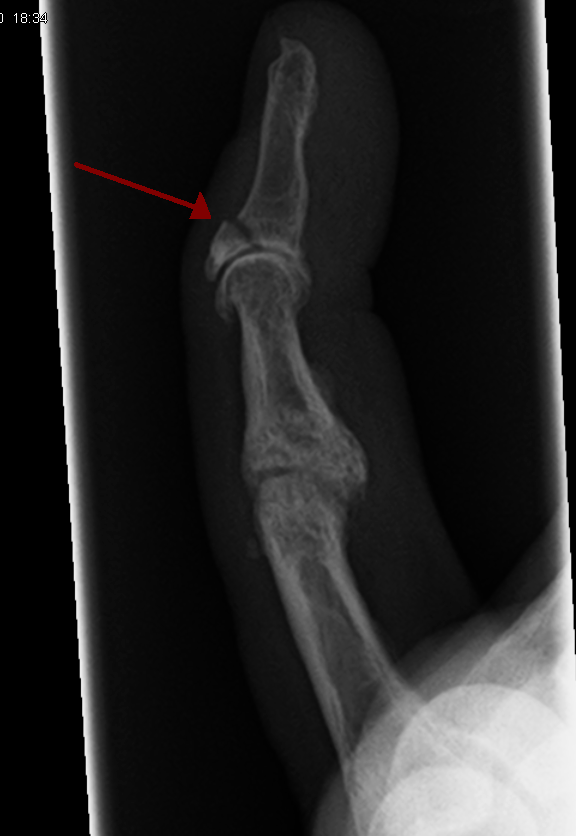
Fractures in the joints are often caused by jammed finger injuries, the hand equivalent of a stubbed toe. If a tendon pulls away the bit of bone to which it is attached (an avulsion fracture, shown in the image at the top of the page, and in the Busch fracture images below), that will also lead to a fracture in a joint.
Putting out a hand to break a fall and landing badly can fracture a finger. Crushing injuries may occur when a finger gets shut in a door (most common among children under eight), or in an accident with machinery or a heavy object. A jammed finger (a trauma from a blow on the end of the finger) is often caused by trying to catch a ball and may break the finger. Misusing tools, especially power tools, can also break fingers.
Occasionally, an infection or tumour can cause a broken finger; this is called a pathological fracture.
Hub AI
Broken finger AI simulator
(@Broken finger_simulator)
Broken finger
A broken finger or finger fracture is a common type of bone fracture, affecting a finger. Symptoms may include pain, swelling, tenderness, bruising, deformity and reduced ability to move the finger. Although most finger fractures are easy to treat, failing to deal with a fracture appropriately may result in long-term pain and disability.
The cause is usually traumatic injury. These are most commonly falls, crushing injuries, and sports injuries. Pathological fractures, from an infection or a tumour, are rarer.
Finger fractures are identified by the bone on which they occur. Fingers are numbered 1 to 5, with 1 being the thumb. The distal (tip) finger bones are divided into tuft (the very tip of the bone, at the end of each finger), shaft (the thinner middle section), and base. The rest of the finger bones (the middle finger bones, and the proximal or innermost finger bones) are divided into base, shaft, and condyle (outer end). Extensive tendons surround the joints and move the fingers. On the front and back of each finger is a digital nerve and artery; these can also be injured when the finger is broken.
The AO Foundation/Orthopaedic Trauma Association (AO/OTA) classification generates language-neutral numeric codes for describing broken fingers. They run 78[meaning a fracture of the phalanges of the hand].[number-code of the finger, with thumb=1 and the little finger=5].[number-code of phalanx, counting 1 to 3 outwards from the hand].[number-code of location on the bone, with 1 being the inner end, 3 the outer, and 2 in-between]. So, for instance, 78.1.1.1 means a fracture to the thumb's innermost bone, at the inner end (the base of the thumb). A letter can be added to describe the fracture pattern.
If the blow that breaks the bone bends it sideways, it will usually cause a transverse fracture, a break across the finger. A force at an angle is likely to produce an oblique fracture, and a twisting force is more likely to cause a spiral fracture. Crushing injuries may or may not shatter the bone into multiple pieces, which is called a comminuted fracture.
Fractures in the joints are often caused by jammed finger injuries, the hand equivalent of a stubbed toe. If a tendon pulls away the bit of bone to which it is attached (an avulsion fracture, shown in the image at the top of the page, and in the Busch fracture images below), that will also lead to a fracture in a joint.
Putting out a hand to break a fall and landing badly can fracture a finger. Crushing injuries may occur when a finger gets shut in a door (most common among children under eight), or in an accident with machinery or a heavy object. A jammed finger (a trauma from a blow on the end of the finger) is often caused by trying to catch a ball and may break the finger. Misusing tools, especially power tools, can also break fingers.
Occasionally, an infection or tumour can cause a broken finger; this is called a pathological fracture.