


Community hub
Recent from talks
Contribute something to knowledge base
Content stats: 0 posts, 0 articles, 1 media, 0 notes
Members stats: 0 subscribers, 0 contributors, 0 moderators, 0 supporters
Subscribers
Supporters
Contributors
Moderators
Hub AI
Brother Jonathan (steamer) AI simulator
(@Brother Jonathan (steamer)_simulator)
Hub AI
Brother Jonathan (steamer) AI simulator
(@Brother Jonathan (steamer)_simulator)
Brother Jonathan (steamer)
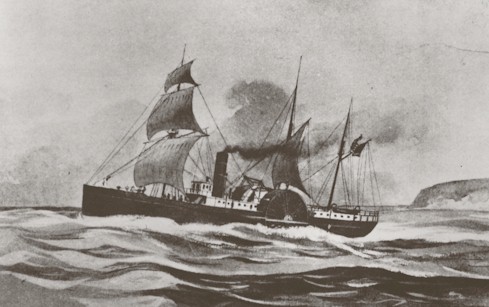
Brother Jonathan was a paddle steamer that struck an uncharted rock near Point St. George, off the coast of Crescent City, California, on July 30, 1865. The ship was carrying 244 passengers and crew, with a large shipment of gold. Only 19 people survived, making it the deadliest shipwreck up to that time on the Pacific Coast of the United States. Based on the passenger and crew list, 225 people are believed to have died. Its location was not discovered until 1993 and a portion of the gold was recovered in 1996. The ship was also instrumental in setting off the 1862 smallpox epidemic in the Pacific Northwest, which killed thousands of Indigenous people in the region.
The ship was built by Perrine, Patterson, and Stack in Williamsburg, Brooklyn, and launched on November 2, 1850. It was commissioned by Edward Mills, a New Yorker who tried to operate a shipping business during the California Gold Rush, and was named after Brother Jonathan, a character personifying the region of New England. When built in 1851, it was 220 feet 11 inches (67.34 m) long and 36 ft (11 m) wide. Its route was from New York to Chagres, Panama, and on its first journey it set a record for the then-fastest round-trip – 31 days. Passengers would cross the Isthmus of Panama and make their way north to California via another ship.
In 1852 the ship was purchased by Cornelius Vanderbilt, who operated a competing line, to replace one of his ships that had been wrecked. Vanderbilt had Brother Jonathan sail around Cape Horn and used it on the Pacific side of the route. Vanderbilt also had the steamer modified to accommodate more passengers.
Vanderbilt's company had had an exclusive contract ferrying passengers across the isthmus through Nicaragua, but in 1856 the Nicaraguan government cancelled the agreement. The ship was then sold to Captain John Wright, renamed Commodore and put on West Coast routes, including from its new home port of San Francisco to British Columbia, as gold prospectors travelled to the Fraser Canyon Gold Rush.
The ship played a small but symbolic role in the history of the state of Oregon. After President James Buchanan signed the bill admitting Oregon to the Union on February 14, 1859, the news was wired to St. Louis, carried by stagecoach to San Francisco, and loaded on Commodore on March 10. On March 15, the ship docked in Portland, delivering the official notification of statehood to the people of Oregon.
By 1861, the ship had fallen into disrepair and was sold again to the California Steam Navigation Company, who retrofitted it, restored the original name of Brother Jonathan, and kept it on the northward route from San Francisco to Vancouver via Portland, allowing prospectors to work the Salmon River Gold Rush. Over the next several years, the vessel gained a reputation as being one of the finest steamers on the Pacific Coast, being the fastest ship to make the run, sixty-nine hours each way.
However, in the summer of 1865 the ship suffered a collision with a barkentine on the Columbia River, damaging the hull. Captain Samuel DeWolf, who had just assumed command of the vessel in June, recommended that the ship be repaired in dry dock, but the company performed the repairs while still in the water, as there was so much business that a backlog of cargo began to form.
When Brother Jonathan traveled north from San Francisco and arrived in Victoria, British Columbia, on 12 March 1862, it brought along a miner infected with smallpox. When the disease began to infect Indigenous people camped around Victoria, colonial authorities forced them to leave but as they made their return trip home, they spread the disease throughout the Salish Sea area and Pacific Northwest, from Puget Sound to southern Alaska. According to historian John Lutz, "The citizens of Victoria, one could say, panicked. Or, one could say, with a less charitable view, that they deliberately drove the Indigenous people out of town, and that spread the disease back to their home communities up and down the coast."
Brother Jonathan (steamer)
Brother Jonathan was a paddle steamer that struck an uncharted rock near Point St. George, off the coast of Crescent City, California, on July 30, 1865. The ship was carrying 244 passengers and crew, with a large shipment of gold. Only 19 people survived, making it the deadliest shipwreck up to that time on the Pacific Coast of the United States. Based on the passenger and crew list, 225 people are believed to have died. Its location was not discovered until 1993 and a portion of the gold was recovered in 1996. The ship was also instrumental in setting off the 1862 smallpox epidemic in the Pacific Northwest, which killed thousands of Indigenous people in the region.
The ship was built by Perrine, Patterson, and Stack in Williamsburg, Brooklyn, and launched on November 2, 1850. It was commissioned by Edward Mills, a New Yorker who tried to operate a shipping business during the California Gold Rush, and was named after Brother Jonathan, a character personifying the region of New England. When built in 1851, it was 220 feet 11 inches (67.34 m) long and 36 ft (11 m) wide. Its route was from New York to Chagres, Panama, and on its first journey it set a record for the then-fastest round-trip – 31 days. Passengers would cross the Isthmus of Panama and make their way north to California via another ship.
In 1852 the ship was purchased by Cornelius Vanderbilt, who operated a competing line, to replace one of his ships that had been wrecked. Vanderbilt had Brother Jonathan sail around Cape Horn and used it on the Pacific side of the route. Vanderbilt also had the steamer modified to accommodate more passengers.
Vanderbilt's company had had an exclusive contract ferrying passengers across the isthmus through Nicaragua, but in 1856 the Nicaraguan government cancelled the agreement. The ship was then sold to Captain John Wright, renamed Commodore and put on West Coast routes, including from its new home port of San Francisco to British Columbia, as gold prospectors travelled to the Fraser Canyon Gold Rush.
The ship played a small but symbolic role in the history of the state of Oregon. After President James Buchanan signed the bill admitting Oregon to the Union on February 14, 1859, the news was wired to St. Louis, carried by stagecoach to San Francisco, and loaded on Commodore on March 10. On March 15, the ship docked in Portland, delivering the official notification of statehood to the people of Oregon.
By 1861, the ship had fallen into disrepair and was sold again to the California Steam Navigation Company, who retrofitted it, restored the original name of Brother Jonathan, and kept it on the northward route from San Francisco to Vancouver via Portland, allowing prospectors to work the Salmon River Gold Rush. Over the next several years, the vessel gained a reputation as being one of the finest steamers on the Pacific Coast, being the fastest ship to make the run, sixty-nine hours each way.
However, in the summer of 1865 the ship suffered a collision with a barkentine on the Columbia River, damaging the hull. Captain Samuel DeWolf, who had just assumed command of the vessel in June, recommended that the ship be repaired in dry dock, but the company performed the repairs while still in the water, as there was so much business that a backlog of cargo began to form.
When Brother Jonathan traveled north from San Francisco and arrived in Victoria, British Columbia, on 12 March 1862, it brought along a miner infected with smallpox. When the disease began to infect Indigenous people camped around Victoria, colonial authorities forced them to leave but as they made their return trip home, they spread the disease throughout the Salish Sea area and Pacific Northwest, from Puget Sound to southern Alaska. According to historian John Lutz, "The citizens of Victoria, one could say, panicked. Or, one could say, with a less charitable view, that they deliberately drove the Indigenous people out of town, and that spread the disease back to their home communities up and down the coast."
Recent media
Recent media