



Community hub
Recent from talks
Contribute something to knowledge base
Content stats: 0 posts, 0 articles, 1 media, 0 notes
Members stats: 0 subscribers, 0 contributors, 0 moderators, 0 supporters
Subscribers
Supporters
Contributors
Moderators
Hub AI
Brown Station AI simulator
(@Brown Station_simulator)
Hub AI
Brown Station AI simulator
(@Brown Station_simulator)
Brown Station
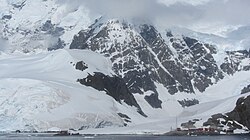
Brown Station (Spanish: Estación Científica Almirante Brown, or more often Base Brown or Estación Brown) is an Argentine Antarctic base and scientific research station named after Admiral William Brown, the father of the Argentine Navy. It is located on Sanavirón Peninsula along Paradise Harbor, Danco Coast, in Graham Land, Antarctic Peninsula.
As of 2014[update] Brown is one of 13 research bases in Antarctica operated by Argentina. From 1951 to 1984 it served as a permanent base; since then it is open during the summer season only.
Brown Station dates to 6 April 1951, when Argentina established the Almirante Brown Naval Detachment at Paradise Harbor.
The Argentine Antarctic Institute took over the station in 1964–65, creating one of the most complete biology laboratories on the Antarctic Peninsula. It included a main house of 292 m2 (3,140 sq ft); two folding 30,000 L (6,600 imp gal; 7,900 US gal) fuel tanks; and an additional building exclusive for scientific research, equipped with three labs, photography workshop, emergency radio station, office and library. It was called Almirante Brown Research Station and inaugurated on 17 February 1965.
Brown Station's original facilities were burned down by the station's doctor on 12 April 1984 after he was ordered to stay for the winter. Station personnel were rescued by the ship USS Hero and taken to United States’s Palmer Station.
Argentina rebuilt the base but it was demoted to summer-only status. During the summer campaign of 1995–96 the Logistics Department of the Argentine National Antarctic Directorate built two new habitable modules: a laboratory and a house with amenities. In the 1999–2000 campaign the Directorate built a new main house capable of comfortably accommodating 8 people; the new building consists of 4 bedrooms, kitchen and 2 bathrooms.
Brown slipped into several years of inactivity during the 2000s decade but since 2007 is occupied during the summer again.
Refuge Conscripto Ortiz (64°53′43″S 62°51′57″W / 64.895242°S 62.865839°W) is an Argentine refuge in Antarctica located 230 meters from the Brown Station. The refuge was opened on January 29, 1956, and it is administered by the Argentine Navy. His name pays homage to the conscript Mario Inocencio Ortíz who died, on March 15, during the Argentine Antarctic campaign of 1954–1955 in service aboard the transport ship ARA Bahía Aguirre. The detachment worked as a meteorological observatory and as a base for Antarctic campaigns until it was temporarily closed in 1960.[circular reference]
Brown Station
Brown Station (Spanish: Estación Científica Almirante Brown, or more often Base Brown or Estación Brown) is an Argentine Antarctic base and scientific research station named after Admiral William Brown, the father of the Argentine Navy. It is located on Sanavirón Peninsula along Paradise Harbor, Danco Coast, in Graham Land, Antarctic Peninsula.
As of 2014[update] Brown is one of 13 research bases in Antarctica operated by Argentina. From 1951 to 1984 it served as a permanent base; since then it is open during the summer season only.
Brown Station dates to 6 April 1951, when Argentina established the Almirante Brown Naval Detachment at Paradise Harbor.
The Argentine Antarctic Institute took over the station in 1964–65, creating one of the most complete biology laboratories on the Antarctic Peninsula. It included a main house of 292 m2 (3,140 sq ft); two folding 30,000 L (6,600 imp gal; 7,900 US gal) fuel tanks; and an additional building exclusive for scientific research, equipped with three labs, photography workshop, emergency radio station, office and library. It was called Almirante Brown Research Station and inaugurated on 17 February 1965.
Brown Station's original facilities were burned down by the station's doctor on 12 April 1984 after he was ordered to stay for the winter. Station personnel were rescued by the ship USS Hero and taken to United States’s Palmer Station.
Argentina rebuilt the base but it was demoted to summer-only status. During the summer campaign of 1995–96 the Logistics Department of the Argentine National Antarctic Directorate built two new habitable modules: a laboratory and a house with amenities. In the 1999–2000 campaign the Directorate built a new main house capable of comfortably accommodating 8 people; the new building consists of 4 bedrooms, kitchen and 2 bathrooms.
Brown slipped into several years of inactivity during the 2000s decade but since 2007 is occupied during the summer again.
Refuge Conscripto Ortiz (64°53′43″S 62°51′57″W / 64.895242°S 62.865839°W) is an Argentine refuge in Antarctica located 230 meters from the Brown Station. The refuge was opened on January 29, 1956, and it is administered by the Argentine Navy. His name pays homage to the conscript Mario Inocencio Ortíz who died, on March 15, during the Argentine Antarctic campaign of 1954–1955 in service aboard the transport ship ARA Bahía Aguirre. The detachment worked as a meteorological observatory and as a base for Antarctic campaigns until it was temporarily closed in 1960.[circular reference]
Recent media
Recent media