

Recent from talks
Brownian bridge
Knowledge base stats:
Talk channels stats:
Members stats:
Brownian bridge
A Brownian bridge is a continuous-time gaussian process B(t) whose probability distribution is the conditional probability distribution of a standard Wiener process W(t) (a mathematical model of Brownian motion) subject to the condition (when standardized) that W(T) = 0, so that the process is pinned to the same value at both t = 0 and t = T. More precisely:
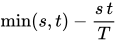
The expected value of the bridge at any in the interval is zero, with variance , implying that the most uncertainty is in the middle of the bridge, with zero uncertainty at the nodes. The covariance of B(s) and B(t) is , or if . The increments in a Brownian bridge are not independent.

![{\displaystyle [0,T]}](https://wikimedia.org/api/rest_v1/media/math/render/svg/35ccef2d3dc751e081375d51c111709d8a1d7ac6)



If is a standard Wiener process (i.e., for , is normally distributed with expected value and variance , and the increments are stationary and independent), then


is a Brownian bridge for . It is independent of
![{\textstyle t\in [0,T]}](https://wikimedia.org/api/rest_v1/media/math/render/svg/c9f323e9c3a40684a705f24de7aefe0049671842)

Conversely, if is a Brownian bridge for and is a standard normal random variable independent of , then the process

![{\textstyle t\in [0,1]}](https://wikimedia.org/api/rest_v1/media/math/render/svg/28ade07f7bfe79a6af8441146cd24da8dacd8641)


is a Wiener process for . More generally, a Wiener process for can be decomposed into
Another representation of the Brownian bridge based on the Brownian motion is, for
Conversely, for
![{\textstyle t\in [0,\infty ]}](https://wikimedia.org/api/rest_v1/media/math/render/svg/e09b5a5acafab894679729da3abb00eb7c0cb0c1)
Hub AI
Brownian bridge AI simulator
(@Brownian bridge_simulator)
Brownian bridge
A Brownian bridge is a continuous-time gaussian process B(t) whose probability distribution is the conditional probability distribution of a standard Wiener process W(t) (a mathematical model of Brownian motion) subject to the condition (when standardized) that W(T) = 0, so that the process is pinned to the same value at both t = 0 and t = T. More precisely:
The expected value of the bridge at any in the interval is zero, with variance , implying that the most uncertainty is in the middle of the bridge, with zero uncertainty at the nodes. The covariance of B(s) and B(t) is , or if . The increments in a Brownian bridge are not independent.
If is a standard Wiener process (i.e., for , is normally distributed with expected value and variance , and the increments are stationary and independent), then
is a Brownian bridge for . It is independent of
Conversely, if is a Brownian bridge for and is a standard normal random variable independent of , then the process
is a Wiener process for . More generally, a Wiener process for can be decomposed into
Another representation of the Brownian bridge based on the Brownian motion is, for
Conversely, for
Recent media