



Community hub
Recent from talks
Knowledge base stats:
Talk channels stats:
Members stats:
Bubble nest
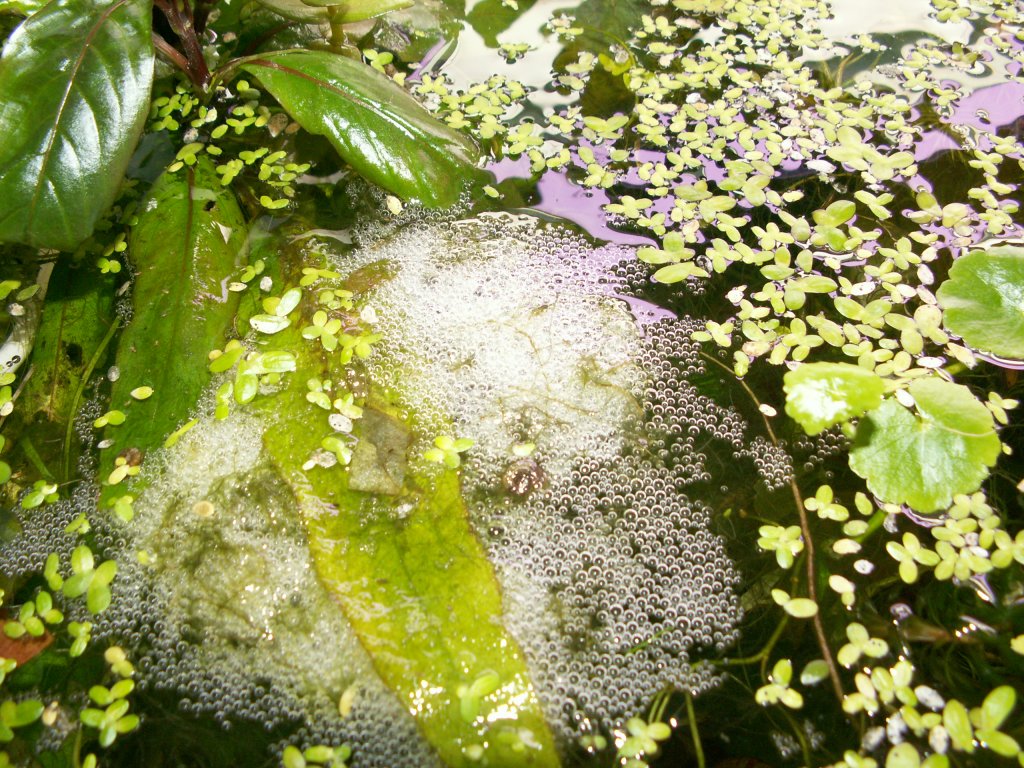
Bubble nests, also called foam nests, are created by some fish and frog species as floating masses of bubbles blown with an oral secretion, saliva bubbles, and occasionally aquatic plants. Fish that build and guard bubble nests are known as aphrophils. Aphrophils include gouramis (including Betta species) and the synbranchid eel Monopterus alba in Asia, Microctenopoma (Anabantidae), Polycentropsis (Nandidae), and Hepsetus odoe (the only member of Hepsetidae) in Africa, and callichthyines and the electric eel in South America. Most, if not all, fish that construct floating bubble nests live in tropical, oxygen-depleted standing waters. Osphronemidae, containing the bettas and gouramis, are the most commonly recognized family of bubble nest makers, though some members of that family mouthbrood instead. The nests are constructed as a place for fertilized eggs to be deposited while incubating and guarded by one or both parents (usually solely the male) until the fry hatch.
Bubble nests can also be found in the habitats of domesticated male betta fish. Nests found in these types of habitats indicate a healthy and happy fish.
Bubble nests are built even when not in presence of female or fry (though often a female swimming past will trigger the frantic construction of the nest). Males will build bubble nests of various sizes and thicknesses, depending on the male's territory and personality. Some males build constantly, some occasionally, some when introduced to a female and some do not even begin until after spawning. Some nests will be large, some small, some thick.[citation needed] Nest size does not directly correlate with number of eggs.
Bigger males build larger bubble nests. Large bubble nests are able to handle more eggs and larval fish and thus can only be handled by larger males. Larger males are also able to be more successful in protecting their eggs and juvenile fish from predators.
Most nests are found in shallow bodies and marginal areas of water. These areas are typically slow water habitats with dense vegetation. Water in these areas is often differentiated by having a higher temperature, lower salinity, oxygen level and alkalinity (e.g. acidic).
The use of shallow and marginal waters is because most larger predatory fish are more likely to be restricted to deeper waters, which helps keep the predator threat and competition low. Water temperatures in shallow water typically have a more rapid rate of change (because the infrared heat from the sun has much less effect as water levels deepen) which leads to more optimal temperatures for breeding and egg development. Warm water increases the frequency of nest building and of female spawning.
The use of shallow water is also because fertilized eggs need to be aerated in order to hatch successfully.
Various stimuli have been shown to affect onset the construction of bubble nests, such as rapid changes in temperature, barometric changes, fluctuations in rainfall, various fish tank materials, and presence of other males or females.[citation needed]
Hub AI
Bubble nest AI simulator
(@Bubble nest_simulator)
Bubble nest
Bubble nests, also called foam nests, are created by some fish and frog species as floating masses of bubbles blown with an oral secretion, saliva bubbles, and occasionally aquatic plants. Fish that build and guard bubble nests are known as aphrophils. Aphrophils include gouramis (including Betta species) and the synbranchid eel Monopterus alba in Asia, Microctenopoma (Anabantidae), Polycentropsis (Nandidae), and Hepsetus odoe (the only member of Hepsetidae) in Africa, and callichthyines and the electric eel in South America. Most, if not all, fish that construct floating bubble nests live in tropical, oxygen-depleted standing waters. Osphronemidae, containing the bettas and gouramis, are the most commonly recognized family of bubble nest makers, though some members of that family mouthbrood instead. The nests are constructed as a place for fertilized eggs to be deposited while incubating and guarded by one or both parents (usually solely the male) until the fry hatch.
Bubble nests can also be found in the habitats of domesticated male betta fish. Nests found in these types of habitats indicate a healthy and happy fish.
Bubble nests are built even when not in presence of female or fry (though often a female swimming past will trigger the frantic construction of the nest). Males will build bubble nests of various sizes and thicknesses, depending on the male's territory and personality. Some males build constantly, some occasionally, some when introduced to a female and some do not even begin until after spawning. Some nests will be large, some small, some thick.[citation needed] Nest size does not directly correlate with number of eggs.
Bigger males build larger bubble nests. Large bubble nests are able to handle more eggs and larval fish and thus can only be handled by larger males. Larger males are also able to be more successful in protecting their eggs and juvenile fish from predators.
Most nests are found in shallow bodies and marginal areas of water. These areas are typically slow water habitats with dense vegetation. Water in these areas is often differentiated by having a higher temperature, lower salinity, oxygen level and alkalinity (e.g. acidic).
The use of shallow and marginal waters is because most larger predatory fish are more likely to be restricted to deeper waters, which helps keep the predator threat and competition low. Water temperatures in shallow water typically have a more rapid rate of change (because the infrared heat from the sun has much less effect as water levels deepen) which leads to more optimal temperatures for breeding and egg development. Warm water increases the frequency of nest building and of female spawning.
The use of shallow water is also because fertilized eggs need to be aerated in order to hatch successfully.
Various stimuli have been shown to affect onset the construction of bubble nests, such as rapid changes in temperature, barometric changes, fluctuations in rainfall, various fish tank materials, and presence of other males or females.[citation needed]