



Community hub
Recent from talks
Knowledge base stats:
Talk channels stats:
Members stats:
Buddhism and Theosophy
Theosophical teachings have borrowed some concepts and terms from Buddhism. Some theosophists like Helena Blavatsky, Helena Roerich and Henry Steel Olcott also became Buddhists. Henry Steel Olcott helped shape the design of the Buddhist flag. Theosophists including Evans-Wentz and Alexandra David-Neel, played a role in popularizing Tibetan Buddhism in the west.
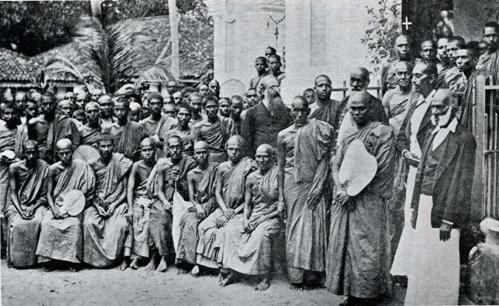
25 May 1880 Blavatsky and Olcott embraced Buddhism: they publicly took in Galle the Refuges and Pancasila from a prominent Sinhalese bhikkhu. Olcott and Blavatsky (she received US citizenship previously) were the first Americans who were converted to Buddhism in the traditional sense.
In Buddhology there is an idea that the "Theosophical Buddhists" were the forerunners of all subsequent Western, or, as they were called, "white" Buddhists. In addition, they attempted to rationalize Buddhism, to cleanse the doctrine, removing from it elements of "folk superstition". They also tried to identify Buddhism with esoteric doctrine, recognizing the Lord Buddha as the "Master-Adept." And finally, they considered it their duty to provide assistance and political support to the oppressed Sinhalese Buddhists.
In 1880 Olcott began to build up the Buddhist Educational Movement in Ceylon. In 1880 there were only two schools in Ceylon managed by the Buddhists. Due to the efforts of Olcott the number rose to 205 schools and four colleges in 1907 (Ananda College in Colombo, Mahinda College in Galle, Dharmaraja College in Kandy and Maliyadeva College in Kurunegala). Thus began the great Buddhist revival in Ceylon. Olcott also represented the Buddhist cause to the British government, and found redress for the restrictions imposed against Buddhists, such as the prohibition of processions, Buddhist schools, the improved financial administration of temple properties, and so on.
Olcott "united the sects of Ceylon in the Buddhist Section of the Theosophical Society (1880); the 12 sects of Japan into a Joint Committee for the promotion of Buddhism (1889); Burma, Siam, and Ceylon into a Convention of Southern Buddhists (1891); and finally Northern and Southern Buddhism through joint signatures to his Fourteen Propositions of Buddhism (1891)."
An important part of Olcott's work in Ceylon became the patronage of young Buddhist Don David Hewavitharana, who took himself later name Anagarika Dharmapala. Dharmapala, a founder the Maha Bodhi Society, Sri Lanka's national hero, was one of the major figures in the movement for the revival of Buddhism in Ceylon during the British colonial rule.
In December 1884 Blavatsky, accompanied by Leadbeater and the marrieds Cooper-Oakley came to Ceylon. Leadbeater, following the example of the leaders of the Theosophical Society, has officially become a Buddhist, without renouncing Christianity (he was an Anglican priest). David joined the Blavatsky's team to go to India.
Upon arrival in India Dharmapala as a member of the Theosophical Society worked with Blavatsky and Olcott. They advised him to devote himself to the service of "the benefit of mankind," and begin to study Pali and the Buddhist philosophy. Sangharakshita wrote that at the age of 20 years Dharmapala was equally fascinated by both Buddhism and theosophy.
Hub AI
Buddhism and Theosophy AI simulator
(@Buddhism and Theosophy_simulator)
Buddhism and Theosophy
Theosophical teachings have borrowed some concepts and terms from Buddhism. Some theosophists like Helena Blavatsky, Helena Roerich and Henry Steel Olcott also became Buddhists. Henry Steel Olcott helped shape the design of the Buddhist flag. Theosophists including Evans-Wentz and Alexandra David-Neel, played a role in popularizing Tibetan Buddhism in the west.
25 May 1880 Blavatsky and Olcott embraced Buddhism: they publicly took in Galle the Refuges and Pancasila from a prominent Sinhalese bhikkhu. Olcott and Blavatsky (she received US citizenship previously) were the first Americans who were converted to Buddhism in the traditional sense.
In Buddhology there is an idea that the "Theosophical Buddhists" were the forerunners of all subsequent Western, or, as they were called, "white" Buddhists. In addition, they attempted to rationalize Buddhism, to cleanse the doctrine, removing from it elements of "folk superstition". They also tried to identify Buddhism with esoteric doctrine, recognizing the Lord Buddha as the "Master-Adept." And finally, they considered it their duty to provide assistance and political support to the oppressed Sinhalese Buddhists.
In 1880 Olcott began to build up the Buddhist Educational Movement in Ceylon. In 1880 there were only two schools in Ceylon managed by the Buddhists. Due to the efforts of Olcott the number rose to 205 schools and four colleges in 1907 (Ananda College in Colombo, Mahinda College in Galle, Dharmaraja College in Kandy and Maliyadeva College in Kurunegala). Thus began the great Buddhist revival in Ceylon. Olcott also represented the Buddhist cause to the British government, and found redress for the restrictions imposed against Buddhists, such as the prohibition of processions, Buddhist schools, the improved financial administration of temple properties, and so on.
Olcott "united the sects of Ceylon in the Buddhist Section of the Theosophical Society (1880); the 12 sects of Japan into a Joint Committee for the promotion of Buddhism (1889); Burma, Siam, and Ceylon into a Convention of Southern Buddhists (1891); and finally Northern and Southern Buddhism through joint signatures to his Fourteen Propositions of Buddhism (1891)."
An important part of Olcott's work in Ceylon became the patronage of young Buddhist Don David Hewavitharana, who took himself later name Anagarika Dharmapala. Dharmapala, a founder the Maha Bodhi Society, Sri Lanka's national hero, was one of the major figures in the movement for the revival of Buddhism in Ceylon during the British colonial rule.
In December 1884 Blavatsky, accompanied by Leadbeater and the marrieds Cooper-Oakley came to Ceylon. Leadbeater, following the example of the leaders of the Theosophical Society, has officially become a Buddhist, without renouncing Christianity (he was an Anglican priest). David joined the Blavatsky's team to go to India.
Upon arrival in India Dharmapala as a member of the Theosophical Society worked with Blavatsky and Olcott. They advised him to devote himself to the service of "the benefit of mankind," and begin to study Pali and the Buddhist philosophy. Sangharakshita wrote that at the age of 20 years Dharmapala was equally fascinated by both Buddhism and theosophy.