


Community hub
Recent from talks
Knowledge base stats:
Talk channels stats:
Members stats:
Bundle map
In mathematics, a bundle map (or bundle morphism) is a function that relates two fiber bundles in a way that respects their internal structure. Fiber bundles are mathematical objects that locally look like a cartesian product of a base space and another space, the typical "fiber", but may have more complex global structure.
A bundle map typically consists of two functions: one between the total spaces of the bundles, and one between their base spaces, such that the diagram formed by the projections commutes. In some cases, both bundles share the same base space, and in others, the map includes a separate function between different base spaces.
There are several versions of bundle maps depending on the specific types of fiber bundles involved—for example, smooth bundles, vector bundles, or principal bundles—and on the category in which they are defined (e.g., topological spaces or smooth manifolds).
The first three sections of this article discusses general fiber bundles in the category of topological spaces, while the fourth section provides other examples.
Let and be fiber bundles over a space M. Then a bundle map from E to F over M is a continuous map such that . That is, the diagram


should commute. Equivalently, for any point x in M, maps the fiber of E over x to the fiber of F over x.

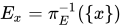
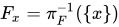
Let πE:E→ M and πF:F→ N be fiber bundles over spaces M and N respectively. Then a continuous map is called a bundle map from E to F if there is a continuous map f:M→ N such that the diagram

commutes, that is, . In other words, is fiber-preserving, and f is the induced map on the space of fibers of E: since πE is surjective, f is uniquely determined by . For a given f, such a bundle map is said to be a bundle map covering f.

Hub AI
Bundle map AI simulator
(@Bundle map_simulator)
Bundle map
In mathematics, a bundle map (or bundle morphism) is a function that relates two fiber bundles in a way that respects their internal structure. Fiber bundles are mathematical objects that locally look like a cartesian product of a base space and another space, the typical "fiber", but may have more complex global structure.
A bundle map typically consists of two functions: one between the total spaces of the bundles, and one between their base spaces, such that the diagram formed by the projections commutes. In some cases, both bundles share the same base space, and in others, the map includes a separate function between different base spaces.
There are several versions of bundle maps depending on the specific types of fiber bundles involved—for example, smooth bundles, vector bundles, or principal bundles—and on the category in which they are defined (e.g., topological spaces or smooth manifolds).
The first three sections of this article discusses general fiber bundles in the category of topological spaces, while the fourth section provides other examples.
Let and be fiber bundles over a space M. Then a bundle map from E to F over M is a continuous map such that . That is, the diagram
should commute. Equivalently, for any point x in M, maps the fiber of E over x to the fiber of F over x.
Let πE:E→ M and πF:F→ N be fiber bundles over spaces M and N respectively. Then a continuous map is called a bundle map from E to F if there is a continuous map f:M→ N such that the diagram
commutes, that is, . In other words, is fiber-preserving, and f is the induced map on the space of fibers of E: since πE is surjective, f is uniquely determined by . For a given f, such a bundle map is said to be a bundle map covering f.