Hubbry Logo
Cartesian productCartesian productMain
Open search
Cartesian product
Community hub
Cartesian product
logo
8 pages, 0 posts
0 subscribers
Be the first to start a discussion here.
Cartesian product
Cartesian product
from Wikipedia

Cartesian product of the sets {x,y,z} and {1,2,3}

In mathematics, specifically set theory, the Cartesian product of two sets A and B, denoted A × B, is the set of all ordered pairs (a, b) where a is an element of A and b is an element of B.[1] In terms of set-builder notation, that is [2][3]

A table can be created by taking the Cartesian product of a set of rows and a set of columns. If the Cartesian product rows × columns is taken, the cells of the table contain ordered pairs of the form (row value, column value).[4]

One can similarly define the Cartesian product of n sets, also known as an n-fold Cartesian product, which can be represented by an n-dimensional array, where each element is an n-tuple. An ordered pair is a 2-tuple or couple. More generally still, one can define the Cartesian product of an indexed family of sets.

The Cartesian product is named after René Descartes,[5] whose formulation of analytic geometry gave rise to the concept, which is further generalized in terms of direct product.

Set-theoretic definition

[edit]

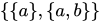
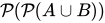
A rigorous definition of the Cartesian product requires a domain to be specified in the set-builder notation. In this case the domain would have to contain the Cartesian product itself. For defining the Cartesian product of the sets and , with the typical Kuratowski's definition of a pair as , an appropriate domain is the set where denotes the power set. Then the Cartesian product of the sets and would be defined as[6]

Examples

[edit]

A deck of cards

[edit]
Standard 52-card deck

An illustrative example is the standard 52-card deck. The standard playing card ranks {A, K, Q, J, 10, 9, 8, 7, 6, 5, 4, 3, 2} form a 13-element set. The card suits {♠, , , ♣} form a four-element set. The Cartesian product of these sets returns a 52-element set consisting of 52 ordered pairs, which correspond to all 52 possible playing cards.

Ranks × Suits returns a set of the form {(A, ♠), (A, ), (A, ), (A, ♣), (K, ♠), ..., (3, ♣), (2, ♠), (2, ), (2, ), (2, ♣)}.

Suits × Ranks returns a set of the form {(♠, A), (♠, K), (♠, Q), (♠, J), (♠, 10), ..., (♣, 6), (♣, 5), (♣, 4), (♣, 3), (♣, 2)}.

These two sets are distinct, even disjoint, but there is a natural bijection between them, under which (3, ♣) corresponds to (♣, 3) and so on.

A two-dimensional coordinate system

[edit]
Cartesian coordinates of example points

The main historical example is the Cartesian plane in analytic geometry. In order to represent geometrical shapes in a numerical way, and extract numerical information from shapes' numerical representations, René Descartes assigned to each point in the plane a pair of real numbers, called its coordinates. Usually, such a pair's first and second components are called its x and y coordinates, respectively (see picture). The set of all such pairs (i.e., the Cartesian product , with denoting the real numbers) is thus assigned to the set of all points in the plane.[7]

Most common implementation (set theory)

[edit]

A formal definition of the Cartesian product from set-theoretical principles follows from a definition of ordered pair. The most common definition of ordered pairs, Kuratowski's definition, is . Under this definition, is an element of , and is a subset of that set, where represents the power set operator. Therefore, the existence of the Cartesian product of any two sets in ZFC follows from the axioms of pairing, union, power set, and specification. Since functions are usually defined as a special case of relations, and relations are usually defined as subsets of the Cartesian product, the definition of the two-set Cartesian product is necessarily prior to most other definitions.

Non-commutativity and non-associativity

[edit]

Let A, B, and C be sets.

The Cartesian product A × B is not commutative, [4] because the ordered pairs are reversed unless at least one of the following conditions is satisfied:[8]

For example:

A = {1,2}; B = {3,4}
A × B = {1,2} × {3,4} = {(1,3), (1,4), (2,3), (2,4)}
B × A = {3,4} × {1,2} = {(3,1), (3,2), (4,1), (4,2)}
A = B = {1,2}
A × B = B × A = {1,2} × {1,2} = {(1,1), (1,2), (2,1), (2,2)}
A = {1,2}; B = ∅
A × B = {1,2} × ∅ = ∅
B × A = ∅ × {1,2} = ∅

Strictly speaking, the Cartesian product is not associative (unless one of the involved sets is empty). If for example A = {1}, then (A × A) × A = {((1, 1), 1)} ≠ {(1, (1, 1))} = A × (A × A).

Intersections, unions, and subsets

[edit]
Example sets

A = [1,4], B = [2,5], and
C = [4,7], demonstrating
A × (BC) = (A×B) ∩ (A×C),
A × (BC) = (A×B) ∪ (A×C), and

A × (B \ C) = (A×B) \ (A×C)
Example sets

A = [2,5], B = [3,7], C = [1,3],
D = [2,4], demonstrating

(AB) × (CD) = (A×C) ∩ (B×D).
(AB) × (CD) ≠ (A×C) ∪ (B×D) can be seen from the same example.

The Cartesian product satisfies the following property with respect to intersections (see middle picture).

In most cases, the above statement is not true if we replace intersection with union (see rightmost picture).

In fact, we have that:

For the set difference, we also have the following identity:

Here are some rules demonstrating distributivity with other operators (see leftmost picture):[8] where denotes the absolute complement of A.

Other properties related with subsets are:

[9]

Cardinality

[edit]

The cardinality of a set is the number of elements of the set. For example, defining two sets: A = {a, b} and B = {5, 6}. Both set A and set B consist of two elements each. Their Cartesian product, written as A × B, results in a new set which has the following elements:

A × B = {(a,5), (a,6), (b,5), (b,6)}.

where each element of A is paired with each element of B, and where each pair makes up one element of the output set. The number of values in each element of the resulting set is equal to the number of sets whose Cartesian product is being taken; 2 in this case. The cardinality of the output set is equal to the product of the cardinalities of all the input sets. That is,

|A × B| = |A| · |B|.[4]

In this case, |A × B| = 4

Similarly,

|A × B × C| = |A| · |B| · |C|

and so on.

The set A × B is infinite if either A or B is infinite, and the other set is not the empty set.[10]

Cartesian products of several sets

[edit]

n-ary Cartesian product

[edit]

The Cartesian product can be generalized to the n-ary Cartesian product over n sets X1, ..., Xn as the set

of n-tuples. If tuples are defined as nested ordered pairs, it can be identified with (X1 × ... × Xn−1) × Xn. If a tuple is defined as a function on {1, 2, ..., n} that takes its value at i to be the i-th element of the tuple, then the Cartesian product X1 × ... × Xn is the set of functions

Cartesian nth power

[edit]

The Cartesian square of a set X is the Cartesian product X2 = X × X. An example is the 2-dimensional plane R2 = R × R where R is the set of real numbers:[1] R2 is the set of all points (x,y) where x and y are real numbers (see the Cartesian coordinate system).

The Cartesian nth power of a set X, denoted , can be defined as

An example of this is R3 = R × R × R, with R again the set of real numbers,[1] and more generally Rn.

The Cartesian nth power of a set X may be identified with the set of the functions mapping to X the n-tuples of elements of X. As a special case, the Cartesian 0th power of X is the singleton set, that has the empty function with codomain X as its unique element.

Intersections, unions, complements and subsets

[edit]

Let Cartesian products be given and . Then

  1. , if and only if for all ;[11]
  2. , at the same time, if there exists at least one such that , then ;[11]
  3. , moreover, equality is possible only in the following cases:[12]
    1. or ;
    2. for all except for one from .
  4. The complement of a Cartesian product can be calculated,[12] if a universe is defined . To simplify the expressions, we introduce the following notation. Let us denote the Cartesian product as a tuple bounded by square brackets; this tuple includes the sets from which the Cartesian product is formed, e.g.:
.

In n-tuple algebra (NTA),[12] such a matrix-like representation of Cartesian products is called a C-n-tuple.

With this in mind, the union of some Cartesian products given in the same universe can be expressed as a matrix bounded by square brackets, in which the rows represent the Cartesian products involved in the union:

.

Such a structure is called a C-system in NTA.

Then the complement of the Cartesian product will look like the following C-system expressed as a matrix of the dimension :

.

The diagonal components of this matrix are equal correspondingly to .

In NTA, a diagonal C-system , that represents the complement of a C-n-tuple , can be written concisely as a tuple of diagonal components bounded by inverted square brackets:

.

This structure is called a D-n-tuple. Then the complement of the C-system is a structure , represented by a matrix of the same dimension and bounded by inverted square brackets, in which all components are equal to the complements of the components of the initial matrix . Such a structure is called a D-system and is calculated, if necessary, as the intersection of the D-n-tuples contained in it. For instance, if the following C-system is given:

,

then its complement will be the D-system

.

Let us consider some new relations for structures with Cartesian products obtained in the process of studying the properties of NTA.[12] The structures defined in the same universe are called homotypic ones.

  1. The intersection of C-systems. Assume the homotypic C-systems are given and . Their intersection will yield a C-system containing all non-empty intersections of each C-n-tuple from with each C-n-tuple from .
  2. Checking the inclusion of a C-n-tuple into a D-n-tuple. For the C-n-tuple and the D-n-tuple holds , if and only if, at least for one holds .
  3. Checking the inclusion of a C-n-tuple into a D-system. For the C-n-tuple and the D-system is true , if and only if, for every D-n-tuple from holds .

Infinite Cartesian products

[edit]

It is possible to define the Cartesian product of an arbitrary (possibly infinite) indexed family of sets. If I is any index set, and is a family of sets indexed by I, then the Cartesian product of the sets in is defined to be that is, the set of all functions defined on the index set I such that the value of the function at a particular index i is an element of Xi. Even if each of the Xi is nonempty, the Cartesian product may be empty if the axiom of choice, which is equivalent to the statement that every such product is nonempty, is not assumed. may also be denoted .[13]

For each j in I, the function defined by is called the j-th projection map.

Cartesian power is a Cartesian product where all the factors Xi are the same set X. In this case, is the set of all functions from I to X, and is frequently denoted XI. This case is important in the study of cardinal exponentiation. An important special case is when the index set is , the natural numbers: this Cartesian product is the set of all infinite sequences with the i-th term in its corresponding set Xi. For example, each element of can be visualized as a vector with countably infinite real number components. This set is frequently denoted , or .

Other forms

[edit]

Abbreviated form

[edit]

If several sets are being multiplied together (e.g., X1, X2, X3, ...), then some authors[14] choose to abbreviate the Cartesian product as simply ×Xi.

Cartesian product of functions

[edit]

If f is a function from X to A and g is a function from Y to B, then their Cartesian product f × g is a function from X × Y to A × B with

This can be extended to tuples and infinite collections of functions. This is different from the standard Cartesian product of functions considered as sets.

Cylinder

[edit]

Let be a set and . Then the cylinder of with respect to is the Cartesian product of and .

Normally, is considered to be the universe of the context and is left away. For example, if is a subset of the natural numbers , then the cylinder of is .

Definitions outside set theory

[edit]

Category theory

[edit]

Although the Cartesian product is traditionally applied to sets, category theory provides a more general interpretation of the product of mathematical structures. Product is the simplest example of categorical limit, where the indexing category is discrete. As category of sets can be identified with discrete categories and embedded this way as full subcategory of the diagrams indexing products can be reduced to indexing sets matching the set-theoretic definition.

Graph theory

[edit]

In graph theory, the Cartesian product of two graphs G and H is the graph denoted by G × H, whose vertex set is the (ordinary) Cartesian product V(G) × V(H) and such that two vertices (u,v) and (u′,v′) are adjacent in G × H, if and only if u = u and v is adjacent with v′ in H, or v = v and u is adjacent with u′ in G. The Cartesian product of graphs is not a product in the sense of category theory. Instead, the categorical product is known as the tensor product of graphs.

See also

[edit]

References

[edit]
[edit]
Revisions and contributorsEdit on WikipediaRead on Wikipedia
from Grokipedia
In , particularly in , the Cartesian product of two sets AA and BB, denoted A×BA \times B, is defined as the set of all ordered pairs (a,b)(a, b) where aAa \in A and bBb \in B. This construction generalizes to finite collections of sets, yielding nn-tuples for nn sets, such as A×B×C={(a,b,c)aA,bB,cC}A \times B \times C = \{(a, b, c) \mid a \in A, b \in B, c \in C\}. Named after the philosopher and mathematician (1596–1650), the concept emerged from his development of in the , where it underpins the representation of points in the plane as pairs of real numbers, forming the R×R\mathbb{R} \times \mathbb{R}. In modern , formalized by mathematicians like in the late , the Cartesian product serves as a foundational operation for building more complex structures. A key application lies in the theory of relations and functions: a binary relation between sets AA and BB is any subset of A×BA \times B, while a function from AA to BB is a relation where each element of AA pairs with exactly one element of BB. This framework extends to higher dimensions and infinite products, influencing areas such as topology, where product spaces like Rn\mathbb{R}^n define Euclidean spaces, and computer science, including database queries and graph theory via Cartesian products of graphs. The operation's cardinality follows A×B=AB|A \times B| = |A| \cdot |B| for finite sets, highlighting its role in combinatorics.

Definition and Notation

Set-theoretic definition

In set theory, the Cartesian product of two sets AA and BB, denoted A×BA \times B, is defined as the set of all ordered pairs (a,b)(a, b) such that aAa \in A and bBb \in B. This operation combines elements from each set to form a new set whose members are these pairs, providing a foundational structure for representing relations and functions between sets. Formally, the definition is expressed as A×B={(a,b)aA, bB}.A \times B = \{ (a, b) \mid a \in A,\ b \in B \}. An ordered pair (a,b)(a, b) differs fundamentally from an unordered pair {a,b}\{a, b\}, as the former preserves the sequence of elements—(a,b)=(c,d)(a, b) = (c, d) if and only if a=ca = c and b=db = d—while the latter does not distinguish order, so {a,b}={b,a}\{a, b\} = \{b, a\}. In axiomatic set theory, ordered pairs can be constructed using the Kuratowski definition, (a,b)={{a},{a,b}}(a, b) = \{\{a\}, \{a, b\}\}, or using the Hausdorff definition, (a,b)={{a,1},{b,2}}(a, b) = \{\{a, 1\}, \{b, 2\}\}, where 1 and 2 are distinct objects different from a and b, both of which encode order using only sets without assuming pairs as primitives. The concept originated with in the 17th century, who introduced it through his development of to pair algebraic equations with geometric points via coordinates.

Standard notation and abbreviations

The standard notation for the Cartesian product of two sets AA and BB in is A×BA \times B, where the symbol ×\times represents the cross product operation. This notation emphasizes the formation of ordered pairs from elements of the respective sets. For products involving multiple sets indexed by a set II, the abbreviated form iIAi\prod_{i \in I} A_i or ×iIAi\times_{i \in I} A_i is commonly used, particularly when the II is finite or specified explicitly to avoid ambiguity in chaining binary products. This indexed notation allows for a compact representation of the set of all functions f:IiIAif: I \to \bigcup_{i \in I} A_i such that f(i)Aif(i) \in A_i for each iIi \in I. In , the ×\times symbol remains the conventional choice for denoting Cartesian products of sets. In , however, subtle variations appear in the context of product types for data structures; for instance, functional programming languages like use the asterisk * to denote product types, as in int * bool. (Note: This citation references Pierce's "Types and Programming Languages," a seminal work on type systems, where product types are discussed, aligning with notations like those in ML-family languages.) The , or Cartesian product over an , is defined as the singleton set containing the , {()}\{()\}, which serves as the for the Cartesian product operation in . This convention ensures consistency in the recursive definition of products, where the nullary case yields a unique "empty" .

Examples

Deck of cards

A standard deck of playing cards provides a concrete illustration of the Cartesian product in set theory. The set of suits consists of four elements: hearts, diamonds, clubs, and spades. The set of ranks includes thirteen elements: ace, 2, 3, 4, 5, 6, 7, 8, 9, 10, jack, queen, and king. The deck itself is the Cartesian product of these sets, denoted as S×RS \times R, where SS is the set of suits and RR is the set of ranks. Each card in the deck corresponds to a unique (s,r)(s, r), with the suit ss appearing first by convention to specify the card's identity, such as (,ace)(\heartsuit, \text{ace}) for the . This structure ensures that no two cards share the same combination, distinguishing, for example, the from the . To visualize a portion of this product, consider the following partial table for the suits hearts and diamonds crossed with the ranks ace through 3:
Suit / RankAce23
Hearts(,ace)(\heartsuit, \text{ace})(,2)(\heartsuit, 2)(,3)(\heartsuit, 3)
Diamonds(,ace)(\diamondsuit, \text{ace})(,2)(\diamondsuit, 2)(,3)(\diamondsuit, 3)
This subset demonstrates how the full product generates all possible unique pairings systematically.

Coordinate systems

The Cartesian product provides a foundational structure for coordinate geometry by combining the set of points on the x-axis with those on the y-axis. Consider the set of all real numbers, denoted R\mathbb{R}, which represents the points along each axis. The product R×R\mathbb{R} \times \mathbb{R} consists of all ordered pairs (x,y)(x, y) where xRx \in \mathbb{R} and yRy \in \mathbb{R}, forming the Euclidean plane R2\mathbb{R}^2. This construction identifies each ordered pair with a unique point in the plane, enabling the algebraic manipulation of geometric objects. This approach originated with René Descartes, who in his 1637 work La Géométrie—an appendix to Discours de la méthode—introduced the method of assigning coordinates to points on a plane to bridge algebra and geometry. Descartes demonstrated how equations could describe curves by relating variables to distances along perpendicular lines, laying the groundwork for analytic geometry. In visualization, the Cartesian plane features a horizontal x-axis and a vertical y-axis intersecting at the origin (0,0)(0, 0). Points are located by moving along the x-axis first (positive to the right, negative to the left) and then the y-axis (positive upward, negative downward). The plane divides into four quadrants: the first quadrant contains points with positive xx and yy, the second has negative xx and positive yy, the third negative xx and yy, and the fourth positive xx and negative yy. This mapping allows for intuitive representation of positions and facilitates plotting functions and shapes.

Properties in Set Theory

Non-commutativity and non-associativity

The Cartesian product of two sets is non-commutative. For distinct nonempty sets AA and BB, A×BB×AA \times B \neq B \times A, since the elements of A×BA \times B are ordered pairs (a,b)(a, b) with the first component from AA and the second from BB, whereas the elements of B×AB \times A are ordered pairs (b,a)(b, a) with the first component from BB and the second from AA. To illustrate, consider A={1}A = \{1\} and B={a,b}B = \{a, b\}. Then A×B={(1,a),(1,b)}A \times B = \{(1, a), (1, b)\}, while B×A={(a,1),(b,1)}B \times A = \{(a, 1), (b, 1)\}; these sets differ despite the existence of a bijection between them. This structural difference underscores that the order of factors matters in the Cartesian product operation. Similarly, the Cartesian product is non-associative. For sets AA, BB, and CC, (A×B)×CA×(B×C)(A \times B) \times C \neq A \times (B \times C), as the former consists of ordered pairs whose first element is itself an ordered pair from A×BA \times B—that is, elements of the form ((a,b),c)((a, b), c)—while the latter has elements of the form (a,(b,c))(a, (b, c)). A concrete counterexample uses A={1}A = \{1\}, B={2}B = \{2\}, and C={3}C = \{3\}: (A×B)×C={((1,2),3)}(A \times B) \times C = \{((1, 2), 3)\} and A×(B×C)={(1,(2,3))}A \times (B \times C) = \{(1, (2, 3))\}, which are unequal sets. These nested structures highlight the need for explicit parentheses in expressions involving multiple Cartesian products, as neither commutativity nor associativity holds for the operation.

Cardinality

The cardinality of the Cartesian product of two finite sets AA and BB, denoted A×B|A \times B|, equals the product of their individual : A×B=A×B|A \times B| = |A| \times |B|. This follows from the existence of a bijection between A×BA \times B and the set of all ordered pairs where the first component ranges over A|A| elements and the second over B|B| elements, effectively counting the total number of unique pairs without repetition. For instance, if A={1,2}A = \{1, 2\} with A=2|A| = 2 and B={a,b,c}B = \{a, b, c\} with B=3|B| = 3, then A×B={(1,a),(1,b),(1,c),(2,a),(2,b),(2,c)}A \times B = \{(1,a), (1,b), (1,c), (2,a), (2,b), (2,c)\} has cardinality 6./01%3A_Set_Theory/1.03%3A_Cartesian_Products_and_Power_Sets) For infinite sets, the cardinality of the Cartesian product behaves differently under cardinal arithmetic. Assuming the , if both AA and BB are infinite, then A×B=max(A,B)|A \times B| = \max(|A|, |B|). If one set is finite with at least one element and the other is infinite, then A×B=infinite set=max(A,B)|A \times B| = |\text{infinite set}| = \max(|A|, |B|). This holds because the product can be injectively mapped into the larger set and, via choice, a surjection from the larger set onto the product exists, establishing the equality. For example, the set of natural numbers N\mathbb{N} satisfies N×N=0=N|\mathbb{N} \times \mathbb{N}| = \aleph_0 = |\mathbb{N}|, demonstrated by the (m,n)2m(2n+1)1(m, n) \mapsto 2^m (2n + 1) - 1, which enumerates all pairs uniquely. A similar result applies to uncountable infinities, where the is essential for the general formulation. Consider the real numbers R\mathbb{R}, with R=20|\mathbb{R}| = 2^{\aleph_0}; then R×R=20=R|\mathbb{R} \times \mathbb{R}| = 2^{\aleph_0} = |\mathbb{R}|, as the product injects into R\mathbb{R} (e.g., via interleaving decimal expansions) and the reverse surjection relies on choice principles for bases. Without the , such equalities may fail for certain pathological sets, but it underpins the standard results in ZFC .

Operations: intersections, unions, and subsets

The intersection of two Cartesian products can be expressed as the Cartesian product of their respective component intersections. For sets AA, BB, CC, and DD, it holds that (A×B)(C×D)=(AC)×(BD)(A \times B) \cap (C \times D) = (A \cap C) \times (B \cap D). This equality arises from the definition of the Cartesian product as the set of ordered pairs and the definition of intersection as the common elements. Specifically, an ordered pair (x,y)(x, y) belongs to both A×BA \times B and C×DC \times D if and only if xACx \in A \cap C and yBDy \in B \cap D, establishing the component-wise correspondence. In contrast, the union of two Cartesian products does not generally equal the Cartesian product of the unions. In general, (A×B)(C×D)(AC)×(BD)(A \times B) \cup (C \times D) \subseteq (A \cup C) \times (B \cup D), but equality holds only under specific conditions, such as when A=CA = C or B=DB = D. For instance, if A={1}A = \{1\}, B={a}B = \{a\}, C={2}C = \{2\}, D={b}D = \{b\}, then (A×B)(C×D)={(1,a),(2,b)}(A \times B) \cup (C \times D) = \{(1,a), (2,b)\}, while (AC)×(BD)={(1,a),(1,b),(2,a),(2,b)}(A \cup C) \times (B \cup D) = \{(1,a), (1,b), (2,a), (2,b)\}; the latter includes extra cross terms (1,b)(1,b) and (2,a)(2,a). The Cartesian product preserves subset relations between its components. If AAA' \subseteq A and BBB' \subseteq B, then A×BA×BA' \times B' \subseteq A \times B. This follows directly from the definitions: every (x,y)(x, y) with xAx \in A' and yBy \in B' satisfies xAx \in A and yBy \in B, placing it in A×BA \times B. The converse does not hold in general, as a subset of a product may mix elements from different components. Distributivity laws govern how unions and intersections interact with Cartesian products. Notably, the union distributes over the product on the right: A×(BC)=(A×B)(A×C)A \times (B \cup C) = (A \times B) \cup (A \times C). To see this, consider an element (a,z)(a, z) in the left side; zBCz \in B \cup C implies zBz \in B or zCz \in C, so (a,z)A×B(a, z) \in A \times B or A×CA \times C, hence in the right side. Conversely, any (a,b)(a, b) from A×BA \times B or (a,c)(a, c) from A×CA \times C has bBBCb \in B \subseteq B \cup C or cCBCc \in C \subseteq B \cup C, placing it in A×(BC)A \times (B \cup C). A symmetric distributivity holds for intersection: A×(BC)=(A×B)(A×C)A \times (B \cap C) = (A \times B) \cap (A \times C), verified similarly by membership conditions. These laws highlight the product operation's compatibility with Boolean structure on one factor.

Generalizations

Finite n-ary Cartesian products

The finite n-ary Cartesian product extends the binary Cartesian product to any finite collection of sets A1,A2,,AnA_1, A_2, \dots, A_n, where n2n \geq 2. It is defined as the set A1×A2××An={(a1,a2,,an)aiAi for all i=1,2,,n},A_1 \times A_2 \times \cdots \times A_n = \{ (a_1, a_2, \dots, a_n) \mid a_i \in A_i \text{ for all } i = 1, 2, \dots, n \}, consisting of all possible ordered selections, one from each set. The elements of this product are ordered n-tuples, which generalize ordered pairs by arranging nn elements in a specific where the position of each element corresponds to its originating set; unlike unordered sets, the order in an n-tuple is significant, and repetitions are permitted if the sets allow them. This direct definition for the n-ary case avoids the need for iterative binary products, ensuring the structure is unambiguous regardless of grouping, as the binary product is associative up to canonical . Notation for the n-ary product employs the multiplication symbol ×\times between the sets, while elements are enclosed in parentheses with components separated by commas for clarity, such as (a1,a2,,an)(a_1, a_2, \dots, a_n).

Cartesian powers

The Cartesian power of a set AA, denoted AnA^n for a positive nn, is the nn-fold Cartesian product of AA with itself. Formally, An=A×A××An times={(a1,a2,,an)aiA i=1,,n}.A^n = \underbrace{A \times A \times \cdots \times A}_{n \text{ times}} = \{ (a_1, a_2, \dots, a_n) \mid a_i \in A \ \forall i = 1, \dots, n \}.
Add your contribution
Related Hubs
User Avatar
No comments yet.