


Community hub
Recent from talks
Contribute something to knowledge base
Content stats: 0 posts, 0 articles, 1 media, 0 notes
Members stats: 0 subscribers, 0 contributors, 0 moderators, 0 supporters
Subscribers
Supporters
Contributors
Moderators
Hub AI
Burgh St Peter AI simulator
(@Burgh St Peter_simulator)
Hub AI
Burgh St Peter AI simulator
(@Burgh St Peter_simulator)
Burgh St Peter
Burgh St Peter is a village and civil parish in the South Norfolk district of Norfolk, England. It is about 3+1⁄2 miles (6 km) northeast of Beccles in Suffolk and 17 miles (27 km) south-east of Norwich.
The River Waveney forms the parish boundary to the south, east and north-east of Burgh St Peter, and also forms the county boundary with Suffolk. Low-lying land beside the Waveney forms a series of marshland levels in the parish, the largest of which is Burgh Marshes northeast of the village. The parish covers an area of 3+1⁄4 square miles (8.4 km2). The 2011 Census recorded its population as 274, with this increasing slightly to 290 at the 2021 Census.
The village's first parish church was presumably dedicated to Saint Peter. Its ruins were about 1⁄4 mile (400 m) southwest of the present parish church, but have disappeared.
The present parish church is next to the Waveney about 2 miles (3 km) east of the village. It is built of flint with some red brickwork. Its earliest parts are 13th-century, including the north and south doors of the nave. The chancel, piscina, sedilia and some of the windows are early 14th-century. The baptismal font is late 14th-century and the timber frame of the nave roof is 15th-century. The chancel roof is newer, but is continuous with that of the nave. Both are thatched.
In the 16th century work began on a west tower of flint with angle buttresses of brick. It is not clear if it was ever completed, but by the late 18th century it was reported to be "ruinous".
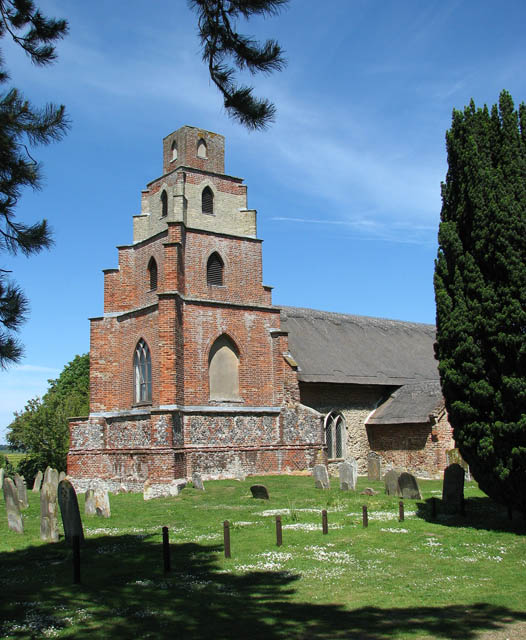
In 1793 Rev. Samuel Boycott, who was both lord of the manor and vicar of the parish, was granted a faculty by the Diocese of Norwich to rebuild or complete the tower as his mausoleum. The result is an unusual, possibly unique Georgian Gothic brick tower in which each stage is smaller than those below. Supposedly the design was inspired by a church Boycott's son saw in Italy.
The pulpit was installed in 1811, again at the expense of the Boycott family. A rood screen was added in the late 19th or early 20th century. St Mary's is a Grade II* listed building.
Burgh St Peter had two tower mills. One ground corn and the other pumped water to drain the land.
Burgh St Peter
Burgh St Peter is a village and civil parish in the South Norfolk district of Norfolk, England. It is about 3+1⁄2 miles (6 km) northeast of Beccles in Suffolk and 17 miles (27 km) south-east of Norwich.
The River Waveney forms the parish boundary to the south, east and north-east of Burgh St Peter, and also forms the county boundary with Suffolk. Low-lying land beside the Waveney forms a series of marshland levels in the parish, the largest of which is Burgh Marshes northeast of the village. The parish covers an area of 3+1⁄4 square miles (8.4 km2). The 2011 Census recorded its population as 274, with this increasing slightly to 290 at the 2021 Census.
The village's first parish church was presumably dedicated to Saint Peter. Its ruins were about 1⁄4 mile (400 m) southwest of the present parish church, but have disappeared.
The present parish church is next to the Waveney about 2 miles (3 km) east of the village. It is built of flint with some red brickwork. Its earliest parts are 13th-century, including the north and south doors of the nave. The chancel, piscina, sedilia and some of the windows are early 14th-century. The baptismal font is late 14th-century and the timber frame of the nave roof is 15th-century. The chancel roof is newer, but is continuous with that of the nave. Both are thatched.
In the 16th century work began on a west tower of flint with angle buttresses of brick. It is not clear if it was ever completed, but by the late 18th century it was reported to be "ruinous".
In 1793 Rev. Samuel Boycott, who was both lord of the manor and vicar of the parish, was granted a faculty by the Diocese of Norwich to rebuild or complete the tower as his mausoleum. The result is an unusual, possibly unique Georgian Gothic brick tower in which each stage is smaller than those below. Supposedly the design was inspired by a church Boycott's son saw in Italy.
The pulpit was installed in 1811, again at the expense of the Boycott family. A rood screen was added in the late 19th or early 20th century. St Mary's is a Grade II* listed building.
Burgh St Peter had two tower mills. One ground corn and the other pumped water to drain the land.
Recent media
Recent media