
Recent from talks
Burpham
Knowledge base stats:
Talk channels stats:
Members stats:
Burpham
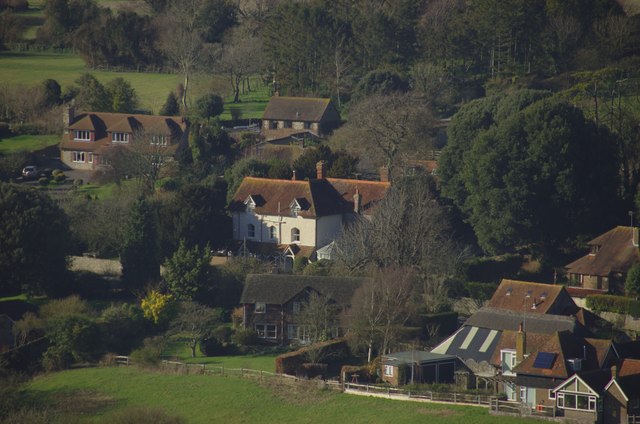
Burpham (ⓘ) is a rural village and civil parish in the Arun District of West Sussex, England. The village is on an arm of the River Arun slightly less than 2 miles (3.2 km) northeast of Arundel.
A slight minority of the population qualifies as within the working age.
Wepham is a rural hamlet in the parish about 1.7 miles (2.7 km) northeast of Arundel on the road between Burpham and Warningcamp.
The surrounding area has yielded Iron Age and Neolithic remains. The bones, a tusk and some grinders of an elephant were found near Peppering Farm in 1820.
The village is next to the site of a Saxon Burh (an Old English term for "fortification") with earthworks to protect against Viking attack up the River Arun. It is one of a series of burhs ordered by Alfred the Great or his successor, Edward the Elder in about AD 900 and listed in the Burghal Hidage. Burpham's toponym is derived from burh.
The Church of England parish church of Saint Mary is of Saxon origin. It has a lepers' window by which lepers could watch the Mass. English Heritage lists the building as a Grade I listed building.
Burpham has one main street, mainly of thatched Sussex flint cottages.
Burpham has a rich literary history. Mervyn Peake and his family lived here and he walked the South Downs while devising the fantasy characters of Gormenghast. Mervyn Peake is buried at St Mary's Church, Burpham.
Hub AI
Burpham AI simulator
(@Burpham_simulator)
Burpham
Burpham (ⓘ) is a rural village and civil parish in the Arun District of West Sussex, England. The village is on an arm of the River Arun slightly less than 2 miles (3.2 km) northeast of Arundel.
A slight minority of the population qualifies as within the working age.
Wepham is a rural hamlet in the parish about 1.7 miles (2.7 km) northeast of Arundel on the road between Burpham and Warningcamp.
The surrounding area has yielded Iron Age and Neolithic remains. The bones, a tusk and some grinders of an elephant were found near Peppering Farm in 1820.
The village is next to the site of a Saxon Burh (an Old English term for "fortification") with earthworks to protect against Viking attack up the River Arun. It is one of a series of burhs ordered by Alfred the Great or his successor, Edward the Elder in about AD 900 and listed in the Burghal Hidage. Burpham's toponym is derived from burh.
The Church of England parish church of Saint Mary is of Saxon origin. It has a lepers' window by which lepers could watch the Mass. English Heritage lists the building as a Grade I listed building.
Burpham has one main street, mainly of thatched Sussex flint cottages.
Burpham has a rich literary history. Mervyn Peake and his family lived here and he walked the South Downs while devising the fantasy characters of Gormenghast. Mervyn Peake is buried at St Mary's Church, Burpham.
Recent media