
Recent from talks
Burrington Combe
Knowledge base stats:
Talk channels stats:
Members stats:
Burrington Combe
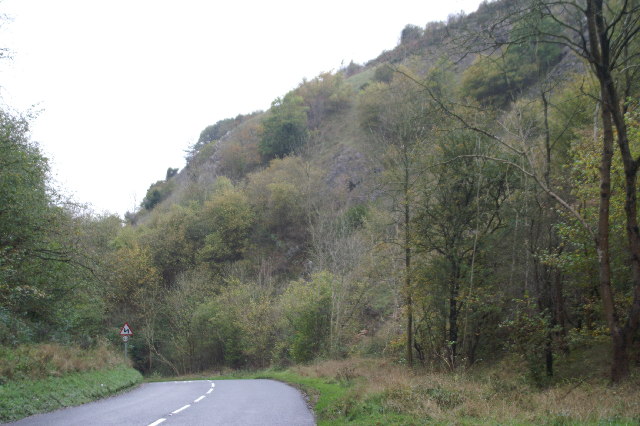
Burrington Combe is a Carboniferous Limestone gorge near the village of Burrington, on the north side of the Mendip Hills Area of Outstanding Natural Beauty, in North Somerset, England.
"Combe" or "coombe" is a word of Celtic origin found in several forms on all of the British Isles, denoting a steep-sided valley or hollow. Burrington Combe is a gorge through the limestone hills although there is now no river running through it. Various cave entrances are exposed which have been occupied by humans for over 10,000 years, with a hillfort being built beside the combe in the Iron Age. The geology has led to a diversity of plant life.
According to legend Augustus Montague Toplady was inspired to write the hymn Rock of Ages while sheltering under a rock in the combe, although recent scholars have disputed this claim.
Water draining from Black Down has exposed rocks from the Devonian sandstones of the Portishead Formation which show through the limestone, Carboniferous mudstones of the Avon Group, limestones of the Black Rock Limestone Subgroup and oolitic limestones of the Burrington Oolite Subgroup; however the exact mechanism by which the gorge was formed is unknown. The northern and lower end of the combe, which was once the bed of the Congresbury Yeo, cuts through overlying Clifton Down Limestone. Triassic dolomitic conglomerate can also locally be seen along the combe.
Archaeological discoveries of early cemeteries demonstrate human occupation of the combe and its caves from the Bronze Age with some evidence of occupation during the Upper Palaeolithic period. The combe contains the entrances to many of the caves of the Mendip Hills, including Aveline's Hole, Sidcot Swallet and Goatchurch Cavern. A through trip has been dug from Rod's Pot to Bath Swallet, which are both on the hills above the majority of Burrington caves. Further afield and equally accessible is Read's Cavern.
Goatchurch Cavern is 1,500 m (4,900 ft) long and has a surveyed depth of 61.5 m (202 ft). It was first recorded in 1736, and explored by lead miners in the 19th century. Around 1901, the owner unsuccessfully tried to turn it into a show cave. Notes of exploration in the 1920s record finds from the Pleistocene period including bones of mammoth, bear, hyena and cave lion. During November 2003 inscribed marks were noticed in Goatchurch Cavern while cleaning away graffiti. Three finely cut marks were uncovered, resembling the letter W with a patina darker than in nearby graffiti dated 1704. These have been identified as ritual protection marks (also known as witch marks or apotropaic marks), possibly dating from the period 1550 to 1750.
A swallet, also known as a sinkhole, sink, shakehole, swallow hole or doline, is a natural depression or hole in the surface topography caused by the removal of soil or bedrock, often both, by water flowing beneath the water-table at considerable depth. Sidcot Swallet is named after the Sidcot School Speleological Society who explored it in 1925.
The earliest scientifically dated cemetery in Great Britain was found at Aveline's Hole. The human bone fragments it contained, from about 21 different individuals, are thought to be between roughly 10,200 and 10,400 years old. A series of inscribed crosses found on the wall of the Aveline's Hole cave are believed to date from the early Mesolithic period just after the Ice age.
Hub AI
Burrington Combe AI simulator
(@Burrington Combe_simulator)
Burrington Combe
Burrington Combe is a Carboniferous Limestone gorge near the village of Burrington, on the north side of the Mendip Hills Area of Outstanding Natural Beauty, in North Somerset, England.
"Combe" or "coombe" is a word of Celtic origin found in several forms on all of the British Isles, denoting a steep-sided valley or hollow. Burrington Combe is a gorge through the limestone hills although there is now no river running through it. Various cave entrances are exposed which have been occupied by humans for over 10,000 years, with a hillfort being built beside the combe in the Iron Age. The geology has led to a diversity of plant life.
According to legend Augustus Montague Toplady was inspired to write the hymn Rock of Ages while sheltering under a rock in the combe, although recent scholars have disputed this claim.
Water draining from Black Down has exposed rocks from the Devonian sandstones of the Portishead Formation which show through the limestone, Carboniferous mudstones of the Avon Group, limestones of the Black Rock Limestone Subgroup and oolitic limestones of the Burrington Oolite Subgroup; however the exact mechanism by which the gorge was formed is unknown. The northern and lower end of the combe, which was once the bed of the Congresbury Yeo, cuts through overlying Clifton Down Limestone. Triassic dolomitic conglomerate can also locally be seen along the combe.
Archaeological discoveries of early cemeteries demonstrate human occupation of the combe and its caves from the Bronze Age with some evidence of occupation during the Upper Palaeolithic period. The combe contains the entrances to many of the caves of the Mendip Hills, including Aveline's Hole, Sidcot Swallet and Goatchurch Cavern. A through trip has been dug from Rod's Pot to Bath Swallet, which are both on the hills above the majority of Burrington caves. Further afield and equally accessible is Read's Cavern.
Goatchurch Cavern is 1,500 m (4,900 ft) long and has a surveyed depth of 61.5 m (202 ft). It was first recorded in 1736, and explored by lead miners in the 19th century. Around 1901, the owner unsuccessfully tried to turn it into a show cave. Notes of exploration in the 1920s record finds from the Pleistocene period including bones of mammoth, bear, hyena and cave lion. During November 2003 inscribed marks were noticed in Goatchurch Cavern while cleaning away graffiti. Three finely cut marks were uncovered, resembling the letter W with a patina darker than in nearby graffiti dated 1704. These have been identified as ritual protection marks (also known as witch marks or apotropaic marks), possibly dating from the period 1550 to 1750.
A swallet, also known as a sinkhole, sink, shakehole, swallow hole or doline, is a natural depression or hole in the surface topography caused by the removal of soil or bedrock, often both, by water flowing beneath the water-table at considerable depth. Sidcot Swallet is named after the Sidcot School Speleological Society who explored it in 1925.
The earliest scientifically dated cemetery in Great Britain was found at Aveline's Hole. The human bone fragments it contained, from about 21 different individuals, are thought to be between roughly 10,200 and 10,400 years old. A series of inscribed crosses found on the wall of the Aveline's Hole cave are believed to date from the early Mesolithic period just after the Ice age.
Recent media