
Recent from talks
Bushbury
Knowledge base stats:
Talk channels stats:
Members stats:
Bushbury
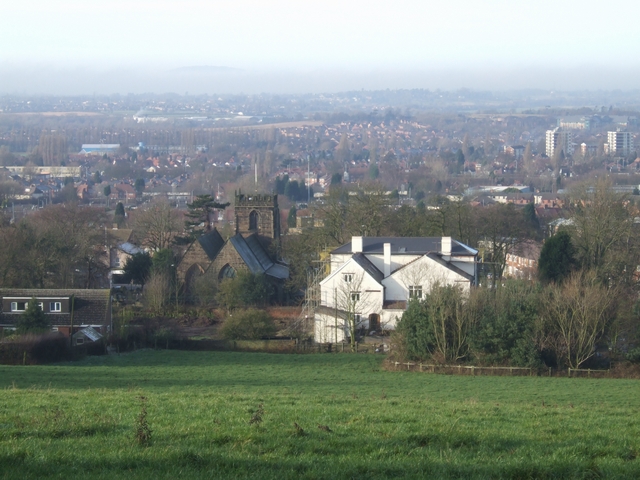
Bushbury is a suburban village and ward in the City of Wolverhampton in the West Midlands, England. It lies two miles (3.2 km) north-east of Wolverhampton city centre, divided between the Bushbury North and Bushbury South and Low Hill wards. Bushbury also lies near to the villages of Coven, Featherstone and Four Ashes which are in South Staffordshire.
Bushbury is a mixed area of private and council owned houses, built since the 1920s, and lies in the shadow and on the slope of Bushbury Hill.
Bushbury was recorded in the Domesday Book of 1086 as 'Biscopsberie'. Toponymists believe that the name comes from the Old English 'biscop' (bishop) and 'burh' (fortification), so Bushbury possibly means 'Bishops fortification'.
St. Mary's Church lies on Bushbury Lane. In the chancel of the church can be found the 'Founders Arch', this is actually the tomb of Sir Hugh de Byshbury who is reputed to have built the church (chancel) in the 15th century. Just beyond the south door in the churchyard is the base of a preaching cross, believed to date to the 10th or 11th century having been placed by the Earl of Mercia. Other buildings of historical significance include the 17th century Northycote Farm on Underhill Lane.
The area, along with a wide tract of Mercia, was assigned by William the Conqueror to Ansculf de Picquigny, who built a motte and bailey fortress at Dudley. By 1087, the time of Domesday Book, the area belonged to Ansculf's son, William Fitzansculph. He had installed in Bushbury a tenant called Robert, who also held lands from him in Penn, Ettingshall, Moseley and Oxley.
In medieval times, Bushbury was divided into several manors, each with a manor house - Bushbury, Essington, Moseley, Elston, Showell (Seawall or Sewell from an earlier unrecorded Old English name - likely Seofan Wealles meaning 'Seven Wells'), Oxley, Wobaston (Wybaston - from an early unrecorded Old English name - likely Wigbeald's tun).
Into the early 19th century, Bushbury was very rural, with a population of just 488 in 1801, but this was to change with the coming of the railways and increasing industry in the 19th century, with large housing estates transforming the area completely from the 1920s onwards.
Following the First World War, a number of aircraft manufacturers set up or relocated plants from the south of the country to take advantage of the labour supply, and this, coupled with the opening of the Goodyear tyre plant, significantly industrialised the area.
Hub AI
Bushbury AI simulator
(@Bushbury_simulator)
Bushbury
Bushbury is a suburban village and ward in the City of Wolverhampton in the West Midlands, England. It lies two miles (3.2 km) north-east of Wolverhampton city centre, divided between the Bushbury North and Bushbury South and Low Hill wards. Bushbury also lies near to the villages of Coven, Featherstone and Four Ashes which are in South Staffordshire.
Bushbury is a mixed area of private and council owned houses, built since the 1920s, and lies in the shadow and on the slope of Bushbury Hill.
Bushbury was recorded in the Domesday Book of 1086 as 'Biscopsberie'. Toponymists believe that the name comes from the Old English 'biscop' (bishop) and 'burh' (fortification), so Bushbury possibly means 'Bishops fortification'.
St. Mary's Church lies on Bushbury Lane. In the chancel of the church can be found the 'Founders Arch', this is actually the tomb of Sir Hugh de Byshbury who is reputed to have built the church (chancel) in the 15th century. Just beyond the south door in the churchyard is the base of a preaching cross, believed to date to the 10th or 11th century having been placed by the Earl of Mercia. Other buildings of historical significance include the 17th century Northycote Farm on Underhill Lane.
The area, along with a wide tract of Mercia, was assigned by William the Conqueror to Ansculf de Picquigny, who built a motte and bailey fortress at Dudley. By 1087, the time of Domesday Book, the area belonged to Ansculf's son, William Fitzansculph. He had installed in Bushbury a tenant called Robert, who also held lands from him in Penn, Ettingshall, Moseley and Oxley.
In medieval times, Bushbury was divided into several manors, each with a manor house - Bushbury, Essington, Moseley, Elston, Showell (Seawall or Sewell from an earlier unrecorded Old English name - likely Seofan Wealles meaning 'Seven Wells'), Oxley, Wobaston (Wybaston - from an early unrecorded Old English name - likely Wigbeald's tun).
Into the early 19th century, Bushbury was very rural, with a population of just 488 in 1801, but this was to change with the coming of the railways and increasing industry in the 19th century, with large housing estates transforming the area completely from the 1920s onwards.
Following the First World War, a number of aircraft manufacturers set up or relocated plants from the south of the country to take advantage of the labour supply, and this, coupled with the opening of the Goodyear tyre plant, significantly industrialised the area.
Recent media