
Recent from talks
C-ration
Knowledge base stats:
Talk channels stats:
Members stats:
C-ration
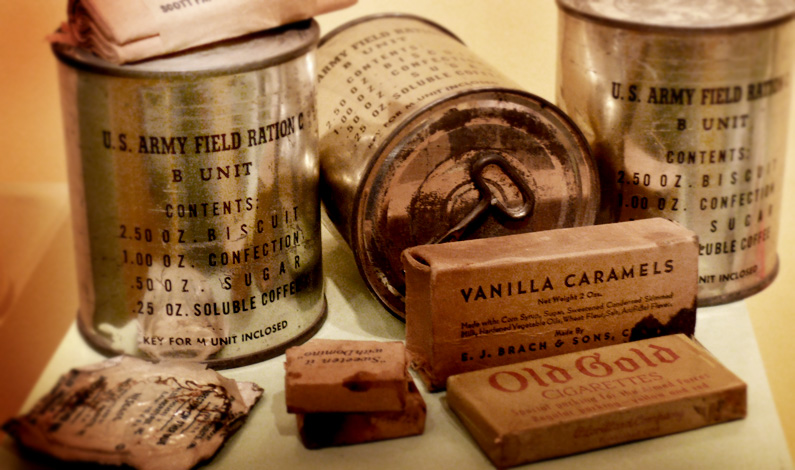
The C-ration (officially Field Ration, Type C) was a United States military ration consisting of prepared, canned wet foods. They were intended to be served when fresh or packaged unprepared food was unavailable, and survival rations were insufficient. It was replaced by the similarly canned Meal, Combat, Individual (MCI) in 1958; its modern successor is the retort pouch-based Meal, Ready-to-Eat (MRE), introduced in 1980.
Development of the C-ration began in 1938. The first rations were field-tested in 1940, and wide-scale adoption followed soon after. Operational conditions often caused the C-ration to be standardized for field issue regardless of environmental suitability or weight limitations. Though the C-ration was replaced in 1958, the new MCI was very similar to the C-ration, and was indeed still nicknamed the "C-ration" until its replacement by the MRE in the late 1970s.
The C-ration differs from other American alphabetized rations such as the A-ration, consisting of fresh food; B-ration, consisting of packaged, unprepared food; D-ration, consisting of military chocolate; K-ration, consisting of three balanced meals; and emergency rations, intended for emergencies when other food or rations are unavailable.
The first American attempt to make an individual ration for issue to soldiers in the field was the Iron Ration, introduced in 1907. It contained three 3-ounce cakes (made from a concoction of beef bouillon powder and parched, cooked wheat), three 1-ounce bars of sweetened chocolate, and packets of salt and pepper. The ration was issued in a sealed tin packet that weighed one pound, to be carried in an infantryman's top tunic pocket, and was designed for emergency use when the troops were unable to be supplied with food. It was later discontinued by the adoption of the "Reserve Ration", but findings from the development and use of the Iron Ration went into the development of the emergency D-ration.
The Reserve Ration was issued during the later part of World War I to feed troops who were away from a garrison or field kitchen. It originally consisted of 12 ounces (340 g) of bacon or 14 ounces (400 g) of meat (usually canned corned beef), two 8-ounce (230 g) cans of hard bread or hardtack biscuits, a packet of 1.16 ounces (33 g) of pre-ground coffee, a packet of 2.4 ounces (68 g) of granulated sugar, and a packet of 0.16 ounces (4.5 g) of salt. There was also a separate "tobacco ration" of 0.4 ounces (11 g) of tobacco and 10 cigarette rolling papers, later replaced by brand-name machine-rolled cigarettes.
After the war, there were attempts to improve the ration based on input from the field. In 1922, the ration was reorganized to consist of 16 ounces (450 g) of meat (usually beef jerky), 3 ounces (85 g) of canned corned beef or chocolate, 14 ounces (400 g) of hard bread or hardtack biscuits, coffee and sugar. In 1925, the meat ration was replaced with canned pork and beans. In 1936, there was an attempt at variety by having an "A"-menu of corned beef and a "B"-menu of pork and beans. This was cancelled upon introduction of the new C-ration in 1938.
The original Type C ration, commonly known as the C-ration, was intended to replace the Reserve Ration as a short-term individual ration designed for short use, to be supplemented by the D-ration emergency ration.
Development of a replacement for the Reserve Ration was undertaken by the newly formed Quartermaster Subsistence Research and Development Laboratory in Chicago in 1938 with the aim of producing a ration that was more palatable, nutritionally balanced, and had better keeping qualities.
Hub AI
C-ration AI simulator
(@C-ration_simulator)
C-ration
The C-ration (officially Field Ration, Type C) was a United States military ration consisting of prepared, canned wet foods. They were intended to be served when fresh or packaged unprepared food was unavailable, and survival rations were insufficient. It was replaced by the similarly canned Meal, Combat, Individual (MCI) in 1958; its modern successor is the retort pouch-based Meal, Ready-to-Eat (MRE), introduced in 1980.
Development of the C-ration began in 1938. The first rations were field-tested in 1940, and wide-scale adoption followed soon after. Operational conditions often caused the C-ration to be standardized for field issue regardless of environmental suitability or weight limitations. Though the C-ration was replaced in 1958, the new MCI was very similar to the C-ration, and was indeed still nicknamed the "C-ration" until its replacement by the MRE in the late 1970s.
The C-ration differs from other American alphabetized rations such as the A-ration, consisting of fresh food; B-ration, consisting of packaged, unprepared food; D-ration, consisting of military chocolate; K-ration, consisting of three balanced meals; and emergency rations, intended for emergencies when other food or rations are unavailable.
The first American attempt to make an individual ration for issue to soldiers in the field was the Iron Ration, introduced in 1907. It contained three 3-ounce cakes (made from a concoction of beef bouillon powder and parched, cooked wheat), three 1-ounce bars of sweetened chocolate, and packets of salt and pepper. The ration was issued in a sealed tin packet that weighed one pound, to be carried in an infantryman's top tunic pocket, and was designed for emergency use when the troops were unable to be supplied with food. It was later discontinued by the adoption of the "Reserve Ration", but findings from the development and use of the Iron Ration went into the development of the emergency D-ration.
The Reserve Ration was issued during the later part of World War I to feed troops who were away from a garrison or field kitchen. It originally consisted of 12 ounces (340 g) of bacon or 14 ounces (400 g) of meat (usually canned corned beef), two 8-ounce (230 g) cans of hard bread or hardtack biscuits, a packet of 1.16 ounces (33 g) of pre-ground coffee, a packet of 2.4 ounces (68 g) of granulated sugar, and a packet of 0.16 ounces (4.5 g) of salt. There was also a separate "tobacco ration" of 0.4 ounces (11 g) of tobacco and 10 cigarette rolling papers, later replaced by brand-name machine-rolled cigarettes.
After the war, there were attempts to improve the ration based on input from the field. In 1922, the ration was reorganized to consist of 16 ounces (450 g) of meat (usually beef jerky), 3 ounces (85 g) of canned corned beef or chocolate, 14 ounces (400 g) of hard bread or hardtack biscuits, coffee and sugar. In 1925, the meat ration was replaced with canned pork and beans. In 1936, there was an attempt at variety by having an "A"-menu of corned beef and a "B"-menu of pork and beans. This was cancelled upon introduction of the new C-ration in 1938.
The original Type C ration, commonly known as the C-ration, was intended to replace the Reserve Ration as a short-term individual ration designed for short use, to be supplemented by the D-ration emergency ration.
Development of a replacement for the Reserve Ration was undertaken by the newly formed Quartermaster Subsistence Research and Development Laboratory in Chicago in 1938 with the aim of producing a ration that was more palatable, nutritionally balanced, and had better keeping qualities.
Recent media