Hubbry Logo
Military chocolate (United States)Military chocolate (United States)Main
Open search
Military chocolate (United States)
Community hub
Military chocolate (United States)
logo
8 pages, 0 posts
0 subscribers
Be the first to start a discussion here.
Military chocolate (United States)
from Wikipedia
Military chocolate
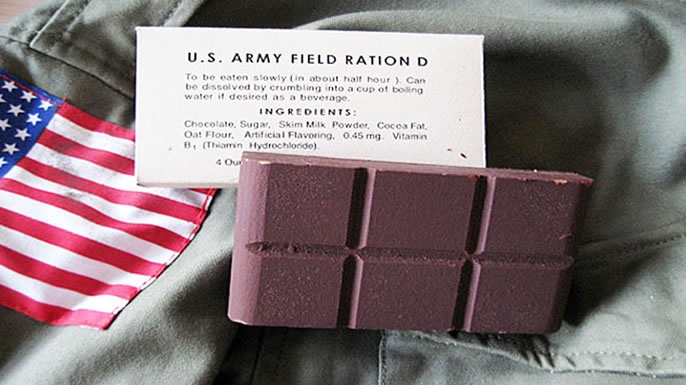
D ration bar
TypeChocolate
Place of originUnited States
Created byThe Hershey Company[1]
Main ingredientsChocolate, sugar, oat flour, cacao fat, skim milk powder, artificial flavoring
  •   Media: Military chocolate

Military chocolate has been a part of standard United States military rations since the original D-ration bar of 1937. Today, military chocolate is issued to troops as part of basic field rations and sundry packs. Chocolate rations served two purposes: as a morale boost, and as a high-energy, pocket-sized emergency ration. Military chocolate rations are often made in special lots to military specifications for weight, size, and endurance. The majority of chocolate issued to US military personnel is produced by The Hershey Company.

When provided as a morale boost or care package, military chocolate is often no different from normal store-bought bars in taste and composition. However, they are frequently packaged or molded differently. The World War II K ration issued in temperate climates sometimes included a bar of Hershey's commercial-formula sweet chocolate. But instead of being the typical flat thin bar, the K ration chocolate was a thick rectangular bar that was square at each end. (In tropical regions, the K ration used Hershey's Tropical Bar formula.)

When provided as an emergency field ration, military chocolate was very different from normal bars. Since its intended use was as an emergency food source, it was formulated so that it would not be a tempting treat that troops might consume before they needed it. Even as attempts to improve the flavor were made, the heat-resistant chocolate bars never received enthusiastic reviews. Emergency ration chocolate bars were made to be high in energy value, easy to carry, and able to withstand high temperatures. Withstanding high temperatures was critical since infantrymen would often be outdoors, sometimes in tropical or desert conditions, with the bars located close to their bodies. These conditions would cause typical chocolate bars to melt within minutes.

Development

[edit]

The first chocolate ration bar commissioned by the United States Army was the Field Ration D or Ration, Type D, commonly known as the "D ration." Army Quartermaster Colonel Paul Logan approached Hershey's Chocolate in April 1937, and met with William Murrie, the company president, and Sam Hinkle, the chief chemist. Milton Hershey was interested in the project when he was informed of the proposal, and the meeting began the first experimental production of the D ration bar.

Colonel Logan had four requirements for the D ration bar, dictating that it had to:

  1. Weigh 4 ounces (113 grams)
  2. Be high in food energy value
  3. Be able to withstand high temperatures
  4. Taste "a little better than a boiled potato" (to keep soldiers from eating their emergency rations in non-emergency situations)

Its ingredients were chocolate,[2] sugar, oatmeal, cacao fat, skim milk powder, and artificial flavoring, fortified with vitamin B1 to prevent beriberi.[3] Chocolate manufacturing equipment was assembled to move the flowing mixture of liquid chocolate and oat flour into preset molds. However, it was found that the temperature-resistant formula became a gooey paste that would not flow at any temperature. Hinkle was forced to develop entirely new production methods to produce the bars. Each four-ounce portion had to be kneaded, weighed, and pressed into a mold by hand. The end result was an extremely hard block of dark brown chocolate that would crumble with some effort and was heat-resistant to 120 °F (49 °C). The resultant bar was wrapped in aluminum foil and placed in a cardboard carton. Three bars made up a daily ration and was intended to furnish the individual combat soldier with the 1,800 calories (7,500 kJ) minimum sustenance recommended each day.

Logan was pleased with the first small batch of samples. In June 1937, the United States Army ordered 90,000 "Logan Bars" and field tested them at bases in the Philippines, Panama, on the Texas border, and at other bases throughout the United States. Some of the bars even found their way into the supplies for Admiral Richard E. Byrd's third Antarctic expedition.[4] These field tests were successful, and the Army began making irregular orders for the bars. After the attack on Pearl Harbor, the bars were ordered to be packaged to make them poison gas-proof. The bars' boxes were covered with an anti-gas coating and were packed 12 to a cardboard carton, which was also coated. These cartons were packed 12 to a wooden crate, for a total of 144 bars to a crate.

After US entry into the Second World War, Congress planned to shut down the candy industry for the duration of the conflict, deeming it non-essential. Milton Hershey, fighting off attempts to ration sugar, corn syrup, and cocoa, claimed to Congress that chocolate was a vital source of nutrition for the nation's troops.[5] During the war years, the bulk of the Hershey Food Corporation's chocolate production was for the military. Between 1940 and 1945, an estimated three billion units of the specially formulated candy bars were distributed to soldiers around the world."[6]

The D ration was almost universally detested for its bitter taste by US troops, and was often discarded instead of consumed when issued.[7] Troops called the D ration "Hitler's Secret Weapon" for its effect on soldiers' intestinal tracts.[7] It could not be eaten at all by soldiers with poor dentition, and even those with good teeth often found it necessary to first shave slices off the bar with a knife before consuming.[7]

Tropical Bar

[edit]
Hershey's Tropical bar from World War II

In 1943, the Procurement Division of the Army approached Hershey about producing a confectionery-style chocolate bar with improved flavor[8] that would still withstand extreme heat[9][10] for issue in the Pacific Theater.[11] After a short period of experimentation, the Hershey company began producing Hershey's Tropical Bar.[12] The bar was designed for issue with field and specialty rations, such as the K ration, and originally came in 1-ounce (28 g) and 2-ounce (56 g) sizes. After 1945, it came in 4-ounce (112 g) D ration sizes as well.[citation needed]

The Tropical Bar (still called the D ration throughout the war, despite its new appellation) had more of a resemblance to normal chocolate bars in its shape and flavor than the original D ration, which it gradually replaced by 1945. While attempts to sweeten its flavor were somewhat successful, nearly all US soldiers found the Tropical Bar tough to chew and unappetizing. Instead, the bar was either discarded or traded to unsuspecting Allied troops or civilians for more appetizing foods or goods. Resistance to accepting the ration soon appeared among the latter groups after the first few trades. In the China-Burma-India Theater of Operations (CBI), the D ration or Tropical Bar did make one group of converts: it was known as the "dysentery ration", since the bar was the only ration those ill with dysentery could tolerate.[13]

In 1957, the bar's formula was changed to make it more appetizing. The unpopular oat flour was removed, non-fat milk solids replaced skim milk powder, cocoa powder replaced cacao fat, and artificial vanilla flavoring was added. It was added with the help of sugar. It greatly improved the flavor of the bar, but it was still difficult to chew.[citation needed]

Hershey production

[edit]

It is estimated that between 1940 and 1945, over 3 billion of the D ration and Tropical Bars were produced and distributed to soldiers throughout the world. In 1939, the Hershey plant was capable of producing 100,000 ration bars a day. By the end of World War II, the entire Hershey plant was producing ration bars at a rate of 24 million a week. For their service throughout World War II, the Hershey Chocolate Company was issued the Army-Navy ‘E’ Award for Excellence for exceeding expectations for quality and quantity in the production of the D ration and the Tropical Bar. Their continued efforts resulted in four stars being added to their pennant signifying the five times they received this distinction. US propaganda used this product distinction during the war as a message "that Allied nations would win the war because of their democratic institutions, but also because of the productivity of the U.S. economy and, especially, its agriculture." In tandem with this state-sponsored rhetoric, radio advertisements for foodstuffs and other consumer goods employed wartime slogans to reinforce military campaigns against Germany and Japan.[14]: 770 

Postwar to modern day

[edit]

The rhetoric of war rations aligned food consumption with the war in Europe and Asia but also with the vitality of US agriculture and consumerism. While these campaigns aimed to conserve US food surpluses for the purpose of providing food aid to overseas militaries and civilian populations, they also functioned to jettison certain foodstuffs.[14] Production of the D ration bar was discontinued at the end of World War II. However, Hershey's Tropical Bar remained a standard ration for the United States Armed Forces. The Tropical Bar saw action in Korea and Vietnam[15] as an element of the "Sundries" kit (which also contained toiletries), before being declared obsolete. It briefly returned to use when it was included on board Apollo 15 in July 1971.[citation needed]

"Desert Bar" (Congo Bar)

[edit]

In the late 1980s, the US Army's Natick Labs created a new high-temperature chocolate (dubbed the "Congo Bar" by researchers) that could withstand heat in excess of 140 °F (60 °C), using egg whites, giving it a fudge-like texture.[16]

During Operation Desert Shield and Operation Desert Storm, Hershey's Chocolate was the major manufacturer, shipping 144,000 bars to American troops in the southwest Asia theater.[17] While Army spokesmen said the bar's taste was good, troop reactions were mixed and the bar was not put into full production.[citation needed]

Since the war ended before Hershey's supplies of the experimental bar were shipped, the remainder of the production run was packaged in a "desert camo" wrapper and was dubbed the Desert Bar. It proved a brief novelty but Hershey declined to make more after supplies ran out.[18]

See also

[edit]

References

[edit]
[edit]
Revisions and contributorsEdit on WikipediaRead on Wikipedia
from Grokipedia
Military chocolate in the United States refers to specialized chocolate products formulated for inclusion in armed forces rations, providing compact, high-energy sustenance, morale enhancement, and nutritional support from the Revolutionary War through contemporary operational rations. These items evolved from basic beverages and blocks in early conflicts to standardized bars in the , with the Hershey's D-ration bar exemplifying emergency-focused designs that prioritized heat resistance and caloric density over palatability to prevent non-essential consumption. The provision of chocolate to U.S. troops originated during the Revolutionary War (1775–1783), when it was issued as a supplemental ration to soldiers, offering a familiar comfort from home amid scarce supplies and serving as both an energy source and morale booster. By the Civil War (1861–1865), chocolate had become an official component of rations, distributed in forms like cakes or drinks to sustain soldiers during grueling campaigns. In (1914–1918), the U.S. military procured massive quantities—up to 20-pound blocks from manufacturers like Hershey—for distribution to troops, marking chocolate's transition from luxury to essential wartime provision. World War II (1939–1945) represented the pinnacle of military chocolate innovation, as the U.S. War Department partnered with companies like Hershey Chocolate Corporation to develop purpose-built products. The D-ration bar, finalized in 1937 after a 1935 solicitation for a 600-calorie, 4-ounce emergency bar (three bars providing a full day's 1,800-calorie emergency ration), consisted of , cocoa butter, sugar, oat flour, and skim milk powder, fortified with ; its intentionally bitter taste and high (designed to withstand 120°F/49°C without melting) ensured it was consumed only in dire need, while providing essential carbohydrates, proteins, fats, and vitamins. In 1943, the more palatable Tropical Bar was introduced, featuring a similar heat-resistant formula but improved flavor for regular morale support, and it appeared in K- and C-rations alongside other confections. Innovations like , developed by Mars in 1941 with a hard-shell coating to prevent melting in uniforms, were also supplied exclusively to troops during the war. Post-World War II, the D-ration was discontinued, but the Tropical Bar persisted in (1950–1953) and (1955–1975) rations, and even fueled astronauts in 1971 before its phase-out in 1991. In modern U.S. military feeding, chocolate remains integrated into Meals Ready-to-Eat (MREs) since their introduction in 1981, appearing as cookies, toffees, or cocoa mixes in various menus to deliver quick energy and psychological comfort in field conditions. Overall, these chocolate rations have not only met nutritional demands but also symbolized resilience and home, influencing civilian products and underscoring chocolate's enduring role in American .

Historical Development

Origins and World War I

In the early 20th century, the U.S. Army's Corps began incorporating into as a compact, high-energy food source suitable for field use. The ration, first formalized in 1907, featured sweetened alongside components like powdered evaporated , parched and cooked , , providing a lightweight, durable option weighing one pound and vacuum-sealed in tins to sustain soldiers during extended campaigns or supply disruptions. This formulation drew inspiration from portable foods used by Native American and forces, emphasizing 's role in delivering concentrated calories without excessive bulk. With the entry of the into in 1917, chocolate became a standard element in emergency rations, valued for its dual function as an energy provider and morale enhancer amid the rigors of . Each emergency ration included three 1-ounce chocolate cakes, prepared by combining equal weights of fine chocolate—containing no less than 20 percent —and pure sugar, then molded for portability. These cakes offered versatility, as they could be consumed directly as candy or dissolved in hot water to create a beverage, making them ideal for dire situations like engagements where regular supplies were unavailable. The Quartermaster Corps oversaw the production and packing of these rations in oval tin cans, alongside beef-wheat cakes, , ensuring non-perishability for overseas deployment. 's advantages were particularly noted in military subsistence efforts: its compact form minimized logistical burdens, while its non-thirst-provoking nature—unlike salted meats—prevented in combat conditions, and it provided essential psychological uplift to troops facing prolonged hardships. Distributed primarily to soldiers in under strict officer oversight or in emergencies, these early inclusions laid the groundwork for more specialized formulations in subsequent conflicts.

World War II Innovations

The development of the D-ration bar began in 1937 under the auspices of the U.S. Army Quartermaster Corps, which sought an emergency ration capable of providing 600 calories in a compact 4-ounce form suitable for field use. Captain Paul Logan of the Quartermaster Corps led the initial efforts, collaborating with food scientists to create a non-perishable -based product that could sustain troops during prolonged combat without refrigeration. This built briefly on precedents of as a portable energy source but emphasized standardized engineering for global deployment. By 1940, the design had evolved through iterative testing to meet rigorous specifications, including the ability to endure temperatures up to 120°F without melting, achieved via a formulation of chocolate liquor, sugar, oat flour, and cacao fat that absorbed excess moisture and stabilized the structure. Field trials conducted in hot climates, such as Panama, the Philippines, and Hawaii, confirmed its tropical durability, ensuring it remained intact under extreme humidity and heat. The intentional bitter flavor, derived from minimal sugar and high cocoa content, was a key innovation to discourage overconsumption and preserve stocks as an emergency item rather than a treat. In 1941, as U.S. involvement in the war loomed, the Quartermaster Corps awarded larger contracts that scaled production from experimental batches to millions of units, enabling widespread distribution to troops. By 1943, the D-ration bar was issued alongside K-rations for mobile infantry and as a supplement to C-rations for extended field operations, becoming a standard issue for all U.S. soldiers across theaters. Beyond nutrition, it played a vital psychological role, boosting morale amid the rigors of combat in the Pacific and European theaters by offering a familiar, comforting element in otherwise austere conditions.

Postwar Evolution

Following , U.S. military rations transitioned from the standard C-rations to group-oriented 5-in-1 and 10-in-1 rations between 1945 and 1948, which were designed for small units and retained as a key morale-boosting and energy-providing component with minor adjustments to enhance through improved packaging and stabilizers. The 5-in-1 ration, specified in 1946 under QMC Tent Spec CQD 126A, continued to include chocolate D bars for their compact, high-calorie profile, while the 10-in-1 was finalized in 1945 but largely discontinued shortly thereafter due to logistical complexities. These changes built on World War II innovations like heat-resistant formulations as a baseline for postwar storage needs. In the 1950s, updates to chocolate rations incorporated vitamin fortification, particularly , to meet evolving nutritional requirements, alongside efforts to reduce the inherent bitterness of earlier bars for better troop acceptance without compromising functionality. During the (1950-1953), soldier feedback highlighted the need for greater palatability in cold-weather conditions, prompting the introduction of flavor varieties such as plain and nut-filled chocolate options to improve consumption rates and morale. By 1958, pure D-rations were discontinued in favor of integrated components within updated rations, reflecting a shift away from standalone emergency bars. The 1960s marked a significant evolution with the adoption of the Meal, Combat, Individual (MCI) ration in 1958, which replaced the older C-2 variant and featured chocolate disks in B-units, including solid chocolate, chocolate creme, and chocolate coconut varieties paired with crackers for a balanced snack. These disks provided approximately 230 calories each, contributing to the B-unit's energy provision and aligning with nutritional standards outlined in Army Regulation 40-25, which emphasized balanced caloric intake and psychological sustenance to sustain soldiers during prolonged engagements by combining energy density with appealing flavors.

Key Formulations

D-Ration Bar

The D-Ration Bar served as the primary chocolate ration for U.S. military personnel during , providing a compact, high-energy source intended to sustain troops in combat or survival situations. Developed in response to the need for a non-perishable, calorie-dense item that could replace a missed , the bar was formulated to deliver essential without encouraging casual consumption. Each 4-ounce bar supplied approximately 600 calories, with three bars constituting a full daily ration of 1,800 calories, designed for short-term use of 1-2 days when standard meals were unavailable. The bar's composition emphasized durability and energy efficiency, consisting of chocolate liquor, sugar, skim milk powder, cocoa butter, oat flour, and vanillin, with later variants fortified with thiamine hydrochloride to aid nutrient absorption. To achieve its goals, the recipe featured approximately 36% chocolate liquor, 36% sugar, 16% skim milk powder, 7% added cacao fat, and 5% oat flour, resulting in a dense, semi-hard texture primarily derived from fats and carbohydrates for sustained energy release. The intentionally bitter flavor, often likened to "slightly better than a boiled potato," deterred overuse and promoted rationing. Packaging was optimized for field conditions, with each bar wrapped in inside a waxed to resist temperatures up to 120°F (49°C), preventing melting during transport or storage in temperate climates. Deployed from to 1945 across European, Pacific, and North African theaters, the D-Ration proved vital for troop morale and survival, with soldiers crediting it for endurance during grueling ordeals such as the in April , where limited rations including these bars helped mitigate starvation amid forced marches and captivity. Hershey Chocolate Corporation produced nearly 3 billion units during the war, peaking at 24 million per week by 1945, underscoring its scale as a logistical staple. Despite its innovations, the D-Ration had limitations in extreme environments; while heat-resistant in dry conditions, it could soften or melt in high humidity, prompting adaptations for tropical theaters and highlighting its design focus on temperate operations. Its role extended beyond nutrition, boosting as a familiar American treat in harsh settings, though soldiers often traded or hoarded bars for their symbolic value.

Tropical Bar

The Tropical Bar was a specialized ration developed by the Hershey Chocolate Corporation in at the request of the U.S. Army Quartermaster Corps, evolving from the earlier D-ration bar to provide a more palatable option while enhancing resistance for troops in humid, tropical environments like the Pacific Theater. Unlike standard that melted easily in high and , the Tropical Bar's formulation prioritized solidity to avoid turning into an unmanageable "chocolate soup" during jungle operations, though this came at the expense of a smoother texture and taste, resulting in a dense, somewhat gritty consistency from its key additives. The bar's recipe incorporated chocolate liquor, cocoa butter, powdered sugar, skim milk powder, vanillin for flavoring, oat flour to elevate the melting point, and thiamine hydrochloride (Vitamin B-1) to combat beriberi, a deficiency disease prevalent among soldiers in tropical regions due to limited dietary variety. Oat flour served as a critical structural agent, binding the mixture to withstand temperatures up to 120°F for at least one hour without deforming, a significant engineering trade-off that sacrificed the creamy mouthfeel of civilian chocolate for reliability in extreme conditions. Produced in 1-ounce and 2-ounce sizes, it offered a compact energy source as a supplemental treat rather than a full emergency ration, helping maintain morale without encouraging overconsumption. Following a brief experimentation phase, began in 1943, with the bars issued starting that year to U.S. Marines and units deployed in tropical areas, including widespread distribution by as combat intensified in the Pacific. By the end of , Hershey had manufactured nearly 380 million 2-ounce Tropical Bars, contributing to the overall wartime output of over 3 billion military chocolate units that sustained Allied forces globally. The inclusion of Vitamin B-1 not only addressed nutritional risks in settings but underscored the bar's dual role as both a booster and a preventive measure, ensuring troops could carry a non-perishable indulgence without logistical melt-downs.

Desert Bar

The Desert Bar, also known as the Congo Bar, was a specialized heat-resistant ration developed by the U.S. Army's Natick Soldier , Development and Center in the late to address the challenges of extreme heat in desert environments. Designed for operations in arid regions with direct sun exposure, it prioritized non-melting stability over palatability, focusing on providing compact, high-energy nutrition to support troop endurance in temperatures exceeding typical field conditions. This formulation emphasized energy density for quick consumption during missions, with an underlying nutritional profile aimed at maintaining and physical performance in electrolyte-depleting climates, differing from earlier humidity-focused designs like the Tropical Bar by targeting dry-heat degradation rather than moisture absorption. The bar's composition incorporated high-melt-point fats to replace a portion of traditional , along with , , and stabilizers such as emulsifiers to achieve resilience up to 140°F (60°C) without liquefying, resulting in a dense, fudge-like texture through high-melt-point fats, stabilizers, and egg whites. Weighing 1 , it was engineered for slow eating to prevent rapid overconsumption, with a gritty reminiscent of prior military chocolates but improved flavor to encourage compliance. Researchers at Natick Labs nicknamed it the "Congo Bar" during development, drawing from testing in simulated equatorial conditions, though exact mineral additives for support were not publicly detailed in declassified specifications. Introduced in 1990 as part of rations for Operation Desert Shield, the Desert Bar saw limited deployment during Operation Desert Storm in 1991, where it was issued to U.S. troops in the Persian Gulf to combat the region's intense aridity and solar heat, which could reach over 120°F in shaded areas. Hershey Chocolate Corporation, long involved in military rations, produced the bars in desert camouflage wrappers for field use, marking a post-Cold War adaptation for potential hot-zone conflicts in the Middle East. Its use was short-lived, phased out by 1991 with the transition to more palatable Meal, Ready-to-Eat (MRE) systems, though surplus stocks were briefly marketed to civilians before discontinuation.

Production and Manufacturing

Hershey's Involvement

In 1937, the Hershey Chocolate Corporation began collaborating with the U.S. Army Quartermaster Corps to develop an emergency ration bar, following a visit from Captain Paul Logan, who outlined specifications for a four-ounce product that could withstand extreme temperatures, provide high caloric value (approximately 600 calories per bar), and taste only slightly better than a boiled to prevent overconsumption. Led by chemist Sam Hinkle, the company formulated the initial Ration D bar using , sugar, skim milk powder, , oat flour for stabilization, and , with the addition of hydrochloride for nutritional enhancement; this prototype was tested and approved within days, leading to the first production run of 90,000 bars in June 1937. The formula's use of oat flour and adjusted fat content innovated a non-melting texture suitable for field conditions, marking Hershey's early pivot toward military-specific adaptations. Following the U.S. entry into in 1941, Hershey expanded its facilities at the Pennsylvania plant to dedicate multiple production lines exclusively to , including automated molding equipment to handle the bar's thick, non-flowing paste and specialized packaging processes such as wrapping and wax-dipped cartons for protection against environmental hazards and gas. By 1945, three floors of the plant were operational for ration bar output, achieving a peak of 24 million units per week under strict wartime secrecy protocols that involved coded shipments to maintain confidentiality. In recognition of these efforts, Hershey received five Army-Navy "E" Awards for excellence in production and quality, the first awarded on August 22, 1942. To address needs in tropical theaters, Hershey introduced the Tropical Bar in 1943, refining the Ration D formula with a heat-resistant composition that maintained integrity at 120°F for at least one hour, incorporating similar stabilizers like oat flour alongside , , , skim milk powder, and . Between 1941 and 1945, the company produced over three billion Ration D bars and approximately 380 million two-ounce Tropical Bars at the Hershey plant, supplying these to various military packs including Ration K and the 10-in-1 ration. Hershey's military involvement extended beyond , with continued adaptations such as the 1990 introduction of the Hershey Desert Bar for Operations Desert Shield and , featuring enhanced stability for arid environments. As of 2025, Hershey components, including stabilized chocolate formulations derived from wartime innovations, remain integrated into (MRE) rations, adhering to military standards for packaging and durability.

Government Contracts and Specifications

The U.S. military's procurement of chocolate rations began under the oversight of the Quartermaster Corps, which established initial specifications in the late 1930s and early 1940s to meet emergency nutritional needs. In 1937, the Corps collaborated with chocolate manufacturers to develop the Field Ration D bar, requiring it to weigh approximately four ounces, provide high caloric value (around 600 calories), resist melting in high temperatures, and taste only slightly better than a boiled potato to prevent overconsumption. By 1941, tentative specifications for confections in Field Ration K included heat-stable chocolate components fortified with thiamine hydrochloride to combat beriberi, ensuring stability in soldiers' pockets during tropical operations. These early standards emphasized durability over palatability, with production contracts awarded irregularly starting in 1937 and scaling up with the first major wartime order on January 2, 1942, for 300,000 four-ounce D bars. Bidding processes for chocolate production during involved competitive awards to multiple manufacturers to ensure supply reliability, with Hershey Chocolate Corporation receiving the largest share—approximately 70% of total output—while competitors like Mars Incorporated supplied alternative products such as plain chocolate candies, which were introduced in 1941 specifically for military use due to their melt-resistant hard shell coating. Hershey produced over three billion D-ration bars and approximately 380 million Tropical Bars between 1941 and 1945. Postwar, diversification continued into the 1950s and 1970s, with firms like and smaller producers contributing to ration components to mitigate single-supplier risks, though Hershey remained dominant in core chocolate bar production. Oversight evolved after the establishment of the (DLA) in 1961, with full responsibility for subsistence items including chocolate rations transferring to DLA Troop Support by 1977, centralizing procurement and quality control for operational rations. Modern specifications adhere to Military Standards (MIL-SPECs), such as MIL-C-43205G for dry cookie mix in unitized group rations, requiring medium-fat cocoa powder from domestically roasted beans with specific alkalinity and fineness levels, and MIL-C-44072C for chocolate-covered and brownies, mandating Salmonella-free coatings and uniform distribution of inclusions. Additional requirements under FED-STD-123 ensure proper marking of packages for shipment, including unit loads with clear, legible English labels for identification and handling. Quality assurance testing occurs at the U.S. Army Combat Capabilities Development Command Soldier Center (formerly Natick Soldier Research, Development and Engineering Center), where prototypes like the Performance Readiness Bar—a chocolate-based supplement fortified with calcium and to prevent stress fractures—are evaluated for nutritional , , and environmental resilience, including heat exposure up to 140°F and sensory acceptance by soldiers. The Performance Readiness Bar in chocolate flavor is produced under National Stock Number 8920-01-651-9083 as of 2025. DLA-managed contracts in the 2020s support ongoing production of such chocolate items to sustain diversified sourcing and compliance.

Modern Applications

Cold War and Vietnam Era

During the Cold War, U.S. military chocolate continued to evolve as a key component of field rations, particularly with the introduction of the Meal, Combat, Individual (MCI) in 1958, which became the primary ration during the from 1965 to 1973. The MCI incorporated chocolate in its B-1 accessory packets as discs or coated varieties, including solid chocolate, chocolate creme, and chocolate coconut options, often paired with crackers for a compact energy source. These variants aimed to enhance palatability over earlier wartime bars while maintaining high caloric density, typically contributing to the overall 1,200 calories per MCI meal to support extended operations. Canned chocolate nut rolls also appeared in some MCI menus, providing a shelf-stable treat amid the transition from postwar C-rations. Vietnam's extreme jungle humidity and temperatures, often exceeding 100°F, challenged the durability of rations. remained a favored item for quick energy and psychological uplift in prolonged engagements. A significant shift occurred toward modular, air-droppable rations with the 1964 development of the Long Range Patrol () ration, tailored for Vietnam's and patrols, featuring lightweight pieces and rolls in freeze-dehydrated formats for easier and reduced weight. studies during the era, including Army evaluations of ration impacts, underscored food's role in boosting in high-heat conditions, influencing specs for durability against potential adversary comparisons in exercises. By the , testing of freeze-dried precursors advanced amid broader ration modernization, paving the way for enhanced shelf life and portability in contingencies.

Contemporary Use in Rations

The (MRE) system, introduced by the U.S. military in , marked a significant evolution in field rations, incorporating components such as cocoa-coated disks to provide compact, high-energy snacks. These disks, often paired with or nuts, deliver approximately 280 calories per serving, contributing to the overall 1,200-1,300 calories per MRE while offering a morale-boosting treat resistant to melting in operational environments. Designed for extended shelf stability, MREs including these elements maintain quality for at least three years when stored at 80°F (27°C), enabling reliable deployment in diverse climates. During major conflicts like the 1991 and the and operations from 2003 to 2021, chocolate rations in MREs served as essential supplements, with Hershey supplying over 144,000 heat-resistant Desert Bars for troops to combat extreme desert conditions. In later wars, these items, including pan-coated chocolate disks, were prized for their portability and psychological benefits, helping sustain soldiers during prolonged patrols and high-stress missions. By the , variants such as high-protein chocolate , like the First Strike Bar, have been integrated into MREs and specialized rations, providing 20-30 grams of protein per bar alongside sustained energy from carbohydrates and fats. Nutritionally, chocolate components in modern rations align with Department of Defense guidelines outlined in TB MED 530, the Tri-Service Code, which emphasizes balanced micronutrient delivery to support operational performance; for instance, these items can contribute up to 20% of an MRE's caloric content while supplying antioxidants, magnesium, and iron for immune function and energy metabolism. Advancements in , such as , have enhanced flavor retention and nutrient stability in these chocolates, protecting volatile compounds during prolonged storage and heat exposure without altering texture. In 2025, the DoD advanced sustainability initiatives by prioritizing plant-based formulations in rations, including dairy-reduced chocolate options to lower environmental impact and accommodate dietary preferences; this includes plans to replace existing vegetarian MREs with fully plant-based (vegan-friendly) options by 2027, with four out of 24 MRE menus becoming vegan. As of 2025, the U.S. Army Combat Capabilities Development Command at Natick Soldier Center oversees the development and testing of these rations. Early research in the explored 3D-printed personalized food items, including potential chocolate bars tailored to nutritional needs, though no recent advancements have been reported.

References

Add your contribution
Related Hubs
User Avatar
No comments yet.