
Recent from talks
Caledonian orogeny
Knowledge base stats:
Talk channels stats:
Members stats:
Caledonian orogeny
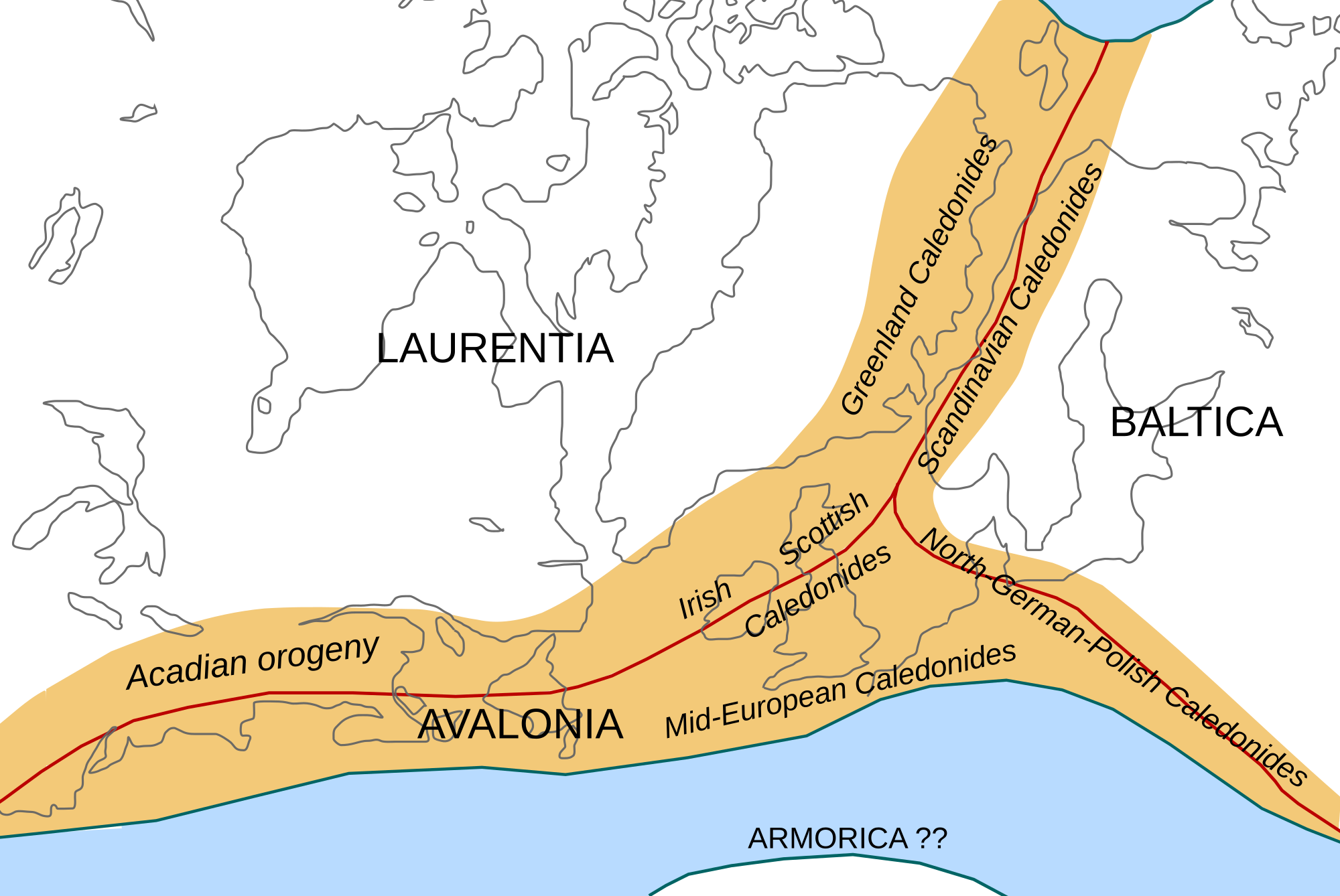
The Caledonian orogeny was a mountain-building cycle recorded in the northern parts of the British Isles, the Scandinavian Caledonides, Svalbard, eastern Greenland and parts of north-central Europe. The Caledonian orogeny encompasses events that occurred from the Ordovician to Early Devonian, roughly 490–390 million years ago (Ma). It was caused by the closure of the Iapetus Ocean when the Laurentia and Baltica continents and the Avalonia microcontinent collided.
The orogeny is named for Caledonia, the Latin name for Scotland. The term was first used in 1885 by Austrian geologist Eduard Suess for an episode of mountain building in northern Europe that predated the Devonian period. Geologists like Émile Haug and Hans Stille saw the Caledonian event as one of several episodic phases of mountain building that had occurred during Earth's history. Current understanding has it that the Caledonian orogeny encompasses a number of tectonic phases that can laterally be diachronous, meaning that different parts of the mountain range formed at different times. The name "Caledonian" can therefore not be used for an absolute period of geological time, it applies only to a series of tectonically related events.
In the Neoproterozoic most of the Earth's landmasses were united in the Rodinia supercontinent. The majority of its bulk consisted of the landmass of Gondwana. Near the end of the Neoproterozoic, during the breakup of this supercontinent, Laurentia and Baltica rifted from the western (Amazonian craton) and northern (African) margins of Gondwana respectively.
Laurentia first drifted westward away from Gondwana and then migrated northward. This led to the opening of the Iapetus Ocean between Laurentia, Baltica and Gondwana. Its initial opening phase was between the adjacent Laurentia and Baltica (to the West and East respectively) and caused the two to breakup c. 615 Ma or 590 Ma. Then the part between Laurentia and Gondwana (to the east), opened c. 550 Ma. Further spreading of the Iapetus Ocean also caused Laurentia and Baltica to move away from each other.
Baltica drifted northward, too. This involved the opening of the Tornquist Ocean which separated it from the northern margin of Gondwana to the south. The onset of Baltica rifting and the Tornquist Ocean opening are difficult to date due to insufficient palaeomagnetic data but must have occurred in similar times as those of Laurentia and the Iapetus Ocean.
Either in the Late Precambrian or Early Ordovician, the Avalonia microcontinent started to drift northwestward from the northern margin of Gondwana (Amazonia and northwest Africa) close to the original position of Baltica which had been to its north. Its rifting involved the opening and spreading of the Rheic Ocean to its south, which separated it from Gondwana. This rifting and opening were coeval with and may be related to subduction onset in the Iapetus Ocean. The drift of Avalonia was towards the positions where Baltica and Laurentia had been in the Ordovician; these continents were by then further north. It also involved the consumption of both the Iapetus Ocean and the Tornquist Ocean along its northern margin.
Avalonia's motion was related to slab pull created by the subduction of the Iapetus Ocean beneath the margin of Laurentia to its northwest and possibly also by ridge push created by the spreading of the Rheic Ocean. It migrated across the Iapetus Ocean orthogonally (at a right angle). Its drift included an up to 55° counterclockwise rotation with respect to the subduction zone to its north, mainly in the 470–450 Ma timeframe. It moved significantly faster than Baltica but slowed down to a rate comparable to that of the latter in the Late Ordovician when it got close to it.
The main phases of the Caledonian orogeny resulted from the convergence of Baltica, Laurentia and Avalonia which led to the closure of the Iapetus Ocean.
Hub AI
Caledonian orogeny AI simulator
(@Caledonian orogeny_simulator)
Caledonian orogeny
The Caledonian orogeny was a mountain-building cycle recorded in the northern parts of the British Isles, the Scandinavian Caledonides, Svalbard, eastern Greenland and parts of north-central Europe. The Caledonian orogeny encompasses events that occurred from the Ordovician to Early Devonian, roughly 490–390 million years ago (Ma). It was caused by the closure of the Iapetus Ocean when the Laurentia and Baltica continents and the Avalonia microcontinent collided.
The orogeny is named for Caledonia, the Latin name for Scotland. The term was first used in 1885 by Austrian geologist Eduard Suess for an episode of mountain building in northern Europe that predated the Devonian period. Geologists like Émile Haug and Hans Stille saw the Caledonian event as one of several episodic phases of mountain building that had occurred during Earth's history. Current understanding has it that the Caledonian orogeny encompasses a number of tectonic phases that can laterally be diachronous, meaning that different parts of the mountain range formed at different times. The name "Caledonian" can therefore not be used for an absolute period of geological time, it applies only to a series of tectonically related events.
In the Neoproterozoic most of the Earth's landmasses were united in the Rodinia supercontinent. The majority of its bulk consisted of the landmass of Gondwana. Near the end of the Neoproterozoic, during the breakup of this supercontinent, Laurentia and Baltica rifted from the western (Amazonian craton) and northern (African) margins of Gondwana respectively.
Laurentia first drifted westward away from Gondwana and then migrated northward. This led to the opening of the Iapetus Ocean between Laurentia, Baltica and Gondwana. Its initial opening phase was between the adjacent Laurentia and Baltica (to the West and East respectively) and caused the two to breakup c. 615 Ma or 590 Ma. Then the part between Laurentia and Gondwana (to the east), opened c. 550 Ma. Further spreading of the Iapetus Ocean also caused Laurentia and Baltica to move away from each other.
Baltica drifted northward, too. This involved the opening of the Tornquist Ocean which separated it from the northern margin of Gondwana to the south. The onset of Baltica rifting and the Tornquist Ocean opening are difficult to date due to insufficient palaeomagnetic data but must have occurred in similar times as those of Laurentia and the Iapetus Ocean.
Either in the Late Precambrian or Early Ordovician, the Avalonia microcontinent started to drift northwestward from the northern margin of Gondwana (Amazonia and northwest Africa) close to the original position of Baltica which had been to its north. Its rifting involved the opening and spreading of the Rheic Ocean to its south, which separated it from Gondwana. This rifting and opening were coeval with and may be related to subduction onset in the Iapetus Ocean. The drift of Avalonia was towards the positions where Baltica and Laurentia had been in the Ordovician; these continents were by then further north. It also involved the consumption of both the Iapetus Ocean and the Tornquist Ocean along its northern margin.
Avalonia's motion was related to slab pull created by the subduction of the Iapetus Ocean beneath the margin of Laurentia to its northwest and possibly also by ridge push created by the spreading of the Rheic Ocean. It migrated across the Iapetus Ocean orthogonally (at a right angle). Its drift included an up to 55° counterclockwise rotation with respect to the subduction zone to its north, mainly in the 470–450 Ma timeframe. It moved significantly faster than Baltica but slowed down to a rate comparable to that of the latter in the Late Ordovician when it got close to it.
The main phases of the Caledonian orogeny resulted from the convergence of Baltica, Laurentia and Avalonia which led to the closure of the Iapetus Ocean.
Recent media