Hubbry Logo
CaledoniaCaledoniaMain
Open search
Caledonia
Community hub
Caledonia
logo
8 pages, 0 posts
0 subscribers
Be the first to start a discussion here.
Caledonia
Caledonia
from Wikipedia

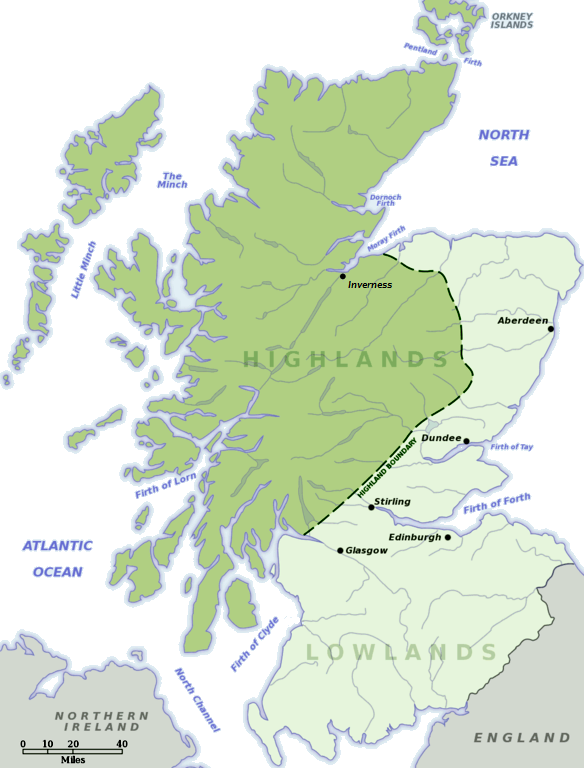
Scottish Highlands and Lowlands
Map of the British Isles drawn from Ptolemy's cartographic works, showing his rotation of Caledonia to the east and delimited from the rest of Great Britain by the estuaries of the Boderia (Firth of Forth) and the Clota (Firth of Clyde). From Edward Bunbury's A History of Ancient Geography Among the Greeks and Romans (1879)

Caledonia (/ˌkælɪˈdniə/; Latin: Calēdonia [kaleːˈdonia]) was the Latin name used by the Roman Empire to refer to the forested region in the central and western Scottish Highlands, particularly stretching through parts of what are now Lochaber, Badenoch, Strathspey, and possibly as far south as Rannoch Moor, known as Coed Celedon (Coed Celyddon using the modern alphabet) to the native Brython (Britons).[1] Today, it is used as a romantic or poetic name for all of Scotland.[2] During the Roman Empire's occupation of Britain, the area they called Caledonia was physically separated from the rest of the island by the Antonine Wall. It remained outside the administration of Roman Britain.

Latin historians, including Tacitus and Cassius Dio, referred to the territory north of the River Forth as "Caledonia", and described it as inhabited by the Maeatae and the Caledonians (Latin: Caledonii).

The north-west ridge of Schiehallion, the "fairy hill of the Caledonians".

History

[edit]

Etymology

[edit]

In 1824, Scottish antiquarian George Chalmers posited that Caledonia derived from Cal-ydon, the name of a Greek province famous for its forests. He hypothesized that classical writers such as Tacitus later applied this name to the Scottish Highlands as another area of woods.[3] This derivation is no longer accepted by modern linguists.[4]

According to linguist Stefan Zimmer, Caledonia is derived from the tribal name Caledones (a Latinization of a Brittonic nominative plural n-stem Calēdones or Calīdones, from earlier *Kalē=Black River=don/Danue Goddess[i]oi). He etymologises this name as perhaps 'possessing hard feet' ("alluding to standfastness or endurance"), from the Proto-Celtic roots *kal- 'hard' and *pēd- 'foot', with *pēd- contracting to -ed-. The singular form of the ethnic name is attested as Caledo (a Latinization of the Brittonic nominative singular n-stem *Calidū) on a Romano-British inscription from Colchester. However, some authors have doubted the link between Calidones and kalet- 'hard',[4] especially in light of the theory that the Caledonians and Picts might not have been Celtic speakers.[5]

Map of the populations in northern Britain, based on the testimony of Ptolemy.

Toponymy

[edit]

The name of the Caledonians may be found in toponymy, such as Dùn Chailleann, the Scottish Gaelic name of the town of Dunkeld, meaning 'fort of the Caledonii', and possibly in that of the mountain Sìdh Chailleann, the 'fairy hill of the Caledonians'.[6][7] According to Historia Brittonum, the site of the seventh battle of the legendary King Arthur was a forest in what is now Scotland, called Coit Celidon in early Welsh.[8][9] The name seems to relate to that of a large central Brythonic tribe, the Caledonii, one amongst several in the area and perhaps the dominant tribe, which would explain the binomial Caledonia/Caledonii.[citation needed]

Modern usage

[edit]
Scottish pub in Budapest named "The Caledonia"

The modern use of "Caledonia" in English and Scots is either as a historical description of northern Britain during the Roman era or as a romantic or poetic name for Scotland as a whole.[9][10]

The name has been widely used by organisations and commercial entities. Notable examples include Glasgow Caledonian University, ferry operator Caledonian MacBrayne, and the now-defunct British Caledonian airline and Caledonian Railway. The Caledonian Sleeper is an overnight train service from London to Scottish destinations.

The Inverness Caledonian Thistle F.C. is a professional football club. In music, "Caledonia" is a popular Scottish patriotic song and folk ballad written by Dougie MacLean in 1977 and published in 1979 on an album of the same name; it has since been covered by various other artists, most notably Frankie Miller and Van Morrison.[11][12] An original rock piece titled Caledonia appeared on Robin Trower's fourth album, "Long Misty Days", where coincidentally Frankie Miller cowrote another track on that album. The web series Caledonia and associated novel is a supernatural police drama that takes place in Glasgow, Scotland.[13][14]

Ptolemy's account in his Geography also referred to the Caledonia Silva, an idea still recalled in the modern expression "Caledonian Forest", although the woods are much reduced in size since Roman times.[15][note 1]

Some scholars point out that the name "Scotland" is ultimately derived from Scotia, a Latin term first used for Ireland (also called Hibernia by the Romans) and later for Scotland, the Scoti peoples having originated in Ireland and resettled in Scotland.[note 2] Another, post-conquest, Roman name for the island of Great Britain was Albion, which is cognate with the Scottish Gaelic name for Scotland: Alba.

There is an emerging trend to use the term Caledonia to describe New Caledonia in English, which reflects the usage in French of Calédonie (where the full name is La Nouvelle-Calédonie). The New Caledonian trade and investment department promotes inward investment with the slogan "Choose Caledonia".

See also

[edit]

Notes

[edit]

References

[edit]
[edit]
Revisions and contributorsEdit on WikipediaRead on Wikipedia
from Grokipedia
Caledonia was the Latin name used by the ancient Romans to refer to the northern part of the island of , encompassing the region that roughly corresponds to modern-day . This area, primarily located north of the (the northernmost Roman frontier in Britain, including the earlier further south), was never fully conquered by the Romans and served as a against their expansion. The name derives from the Celtic inhabitants known as the Caledonii, a tribal in the , though its precise etymology remains unknown and is presumed to be of Celtic origin. The region was home to various Celtic tribes in northern Britain, such as the Caledonii in the north, the Venicones in the east, the Votadini in the southeast, and the Damnoni in the southwest. The northern tribes, particularly the Caledonii, were referred to by Romans as and later as —meaning "the painted ones"—due to their custom of body decoration with dyes and paints. These groups lived in tribal societies, engaging in farming, fishing, hunting, and inter-tribal conflicts, with no surviving written records from them; historical knowledge comes primarily from Roman accounts, such as those by the historian , who described the as red-haired with large limbs. Roman military campaigns, including those led by in AD 84 at the and by Emperor in 209–211, aimed to subdue the area but achieved only temporary gains, leading to the eventual Roman withdrawal by the early 5th century. In the post-Roman era, Caledonia saw the emergence of the Pictish kingdom dominating central and eastern , alongside Irish settlers known as the Scotti who established the kingdom of around 500–550, contributing to the cultural foundations of medieval . These developments laid the groundwork for the unification of under in the . The term "Caledonia" persisted poetically into the and beyond as a romantic reference to or its Highlands, evoking its rugged landscapes and historical independence.

Name and Origins

Etymology

The name "Caledonia" derives from the tribal designation Caledones, referring to a Celtic-speaking group inhabiting northern Britain during the Roman era. This is first attested in Latin sources from the late AD, with the earliest explicit reference appearing in ' Agricola (c. 98 AD), where it describes the region beyond the Forth-Clyde as the homeland of the Caledones, whom the Romans encountered during Gnaeus Julius Agricola's campaigns. Linguistically, Caledones is reconstructed as a Proto-Celtic from the roots *kal- ("hard" or "harsh") and *pēd- ("foot"), yielding a meaning such as "possessing hard feet," which scholars interpret as alluding to the of the people or the rugged, unyielding terrain of their mountainous homeland. This aligns with patterns in other Celtic tribal names and is supported by comparative analysis of and Brythonic forms, such as the moneyer's name Caletedu ("having hard feet"). Earlier 19th-century proposals, such as that by Scottish antiquarian George Chalmers, who derived Caledonia from the region of Calydon—renowned for its dense forests—and suggested a phonetic and thematic link to North Britain's wooded landscapes, have been widely rejected in favor of the Celtic origins.

Toponymy

The term "Caledonii" appears in Claudius Ptolemy's (c. 150 AD) as the name of a tribal group inhabiting the northern regions of Britain, north of the , thereby establishing an early toponymic association with the broader area later known as Caledonia. This designation influenced subsequent Roman and post-Roman mappings of the region, where the Caledonii were positioned among other northern tribes like the Vacomagi and Taexali, contributing to the enduring linkage of the name with Scotland's Highland landscapes. In Scottish Gaelic, while "Alba" serves as the modern endonym for Scotland—derived from earlier Pictish and Irish Gaelic roots—"Caledonia" persists in localized toponyms that evoke its ancient tribal connotations. Notable examples include Dùn Chailleann, the Gaelic name for meaning "fort of the Caledonii," and Sìdh Chailleann, referring to as the "fairy hill of the Caledonii," reflecting a of the ancient people in Perthshire place names. These forms demonstrate how the root Caled- adapted into Gaelic nomenclature for fortified sites and mythical elevations, preserving the term's resonance without supplanting Alba as the national identifier. The name's legacy extends into Welsh traditions, where "Celyddon" evolved as a poetic synonym for dense forest or untamed wilderness, often denoting the mythical Caledonian Wood. In Arthurian legend, this manifests as "Coit Celidon" or "Cat Coit Celidon" (Battle of the Wood of Celyddon), a site of King Arthur's seventh battle against northern invaders in early Welsh texts like the Historia Brittonum, symbolizing a primordial, enchanted woodland spanning southern Scotland and northern England. This usage underscores Celyddon's role in medieval Welsh literature as an archetypal wild domain, distinct from but echoing the Roman Caledonia in evoking northern Britain's forested frontiers.

Historical Usage

Roman Period

The Roman Empire's interactions with Caledonia began in earnest during the late 1st century AD, as governors sought to extend control northward from the conquered provinces of . , governor from AD 77 to 84, conducted a series of campaigns that pushed Roman forces into Caledonian territory, subduing tribes through a combination of military action and fort construction. These efforts culminated in the around AD 83, where Agricola's legions confronted a of Caledonian tribes led by the chieftain ; reports a decisive Roman victory, with approximately 10,000 Caledonians slain and only 360 Roman casualties, though the exact location remains debated among the hills of northeastern . Roman historians provided vivid, if biased, descriptions of Caledonia as a rugged . In his biography Agricola, portrayed the region as a wild expanse of dense forests, marshes, and mountains, emphasizing its inhospitable terrain that hindered Roman advance and symbolized the untamed spirit of its inhabitants; he noted that prior to Agricola's campaigns, Roman knowledge extended little beyond the "." This depiction served to glorify Agricola's achievements while critiquing imperial overreach. Following Agricola's recall to in AD 84, Roman presence in the far north waned, but in AD 142, Emperor ordered the construction of the —a turf and stone barrier stretching 37 miles from the to the —to demarcate the frontier, with Caledonia lying immediately to its north. By the early 3rd century, renewed conflict arose as Caledonian tribes allied against Roman incursions. The Caledonians formed a confederation with the Maeatae, a group inhabiting lands south of the Highlands, to challenge provincial borders; this alliance intensified during Emperor Septimius Severus' expedition from AD 208 to 211, when the Maeatae rebelled and persuaded the Caledonians to join them in breaking truces. Severus led a massive force of up to 50,000 troops into Caledonia, ravaging the landscape through scorched-earth tactics and constructing temporary camps, but the campaign yielded no permanent conquest and ended with his death in Eboracum (York) in AD 211; Cassius Dio recounts the emperor's frustration with the "endless wilderness" and elusive foes. In Roman accounts, Caledonia encompassed the territory roughly corresponding to modern north of the , a region inhabited by P-Celtic-speaking tribes whose Brittonic language distinguished them from southern Britons. These peoples maintained a decentralized tribal structure, relying on guerrilla warfare amid the terrain's natural defenses, which repeatedly frustrated Roman ambitions for full subjugation.

Post-Roman Developments

Following the Roman withdrawal from Britain in 410 AD, when Emperor Honorius instructed the Britons to defend themselves against increasing incursions from , Scots, and , the region north of —known to Romans as Caledonia—was left under the control of indigenous groups, including remnants of the Caledonian tribes. This abandonment marked the end of direct Roman administration in the area, allowing local polities to consolidate without imperial oversight, though sporadic raids from the south persisted into the fifth century. The are widely regarded as precursors to the , who emerged as a dominant in northern and eastern from the fifth to ninth centuries, forming kingdoms such as those centered in and Circinn. Scholarly analyses trace this continuity through linguistic and cultural links, with the likely comprising Brittonic-speaking groups augmented by earlier Caledonian elements and possibly refugees from Romanized southern Britain. By the sixth century, the term "Caledonia" began to fade in contemporary records, supplanted by "Pictland" or "Pictavia" in Latin sources, reflecting the ' self-identification as a painted or tattooed people (Picti). Early medieval texts, including and 's Ecclesiastical History of the English People (completed in 731 AD), frequently link the to both and Scots in narratives of migration and conflict. describes the as arriving from via before settling in northern Britain, where they allied with Scots against Britons in the post-Roman era, while Irish chronicles such as those compiled in the Annals of the Caledonians, Picts, and Scots portray as indigenous to the region, often conflated with in accounts of battles and royal successions up to the eighth century. These sources highlight ongoing interactions, such as Pictish raids on and alliances with Scots. The Christianization of these groups, beginning with St. Columba's mission to the northern in 565 AD, facilitated cultural integration and paved the way for political unification. Columba's establishment of the monastery on influenced both and Scots, standardizing practices like the cycle by the early eighth century under King Nechtan. This religious convergence contributed to the formation of the Kingdom of Alba in the ninth century, when united Pictish and Scottish territories around 843 AD, rendering "Caledonia" an archaic term in favor of the Gaelic-derived "Alba." By this unification, Pictish identity merged into the broader Scottish realm, with the last distinct Pictish king recorded around 900 AD.

Geography and Extent

Roman Descriptions

Roman writers portrayed Caledonia as a rugged, inhospitable territory characterized by dense forests, towering mountains, and numerous lochs, contrasting sharply with the more fertile southern regions of Britain. In his Agricola, describes the landscape as a northern extension of Britain forming a promontory-like , with its irregular shape resembling a double-headed battle-axe due to protruding arms that likely correspond to major sea lochs. He emphasizes the challenging terrain encountered during military campaigns, including thick woodlands and elevated grounds that hindered Roman advances. also depicts the inhabitants as hardy warriors organized in tribal societies, noting their tall stature, red hair, and large limbs—traits he attributes to a possible Germanic origin—while highlighting their fierce independence and reliance on guerrilla tactics in the mountainous interior. The geographer Claudius provided one of the most detailed cartographic representations of Caledonia in his second-century work , compiling data from earlier Roman surveys and maritime explorations. lists nine major Caledonian s, including prominent groups such as the Caledonii in the central Highlands, the Taexali in the northeast, and the Venicones further south near the Tay, along with coordinates for key settlements and natural features. Notable sites include the town of Virodumum associated with the Smertae and Mons Graupius, site of a significant Roman victory under Agricola. This mapping effort underscores the fragmented political landscape of tribal confederacies rather than unified kingdoms, aiding Roman strategic planning despite the region's remoteness. Environmental descriptions from later historians like and reinforce the image of Caledonia as a wild, forested expanse dominating the Highlands. Dio, recounting ' campaigns around 210 CE, details the "countless hardships" of traversing the terrain, including cutting down vast forests, leveling heights, filling swamps, and bridging rivers, portraying the as an immense, impenetrable barrier covering much of the interior. similarly notes the Britons beyond —encompassing the and —as dwelling amid "inaccessible mountains and dense forests," where they constructed temporary huts from branches and subsisted through raiding, emphasizing the landscape's role in fostering a nomadic, resilient . These accounts highlight how the thick woodland, often referred to as the Caledonia Silva, shaped both daily existence and resistance to invasion. Roman sources consistently defined Caledonia's boundaries as commencing north of the , a turf fortification stretching 37 miles across the isthmus between the and , established around 142 CE under Emperor to demarcate the empire's northern frontier. This wall separated Roman Britannia from the unconquered territories, with Caledonia extending northward through the Highlands to encompass the northern isles, including the Orkney Islands (Orcades) as noted by in his account of Agricola's fleet circumnavigating the coast. Excluding the more Romanized southern Britain, this delineation reflected both strategic defenses and the perceived cultural divide between civilized provinces and barbarian wilderness.

Associated Landscapes

The term Caledonia, derived from the Roman name for the northern British region, has a geological tie to the Caledonian Orogeny, a Devonian-period mountain-building event approximately 400 million years ago that shaped the Scottish Highlands' rugged backbone, with the orogeny's name itself drawing from this ancient designation for Scotland. Central to the landscapes associated with Caledonia is the ancient Caledonian Forest, a vast woodland that once covered about 1.5 million hectares across the Scottish Highlands during prehistoric times, dominated by Scots pine, birch, and other native species. Today, this forest has been reduced to roughly 17,900 hectares across scattered remnants in the central and northeastern Grampian mountains and northern and western Highlands, primarily due to historical deforestation from agriculture, timber extraction, and grazing. Restoration efforts, such as those led by the Trees for Life charity since 1993, focus on rewilding initiatives at sites like the Dundreggan estate, planting native trees and managing deer populations to regenerate ecological diversity and connectivity in these pinewoods. The mountainous terrain of Caledonia evokes the etymology of the name, possibly from the Caledones tribe meaning "possessing hard feet," alluding to the endurance required to navigate the rocky, elevated landscapes that challenged ancient inhabitants and Roman explorers alike. This ruggedness is exemplified by the , a broad range formed during the , encompassing high plateaus and peaks that define the Highland interior. Within this, the stand as a prominent sub-range, featuring granite-cored summits rising over 1,200 meters, their exposed tors and glacial valleys preserving a direct link to the prehistoric environment Romans encountered north of their Forth-Clyde frontier. Rivers and coasts noted in Roman accounts further anchor Caledonian identity, with the River Tay serving as a key navigable waterway that facilitated military campaigns, as Emperor sailed along it in 209 CE to reach northern strongholds. Similarly, the River Clyde marked a southern boundary in Roman descriptions, its forming part of the between the Clyde and Forth that delimited the forested, tribal lands of Caledonia proper. These waterways, flowing through glens and emptying into firths, integrated with the Highland topography to create a cohesive, enduring geographical character that persists in modern .

Cultural Significance

Literary References

In medieval Welsh Arthurian literature, Caledonia appears as a forested realm associated with ancient kings and heroic quests. In the tale (c. ), the protagonist is the son of Cilydd, son of Celyddon—a name derived from the Welsh Coed Celyddon, referring to the dense north of the Forth-Clyde , symbolizing a wild, untamed Scottish landscape integral to Arthurian lore. This depiction portrays Caledonia not as a mere geographic entity but as a mythical domain of exile and adventure, where figures like the wild man Gwrhyr Gwalstawd Ieithoedd navigate its woods in pursuit of boars and treasures. The 18th-century revival of Caledonia as a literary motif emerged in patriotic poetry responding to political turmoil. Tobias Smollett's The Tears of Scotland (1746), composed in the aftermath of the , invokes "hapless Caledonia" as a personified victim of English oppression, with lines like "Mourn, hapless Caledonia, mourn / Thy banish'd peace—thy laurels torn!" lamenting the slaughter of Highland clans and the destruction of their homes. This work uses Caledonia to evoke national grief and resilience, transforming the classical name into a symbol of 's martial heritage and post-Jacobite suffering, influencing later sentimental verse on union and loss. During the Romantic era, James Macpherson's forged Ossianic poems (1760s) romanticized Caledonia as a heroic, mist-shrouded homeland of ancient warriors. In Fingal (1762), Ossian, the blind bard, mourns the "dark-rolling clouds of Caledonia" and its "sons of the mighty," portraying the land as a sublime wilderness where ghosts of fallen heroes wander amid tempests and glens, blending Gaelic folklore with classical epic to idealize pre-Roman Scotland. These evocations, presented as translations from third-century Gaelic, captivated European Romantics by framing Caledonia as a site of primal nobility and melancholy, though later exposed as Macpherson's inventions, they shaped perceptions of Scottish identity as timeless and untamed. In the Victorian period, Sir Walter Scott integrated Caledonia into his historical novels to reinforce Scottish cultural identity amid British integration. In Waverley (1814), the term appears in descriptions of Highland customs, such as a French traveler's note on "the memorabilia of Caledonia" regarding village dogs, underscoring the region's rugged traditions during the 1745 Jacobite Rising. Scott's references, often poetic like the "Albyn" verses sung by Flora Mac-Ivor—"‘T was then thou sought’st on Albyn’s hill"—evoke Caledonia as a land of resistance and romance, weaving it into narratives that celebrate Scotland's distinct heritage while affirming union, thus popularizing the motif in 19th-century literature.

Artistic and Symbolic Uses

In music, "Caledonia" stands as a prominent example of the term's enduring appeal, particularly through Dougie MacLean's 1977 folk ballad of the same name. Written in just ten minutes while MacLean felt homesick on a beach in , , the song expresses a deep longing for and has evolved into an unofficial anthem for the , resonating with themes of home and identity among expatriates worldwide. Visual arts in the 19th century frequently invoked Caledonia to romanticize Scotland's rugged terrains, with Horatio McCulloch emerging as a key figure in this tradition. A Glasgow-born painter active from the 1830s onward, McCulloch specialized in dramatic Highland landscapes that emphasized sublime natural beauty and emotional depth, contributing to the Victorian-era idealization of Caledonian scenery as wild and majestic. Notable works include his 1864 depiction of Glencoe, which portrays the valley's brooding cliffs and misty atmosphere to evoke a sense of untamed Highland spirit. His paintings, often exhibited at the Royal Scottish Academy, helped shape public perceptions of Caledonia as a poetic emblem of Scotland's primal allure. Symbolically, Caledonia has long embodied Scottish resilience, serving as an ancient Latin descriptor for the northern realms beyond Roman control and thus representing enduring . In , it appears in emblems like the badge of HMS Caledonia, incorporating thistles and lions—traditional Scottish motifs—to honor this historical nomenclature as a marker of national fortitude. During the Jacobite risings of the , such evocations of Caledonian heritage underpinned broader of defiance, with tartans and highland reinforcing ties to pre-Union amid efforts to restore the Stuart monarchy. In film and theater, Caledonia's legacy manifests through narratives that channel its ancient warrior ethos, as seen in Mel Gibson's 1995 epic . The film dramatizes William Wallace's 13th-century rebellion against English rule, portraying Scottish fighters as inheritors of a fierce Caledonian resolve that symbolizes unyielding cultural and territorial pride. This depiction, while historically dramatized, amplifies Caledonia as a shorthand for Scotland's mythic resistance in popular media.

Modern Legacy

Usage in Scotland

In contemporary Scotland, the term "Caledonia" persists in the nomenclature of key institutions and enterprises, symbolizing national heritage in education, sports, transport, and industry. , a public research institution in , was formed on 1 April 1993 through the merger of The Queen's College, Glasgow (established 1875) and Glasgow Polytechnic (formerly Glasgow College of Technology, founded 1971), serving nearly 23,000 students as of 2024 across diverse programs in health, business, and engineering. In sports, , a professional football club based in , was officially established in August 1994 via the merger of Caledonian F.C. (founded 1885) and Inverness Thistle F.C. (also 1885), enabling entry into the and eventual promotion to the . The transport sector prominently features "Caledonia" in both current and historical operations. Caledonian MacBrayne Ltd (CalMac), Scotland's main ferry operator for the west coast and islands, was created in 1973 by amalgamating the Caledonian Steam Packet Company (established 1889) and David MacBrayne Ltd (roots in 1851), now managing over 30 routes and carrying millions of passengers annually under public ownership. Historically, the Caledonian Railway, authorized by the Caledonian Railway Act of 1845, developed an extensive network linking , , and Carlisle to , operating until its integration into the London, Midland and Scottish Railway on 1 January 1923 as part of the Railways Act 1921. Beyond transport, the exemplifies enduring infrastructure named after the term; engineered by and completed in 1822 after 19 years of construction at a cost of £910,000, this 60-mile waterway traverses the , connecting and other lochs with 29 locks to enable sea-to-sea passage for vessels up to 150 feet long. In brewing, the in , established in 1869 by George Lorimer and Robert Clark adjacent to the Caledonian Railway, specialized in traditional ales like Deuchars IPA and 80/-, becoming the city's last major brewery before its 2022 closure announcement by owner , with production shifting elsewhere; the site was sold in late 2023 and plans for 168 homes were approved in May 2025. Politically, "Caledonia" sees sporadic invocation in discourse, notably during the 2014 campaign, where it surfaced in media analyses and commentary as a romantic emblem of Scotland's distinct identity amid debates on . This usage underscores the term's role in evoking cultural pride, though it remains more poetic than formal in policy contexts.

International Adaptations

The name "Caledonia" has been adopted in various international place names, reflecting influences and historical explorations. In , the community of Caledonia in , , was named by founder Ranald McKinnon, who was of Scottish ancestry, to honor his heritage when he laid out the village in the early . Similarly, Caledonia County in northeastern , USA, derives its name from the ancient Roman term for , chosen in 1796 to recognize the significant number of Scottish settlers who had purchased land there and contributed to its early development. In the Pacific, the archipelago known as (Nouvelle-Calédonie) was named by British explorer in 1774 after the Latin word for , due to perceived resemblances in its landscape to the ; formally annexed it in 1853. Scottish emigrants have carried the name "Caledonia" to communities worldwide, establishing societies to preserve cultural ties. For instance, the Caledonian Society of , founded in 1839 by Scots living in , promotes fellowship among those connected to and supports charitable works benefiting Scottish causes, serving as a model for similar groups in other countries. In global media, the term "Caledonia" appears in cultural exports, particularly through music and literature. Dougie MacLean's 1977 folk song "Caledonia," often regarded as a modern anthem evoking Scottish identity, has been covered by over 200 artists internationally, including Irish singer on his 2006 Winter Songs, which brought the track to broader audiences beyond .

References

Add your contribution
Related Hubs
User Avatar
No comments yet.