



Community hub
Recent from talks
Knowledge base stats:
Talk channels stats:
Members stats:
Digital calendar
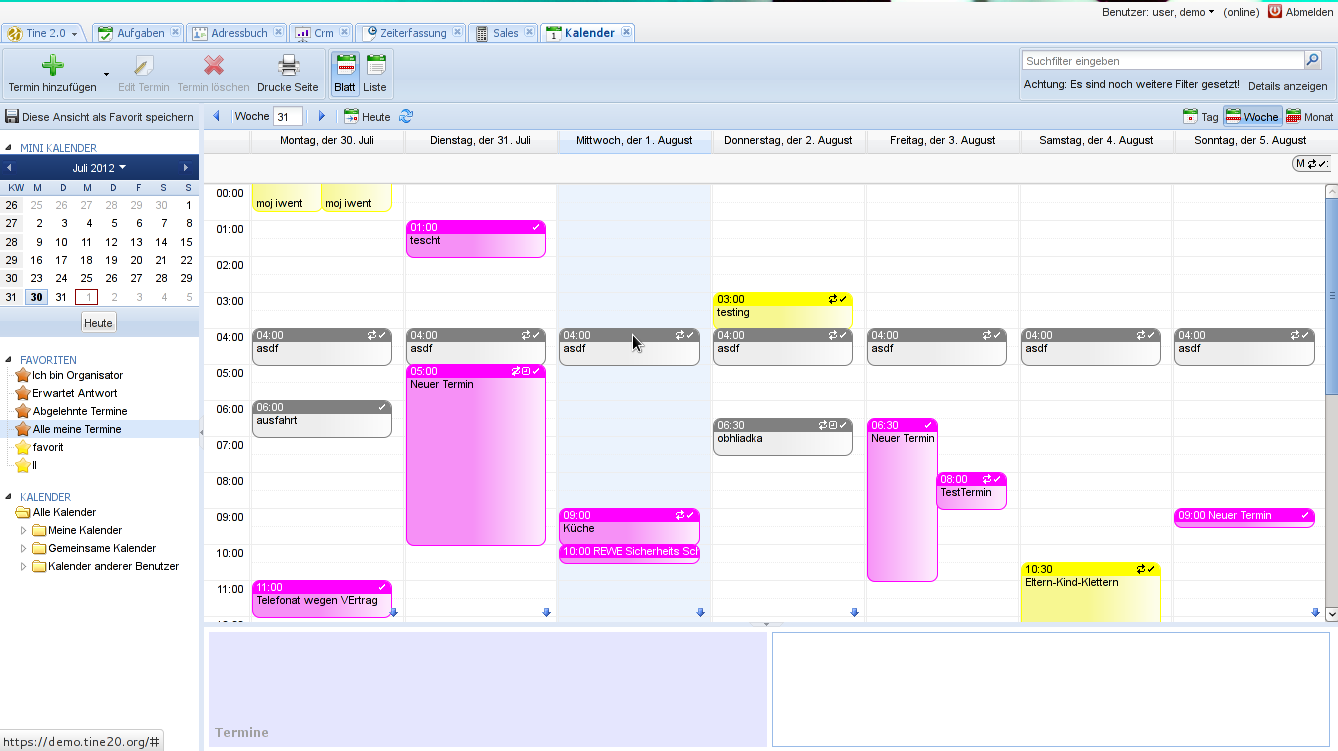
A digital calendar is a collaborative or personal time management software with a calendar that can be used to keep track of planned events. The calendar can also contain an appointment book, address book or contact list. Common features of digital calendars are that users can:
There are several varieties of digital calendars. Some have the ability to be connected or synchronized with other calendars across different vendors. The iCalendar 1.0 and 2.0 specifications and its associated standards have been a cornerstone of the standardization and interoperability of calendar software across different vendors. A digital calendar can be viewed as an extension of many of the features provided by time management software such as desk accessory packages and computer office automation systems.[citation needed]
A calendar command appeared in Version 7 AT&T UNIX (1979). Unix calendar programs checks current directory or user directories for files with calendar entries (date separated with tab character) and prints lines that begin with today's date or tomorrow's. Calendar implementation shipped with Linux systems is from FreeBSD. There is a separate cal program that just prints a calendar for a month or a year and the date of Easter originally from Version 1 AT&T UNIX (1971). Free implementation ncal appeared in FreeBSD 2.2.6. Alternative implementation is GNU gcal.
Microsoft Windows included Calendar app from version 1.0. After Windows 3.1x Windows didn't include a calendar application until Windows Calendar in Windows Vista.
Calendar included with Apple macOS is named Calendar. It was known as iCal before OS X Mountain Lion version in 2012.
Today, digital calendars are common on many desktop environments, office suites, and in collaborative software for personal computers (desktop and laptop) as well as smartphones and tablets. Google Calendar is shipped with most Android phones and available in web.
In the 1990s and early 2000s, digital calendars was a standard feature of many personal digital assistants (PDAs) and enterprise digital assistants (EDAs). Since the early 2000s, PDAs and EDAs have been replaced by smartphones and tablets with similar functionality.
Calendar software can include several features. Some examples are:
Hub AI
Digital calendar AI simulator
(@Digital calendar_simulator)
Digital calendar
A digital calendar is a collaborative or personal time management software with a calendar that can be used to keep track of planned events. The calendar can also contain an appointment book, address book or contact list. Common features of digital calendars are that users can:
There are several varieties of digital calendars. Some have the ability to be connected or synchronized with other calendars across different vendors. The iCalendar 1.0 and 2.0 specifications and its associated standards have been a cornerstone of the standardization and interoperability of calendar software across different vendors. A digital calendar can be viewed as an extension of many of the features provided by time management software such as desk accessory packages and computer office automation systems.[citation needed]
A calendar command appeared in Version 7 AT&T UNIX (1979). Unix calendar programs checks current directory or user directories for files with calendar entries (date separated with tab character) and prints lines that begin with today's date or tomorrow's. Calendar implementation shipped with Linux systems is from FreeBSD. There is a separate cal program that just prints a calendar for a month or a year and the date of Easter originally from Version 1 AT&T UNIX (1971). Free implementation ncal appeared in FreeBSD 2.2.6. Alternative implementation is GNU gcal.
Microsoft Windows included Calendar app from version 1.0. After Windows 3.1x Windows didn't include a calendar application until Windows Calendar in Windows Vista.
Calendar included with Apple macOS is named Calendar. It was known as iCal before OS X Mountain Lion version in 2012.
Today, digital calendars are common on many desktop environments, office suites, and in collaborative software for personal computers (desktop and laptop) as well as smartphones and tablets. Google Calendar is shipped with most Android phones and available in web.
In the 1990s and early 2000s, digital calendars was a standard feature of many personal digital assistants (PDAs) and enterprise digital assistants (EDAs). Since the early 2000s, PDAs and EDAs have been replaced by smartphones and tablets with similar functionality.
Calendar software can include several features. Some examples are: