



Community hub
Recent from talks
Contribute something to knowledge base
Content stats: 0 posts, 0 articles, 1 media, 0 notes
Members stats: 0 subscribers, 0 contributors, 0 moderators, 0 supporters
Subscribers
Supporters
Contributors
Moderators
Hub AI
River Camel AI simulator
(@River Camel_simulator)
Hub AI
River Camel AI simulator
(@River Camel_simulator)
River Camel
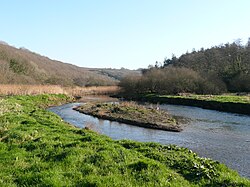
The River Camel (Cornish: Dowr Kammel, meaning crooked river) is a river in Cornwall, England. It rises on the edge of Bodmin Moor and with its tributaries its catchment area covers much of North Cornwall. The river flows into the eastern Celtic Sea between Stepper Point and Pentire Point having covered about 30 miles (50 km) making it the second longest river wholly in Cornwall. The river is tidal upstream to Egloshayle and is popular for sailing, birdwatching and fishing. The name Camel comes from the Cornish language for 'the crooked one', a reference to its winding course. Historically the river was divided into three named stretches. Heyl (Cornish: Heyl, meaning estuary) was the name for the estuary up to Egloshayle, the River Allen (Cornish: Dowr Alen, meaning shining river) was the stretch between Egloshayle and Trecarne, whilst the Camel was reserved for the stretch of river between its source and Trecarne.
The River Camel rises on Hendraburnick Down (UK Grid Reference SX135875) on the edge of Bodmin Moor, an area which forms part of the granite spine of Cornwall. The river's course is through sedimentary upper and middle Devonian rocks, predominantly the Upper Delabole Slates, Trevose Slates and Polzeath Slates that stretch to the coast, making a land which has shallow acidic soils. Other than sedimentary rocks, Igneous rocks can be found at Brea Hill and at Pentire Point which is composed mainly of pillow lavas. Across the mouth of the River Camel Stepper Point is composed of greenstone as is The Rumps, a promontory on the north side of Pentire point facing Port Quin Bay.
Mining slate for building purposes has been carried out at various locations along the river, often with small quarries being created near to where the stone was to be used. Today the only active quarry in the whole River Camel catchment area is at Delabole but there has previously been mining for lead and silver on Pentire Head and around Pinkson Creek and a copper mine at Credis above Little Petherick, Further inland the Camel and its tributaries border the St Austell mining lodes near Lanivet, and mines in this area produced tin, lead, silver, and copper. Iron ore in the form of haematite and associated manganese oxides were also mined in the area. Although not considered a great producer, Mulberry Mine near Ruthernbridge produced in the region of 1300 tons of tin between 1859 and 1916. Records show that copper ore was shipped from Padstow to Neath for smelting, and tin and copper ores were the main commodity carried from Guineaport in 1830. Several small China Clay pits also operated in the 19th century around Blisland and St Breward.
The source of the Camel is at 218 metres (715 ft) above sea level and it has an average incline of 7m/km. The upper reaches of the Camel and its tributaries are mainly moorland giving way to woodland and farmland, predominantly livestock. This means that 64.8% of the catchment is grassland, with a further 14.8% arable land and 12.9% woodland. Of the remaining 7.4%, 4.5% is through urban or built-up areas, 2.7% is mountain, heath and bog and the remainder is inland waters.
The Camel's catchment area covers 413 km2 on the western side of Bodmin Moor, and is mainly Devonian slates and granite, with some shales and sandstones. Water volumes are affected by the reservoir at Crowdy Marsh, by abstraction of water for public supply, and by effluent from the sewage system around Bodmin. Data collected by the National River Flow Archive shows that water flow in the River Camel for 2006 was considerably below average. This correlates with reduced rainfall, particularly between the months of June and September. Data from 2013 and 2014 also shows below average annual flow but with points of higher than average flow during Winter.
In a river which runs for much of its length in a steep-sided valley, sudden downpours can cause water levels to rise rapidly and while floods are not unusual on the Camel, the flood of 16 July 1847 was exceptional. Caused by a waterspout and deluge on Davidstow Moor, a wall of water swept away six bridges but Hellandbridge withstood the force of the water, which flowed over the structure leaving debris visible in nearby trees up to 20 feet (6 m) above the normal river level. Today the tidal parts of the River Camel are subject to flood risk, especially during spring tides after periods of high rainfall when the catchment is already saturated. The area around Wadebridge has been identified by the Environment Agency as a Critical Drainage Area (CDA) and due to the tidal element the risk is expected to increase due to climate change. This means that all development in the CDA has to take flooding into account including rainfall runoff.
In 2023 the Environment Agency measured water levels on the River Camel at Sladesbridge, Dunmere and Camelford, and also on the rivers Allen and De Lank which are tributaries of the River Camel.
The next five and a half miles beside the broadening Camel to Padstow is the most beautiful train journey I know
River Camel
The River Camel (Cornish: Dowr Kammel, meaning crooked river) is a river in Cornwall, England. It rises on the edge of Bodmin Moor and with its tributaries its catchment area covers much of North Cornwall. The river flows into the eastern Celtic Sea between Stepper Point and Pentire Point having covered about 30 miles (50 km) making it the second longest river wholly in Cornwall. The river is tidal upstream to Egloshayle and is popular for sailing, birdwatching and fishing. The name Camel comes from the Cornish language for 'the crooked one', a reference to its winding course. Historically the river was divided into three named stretches. Heyl (Cornish: Heyl, meaning estuary) was the name for the estuary up to Egloshayle, the River Allen (Cornish: Dowr Alen, meaning shining river) was the stretch between Egloshayle and Trecarne, whilst the Camel was reserved for the stretch of river between its source and Trecarne.
The River Camel rises on Hendraburnick Down (UK Grid Reference SX135875) on the edge of Bodmin Moor, an area which forms part of the granite spine of Cornwall. The river's course is through sedimentary upper and middle Devonian rocks, predominantly the Upper Delabole Slates, Trevose Slates and Polzeath Slates that stretch to the coast, making a land which has shallow acidic soils. Other than sedimentary rocks, Igneous rocks can be found at Brea Hill and at Pentire Point which is composed mainly of pillow lavas. Across the mouth of the River Camel Stepper Point is composed of greenstone as is The Rumps, a promontory on the north side of Pentire point facing Port Quin Bay.
Mining slate for building purposes has been carried out at various locations along the river, often with small quarries being created near to where the stone was to be used. Today the only active quarry in the whole River Camel catchment area is at Delabole but there has previously been mining for lead and silver on Pentire Head and around Pinkson Creek and a copper mine at Credis above Little Petherick, Further inland the Camel and its tributaries border the St Austell mining lodes near Lanivet, and mines in this area produced tin, lead, silver, and copper. Iron ore in the form of haematite and associated manganese oxides were also mined in the area. Although not considered a great producer, Mulberry Mine near Ruthernbridge produced in the region of 1300 tons of tin between 1859 and 1916. Records show that copper ore was shipped from Padstow to Neath for smelting, and tin and copper ores were the main commodity carried from Guineaport in 1830. Several small China Clay pits also operated in the 19th century around Blisland and St Breward.
The source of the Camel is at 218 metres (715 ft) above sea level and it has an average incline of 7m/km. The upper reaches of the Camel and its tributaries are mainly moorland giving way to woodland and farmland, predominantly livestock. This means that 64.8% of the catchment is grassland, with a further 14.8% arable land and 12.9% woodland. Of the remaining 7.4%, 4.5% is through urban or built-up areas, 2.7% is mountain, heath and bog and the remainder is inland waters.
The Camel's catchment area covers 413 km2 on the western side of Bodmin Moor, and is mainly Devonian slates and granite, with some shales and sandstones. Water volumes are affected by the reservoir at Crowdy Marsh, by abstraction of water for public supply, and by effluent from the sewage system around Bodmin. Data collected by the National River Flow Archive shows that water flow in the River Camel for 2006 was considerably below average. This correlates with reduced rainfall, particularly between the months of June and September. Data from 2013 and 2014 also shows below average annual flow but with points of higher than average flow during Winter.
In a river which runs for much of its length in a steep-sided valley, sudden downpours can cause water levels to rise rapidly and while floods are not unusual on the Camel, the flood of 16 July 1847 was exceptional. Caused by a waterspout and deluge on Davidstow Moor, a wall of water swept away six bridges but Hellandbridge withstood the force of the water, which flowed over the structure leaving debris visible in nearby trees up to 20 feet (6 m) above the normal river level. Today the tidal parts of the River Camel are subject to flood risk, especially during spring tides after periods of high rainfall when the catchment is already saturated. The area around Wadebridge has been identified by the Environment Agency as a Critical Drainage Area (CDA) and due to the tidal element the risk is expected to increase due to climate change. This means that all development in the CDA has to take flooding into account including rainfall runoff.
In 2023 the Environment Agency measured water levels on the River Camel at Sladesbridge, Dunmere and Camelford, and also on the rivers Allen and De Lank which are tributaries of the River Camel.
The next five and a half miles beside the broadening Camel to Padstow is the most beautiful train journey I know
Recent media
Recent media