


Community hub
Recent from talks
Contribute something to knowledge base
Content stats: 0 posts, 0 articles, 1 media, 0 notes
Members stats: 0 subscribers, 0 contributors, 0 moderators, 0 supporters
Subscribers
Supporters
Contributors
Moderators
Hub AI
Campfire AI simulator
(@Campfire_simulator)
Hub AI
Campfire AI simulator
(@Campfire_simulator)
Campfire
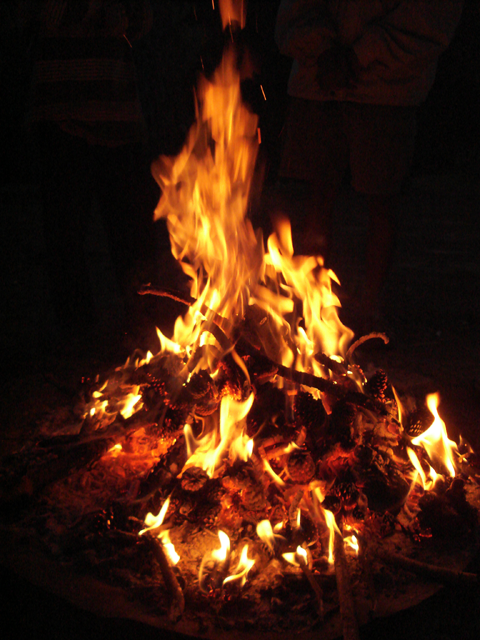
A campfire is a fire at a campsite that provides light and warmth, and heat for cooking. It can also serve as a beacon, and an insect and predator deterrent. Established campgrounds often provide a stone or steel fire ring for safety. Campfires are a popular feature of camping. At summer camps, the word campfire often refers to an event (ceremony, get together, etc.) at which there is a fire. Some camps refer to the fire itself as a campfire.
A new analysis of burned antelope bones from caves in Swartkrans, South Africa, confirms that Australopithecus robustus and/or Homo erectus built campfires roughly 1.6 million years ago. Nearby evidence within Wonderwerk Cave, at the edge of the Kalahari Desert, has been called the oldest known controlled fire. Microscopic analysis of plant ash and charred bone fragments suggests that materials in the cave were not heated above about 1,300 °F (704 °C). This is consistent with preliminary findings that the fires burned grasses, brush, and leaves. Such fuel would not produce hotter flames. The data suggests humans were cooking prey by campfire as far back as the first appearance of Homo erectus 1.9 million years ago.
Ideally, campfires should be made in a fire ring. If a fire ring is not available, a temporary fire site may be constructed. Bare rock or unvegetated ground is ideal for a fire site. Alternatively, turf may be cut away to form a bare area and carefully replaced after the fire has cooled to minimize damage. Another way is to cover the ground with sand, or other soil mostly free of flammable organic material, to a depth of a few inches. A ring of rocks is sometimes constructed around a fire. Fire rings, however, do not fully protect material on the ground from catching fire. Flying embers are still a threat, and the fire ring may become hot enough to ignite material in contact with it, or the heat the water to a vapor thereby cracking the rocks.
Campfires can spark wildfires. As such, it is important for the fire builder to take multiple safety precautions, including:
There are three types of material involved in building a fire without manufactured fuels or modern conveniences such as lighters:
In most realistic cases nowadays, non-natural additions to the fuels mentioned above will be used. Often, charcoal lighters like hexamine fuel tablets or ethyl alcohol will be used to start the fire, as well as various types of scrap paper. With the proliferation of packaged food, it is quite likely that plastics will be incinerated as well, a practice that not only produces toxic fumes but will also leave polluted ashes behind because of incomplete combustion at too-low open fire temperatures.
There are a variety of designs to choose from in building a campfire. A functional design is important in the early stages of a fire. Most of them make no mention of fuelwood—in most designs, fuelwood is never placed on a fire until the kindling is burning strongly.
The tipi (or teepee) fire-build takes some patience to construct. First, the tinder is piled up in a compact heap. The smaller kindling is arranged around it, like the poles of a tipi. For added strength, it may be possible to lash some of the sticks together. A tripod lashing is quite difficult to execute with small sticks, so a clove hitch should suffice. (Synthetic rope should be avoided since it produces pollutants when it burns.) Then the larger kindling is arranged above the smaller kindling, taking care not to collapse the tipi. A separate tipi as a shell around the first one may work better. Tipi fires are excellent for producing heat to keep people warm. The gases from the bottom quickly come to the top as you add more sticks.
Campfire
A campfire is a fire at a campsite that provides light and warmth, and heat for cooking. It can also serve as a beacon, and an insect and predator deterrent. Established campgrounds often provide a stone or steel fire ring for safety. Campfires are a popular feature of camping. At summer camps, the word campfire often refers to an event (ceremony, get together, etc.) at which there is a fire. Some camps refer to the fire itself as a campfire.
A new analysis of burned antelope bones from caves in Swartkrans, South Africa, confirms that Australopithecus robustus and/or Homo erectus built campfires roughly 1.6 million years ago. Nearby evidence within Wonderwerk Cave, at the edge of the Kalahari Desert, has been called the oldest known controlled fire. Microscopic analysis of plant ash and charred bone fragments suggests that materials in the cave were not heated above about 1,300 °F (704 °C). This is consistent with preliminary findings that the fires burned grasses, brush, and leaves. Such fuel would not produce hotter flames. The data suggests humans were cooking prey by campfire as far back as the first appearance of Homo erectus 1.9 million years ago.
Ideally, campfires should be made in a fire ring. If a fire ring is not available, a temporary fire site may be constructed. Bare rock or unvegetated ground is ideal for a fire site. Alternatively, turf may be cut away to form a bare area and carefully replaced after the fire has cooled to minimize damage. Another way is to cover the ground with sand, or other soil mostly free of flammable organic material, to a depth of a few inches. A ring of rocks is sometimes constructed around a fire. Fire rings, however, do not fully protect material on the ground from catching fire. Flying embers are still a threat, and the fire ring may become hot enough to ignite material in contact with it, or the heat the water to a vapor thereby cracking the rocks.
Campfires can spark wildfires. As such, it is important for the fire builder to take multiple safety precautions, including:
There are three types of material involved in building a fire without manufactured fuels or modern conveniences such as lighters:
In most realistic cases nowadays, non-natural additions to the fuels mentioned above will be used. Often, charcoal lighters like hexamine fuel tablets or ethyl alcohol will be used to start the fire, as well as various types of scrap paper. With the proliferation of packaged food, it is quite likely that plastics will be incinerated as well, a practice that not only produces toxic fumes but will also leave polluted ashes behind because of incomplete combustion at too-low open fire temperatures.
There are a variety of designs to choose from in building a campfire. A functional design is important in the early stages of a fire. Most of them make no mention of fuelwood—in most designs, fuelwood is never placed on a fire until the kindling is burning strongly.
The tipi (or teepee) fire-build takes some patience to construct. First, the tinder is piled up in a compact heap. The smaller kindling is arranged around it, like the poles of a tipi. For added strength, it may be possible to lash some of the sticks together. A tripod lashing is quite difficult to execute with small sticks, so a clove hitch should suffice. (Synthetic rope should be avoided since it produces pollutants when it burns.) Then the larger kindling is arranged above the smaller kindling, taking care not to collapse the tipi. A separate tipi as a shell around the first one may work better. Tipi fires are excellent for producing heat to keep people warm. The gases from the bottom quickly come to the top as you add more sticks.
Recent media
Recent media