
Recent from talks
Fire
Knowledge base stats:
Talk channels stats:
Members stats:
Fire
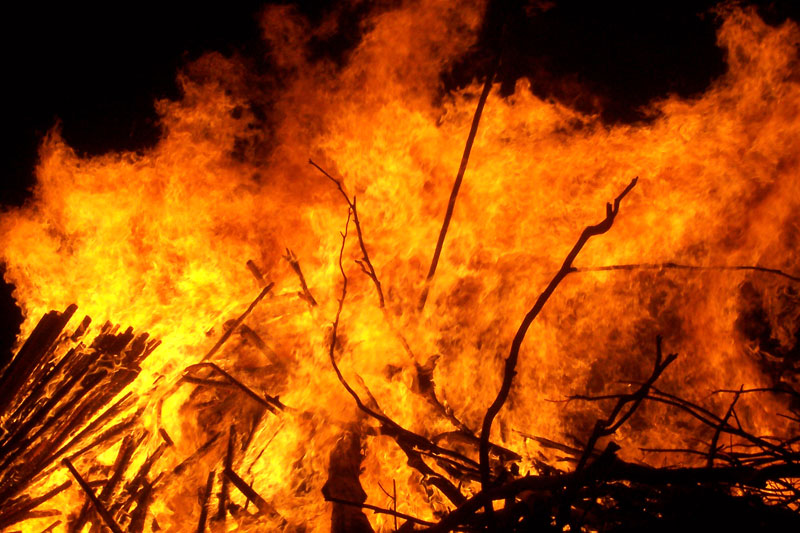
Fire is the rapid oxidation of a fuel in the exothermic chemical process of combustion, releasing heat, light, and various reaction products. Flames, the most visible portion of the fire, are produced in the combustion reaction when the fuel reaches its ignition point temperature. Flames from hydrocarbon fuels consist primarily of carbon dioxide, water vapor, oxygen, and nitrogen. If hot enough, the gases may become ionized to produce plasma. The color and intensity of the flame depend on the type of fuel and composition of the surrounding gases.
Fire, in its most common form, has the potential to result in conflagration, which can lead to permanent physical damage. It directly impacts land-based ecological systems worldwide. The positive effects of fire include stimulating plant growth and maintaining ecological balance. Its negative effects include hazards to life and property, atmospheric pollution, and water contamination. When fire removes protective vegetation, heavy rainfall can cause soil erosion. The burning of vegetation releases nitrogen into the atmosphere, unlike other plant nutrients such as potassium and phosphorus which remain in the ash and are quickly recycled into the soil. This loss of nitrogen produces a long-term reduction in the fertility of the soil, though it can be recovered by nitrogen-fixing plants such as clover, peas, and beans; by decomposition of animal waste and corpses, and by natural phenomena such as lightning.
Fire is one of the four classical elements and has been used by humans in rituals, in agriculture for clearing land, for cooking, generating heat and light, for signaling, propulsion purposes, smelting, forging, incineration of waste, cremation, and as a weapon or mode of destruction. Various technologies and strategies have been devised to prevent, manage, mitigate, and extinguish fires, with professional firefighters playing a leading role.
The word fire comes from Old English fȳr and has cognates in many Germanic languages and other Indo-European languages. The Proto-Germanic nominative form is reconstructed as *fōr, descending from Proto-Indo-European *péh2wr. An alternative spelling existed in Middle English: fier; still preserved in fiery. The word ignite is derived from the classical Latin ignis meaning fire. The Greek term for fire, pyr, is used in words such as pyroclastic or pyrotechnic.
The fossil record of fire first appears with the establishment of a land-based flora in the Middle Ordovician period, 470 million years ago. These land plants contributed large amounts of oxygen to the atmosphere when they released it as a waste product. When this concentration rose above 13%, it permitted the possibility of wildfire. Wildfire is first recorded in the Late Silurian fossil record, 420 million years ago, by fossils of charred plants. Apart from a controversial gap in the Late Devonian, charcoal is present ever since. The level of atmospheric oxygen is closely correlated with the amount of charcoal in the fossil record, clearly pointing to oxygen as the key factor in the prevalence of wildfire. Fire also became more abundant when grasses became the dominant component of many ecosystems, around 6 to 7 million years ago, providing excellent tinder for more rapid spread of fire. This widespread emergence of wildfire may have initiated a positive feedback process, whereby they produced a warmer, drier climate more conducive to fire. Fire made it possible for humans to live at colder places and dark caves. It also protected humans against dangerous animals. It caused nutritional changes, it enabled us to eat with more variation.
The period of history characterized by the influence of human-caused fire activity on Earth has been dubbed the pyrocene. This epoch includes the burning of fossil fuels, especially for technological uses.
The ability to control fire was a dramatic change in the habits of early humans. Making fire to generate heat and light made it possible for people to cook food, simultaneously increasing the variety and availability of nutrients and reducing disease by killing pathogenic microorganisms in the food. The heat produced would also help people stay warm in cold weather, enabling them to live in cooler climates. Fire also kept nocturnal predators at bay. Evidence of occasional cooked food is found from 1 million years ago, suggesting it was used in a controlled fashion. Other sources put the date of regular use at 400,000 years ago. Evidence becomes widespread around 50 to 100 thousand years ago, suggesting regular use from this time; resistance to air pollution started to evolve in human populations at a similar point in time. The use of fire became progressively more sophisticated, as it was used to create charcoal and to control wildlife from tens of thousands of years ago.
By the Neolithic Revolution, during the introduction of grain-based agriculture, people all over the world used fire as a tool in landscape management. These fires were typically controlled burns or "cool fires", as opposed to uncontrolled "hot fires", which damage the soil. Hot fires destroy plants and animals, and endanger communities. This is especially a problem in the forests of today where traditional burning is prevented in order to encourage the growth of timber crops. Cool fires are generally conducted in the spring and autumn. They clear undergrowth, burning up biomass that could trigger a hot fire should it get too dense. They provide a greater variety of environments, which encourages game and plant diversity. For humans, they make dense, impassable forests traversable.
Hub AI
Fire AI simulator
(@Fire_simulator)
Fire
Fire is the rapid oxidation of a fuel in the exothermic chemical process of combustion, releasing heat, light, and various reaction products. Flames, the most visible portion of the fire, are produced in the combustion reaction when the fuel reaches its ignition point temperature. Flames from hydrocarbon fuels consist primarily of carbon dioxide, water vapor, oxygen, and nitrogen. If hot enough, the gases may become ionized to produce plasma. The color and intensity of the flame depend on the type of fuel and composition of the surrounding gases.
Fire, in its most common form, has the potential to result in conflagration, which can lead to permanent physical damage. It directly impacts land-based ecological systems worldwide. The positive effects of fire include stimulating plant growth and maintaining ecological balance. Its negative effects include hazards to life and property, atmospheric pollution, and water contamination. When fire removes protective vegetation, heavy rainfall can cause soil erosion. The burning of vegetation releases nitrogen into the atmosphere, unlike other plant nutrients such as potassium and phosphorus which remain in the ash and are quickly recycled into the soil. This loss of nitrogen produces a long-term reduction in the fertility of the soil, though it can be recovered by nitrogen-fixing plants such as clover, peas, and beans; by decomposition of animal waste and corpses, and by natural phenomena such as lightning.
Fire is one of the four classical elements and has been used by humans in rituals, in agriculture for clearing land, for cooking, generating heat and light, for signaling, propulsion purposes, smelting, forging, incineration of waste, cremation, and as a weapon or mode of destruction. Various technologies and strategies have been devised to prevent, manage, mitigate, and extinguish fires, with professional firefighters playing a leading role.
The word fire comes from Old English fȳr and has cognates in many Germanic languages and other Indo-European languages. The Proto-Germanic nominative form is reconstructed as *fōr, descending from Proto-Indo-European *péh2wr. An alternative spelling existed in Middle English: fier; still preserved in fiery. The word ignite is derived from the classical Latin ignis meaning fire. The Greek term for fire, pyr, is used in words such as pyroclastic or pyrotechnic.
The fossil record of fire first appears with the establishment of a land-based flora in the Middle Ordovician period, 470 million years ago. These land plants contributed large amounts of oxygen to the atmosphere when they released it as a waste product. When this concentration rose above 13%, it permitted the possibility of wildfire. Wildfire is first recorded in the Late Silurian fossil record, 420 million years ago, by fossils of charred plants. Apart from a controversial gap in the Late Devonian, charcoal is present ever since. The level of atmospheric oxygen is closely correlated with the amount of charcoal in the fossil record, clearly pointing to oxygen as the key factor in the prevalence of wildfire. Fire also became more abundant when grasses became the dominant component of many ecosystems, around 6 to 7 million years ago, providing excellent tinder for more rapid spread of fire. This widespread emergence of wildfire may have initiated a positive feedback process, whereby they produced a warmer, drier climate more conducive to fire. Fire made it possible for humans to live at colder places and dark caves. It also protected humans against dangerous animals. It caused nutritional changes, it enabled us to eat with more variation.
The period of history characterized by the influence of human-caused fire activity on Earth has been dubbed the pyrocene. This epoch includes the burning of fossil fuels, especially for technological uses.
The ability to control fire was a dramatic change in the habits of early humans. Making fire to generate heat and light made it possible for people to cook food, simultaneously increasing the variety and availability of nutrients and reducing disease by killing pathogenic microorganisms in the food. The heat produced would also help people stay warm in cold weather, enabling them to live in cooler climates. Fire also kept nocturnal predators at bay. Evidence of occasional cooked food is found from 1 million years ago, suggesting it was used in a controlled fashion. Other sources put the date of regular use at 400,000 years ago. Evidence becomes widespread around 50 to 100 thousand years ago, suggesting regular use from this time; resistance to air pollution started to evolve in human populations at a similar point in time. The use of fire became progressively more sophisticated, as it was used to create charcoal and to control wildlife from tens of thousands of years ago.
By the Neolithic Revolution, during the introduction of grain-based agriculture, people all over the world used fire as a tool in landscape management. These fires were typically controlled burns or "cool fires", as opposed to uncontrolled "hot fires", which damage the soil. Hot fires destroy plants and animals, and endanger communities. This is especially a problem in the forests of today where traditional burning is prevented in order to encourage the growth of timber crops. Cool fires are generally conducted in the spring and autumn. They clear undergrowth, burning up biomass that could trigger a hot fire should it get too dense. They provide a greater variety of environments, which encourages game and plant diversity. For humans, they make dense, impassable forests traversable.
Recent media