
Recent from talks
Canadian Aboriginal syllabics
Knowledge base stats:
Talk channels stats:
Members stats:
Canadian Aboriginal syllabics
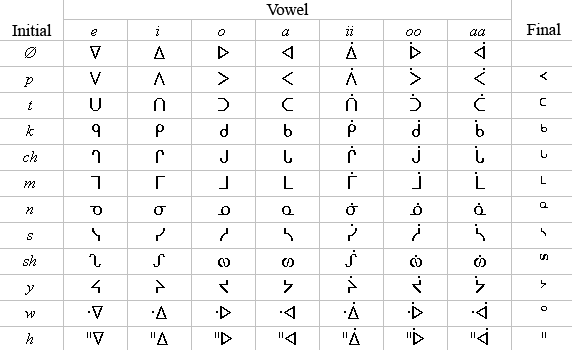
Canadian syllabic writing, or simply syllabics, is a family of writing systems used with a number of indigenous Canadian languages of the Algonquian, Eskaleut, and (formerly) Athabaskan language families. These languages had no formal writing system previously. They are valued for their distinctiveness from the Latin script and for the ease with which literacy can be achieved. For instance, by the late 19th century the Cree had achieved what may have been one of the highest rates of literacy in the world. Syllabics are an abugida, where glyphs represent consonant–vowel pairs, determined by the rotation of the glyphs. They were created by linguist and missionary James Evans working with the Cree and Ojibwe.
Canadian syllabics are currently used to write all of the Cree languages, including Eastern Cree, Plains Cree, Swampy Cree, Woods Cree, and Naskapi. They are used regionally for the other large Canadian Algonquian language, Ojibwe, as well as for Blackfoot. Among the Athabaskan languages further to the west, syllabics have been used at one point or another to write Dakelh (Carrier), Chipewyan, Slavey, Tłı̨chǫ (Dogrib), and Dane-zaa (Beaver). Syllabics have occasionally been used in the United States by communities that straddle the border. Among Inuit languages and dialects of the Canadian Arctic, they are used to write Inuktitut and are co-official with the Latin script in the territory of Nunavut.
Cree syllabics were created in a process that culminated in 1840 by James Evans, a missionary, probably in collaboration with Indigenous language experts. Evans formalized them for Swampy Cree and Ojibwe. Evans had been inspired by the success of Sequoyah's Cherokee syllabary after encountering problems with Latin-based alphabets, and drew on his knowledge of Devanagari and Pitman shorthand. Canadian syllabics would in turn influence the Pollard script, which is used to write various Hmong–Mien and Lolo-Burmese languages. Other missionaries were reluctant to use it, but it was rapidly indigenized and spread to new communities before missionaries arrived.
A conflicting account is recorded in Cree oral traditions, asserting that the script originated from Cree culture before 1840. Per these traditions, syllabics were the invention of Calling Badger (Mistanaskowêw, ᒥᐢᑕᓇᐢᑯᐍᐤ), a Cree man. Legend states that Badger had died and returned from the spirit world to share the knowledge of writing with his people. Some scholars write that these legends were created after 1840. Cree scholar Winona Stevenson explores the possibility that the inspiration for Cree syllabics may have originated from a near-death experience of Calling Badger. Stevenson references Fine Day, cited in David G. Mandelbaum's The Plains Cree, who states that he learned the syllabary from Strikes-him-on-the-back, who learned it directly from Calling Badger.
In 1828, Evans, a missionary from Kingston upon Hull, England, was placed in charge of the Wesleyan mission at Rice Lake, Ontario. Here, he learned the eastern Ojibwe language spoken in the area. By 1833, he had gained further linguistic experience by teaching in various mission schools around the area, and was invited to join a church committee seeking to develop a writing system for Ojibwe, based on the Latin alphabet. By 1837, he had prepared the Speller and Interpreter in English and Indian, but was unable to get its printing sanctioned by the British and Foreign Bible Society. At the time, many missionary societies were opposed to the development of native literacy in their own languages, believing that their situation would be bettered by linguistic assimilation into colonial society.[citation needed]
Evans continued to use his alphabetic Ojibwe orthography despite the rejection, and even travelled to New York City to publish Ojibwe hymnals. As was common at the time, the orthography called for hyphens between the syllables of words, giving written Ojibwe a partially syllabic structure. However, his students appear to have had conceptual difficulties using the same alphabet for two different languages with very different sounds, and Evans himself found this approach awkward.[citation needed] Furthermore, the Ojibwe language was polysynthetic but had few distinct syllables, meaning that most words had a large number of syllables; this made them quite long when written with the Latin script. He began to experiment with creating a more syllabic script that he thought might be less awkward for his students to use.
In 1840, Evans was relocated to Norway House in northern Manitoba. Here he began learning the local Swampy Cree dialect. Like the closely related Ojibwe, it was full of long polysyllabic words.
As an amateur linguist, Evans was acquainted with the Devanagari script used in British India; in Devanagari, each letter stands for a syllable, and is modified to represent the vowel of that syllable. Such a system, now called an abugida, would have readily lent itself to writing a language such as Swampy Cree, which had a simple syllable structure of only eight consonants and four long or short vowels. Evans was also familiar with British shorthand, presumably Samuel Taylor's Universal Stenography, from his days as a merchant in England; and now he acquired familiarity with the newly published Pitman shorthand of 1837.
Hub AI
Canadian Aboriginal syllabics AI simulator
(@Canadian Aboriginal syllabics_simulator)
Canadian Aboriginal syllabics
Canadian syllabic writing, or simply syllabics, is a family of writing systems used with a number of indigenous Canadian languages of the Algonquian, Eskaleut, and (formerly) Athabaskan language families. These languages had no formal writing system previously. They are valued for their distinctiveness from the Latin script and for the ease with which literacy can be achieved. For instance, by the late 19th century the Cree had achieved what may have been one of the highest rates of literacy in the world. Syllabics are an abugida, where glyphs represent consonant–vowel pairs, determined by the rotation of the glyphs. They were created by linguist and missionary James Evans working with the Cree and Ojibwe.
Canadian syllabics are currently used to write all of the Cree languages, including Eastern Cree, Plains Cree, Swampy Cree, Woods Cree, and Naskapi. They are used regionally for the other large Canadian Algonquian language, Ojibwe, as well as for Blackfoot. Among the Athabaskan languages further to the west, syllabics have been used at one point or another to write Dakelh (Carrier), Chipewyan, Slavey, Tłı̨chǫ (Dogrib), and Dane-zaa (Beaver). Syllabics have occasionally been used in the United States by communities that straddle the border. Among Inuit languages and dialects of the Canadian Arctic, they are used to write Inuktitut and are co-official with the Latin script in the territory of Nunavut.
Cree syllabics were created in a process that culminated in 1840 by James Evans, a missionary, probably in collaboration with Indigenous language experts. Evans formalized them for Swampy Cree and Ojibwe. Evans had been inspired by the success of Sequoyah's Cherokee syllabary after encountering problems with Latin-based alphabets, and drew on his knowledge of Devanagari and Pitman shorthand. Canadian syllabics would in turn influence the Pollard script, which is used to write various Hmong–Mien and Lolo-Burmese languages. Other missionaries were reluctant to use it, but it was rapidly indigenized and spread to new communities before missionaries arrived.
A conflicting account is recorded in Cree oral traditions, asserting that the script originated from Cree culture before 1840. Per these traditions, syllabics were the invention of Calling Badger (Mistanaskowêw, ᒥᐢᑕᓇᐢᑯᐍᐤ), a Cree man. Legend states that Badger had died and returned from the spirit world to share the knowledge of writing with his people. Some scholars write that these legends were created after 1840. Cree scholar Winona Stevenson explores the possibility that the inspiration for Cree syllabics may have originated from a near-death experience of Calling Badger. Stevenson references Fine Day, cited in David G. Mandelbaum's The Plains Cree, who states that he learned the syllabary from Strikes-him-on-the-back, who learned it directly from Calling Badger.
In 1828, Evans, a missionary from Kingston upon Hull, England, was placed in charge of the Wesleyan mission at Rice Lake, Ontario. Here, he learned the eastern Ojibwe language spoken in the area. By 1833, he had gained further linguistic experience by teaching in various mission schools around the area, and was invited to join a church committee seeking to develop a writing system for Ojibwe, based on the Latin alphabet. By 1837, he had prepared the Speller and Interpreter in English and Indian, but was unable to get its printing sanctioned by the British and Foreign Bible Society. At the time, many missionary societies were opposed to the development of native literacy in their own languages, believing that their situation would be bettered by linguistic assimilation into colonial society.[citation needed]
Evans continued to use his alphabetic Ojibwe orthography despite the rejection, and even travelled to New York City to publish Ojibwe hymnals. As was common at the time, the orthography called for hyphens between the syllables of words, giving written Ojibwe a partially syllabic structure. However, his students appear to have had conceptual difficulties using the same alphabet for two different languages with very different sounds, and Evans himself found this approach awkward.[citation needed] Furthermore, the Ojibwe language was polysynthetic but had few distinct syllables, meaning that most words had a large number of syllables; this made them quite long when written with the Latin script. He began to experiment with creating a more syllabic script that he thought might be less awkward for his students to use.
In 1840, Evans was relocated to Norway House in northern Manitoba. Here he began learning the local Swampy Cree dialect. Like the closely related Ojibwe, it was full of long polysyllabic words.
As an amateur linguist, Evans was acquainted with the Devanagari script used in British India; in Devanagari, each letter stands for a syllable, and is modified to represent the vowel of that syllable. Such a system, now called an abugida, would have readily lent itself to writing a language such as Swampy Cree, which had a simple syllable structure of only eight consonants and four long or short vowels. Evans was also familiar with British shorthand, presumably Samuel Taylor's Universal Stenography, from his days as a merchant in England; and now he acquired familiarity with the newly published Pitman shorthand of 1837.
Recent media