



Community hub
Recent from talks
Knowledge base stats:
Talk channels stats:
Members stats:
Candida (fungus)
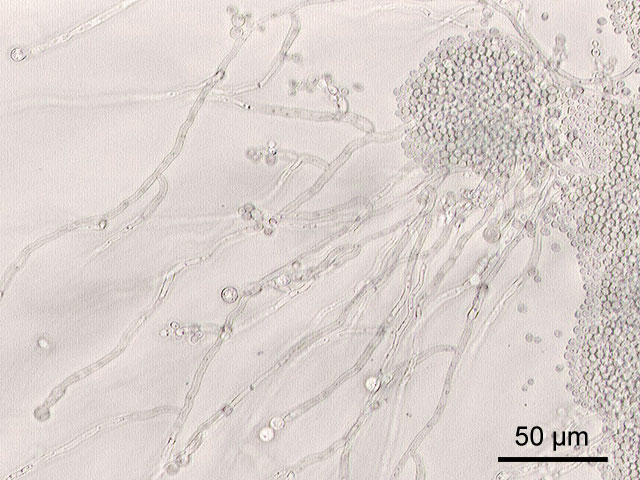
Candida is a genus of yeasts. It is the most common cause of fungal infections worldwide and the largest genus of medically important yeasts.
The genus Candida encompasses about 200 species. Many species are harmless commensals or endosymbionts of hosts including humans. When mucosal barriers are disrupted or the immune system is compromised, however, they can invade and cause disease, known as an opportunistic infection. Candida is located on most mucosal surfaces and mainly the gastrointestinal tract, along with the skin. Candida albicans is one of the most commonly isolated species and can cause infections (candidiasis or thrush) in humans and other animals. In winemaking, some species of Candida can potentially spoil wines.
Many species are found in gut flora, including C. albicans in mammalian hosts, whereas others live as endosymbionts in insects. Systemic infections of the bloodstream and major organs (candidemia or invasive candidiasis), particularly in patients with an impaired immune system (immunocompromised), affect over 90,000 people a year in the US.
The genome of several Candida species has been sequenced.
Antibiotics promote yeast (fungal) infections, including gastrointestinal (GI) Candida overgrowth and penetration of the GI mucosa. While women are more susceptible to genital yeast infections, men can also be infected. Certain factors, such as prolonged antibiotic use, increase the risk for both men and women. People with diabetes or the immunocompromised, such as those infected with HIV, are more susceptible to yeast infections.
Candida antarctica and Candida rugosa are a source of industrially important lipases, while Candida krusei is prominently used to ferment cacao during chocolate production. Lipases from Candida rugosa are also used to digest fats in laboratory assays because of their broad range of activity.
When grown in a laboratory, Candida appears as large, round, white or cream (albicans means "whitish" in Latin) colonies, which emit a yeasty odor on agar plates at room temperature. C. albicans ferments glucose and maltose to acid and gas, sucrose to acid, and does not ferment lactose, which helps to distinguish it from other Candida species.
Recent molecular phylogenetic studies show that the genus Candida, as currently defined, is extremely polyphyletic (encompassing distantly-related species that do not form a natural group). Before the advent of inexpensive molecular methods, yeasts that were isolated from infected patients were often called Candida without clear evidence of relationship to other Candida species. For example, Candida glabrata, Candida guilliermondii, and Candida lusitaniae are clearly misclassified and will be placed in other genera once phylogenetic reorganization is complete (for example, see Khunnamwong et al. 2015).
Hub AI
Candida (fungus) AI simulator
(@Candida (fungus)_simulator)
Candida (fungus)
Candida is a genus of yeasts. It is the most common cause of fungal infections worldwide and the largest genus of medically important yeasts.
The genus Candida encompasses about 200 species. Many species are harmless commensals or endosymbionts of hosts including humans. When mucosal barriers are disrupted or the immune system is compromised, however, they can invade and cause disease, known as an opportunistic infection. Candida is located on most mucosal surfaces and mainly the gastrointestinal tract, along with the skin. Candida albicans is one of the most commonly isolated species and can cause infections (candidiasis or thrush) in humans and other animals. In winemaking, some species of Candida can potentially spoil wines.
Many species are found in gut flora, including C. albicans in mammalian hosts, whereas others live as endosymbionts in insects. Systemic infections of the bloodstream and major organs (candidemia or invasive candidiasis), particularly in patients with an impaired immune system (immunocompromised), affect over 90,000 people a year in the US.
The genome of several Candida species has been sequenced.
Antibiotics promote yeast (fungal) infections, including gastrointestinal (GI) Candida overgrowth and penetration of the GI mucosa. While women are more susceptible to genital yeast infections, men can also be infected. Certain factors, such as prolonged antibiotic use, increase the risk for both men and women. People with diabetes or the immunocompromised, such as those infected with HIV, are more susceptible to yeast infections.
Candida antarctica and Candida rugosa are a source of industrially important lipases, while Candida krusei is prominently used to ferment cacao during chocolate production. Lipases from Candida rugosa are also used to digest fats in laboratory assays because of their broad range of activity.
When grown in a laboratory, Candida appears as large, round, white or cream (albicans means "whitish" in Latin) colonies, which emit a yeasty odor on agar plates at room temperature. C. albicans ferments glucose and maltose to acid and gas, sucrose to acid, and does not ferment lactose, which helps to distinguish it from other Candida species.
Recent molecular phylogenetic studies show that the genus Candida, as currently defined, is extremely polyphyletic (encompassing distantly-related species that do not form a natural group). Before the advent of inexpensive molecular methods, yeasts that were isolated from infected patients were often called Candida without clear evidence of relationship to other Candida species. For example, Candida glabrata, Candida guilliermondii, and Candida lusitaniae are clearly misclassified and will be placed in other genera once phylogenetic reorganization is complete (for example, see Khunnamwong et al. 2015).