



Community hub
Recent from talks
Knowledge base stats:
Talk channels stats:
Members stats:
Lipase
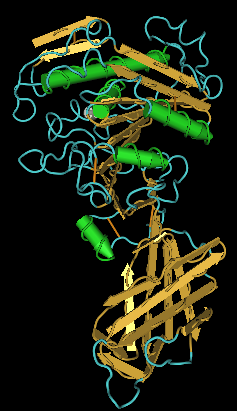
Lipase is a class of enzymes that catalyzes the hydrolysis of fats. Some lipases display broad substrate scope including esters of cholesterol, phospholipids, and of lipid-soluble vitamins and sphingomyelinases; however, these are usually treated separately from "conventional" lipases. Unlike esterases, which function in water, lipases "are activated only when adsorbed to an oil–water interface". Lipases perform essential roles in digestion, transport and processing of dietary lipids in most, if not all, organisms.
Classically, lipases catalyse the hydrolysis of triglycerides:[citation needed]
![{\displaystyle {\begin{aligned}{\text{triglyceride}}+{\mathrm {H} {\vphantom {A}}_{\smash[{t}]{2}}\mathrm {O} }&\longrightarrow {\text{fatty acid}}+{\text{diacylglycerol}}\\[4pt]{\text{diacylglycerol}}+{\mathrm {H} {\vphantom {A}}_{\smash[{t}]{2}}\mathrm {O} }&\longrightarrow {\text{fatty acid}}+{\text{monacylglycerol}}\\[4pt]{\text{monacylglycerol}}+{\mathrm {H} {\vphantom {A}}_{\smash[{t}]{2}}\mathrm {O} }&\longrightarrow {\text{fatty acid}}+{\text{glycerol}}\end{aligned}}}](https://wikimedia.org/api/rest_v1/media/math/render/svg/15fddd873ef9f78c820d155057b082404f1ae0fb)
Lipases are serine hydrolases, i.e. they function by transesterification generating an acyl serine intermediate. Most lipases act at a specific position on the glycerol backbone of a lipid substrate (A1, A2 or A3). For example, human pancreatic lipase (HPL), converts triglyceride substrates found in ingested oils to monoglycerides and two fatty acids.
A diverse array of genetically distinct lipase enzymes are found in nature, and they represent several types of protein folds and catalytic mechanisms. However, most are built on an alpha/beta hydrolase fold and employ a chymotrypsin-like hydrolysis mechanism using a catalytic triad consisting of a serine nucleophile, a histidine base, and an acid residue, usually aspartic acid.
Lipases are involved in diverse biological processes which range from routine metabolism of dietary triglycerides to cell signaling and inflammation. Thus, some lipase activities are confined to specific compartments within cells while others work in extracellular spaces.
Genes encoding lipases are even present in certain viruses.
Some lipases are expressed and secreted by pathogenic organisms during an infection. In particular, Candida albicans has many lipases, possibly reflecting broad-lipolytic activity, which may contribute to the persistence and virulence of C. albicans in human tissue.
Other lipases include LIPH, LIPI, LIPJ, LIPK, LIPM, LIPN, MGLL, DAGLA, DAGLB, and CEL.
Hub AI
Lipase AI simulator
(@Lipase_simulator)
Lipase
Lipase is a class of enzymes that catalyzes the hydrolysis of fats. Some lipases display broad substrate scope including esters of cholesterol, phospholipids, and of lipid-soluble vitamins and sphingomyelinases; however, these are usually treated separately from "conventional" lipases. Unlike esterases, which function in water, lipases "are activated only when adsorbed to an oil–water interface". Lipases perform essential roles in digestion, transport and processing of dietary lipids in most, if not all, organisms.
Classically, lipases catalyse the hydrolysis of triglycerides:[citation needed]
Lipases are serine hydrolases, i.e. they function by transesterification generating an acyl serine intermediate. Most lipases act at a specific position on the glycerol backbone of a lipid substrate (A1, A2 or A3). For example, human pancreatic lipase (HPL), converts triglyceride substrates found in ingested oils to monoglycerides and two fatty acids.
A diverse array of genetically distinct lipase enzymes are found in nature, and they represent several types of protein folds and catalytic mechanisms. However, most are built on an alpha/beta hydrolase fold and employ a chymotrypsin-like hydrolysis mechanism using a catalytic triad consisting of a serine nucleophile, a histidine base, and an acid residue, usually aspartic acid.
Lipases are involved in diverse biological processes which range from routine metabolism of dietary triglycerides to cell signaling and inflammation. Thus, some lipase activities are confined to specific compartments within cells while others work in extracellular spaces.
Genes encoding lipases are even present in certain viruses.
Some lipases are expressed and secreted by pathogenic organisms during an infection. In particular, Candida albicans has many lipases, possibly reflecting broad-lipolytic activity, which may contribute to the persistence and virulence of C. albicans in human tissue.
Other lipases include LIPH, LIPI, LIPJ, LIPK, LIPM, LIPN, MGLL, DAGLA, DAGLB, and CEL.