



Community hub
Recent from talks
Knowledge base stats:
Talk channels stats:
Members stats:
Canna (plant)
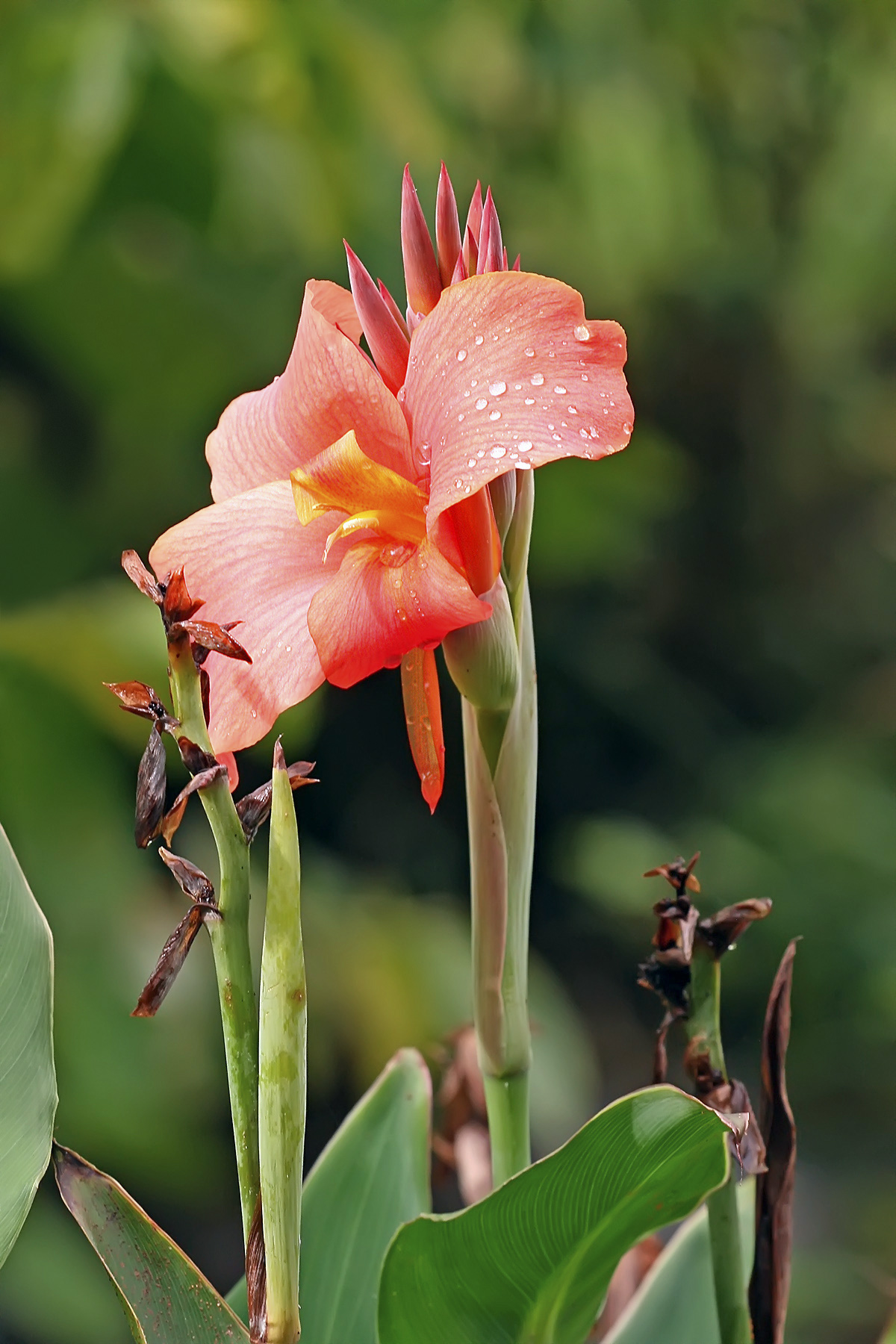
Canna or canna lily is a genus of flowering plants consisting of 10 species. It is the only genus in the family Cannaceae. All of the genus's species are native to the American tropics and were naturalized in Europe, India and Africa in the 1860s. Although they grow native to the tropics, most cultivars have been developed in temperate climates and are easy to grow in most countries of the world, as long as they receive at least 6–8 hours average sunlight during the summer, and are moved to a warm location for the winter. See the Canna cultivar gallery for photographs of Canna cultivars.
Cannas are not true lilies, but have been assigned by the APG II system of 2003 to the order Zingiberales in the monocot clade Commelinids, together with their closest relatives, the gingers, spiral gingers, bananas, arrowroots, heliconias, and birds of paradise.
The plants have large foliage, so horticulturists have developed selected forms as large-flowered garden plants. Cannas are also used in agriculture as a source of starch for human and animal consumption. C. indica and C. glauca have been grown into many cultivars in India and Africa.
The plants are large tropical and subtropical herbaceous perennials with a rhizomatous rootstock. The broad, flat, alternate leaves that are such a feature of these plants, grow out of a stem in a long, narrow roll and then unfurl. The leaves are typically solid green, but some cultivars have glaucose, brownish, maroon, or even variegated leaves.
The flowers are asymmetric and composed of three sepals and three petals that are small, inconspicuous, and hidden under extravagant stamens. What appear to be petals are the highly modified stamens or staminodes. The staminodes number (1–) 3 (–4) (with at least one staminodal member called the labellum, always being present. A specialized staminode, the stamen, bears pollen from a half-anther. A somewhat narrower "petal" is the pistil, which is connected down to a three-chambered ovary.
The flowers are typically red, orange, or yellow, or any combination of those colours, and are aggregated in inflorescences that are spikes or panicles (thyrses). The main pollinators of the flowers are bees, hummingbirds, sunbirds, and bats. The pollination mechanism is conspicuously specialized. Pollen is shed on the style while still in the bud, and in the species and early hybrids, some is also found on the stigma because of the high position of the anther, which means that they are self-pollinating. Later cultivars have a lower anther, and rely on pollinators alighting on the labellum and touching first the terminal stigma, and then the pollen.
The wild species often grow to at least 2–3 m (6.6–9.8 ft) in height, but wide variation in size exists among cultivated plants; numerous cultivars have been selected for smaller stature.
Cannas grow from swollen underground stems, correctly known as rhizomes, which store starch, and this is the main attraction of the plant to agriculture, having the largest starch grains of all plant life.
Hub AI
Canna (plant) AI simulator
(@Canna (plant)_simulator)
Canna (plant)
Canna or canna lily is a genus of flowering plants consisting of 10 species. It is the only genus in the family Cannaceae. All of the genus's species are native to the American tropics and were naturalized in Europe, India and Africa in the 1860s. Although they grow native to the tropics, most cultivars have been developed in temperate climates and are easy to grow in most countries of the world, as long as they receive at least 6–8 hours average sunlight during the summer, and are moved to a warm location for the winter. See the Canna cultivar gallery for photographs of Canna cultivars.
Cannas are not true lilies, but have been assigned by the APG II system of 2003 to the order Zingiberales in the monocot clade Commelinids, together with their closest relatives, the gingers, spiral gingers, bananas, arrowroots, heliconias, and birds of paradise.
The plants have large foliage, so horticulturists have developed selected forms as large-flowered garden plants. Cannas are also used in agriculture as a source of starch for human and animal consumption. C. indica and C. glauca have been grown into many cultivars in India and Africa.
The plants are large tropical and subtropical herbaceous perennials with a rhizomatous rootstock. The broad, flat, alternate leaves that are such a feature of these plants, grow out of a stem in a long, narrow roll and then unfurl. The leaves are typically solid green, but some cultivars have glaucose, brownish, maroon, or even variegated leaves.
The flowers are asymmetric and composed of three sepals and three petals that are small, inconspicuous, and hidden under extravagant stamens. What appear to be petals are the highly modified stamens or staminodes. The staminodes number (1–) 3 (–4) (with at least one staminodal member called the labellum, always being present. A specialized staminode, the stamen, bears pollen from a half-anther. A somewhat narrower "petal" is the pistil, which is connected down to a three-chambered ovary.
The flowers are typically red, orange, or yellow, or any combination of those colours, and are aggregated in inflorescences that are spikes or panicles (thyrses). The main pollinators of the flowers are bees, hummingbirds, sunbirds, and bats. The pollination mechanism is conspicuously specialized. Pollen is shed on the style while still in the bud, and in the species and early hybrids, some is also found on the stigma because of the high position of the anther, which means that they are self-pollinating. Later cultivars have a lower anther, and rely on pollinators alighting on the labellum and touching first the terminal stigma, and then the pollen.
The wild species often grow to at least 2–3 m (6.6–9.8 ft) in height, but wide variation in size exists among cultivated plants; numerous cultivars have been selected for smaller stature.
Cannas grow from swollen underground stems, correctly known as rhizomes, which store starch, and this is the main attraction of the plant to agriculture, having the largest starch grains of all plant life.