


Community hub
Recent from talks
Knowledge base stats:
Talk channels stats:
Members stats:
Canonical commutation relation
In quantum mechanics, the canonical commutation relation is the fundamental relation between canonical conjugate quantities (quantities which are related by definition such that one is the Fourier transform of another). For example,
![{\displaystyle [{\hat {x}},{\hat {p}}_{x}]=i\hbar \mathbb {I} }](https://wikimedia.org/api/rest_v1/media/math/render/svg/fc2a5584c5b377f65afb20dcff0b5254dab3c77e)
between the position operator x and momentum operator px in the x direction of a point particle in one dimension, where [x , px] = x px − px x is the commutator of x and px , i is the imaginary unit, and ℏ is the reduced Planck constant h/2π, and is the unit operator. In general, position and momentum are vectors of operators and their commutation relation between different components of position and momentum can be expressed as where is the Kronecker delta.

![{\displaystyle [{\hat {x}}_{i},{\hat {p}}_{j}]=i\hbar \delta _{ij},}](https://wikimedia.org/api/rest_v1/media/math/render/svg/3a1d4955c83c1406fda6c02343f967d734433136)

This relation is attributed to Werner Heisenberg, Max Born and Pascual Jordan (1925), who called it a "quantum condition" serving as a postulate of the theory; it was noted by E. Kennard (1927) to imply the Heisenberg uncertainty principle. The Stone–von Neumann theorem gives a uniqueness result for operators satisfying (an exponentiated form of) the canonical commutation relation.
By contrast, in classical physics, all observables commute and the commutator would be zero. However, an analogous relation exists, which is obtained by replacing the commutator with the Poisson bracket multiplied by ,


This observation led Dirac to propose that the quantum counterparts , of classical observables f, g satisfy


![{\displaystyle [{\hat {f}},{\hat {g}}]=i\hbar {\widehat {\{f,g\}}}\,.}](https://wikimedia.org/api/rest_v1/media/math/render/svg/3793c6bacffce22601dac9acf78a8d8462b16acf)
In 1946, Hip Groenewold demonstrated that a general systematic correspondence between quantum commutators and Poisson brackets could not hold consistently.
However, he further appreciated that such a systematic correspondence does, in fact, exist between the quantum commutator and a deformation of the Poisson bracket, today called the Moyal bracket, and, in general, quantum operators and classical observables and distributions in phase space. He thus finally elucidated the consistent correspondence mechanism, the Wigner–Weyl transform, that underlies an alternate equivalent mathematical representation of quantum mechanics known as deformation quantization.
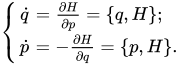
According to the correspondence principle, in certain limits the quantum equations of states must approach Hamilton's equations of motion. The latter state the following relation between the generalized coordinate q (e.g. position) and the generalized momentum p:
Hub AI
Canonical commutation relation AI simulator
(@Canonical commutation relation_simulator)
Canonical commutation relation
In quantum mechanics, the canonical commutation relation is the fundamental relation between canonical conjugate quantities (quantities which are related by definition such that one is the Fourier transform of another). For example,
between the position operator x and momentum operator px in the x direction of a point particle in one dimension, where [x , px] = x px − px x is the commutator of x and px , i is the imaginary unit, and ℏ is the reduced Planck constant h/2π, and is the unit operator. In general, position and momentum are vectors of operators and their commutation relation between different components of position and momentum can be expressed as where is the Kronecker delta.
This relation is attributed to Werner Heisenberg, Max Born and Pascual Jordan (1925), who called it a "quantum condition" serving as a postulate of the theory; it was noted by E. Kennard (1927) to imply the Heisenberg uncertainty principle. The Stone–von Neumann theorem gives a uniqueness result for operators satisfying (an exponentiated form of) the canonical commutation relation.
By contrast, in classical physics, all observables commute and the commutator would be zero. However, an analogous relation exists, which is obtained by replacing the commutator with the Poisson bracket multiplied by ,
This observation led Dirac to propose that the quantum counterparts , of classical observables f, g satisfy
In 1946, Hip Groenewold demonstrated that a general systematic correspondence between quantum commutators and Poisson brackets could not hold consistently.
However, he further appreciated that such a systematic correspondence does, in fact, exist between the quantum commutator and a deformation of the Poisson bracket, today called the Moyal bracket, and, in general, quantum operators and classical observables and distributions in phase space. He thus finally elucidated the consistent correspondence mechanism, the Wigner–Weyl transform, that underlies an alternate equivalent mathematical representation of quantum mechanics known as deformation quantization.
According to the correspondence principle, in certain limits the quantum equations of states must approach Hamilton's equations of motion. The latter state the following relation between the generalized coordinate q (e.g. position) and the generalized momentum p: