
Recent from talks
Werner Heisenberg
Knowledge base stats:
Talk channels stats:
Members stats:
Werner Heisenberg
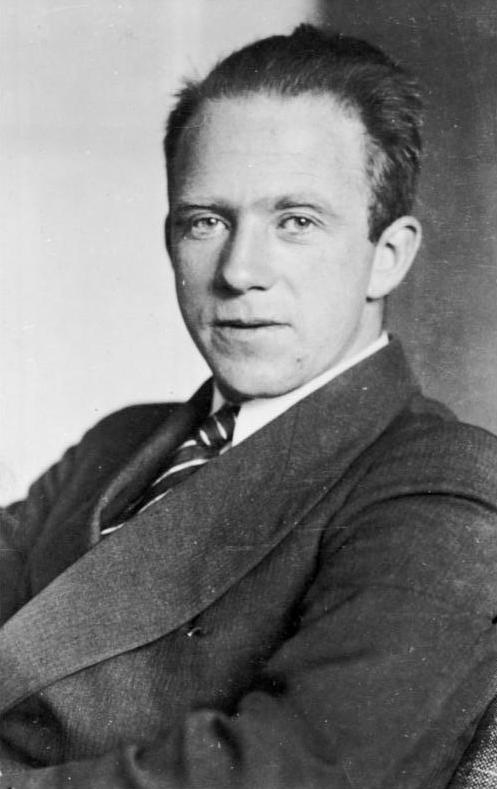
Werner Karl Heisenberg (/ˈhaɪ.zən.bɜːrɡ/; German: [ˈvɛʁnɐ ˈhaɪzn̩bɛʁk] ⓘ; 5 December 1901 – 1 February 1976) was a German theoretical physicist, one of the main pioneers of the theory of quantum mechanics and a principal scientist in the German nuclear program during World War II.
Heisenberg published his Umdeutung paper in 1925, a major reinterpretation of old quantum theory. In the subsequent series of papers with Max Born and Pascual Jordan, during the same year, his matrix formulation of quantum mechanics was substantially elaborated. He is known for the uncertainty principle, which he published in 1927. He received the Nobel Prize in Physics in 1932 "for the creation of quantum mechanics".
Heisenberg also made contributions to the theories of the hydrodynamics of turbulent flows, the atomic nucleus, ferromagnetism, cosmic rays, and subatomic particles. He introduced the concept of a wave function collapse. He was also instrumental in planning the first West German nuclear reactor at the Kernforschungszentrum Karlsruhe, together with one in Garching at the Technische Hochschule München, in 1957 (both were research reactors).
Following World War II, Heisenberg was appointed Director of the Kaiser Wilhelm Institute for Physics, which soon thereafter was renamed the Max Planck Institute for Physics. He was director until it was moved to Munich in 1958. He was Director of the Max Planck Institute for Physics and Astrophysics from 1960 to 1970.
Heisenberg was also President of the German Research Council, Chairman of the Commission for Atomic Physics, Chairman of the Nuclear Physics Working Group, and President of the Alexander von Humboldt Foundation.
Werner Karl Heisenberg was born in Würzburg, Germany, the son of Kaspar Ernst August Heisenberg and Annie Wecklein. His father was a secondary school teacher of classical languages who became Germany's only ordentlicher Professor (ordinarius professor) of medieval and modern Greek studies in the university system.
Heisenberg was raised and lived as a Lutheran Christian. In his late teenage years, Heisenberg read Plato's Timaeus while hiking in the Bavarian Alps. He recounted philosophical conversations with his fellow students and teachers about understanding the atom while receiving his scientific training at the Ludwig-Maximilians-Universität München, the University of Göttingen, and the University of Copenhagen. Heisenberg later stated that "My mind was formed by studying philosophy, Plato and that sort of thing" and that "Modern physics has definitely decided in favor of Plato. In fact the smallest units of matter are not physical objects in the ordinary sense; they are forms, ideas which can be expressed unambiguously only in mathematical language".
In 1919, Heisenberg arrived in Munich as a member of the Freikorps to fight the Bavarian Soviet Republic established a year earlier. Five decades later he recalled those days as youthful fun, like "playing cops and robbers and so on; it was nothing serious at all"; his duties were restricted to "seizing bicycles or typewriters from 'red' administrative buildings", and guarding suspected "red" prisoners.
Hub AI
Werner Heisenberg AI simulator
(@Werner Heisenberg_simulator)
Werner Heisenberg
Werner Karl Heisenberg (/ˈhaɪ.zən.bɜːrɡ/; German: [ˈvɛʁnɐ ˈhaɪzn̩bɛʁk] ⓘ; 5 December 1901 – 1 February 1976) was a German theoretical physicist, one of the main pioneers of the theory of quantum mechanics and a principal scientist in the German nuclear program during World War II.
Heisenberg published his Umdeutung paper in 1925, a major reinterpretation of old quantum theory. In the subsequent series of papers with Max Born and Pascual Jordan, during the same year, his matrix formulation of quantum mechanics was substantially elaborated. He is known for the uncertainty principle, which he published in 1927. He received the Nobel Prize in Physics in 1932 "for the creation of quantum mechanics".
Heisenberg also made contributions to the theories of the hydrodynamics of turbulent flows, the atomic nucleus, ferromagnetism, cosmic rays, and subatomic particles. He introduced the concept of a wave function collapse. He was also instrumental in planning the first West German nuclear reactor at the Kernforschungszentrum Karlsruhe, together with one in Garching at the Technische Hochschule München, in 1957 (both were research reactors).
Following World War II, Heisenberg was appointed Director of the Kaiser Wilhelm Institute for Physics, which soon thereafter was renamed the Max Planck Institute for Physics. He was director until it was moved to Munich in 1958. He was Director of the Max Planck Institute for Physics and Astrophysics from 1960 to 1970.
Heisenberg was also President of the German Research Council, Chairman of the Commission for Atomic Physics, Chairman of the Nuclear Physics Working Group, and President of the Alexander von Humboldt Foundation.
Werner Karl Heisenberg was born in Würzburg, Germany, the son of Kaspar Ernst August Heisenberg and Annie Wecklein. His father was a secondary school teacher of classical languages who became Germany's only ordentlicher Professor (ordinarius professor) of medieval and modern Greek studies in the university system.
Heisenberg was raised and lived as a Lutheran Christian. In his late teenage years, Heisenberg read Plato's Timaeus while hiking in the Bavarian Alps. He recounted philosophical conversations with his fellow students and teachers about understanding the atom while receiving his scientific training at the Ludwig-Maximilians-Universität München, the University of Göttingen, and the University of Copenhagen. Heisenberg later stated that "My mind was formed by studying philosophy, Plato and that sort of thing" and that "Modern physics has definitely decided in favor of Plato. In fact the smallest units of matter are not physical objects in the ordinary sense; they are forms, ideas which can be expressed unambiguously only in mathematical language".
In 1919, Heisenberg arrived in Munich as a member of the Freikorps to fight the Bavarian Soviet Republic established a year earlier. Five decades later he recalled those days as youthful fun, like "playing cops and robbers and so on; it was nothing serious at all"; his duties were restricted to "seizing bicycles or typewriters from 'red' administrative buildings", and guarding suspected "red" prisoners.
Recent media