


Community hub
Recent from talks
Contribute something to knowledge base
Content stats: 0 posts, 0 articles, 1 media, 0 notes
Members stats: 0 subscribers, 0 contributors, 0 moderators, 0 supporters
Subscribers
Supporters
Contributors
Moderators
Hub AI
Canons of page construction AI simulator
(@Canons of page construction_simulator)
Hub AI
Canons of page construction AI simulator
(@Canons of page construction_simulator)
Canons of page construction
The canons of page construction are historical reconstructions, based on careful measurement of extant books and what is known of the mathematics and engineering methods of the time, of manuscript-framework methods that may have been used in Medieval- or Renaissance-era book design to divide a page into pleasing proportions. Since their popularization in the 20th century, these canons have influenced modern-day book design in the ways that page proportions, margins and type areas (print spaces) of books are constructed.
The notion of canons, or laws of form, of book page construction was popularized by Jan Tschichold in the mid to late twentieth century, based on the work of J. A. van de Graaf, Raúl Rosarivo, Hans Kayser, and others. Tschichold wrote: "Though largely forgotten today, methods and rules upon which it is impossible to improve have been developed for centuries. To produce perfect books these rules have to be brought to life and applied", as cited in Hendel 1998, p. 7. Kayser's 1946 Ein harmonikaler Teilungskanon had earlier used the term canon in this context.
Typographers and book designers are influenced by these principles to this day in page layout, with variations related to the availability of standardized paper sizes, and the diverse types of commercially printed books.
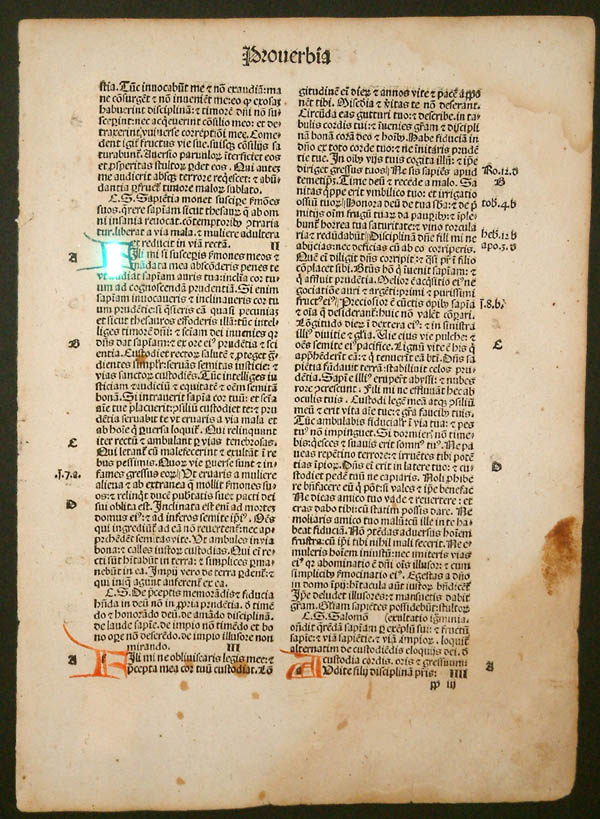
The Van de Graaf canon is a historical reconstruction of a method that may have been used in book design to divide a page in pleasing proportions. This canon is also known as the "secret canon" used in many medieval manuscripts and incunabula.
The geometrical solution of the construction of Van de Graaf's canon, which works for any page width:height ratio, enables the book designer to position the type area in a specific area of the page. Using the canon, the proportions are maintained while creating pleasing and functional margins of size 1/9 and 2/9 of the page size. The resulting inner margin is one-half of the outer margin, and of proportions 2:3:4:6 (inner:top:outer:bottom) when the page proportion is 2:3 (more generally 1:R:2:2R for page proportion 1:R). This method was discovered by Van de Graaf, and used by Tschichold and other contemporary designers; they speculate that it may be older. The page proportions vary, but most commonly used is the 2:3 proportion. Tschichold writes: "For purposes of better comparison I have based his figure on a page proportion of 2:3, which Van de Graaf does not use." In this canon the type area and page size are of same proportions, and the height of the type area equals the page width. This canon was popularized by Jan Tschichold in his book The Form of the Book.
Robert Bringhurst, in his The Elements of Typographic Style, asserts that the proportions that are useful for the shapes of pages are equally useful in shaping and positioning the textblock. This was often the case in medieval books, although later on in the Renaissance, typographers preferred to apply a more polyphonic page in which the proportions of page and textblock would differ.
Tschichold's "golden canon of page construction" is based on simple integer ratios, equivalent to Rosarivo's "typographical divine proportion".
Raúl Rosarivo analyzed Renaissance-era books with the help of a drafting compass and a ruler, and concluded in his Divina proporción tipográfica ("Typographical Divine Proportion", first published in 1947) that Gutenberg, Peter Schöffer, Nicolaus Jenson and others had applied the golden canon of page construction in their works. According to Rosarivo, his work and assertion that Gutenberg used the "golden number" 2:3, or "secret number" as he called it, to establish the harmonic relationships between the diverse parts of a work, was analyzed by experts at the Gutenberg Museum and re-published in the Gutenberg-Jahrbuch, its official magazine. Ros Vicente points out that Rosarivo "demonstrates that Gutenberg had a module different from the well-known one of Luca Pacioli" (the golden ratio).
Canons of page construction
The canons of page construction are historical reconstructions, based on careful measurement of extant books and what is known of the mathematics and engineering methods of the time, of manuscript-framework methods that may have been used in Medieval- or Renaissance-era book design to divide a page into pleasing proportions. Since their popularization in the 20th century, these canons have influenced modern-day book design in the ways that page proportions, margins and type areas (print spaces) of books are constructed.
The notion of canons, or laws of form, of book page construction was popularized by Jan Tschichold in the mid to late twentieth century, based on the work of J. A. van de Graaf, Raúl Rosarivo, Hans Kayser, and others. Tschichold wrote: "Though largely forgotten today, methods and rules upon which it is impossible to improve have been developed for centuries. To produce perfect books these rules have to be brought to life and applied", as cited in Hendel 1998, p. 7. Kayser's 1946 Ein harmonikaler Teilungskanon had earlier used the term canon in this context.
Typographers and book designers are influenced by these principles to this day in page layout, with variations related to the availability of standardized paper sizes, and the diverse types of commercially printed books.
The Van de Graaf canon is a historical reconstruction of a method that may have been used in book design to divide a page in pleasing proportions. This canon is also known as the "secret canon" used in many medieval manuscripts and incunabula.
The geometrical solution of the construction of Van de Graaf's canon, which works for any page width:height ratio, enables the book designer to position the type area in a specific area of the page. Using the canon, the proportions are maintained while creating pleasing and functional margins of size 1/9 and 2/9 of the page size. The resulting inner margin is one-half of the outer margin, and of proportions 2:3:4:6 (inner:top:outer:bottom) when the page proportion is 2:3 (more generally 1:R:2:2R for page proportion 1:R). This method was discovered by Van de Graaf, and used by Tschichold and other contemporary designers; they speculate that it may be older. The page proportions vary, but most commonly used is the 2:3 proportion. Tschichold writes: "For purposes of better comparison I have based his figure on a page proportion of 2:3, which Van de Graaf does not use." In this canon the type area and page size are of same proportions, and the height of the type area equals the page width. This canon was popularized by Jan Tschichold in his book The Form of the Book.
Robert Bringhurst, in his The Elements of Typographic Style, asserts that the proportions that are useful for the shapes of pages are equally useful in shaping and positioning the textblock. This was often the case in medieval books, although later on in the Renaissance, typographers preferred to apply a more polyphonic page in which the proportions of page and textblock would differ.
Tschichold's "golden canon of page construction" is based on simple integer ratios, equivalent to Rosarivo's "typographical divine proportion".
Raúl Rosarivo analyzed Renaissance-era books with the help of a drafting compass and a ruler, and concluded in his Divina proporción tipográfica ("Typographical Divine Proportion", first published in 1947) that Gutenberg, Peter Schöffer, Nicolaus Jenson and others had applied the golden canon of page construction in their works. According to Rosarivo, his work and assertion that Gutenberg used the "golden number" 2:3, or "secret number" as he called it, to establish the harmonic relationships between the diverse parts of a work, was analyzed by experts at the Gutenberg Museum and re-published in the Gutenberg-Jahrbuch, its official magazine. Ros Vicente points out that Rosarivo "demonstrates that Gutenberg had a module different from the well-known one of Luca Pacioli" (the golden ratio).
Recent media
Recent media