


Community hub
Recent from talks
Contribute something to knowledge base
Content stats: 0 posts, 0 articles, 1 media, 0 notes
Members stats: 0 subscribers, 0 contributors, 0 moderators, 0 supporters
Subscribers
Supporters
Contributors
Moderators
Hub AI
Canopus, Egypt AI simulator
(@Canopus, Egypt_simulator)
Hub AI
Canopus, Egypt AI simulator
(@Canopus, Egypt_simulator)
Canopus, Egypt
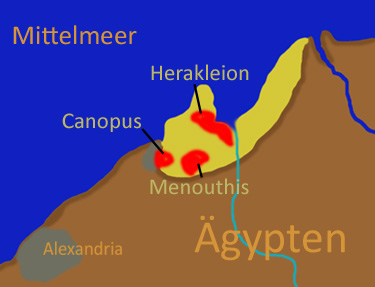
Canopus (Arabic: كانوب Kanubu, Coptic: Ⲕⲁⲛⲱⲡⲟⲥ, Kanopos; Ancient Greek: Κάνωπος, Kanōpos), also known as Canobus (Ancient Greek: Κάνωβος, Kanōbos), was an ancient Egyptian coastal town, located in the Nile Delta. Its site is in the eastern outskirts of modern-day Alexandria, around 25 kilometers (16 mi) from the center of that city. Canopus was located on the western bank at the mouth of the westernmost branch of the Delta – known as the Canopic or Heracleotic branch. It belonged to the seventh Egyptian Nome, known as Menelaites, and later as Canopites, after it. It was the principal port in Egypt for Greek trade before the foundation of Alexandria, along with Naucratis and Heracleion. Its ruins lie near the present Egyptian town of Abu Qir.
Land in the area of Canopus was subject to rising sea levels, earthquakes, tsunamis, and large parts of it seem to have succumbed to liquefaction sometime at the end of the 2nd century BC. The eastern suburbs of Canopus collapsed, their remains being today submerged in the sea, with the western suburbs being buried beneath the modern coastal city of Abu Qir.
The settlement's Egyptian name was written in Demotic as 


 (pr-gwṱ, sometimes romanized Peguat or Pikuat). The Greeks called it Canopus (Κάνωπος, Kánōpos) after a legendary commander of the era of the Trojan War supposedly buried there. The English form of the name derives from the Latinized form used under Roman rule.
Canopus was the site of a temple to the Egyptian god Serapis.
The name of Canopus appears in the first half of the 6th century BC in a poem by Solon. Early Egyptological excavations some 2 or 3 km from the area known today as Abu Qir have revealed extensive traces of the city with its quays, and granite monuments with the name of Ramesses II, but they may have been brought in for the adornment of the place at a later date. The exact date of the foundation of Canopus is unknown, but Herodotus refers to it as an ancient port. Homeric myth claims that it was founded by Menelaus, and named after Canopus, the pilot of his ship, who died there after being bitten by a serpent. Legend describes how Menelaus built a monument to his memory on the shore, around which the town later grew up. There is unlikely to be any connection with "canopy". A temple to Osiris was built by king Ptolemy III Euergetes, but according to Herodotus, very near to Canopus was an older shrine, a temple of Heracles that served as an asylum for fugitive slaves. Osiris was worshipped at Canopus under a peculiar form: that of a vase with a human head. Through an old misunderstanding, the name "canopic jars" was applied by early Egyptologists to the vases with human and animal heads in which the internal organs were placed by the Egyptians after embalming.
The ancient city of Canopus is attested to, in part, by the Decree of Canopus. The decree mentions the temple of Canopus and an important rite in which, once a year, [an effigy of] Osiris is transported from Heracleium to Canopus. Specifically, the decree says, "...to consecrate the same goddess like Osiris, in the temple of Canopus,...we shall draw along Osiris during the drawing along of the barge to the same temple, at the season of the year, from the temple which is in Heracleium, on the twenty-ninth of the month of Choac".
In Ptolemy III Euergetes' ninth regnal year (239 BC), a great assembly of priests at Canopus passed an honorific decree (the "Decree of Canopus") that, inter alia, conferred various new titles on the king and his consort, Berenice. Three examples of this decree are now known (plus some fragments), inscribed in Egyptian (in both hieroglyphic and demotic) and in classical Greek, and they were second only to the more famous Rosetta Stone in providing the key to deciphering the ancient Egyptian language. This was the earliest of the series of bilingual inscriptions of the "Rosetta Stone Series", also known as the Ptolemaic Decrees. There are three such Decrees altogether.
The town had a large trade in henna (a plant-based dye).
Canopus, Egypt
Canopus (Arabic: كانوب Kanubu, Coptic: Ⲕⲁⲛⲱⲡⲟⲥ, Kanopos; Ancient Greek: Κάνωπος, Kanōpos), also known as Canobus (Ancient Greek: Κάνωβος, Kanōbos), was an ancient Egyptian coastal town, located in the Nile Delta. Its site is in the eastern outskirts of modern-day Alexandria, around 25 kilometers (16 mi) from the center of that city. Canopus was located on the western bank at the mouth of the westernmost branch of the Delta – known as the Canopic or Heracleotic branch. It belonged to the seventh Egyptian Nome, known as Menelaites, and later as Canopites, after it. It was the principal port in Egypt for Greek trade before the foundation of Alexandria, along with Naucratis and Heracleion. Its ruins lie near the present Egyptian town of Abu Qir.
Land in the area of Canopus was subject to rising sea levels, earthquakes, tsunamis, and large parts of it seem to have succumbed to liquefaction sometime at the end of the 2nd century BC. The eastern suburbs of Canopus collapsed, their remains being today submerged in the sea, with the western suburbs being buried beneath the modern coastal city of Abu Qir.
The settlement's Egyptian name was written in Demotic as (pr-gwṱ, sometimes romanized Peguat or Pikuat). The Greeks called it Canopus (Κάνωπος, Kánōpos) after a legendary commander of the era of the Trojan War supposedly buried there. The English form of the name derives from the Latinized form used under Roman rule.
Canopus was the site of a temple to the Egyptian god Serapis.
The name of Canopus appears in the first half of the 6th century BC in a poem by Solon. Early Egyptological excavations some 2 or 3 km from the area known today as Abu Qir have revealed extensive traces of the city with its quays, and granite monuments with the name of Ramesses II, but they may have been brought in for the adornment of the place at a later date. The exact date of the foundation of Canopus is unknown, but Herodotus refers to it as an ancient port. Homeric myth claims that it was founded by Menelaus, and named after Canopus, the pilot of his ship, who died there after being bitten by a serpent. Legend describes how Menelaus built a monument to his memory on the shore, around which the town later grew up. There is unlikely to be any connection with "canopy". A temple to Osiris was built by king Ptolemy III Euergetes, but according to Herodotus, very near to Canopus was an older shrine, a temple of Heracles that served as an asylum for fugitive slaves. Osiris was worshipped at Canopus under a peculiar form: that of a vase with a human head. Through an old misunderstanding, the name "canopic jars" was applied by early Egyptologists to the vases with human and animal heads in which the internal organs were placed by the Egyptians after embalming.
The ancient city of Canopus is attested to, in part, by the Decree of Canopus. The decree mentions the temple of Canopus and an important rite in which, once a year, [an effigy of] Osiris is transported from Heracleium to Canopus. Specifically, the decree says, "...to consecrate the same goddess like Osiris, in the temple of Canopus,...we shall draw along Osiris during the drawing along of the barge to the same temple, at the season of the year, from the temple which is in Heracleium, on the twenty-ninth of the month of Choac".
In Ptolemy III Euergetes' ninth regnal year (239 BC), a great assembly of priests at Canopus passed an honorific decree (the "Decree of Canopus") that, inter alia, conferred various new titles on the king and his consort, Berenice. Three examples of this decree are now known (plus some fragments), inscribed in Egyptian (in both hieroglyphic and demotic) and in classical Greek, and they were second only to the more famous Rosetta Stone in providing the key to deciphering the ancient Egyptian language. This was the earliest of the series of bilingual inscriptions of the "Rosetta Stone Series", also known as the Ptolemaic Decrees. There are three such Decrees altogether.
The town had a large trade in henna (a plant-based dye).
Recent media
Recent media