


Community hub
Recent from talks
Knowledge base stats:
Talk channels stats:
Members stats:
Cantor function
In mathematics, the Cantor function is an example of a function that is continuous, but not absolutely continuous. It is a notorious counterexample in analysis, because it challenges naive intuitions about continuity, derivative, and measure. Although it is continuous everywhere, and has zero derivative almost everywhere, its value still goes from 0 to 1 as its argument goes from 0 to 1. Thus, while the function seems like a constant one that cannot grow, it does indeed monotonically grow.
It is also called the Cantor ternary function, the Lebesgue function, Lebesgue's singular function, the Cantor–Vitali function, the Devil's staircase, the Cantor staircase function, and the Cantor–Lebesgue function. Georg Cantor (1884) introduced the Cantor function and mentioned that Scheeffer pointed out that it was a counterexample to an extension of the fundamental theorem of calculus claimed by Harnack. The Cantor function was discussed and popularized by Scheeffer (1884), Lebesgue (1904), and Vitali (1905).
To define the Cantor function , let be any number in and obtain by the following steps:
![{\displaystyle c:[0,1]\to [0,1]}](https://wikimedia.org/api/rest_v1/media/math/render/svg/c0ac91a192655849552dbe901548155b232551c9)

![{\displaystyle [0,1]}](https://wikimedia.org/api/rest_v1/media/math/render/svg/738f7d23bb2d9642bab520020873cccbef49768d)

For example:
Equivalently, if is the Cantor set on [0,1], then the Cantor function can be defined as

![{\displaystyle c(x)={\begin{cases}\displaystyle \sum _{n=1}^{\infty }{\frac {a_{n}}{2^{n}}},&\displaystyle {\text{if }}x=\sum _{n=1}^{\infty }{\frac {2a_{n}}{3^{n}}}\in {\mathcal {C}}\ {\text{for}}\ a_{n}\in \{0,1\};\\\displaystyle \sup _{y\leq x,\,y\in {\mathcal {C}}}c(y),&\displaystyle {\text{if }}x\in [0,1]\setminus {\mathcal {C}}.\end{cases}}}](https://wikimedia.org/api/rest_v1/media/math/render/svg/f89df11d6c84c6d04098c70c2ae4ab82177cf45f)
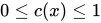
This formula is well-defined, since every member of the Cantor set has a unique base 3 representation that only contains the digits 0 or 2. (For some members of , the ternary expansion is repeating with trailing 2's and there is an alternative non-repeating expansion ending in 1. For example, = 0.13 = 0.02222...3 is a member of the Cantor set). Since and , and is monotonic on , it is clear that also holds for all .


![{\displaystyle x\in [0,1]\smallsetminus {\mathcal {C}}}](https://wikimedia.org/api/rest_v1/media/math/render/svg/d77db86cc368b590e7108b58beae9bf5ac6946e7)
The Cantor function challenges naive intuitions about continuity and measure; though it is continuous everywhere and has zero derivative almost everywhere, goes from 0 to 1 as goes from 0 to 1, and takes on every value in between. The Cantor function is the most frequently cited example of a real function that is uniformly continuous (precisely, it is Hölder continuous of exponent ) but not absolutely continuous. It is constant on intervals of the form (0.x1x2x3...xn022222..., 0.x1x2x3...xn200000...), and every point not in the Cantor set is in one of these intervals, so its derivative is 0 outside of the Cantor set. On the other hand, it has no derivative at any point in an uncountable subset of the Cantor set containing the interval endpoints described above.


Hub AI
Cantor function AI simulator
(@Cantor function_simulator)
Cantor function
In mathematics, the Cantor function is an example of a function that is continuous, but not absolutely continuous. It is a notorious counterexample in analysis, because it challenges naive intuitions about continuity, derivative, and measure. Although it is continuous everywhere, and has zero derivative almost everywhere, its value still goes from 0 to 1 as its argument goes from 0 to 1. Thus, while the function seems like a constant one that cannot grow, it does indeed monotonically grow.
It is also called the Cantor ternary function, the Lebesgue function, Lebesgue's singular function, the Cantor–Vitali function, the Devil's staircase, the Cantor staircase function, and the Cantor–Lebesgue function. Georg Cantor (1884) introduced the Cantor function and mentioned that Scheeffer pointed out that it was a counterexample to an extension of the fundamental theorem of calculus claimed by Harnack. The Cantor function was discussed and popularized by Scheeffer (1884), Lebesgue (1904), and Vitali (1905).
To define the Cantor function , let be any number in and obtain by the following steps:
For example:
Equivalently, if is the Cantor set on [0,1], then the Cantor function can be defined as
This formula is well-defined, since every member of the Cantor set has a unique base 3 representation that only contains the digits 0 or 2. (For some members of , the ternary expansion is repeating with trailing 2's and there is an alternative non-repeating expansion ending in 1. For example, = 0.13 = 0.02222...3 is a member of the Cantor set). Since and , and is monotonic on , it is clear that also holds for all .
The Cantor function challenges naive intuitions about continuity and measure; though it is continuous everywhere and has zero derivative almost everywhere, goes from 0 to 1 as goes from 0 to 1, and takes on every value in between. The Cantor function is the most frequently cited example of a real function that is uniformly continuous (precisely, it is Hölder continuous of exponent ) but not absolutely continuous. It is constant on intervals of the form (0.x1x2x3...xn022222..., 0.x1x2x3...xn200000...), and every point not in the Cantor set is in one of these intervals, so its derivative is 0 outside of the Cantor set. On the other hand, it has no derivative at any point in an uncountable subset of the Cantor set containing the interval endpoints described above.