



Community hub
Recent from talks
Contribute something to knowledge base
Content stats: 0 posts, 0 articles, 1 media, 0 notes
Members stats: 0 subscribers, 0 contributors, 0 moderators, 0 supporters
Subscribers
Supporters
Contributors
Moderators
Hub AI
Caotang Temple AI simulator
(@Caotang Temple_simulator)
Hub AI
Caotang Temple AI simulator
(@Caotang Temple_simulator)
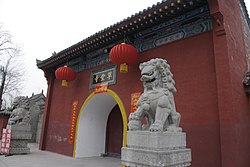
Caotang Temple
Caotang Temple (Chinese: 草堂寺; pinyin: Cǎotáng Sì; lit. 'Cottage Temple') is a Buddhist temple located on the north hillside of Mount Guifeng, in Huyi District of Xi'an, Shaanxi, China.
In the Later Qin (384–417), Kumārajīva resided in Caotang Temple, where he translated Madhyamika-sastra (中论), Sata-sastra (百论) and Dvadashamukha Shastra (十二门论), which laid the foundation for the theory of East Asian Mādhyamaka, so he is respected as the founder of East Asian Mādhyamaka and Caotang Temple is considered as the cradle of East Asian Mādhyamaka.
Caotang Temple traces its origins to the former Xiaoyang Garden (逍遥园), founded by Emperor Yao Xing of Later Qin (384–417) in 401 in order to provide accommodation for renowned Buddhist missionary monk Kumārajīva.
In 606, in the 2nd year of Daye period of Sui dynasty (581–618), Li Yuan, the then prefectural governor of Zhengzhou, visited and presented a Buddha statue to the temple.
After the establishment of the Tang Empire (618–907), Emperor Taizong came to worship the Buddha and wrote poems in the temple. During the reign of Emperor Xuanzong (685–762), Master Feixi (飞锡) settled at Caotang Temple, where he taught Buddhism for many years. In the Yuanhe era of Emperor Xianzong (806–820), the emperor issued the decree rebuilding the temple. Master Guifeng Zongmi was proposed as the abbot. Under his leadership, Caotang Temple was refurbished and redecorated and renamed "Qi Chan Temple" (栖禅寺). After the fall of Tang Empire in the early 10th century, the temple became dilapidated for wars.
In 966, in the 4th year of Qiande period of the Song dynasty (960–1276), the imperial court renovated the temple and renamed it "Qingliang Jianfu Temple" (清凉建福寺).
In 1193, in the reign of Emperor Zhangzong of Jin dynasty (1115–1234), Master Bianzheng (辨正) added lecture hall and it restored the original name.
In 1734, in the Yongzheng era of the Qing dynasty (1644–1911), after the canonization of Kumārajīva's disciple Sengzhao (僧肇), the temple was renamed "Sheng'en Temple" (圣恩寺), which means royal graciousness. In the Tongzhi period (1862–1874), the temple was completely destroyed by wars. In 1881 in the Guangxu period (1875–1908), the recently established temple was washed away by the flood.
Caotang Temple
Caotang Temple (Chinese: 草堂寺; pinyin: Cǎotáng Sì; lit. 'Cottage Temple') is a Buddhist temple located on the north hillside of Mount Guifeng, in Huyi District of Xi'an, Shaanxi, China.
In the Later Qin (384–417), Kumārajīva resided in Caotang Temple, where he translated Madhyamika-sastra (中论), Sata-sastra (百论) and Dvadashamukha Shastra (十二门论), which laid the foundation for the theory of East Asian Mādhyamaka, so he is respected as the founder of East Asian Mādhyamaka and Caotang Temple is considered as the cradle of East Asian Mādhyamaka.
Caotang Temple traces its origins to the former Xiaoyang Garden (逍遥园), founded by Emperor Yao Xing of Later Qin (384–417) in 401 in order to provide accommodation for renowned Buddhist missionary monk Kumārajīva.
In 606, in the 2nd year of Daye period of Sui dynasty (581–618), Li Yuan, the then prefectural governor of Zhengzhou, visited and presented a Buddha statue to the temple.
After the establishment of the Tang Empire (618–907), Emperor Taizong came to worship the Buddha and wrote poems in the temple. During the reign of Emperor Xuanzong (685–762), Master Feixi (飞锡) settled at Caotang Temple, where he taught Buddhism for many years. In the Yuanhe era of Emperor Xianzong (806–820), the emperor issued the decree rebuilding the temple. Master Guifeng Zongmi was proposed as the abbot. Under his leadership, Caotang Temple was refurbished and redecorated and renamed "Qi Chan Temple" (栖禅寺). After the fall of Tang Empire in the early 10th century, the temple became dilapidated for wars.
In 966, in the 4th year of Qiande period of the Song dynasty (960–1276), the imperial court renovated the temple and renamed it "Qingliang Jianfu Temple" (清凉建福寺).
In 1193, in the reign of Emperor Zhangzong of Jin dynasty (1115–1234), Master Bianzheng (辨正) added lecture hall and it restored the original name.
In 1734, in the Yongzheng era of the Qing dynasty (1644–1911), after the canonization of Kumārajīva's disciple Sengzhao (僧肇), the temple was renamed "Sheng'en Temple" (圣恩寺), which means royal graciousness. In the Tongzhi period (1862–1874), the temple was completely destroyed by wars. In 1881 in the Guangxu period (1875–1908), the recently established temple was washed away by the flood.
Recent media
Recent media