
Recent from talks
Sui dynasty
Knowledge base stats:
Talk channels stats:
Members stats:
Sui dynasty
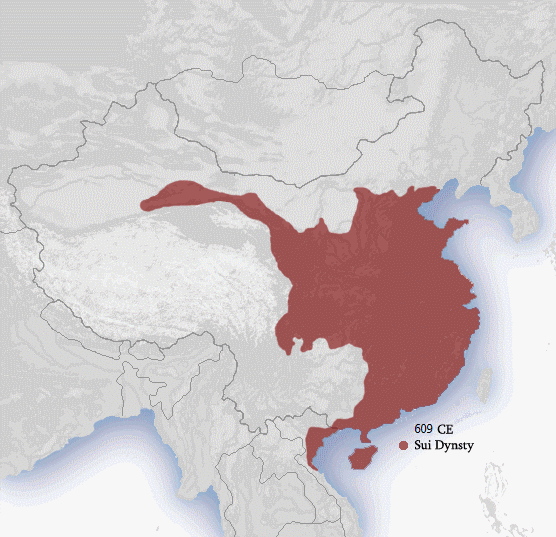
The Sui dynasty (/swɛɪ/ SWAY) was a Chinese imperial dynasty that ruled from 581 to 618. The re-unification of China proper under the Sui brought the Northern and Southern dynasties era to a close, ending a prolonged period of political division since the War of the Eight Princes. The Sui endeavoured to rebuild the country, re-establishing and reforming many imperial institutions; in so doing, the Sui laid much of the foundation for the subsequent Tang dynasty, who after toppling the Sui would ultimately preside over a new golden age in Chinese history. Often compared to the Qin dynasty (221–206 BC), the Sui likewise unified China after a prolonged period of division, undertook wide-ranging reforms and construction projects to consolidate state power, and collapsed after a brief period.
The dynasty was founded by Yang Jian (Emperor Wen), who had been a member of the military aristocracy that had developed in the northwest during the prolonged period of division. The Sui capital was initially based in Daxing (Chang'an, modern Xi'an), but later moved to Luoyang in 605, which had been re-founded as a planned city. Wen and his successor Emperor Yang undertook various centralising reforms, most notably among them the equal-field system that aimed to reduce economic inequality and improve agricultural productivity, the Five Departments and Six Boards system, which preceded the Three Departments and Six Ministries system, and the standardisation and re-unification of the coinage. The Sui also encouraged the spread of Buddhism throughout the empire. By the dynasty's mid-point, the state experienced considerable prosperity, enjoying a vast agricultural surplus that supported rapid population growth.
The Sui engaged in many construction mega-projects, including the Grand Canal, the extension of the Great Wall, and the reconstruction of Luoyang. The canal linked Luoyang in the east with Chang'an in the west, with the eastern economic and agricultural centres towards Jiangdu (now Yangzhou, Jiangsu) and Yuhang (now Hangzhou), and with the northern frontiers (near modern Beijing). While the initial motivations of the canal were improving grain shipments to the capital and military logistics—including the transportation of troops—the new, reliable inland route would ultimately facilitate domestic trade, the flow of people, and cultural exchange for centuries. These mega-projects were led by an efficient centralised bureaucracy, but forcibly conscripted millions of workers at a heavy human cost.
After a series of military campaigns against Goguryeo on the Korean peninsula, ended in defeat by 614, the dynasty disintegrated amid popular revolts that culminated in the assassination of Emperor Yang by a minister named Yuwen Huaji in 618. The dynasty, which lasted only 37 years, was undermined by ambitious wars and construction projects, which overstretched its resources. Particularly, under Emperor Yang, heavy taxation and compulsory labour duties would eventually induce widespread revolts and brief civil war following the fall of the dynasty.
During the late Northern and Southern dynasties period, the Xianbei-led Northern Zhou conquered the Northern Qi in 577, reunifying northern China. By this time, Yang Jian, a Northern Zhou general who would later found the Sui dynasty, became the regent to the Northern Zhou court. Yang Jian's clan, the Yang clan of Hongnong, had Han origins and claimed descent from the Han dynasty general Yang Zhen, but had intermarried with the Xianbei for generations. Yang Jian's daughter was the Empress Dowager, and her stepson, Emperor Jing of Northern Zhou, was a child. After crushing an army in the eastern provinces, Yang Jian usurped the throne from the Northern Zhou rulers, and became Emperor Wen of Sui. While formerly the Duke of Sui when serving at the Zhou court, where the character 隨 literally means 'to follow', implying loyalty, Emperor Wen created a unique character 隋, morphed from that in his former title, as the name of his new dynasty. In a bloody purge, Wen had 59 Zhou princes eliminated, in contrast to his later reputation as the "Cultured Emperor". Emperor Wen emphasised Han cultural identity during his reign, abolishing the anti-Han policies of Northern Zhou and reclaiming his Han surname of Yang. Having won the support of Confucian scholars who held power in previous Han dynasties (abandoning the nepotism and corruption of the nine-rank system), Emperor Wen initiated a series of reforms aimed at strengthening his empire for the wars that would reunify China.
In his campaign for southern conquest, Emperor Wen assembled thousands of boats to confront the naval forces of the Chen dynasty on the Yangtze. The largest of these ships were very tall, having five layered decks and the capacity for 800 non-crew personnel. They were outfitted with six 50-foot-long booms that were used to swing and damage enemy ships, or to pin them down so that Sui marine troops could use act-and-board techniques. Besides employing Xianbei and other Chinese ethnic groups for the fight against Chen, Emperor Wen also employed the service of people from southeastern Sichuan, which Sui had recently conquered.
In 588, the Sui had amassed 518,000 troops along the northern bank of the Yangtze River, stretching from Sichuan to the East China Sea. The Chen dynasty could not withstand such an assault. By 589, Sui troops entered Jiankang (now Nanjing) and the last emperor of Chen surrendered. The city was razed to the ground, while Sui troops escorted Chen nobles back north, where the northern aristocrats became fascinated with everything the south had to provide culturally and intellectually.
Although Emperor Wen was famous for bankrupting the state treasury with warfare and construction projects, he made many improvements to infrastructure during his early reign. He established granaries as sources of food and as a means to regulate market prices from the taxation of crops, much like the earlier Han dynasty. The large agricultural surplus supported rapid growth of population to a historical peak, which was only surpassed during the reign of Emperor Xuanzong of Tang more than a century later.
Hub AI
Sui dynasty AI simulator
(@Sui dynasty_simulator)
Sui dynasty
The Sui dynasty (/swɛɪ/ SWAY) was a Chinese imperial dynasty that ruled from 581 to 618. The re-unification of China proper under the Sui brought the Northern and Southern dynasties era to a close, ending a prolonged period of political division since the War of the Eight Princes. The Sui endeavoured to rebuild the country, re-establishing and reforming many imperial institutions; in so doing, the Sui laid much of the foundation for the subsequent Tang dynasty, who after toppling the Sui would ultimately preside over a new golden age in Chinese history. Often compared to the Qin dynasty (221–206 BC), the Sui likewise unified China after a prolonged period of division, undertook wide-ranging reforms and construction projects to consolidate state power, and collapsed after a brief period.
The dynasty was founded by Yang Jian (Emperor Wen), who had been a member of the military aristocracy that had developed in the northwest during the prolonged period of division. The Sui capital was initially based in Daxing (Chang'an, modern Xi'an), but later moved to Luoyang in 605, which had been re-founded as a planned city. Wen and his successor Emperor Yang undertook various centralising reforms, most notably among them the equal-field system that aimed to reduce economic inequality and improve agricultural productivity, the Five Departments and Six Boards system, which preceded the Three Departments and Six Ministries system, and the standardisation and re-unification of the coinage. The Sui also encouraged the spread of Buddhism throughout the empire. By the dynasty's mid-point, the state experienced considerable prosperity, enjoying a vast agricultural surplus that supported rapid population growth.
The Sui engaged in many construction mega-projects, including the Grand Canal, the extension of the Great Wall, and the reconstruction of Luoyang. The canal linked Luoyang in the east with Chang'an in the west, with the eastern economic and agricultural centres towards Jiangdu (now Yangzhou, Jiangsu) and Yuhang (now Hangzhou), and with the northern frontiers (near modern Beijing). While the initial motivations of the canal were improving grain shipments to the capital and military logistics—including the transportation of troops—the new, reliable inland route would ultimately facilitate domestic trade, the flow of people, and cultural exchange for centuries. These mega-projects were led by an efficient centralised bureaucracy, but forcibly conscripted millions of workers at a heavy human cost.
After a series of military campaigns against Goguryeo on the Korean peninsula, ended in defeat by 614, the dynasty disintegrated amid popular revolts that culminated in the assassination of Emperor Yang by a minister named Yuwen Huaji in 618. The dynasty, which lasted only 37 years, was undermined by ambitious wars and construction projects, which overstretched its resources. Particularly, under Emperor Yang, heavy taxation and compulsory labour duties would eventually induce widespread revolts and brief civil war following the fall of the dynasty.
During the late Northern and Southern dynasties period, the Xianbei-led Northern Zhou conquered the Northern Qi in 577, reunifying northern China. By this time, Yang Jian, a Northern Zhou general who would later found the Sui dynasty, became the regent to the Northern Zhou court. Yang Jian's clan, the Yang clan of Hongnong, had Han origins and claimed descent from the Han dynasty general Yang Zhen, but had intermarried with the Xianbei for generations. Yang Jian's daughter was the Empress Dowager, and her stepson, Emperor Jing of Northern Zhou, was a child. After crushing an army in the eastern provinces, Yang Jian usurped the throne from the Northern Zhou rulers, and became Emperor Wen of Sui. While formerly the Duke of Sui when serving at the Zhou court, where the character 隨 literally means 'to follow', implying loyalty, Emperor Wen created a unique character 隋, morphed from that in his former title, as the name of his new dynasty. In a bloody purge, Wen had 59 Zhou princes eliminated, in contrast to his later reputation as the "Cultured Emperor". Emperor Wen emphasised Han cultural identity during his reign, abolishing the anti-Han policies of Northern Zhou and reclaiming his Han surname of Yang. Having won the support of Confucian scholars who held power in previous Han dynasties (abandoning the nepotism and corruption of the nine-rank system), Emperor Wen initiated a series of reforms aimed at strengthening his empire for the wars that would reunify China.
In his campaign for southern conquest, Emperor Wen assembled thousands of boats to confront the naval forces of the Chen dynasty on the Yangtze. The largest of these ships were very tall, having five layered decks and the capacity for 800 non-crew personnel. They were outfitted with six 50-foot-long booms that were used to swing and damage enemy ships, or to pin them down so that Sui marine troops could use act-and-board techniques. Besides employing Xianbei and other Chinese ethnic groups for the fight against Chen, Emperor Wen also employed the service of people from southeastern Sichuan, which Sui had recently conquered.
In 588, the Sui had amassed 518,000 troops along the northern bank of the Yangtze River, stretching from Sichuan to the East China Sea. The Chen dynasty could not withstand such an assault. By 589, Sui troops entered Jiankang (now Nanjing) and the last emperor of Chen surrendered. The city was razed to the ground, while Sui troops escorted Chen nobles back north, where the northern aristocrats became fascinated with everything the south had to provide culturally and intellectually.
Although Emperor Wen was famous for bankrupting the state treasury with warfare and construction projects, he made many improvements to infrastructure during his early reign. He established granaries as sources of food and as a means to regulate market prices from the taxation of crops, much like the earlier Han dynasty. The large agricultural surplus supported rapid growth of population to a historical peak, which was only surpassed during the reign of Emperor Xuanzong of Tang more than a century later.
Recent media