Hubbry Logo
CapocannoniereCapocannoniereMain
Open search
Capocannoniere
Community hub
Capocannoniere
logo
8 pages, 0 posts
0 subscribers
Be the first to start a discussion here.
Capocannoniere
Capocannoniere
from Wikipedia

Paolo Rossi Award
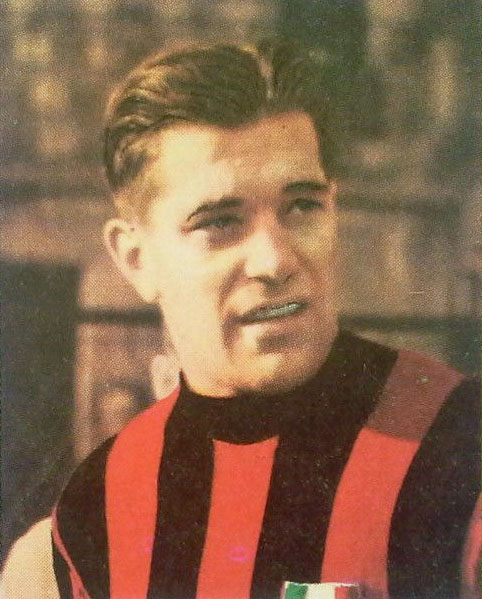
Gunnar Nordahl, by winning the capocannoniere award five times, is the pluricapocannoniere of Serie A, while playing at AC Milan.
Awarded forThe leading goalscorer in a single Serie A season
CountryItaly
Presented byItalian Footballers' Association
Formerly calledCapocannoniere
First award2011
Currently held byMateo Retegui (2024–25)
Most winsGunnar Nordahl (5)

The capocannoniere award (Italian: [ˌkapokannoˈnjɛːre]; lit.'head gunner'), known as Paolo Rossi Award since 2021,[1] is awarded by the Italian Footballers' Association (AIC) to the highest goalscorer of each season in Italy's Serie A. From the 2010–11 season until the change of denomination, it was called the AIC Award to the Top Scorer (Italian: Premio AIC al Capocannoniere in Italian). The award is currently held by Mateo Retegui, who scored 25 goals for Atalanta in the 2024–25 season.

The highest number of goals scored to win the Capocannoniere is 37, by Luigi Cevenini for Inter Milan. Gino Rossetti, Gonzalo Higuaín and Ciro Immobile are in joint second place for this record; they each scored 36 goals for Torino, Napoli and Lazio respectively.

Gunnar Nordahl of AC Milan has won the title of capocannoniere five times: 1949–50, 1950–51, 1952–53, 1953–54 and 1954–55, more than any other player in the history of Italian championship.[2]

Winners

[edit]

Data relating to seasons prior to 1923–24 are incomplete or imprecise due to scarcity of sources.

Key
  Player also won the European Golden Shoe (first awarded in 1968)
Season Player(s) Nationality Club(s) Goals Ref.
1898 Edoardo Bosio
Norman Victor Leaver
Italy
 England
Internazionale Torino
Genoa
2
1899 Albert Weber  Switzerland Internazionale Torino
2
1900
Unknown
1901 Umberto Malvano Italy Juventus
4
1902
Unknown
1903 Umberto Malvano Italy Juventus
4
1904
Unknown[a]
Juventus
1905
Unknown
1906 Guido Pedroni Italy AC Milan
3
1907 Hans Kämpfer  Switzerland Torino
7
1908 Mario Cagliani Italy US Milanese
4
1909 Amilcare Pizzi Italy US Milanese
9
1909–10 Ernest Peterly  Switzerland Inter Milan
22
1910–11
Unknown
1911–12 Carlo Rampini Italy Pro Vercelli
28
1912–13
Unknown
1913–14 Luigi Cevenini Italy Inter Milan
37
1914–15
Unknown
1915–19 Not awarded
1919–20 Luigi Cevenini Italy Inter Milan
23
1920–21 Luigi Cevenini Italy Inter Milan
31
1921–22 (FIGC)
Unknown
1921–22 (CCI)
Unknown
1922–23 Fulvio Bernardini Italy Lazio
24
1923–24 Heinrich Schönfeld  Austria Torino
22
1924–25 Mario Magnozzi Italy Livorno
19
1925–26 Ferenc Hirzer Hungary Juventus
35
1926–27 Anton Powolny  Austria Inter Milan
22
1927–28 Julio Libonatti Italy[b] Torino
36
1928–29 Gino Rossetti Italy Torino
36
Foundation of Serie A
1929–30 Giuseppe Meazza Italy Ambrosiana-Inter
31
1930–31 Rodolfo Volk Italy Roma
28
1931–32 Angelo Schiavio
Pedro Petrone
Italy
 Uruguay
Bologna
Fiorentina
25
1932–33 Felice Borel Italy Juventus
29
1933–34 Felice Borel (2) Italy Juventus
32
1934–35 Enrique Guaita Italy[b] Roma
28
1935–36 Giuseppe Meazza (2) Italy Ambrosiana-Inter
25
1936–37 Silvio Piola Italy Lazio
21
1937–38 Giuseppe Meazza (3) Italy Ambrosiana-Inter
20
1938–39 Ettore Puricelli
Aldo Boffi
 Uruguay
Italy
Bologna
AC Milan
19
1939–40 Aldo Boffi (2) Italy AC Milan
24
1940–41 Ettore Puricelli (2) Italy[b] Bologna
22
1941–42 Aldo Boffi (3) Italy AC Milan
22
1942–43 Silvio Piola (2) Italy Lazio
21
1943–45 Not awarded
1945–46 Guglielmo Gabetto Italy Torino
22
1946–47 Valentino Mazzola  Italy Torino
29
1947–48 Giampiero Boniperti  Italy Juventus
27
1948–49 István Nyers Hungary Inter Milan
26
1949–50 Gunnar Nordahl  Sweden AC Milan
35
1950–51 Gunnar Nordahl (2)  Sweden AC Milan
34
1951–52 John Hansen  Denmark Juventus
30
1952–53 Gunnar Nordahl (3)  Sweden AC Milan
26
1953–54 Gunnar Nordahl (4)  Sweden AC Milan
23
1954–55 Gunnar Nordahl (5)  Sweden AC Milan
27
1955–56 Gino Pivatelli  Italy Bologna
29
1956–57 Dino da Costa  Brazil Roma
22
1957–58 John Charles  Wales Juventus
28
1958–59 Antonio Valentín Angelillo  Argentina Inter Milan
33
1959–60 Omar Sívori  Argentina Juventus
28
1960–61 Sergio Brighenti  Italy Sampdoria
27
1961–62 José Altafini
Aurelio Milani
 Italy[b]
 Italy
AC Milan
Fiorentina
22
1962–63 Harald Nielsen
Pedro Manfredini
 Denmark
 Argentina
Bologna
Roma
19
1963–64 Harald Nielsen (2)  Denmark Bologna
21
1964–65 Sandro Mazzola
Alberto Orlando
 Italy
 Italy
Inter Milan
Fiorentina
17
1965–66 Luís Vinício  Brazil Vicenza
25
1966–67 Gigi Riva  Italy Cagliari
18
1967–68 Pierino Prati  Italy AC Milan
15
1968–69 Gigi Riva (2)  Italy Cagliari
21
1969–70 Gigi Riva (3)  Italy Cagliari
21
1970–71 Roberto Boninsegna  Italy Inter Milan
24
1971–72 Roberto Boninsegna (2)  Italy Inter Milan
22
1972–73 Giuseppe Savoldi
Paolino Pulici
Gianni Rivera
 Italy
 Italy
 Italy
Bologna
Torino
AC Milan
17
1973–74 Giorgio Chinaglia  Italy Lazio
24
1974–75 Paolino Pulici (2)  Italy Torino
18
1975–76 Paolino Pulici (3)  Italy Torino
21
1976–77 Francesco Graziani  Italy Torino
21
1977–78 Paolo Rossi  Italy Vicenza
24
1978–79 Bruno Giordano  Italy Lazio
19
1979–80 Roberto Bettega  Italy Juventus
16
1980–81 Roberto Pruzzo  Italy Roma
18
1981–82 Roberto Pruzzo (2)  Italy Roma
15
1982–83 Michel Platini  France Juventus
16
1983–84 Michel Platini (2)  France Juventus
20
1984–85 Michel Platini (3)  France Juventus
18
1985–86 Roberto Pruzzo (3)  Italy Roma
19
1986–87 Pietro Paolo Virdis  Italy AC Milan
17
1987–88 Diego Maradona  Argentina Napoli
15
1988–89 Aldo Serena  Italy Inter Milan
22
1989–90 Marco van Basten  Netherlands AC Milan
19
1990–91 Gianluca Vialli  Italy Sampdoria
19
1991–92 Marco van Basten (2)  Netherlands AC Milan
25
1992–93 Giuseppe Signori  Italy Lazio
26
1993–94 Giuseppe Signori (2)  Italy Lazio
23
1994–95 Gabriel Batistuta  Argentina Fiorentina
26
1995–96 Igor Protti
Giuseppe Signori (3)
 Italy
 Italy
Bari
Lazio
24
1996–97 Filippo Inzaghi  Italy Atalanta
24
1997–98 Oliver Bierhoff  Germany Udinese
27
1998–99 Márcio Amoroso  Brazil Udinese
22
1999–2000 Andriy Shevchenko  Ukraine AC Milan
24
2000–01 Hernán Crespo  Argentina Lazio
26
2001–02 David Trezeguet
Dario Hübner
 France
 Italy
Juventus
Piacenza
24
2002–03 Christian Vieri  Italy Inter Milan
24
2003–04 Andriy Shevchenko (2)  Ukraine AC Milan
24
2004–05 Cristiano Lucarelli  Italy Livorno
24
2005–06 Luca Toni  Italy Fiorentina
31
2006–07 Francesco Totti  Italy Roma
26
2007–08 Alessandro Del Piero  Italy Juventus
21
2008–09 Zlatan Ibrahimović  Sweden Inter Milan
25
2009–10 Antonio Di Natale  Italy Udinese
29
AIC Award to the Top Scorer
2010–11 Antonio Di Natale (2)  Italy Udinese
28
2011–12 Zlatan Ibrahimović (2)  Sweden AC Milan
28
2012–13 Edinson Cavani  Uruguay Napoli
29
2013–14 Ciro Immobile  Italy Torino
22
2014–15 Mauro Icardi
Luca Toni (2)
 Argentina
 Italy
Inter Milan
Hellas Verona
22
2015–16 Gonzalo Higuaín  Argentina Napoli
36
2016–17 Edin Džeko  Bosnia and Herzegovina Roma
29
2017–18 Mauro Icardi (2)
Ciro Immobile (2)
 Argentina
 Italy
Inter Milan
Lazio
29
2018–19 Fabio Quagliarella  Italy Sampdoria
26
2019–20 Ciro Immobile (3)  Italy Lazio
36
Paolo Rossi Award
2020–21 Cristiano Ronaldo  Portugal Juventus
29
2021–22 Ciro Immobile (4)  Italy Lazio
27
2022–23 Victor Osimhen  Nigeria Napoli
26
2023–24 Lautaro Martínez  Argentina Inter Milan
24
2024–25 Mateo Retegui  Italy[b] Atalanta
25

Statistics

[edit]

Wins by player (multiple)

[edit]

The capocannonieri are unknown for 12 seasons.

Awards Player Club(s) Country Seasons
5 Gunnar Nordahl AC Milan  Sweden 1949–50, 1950–51, 1952–53, 1953–54, 1954–55
4 Ciro Immobile Torino, Lazio  Italy 2013–14, 2017–18, 2019–20, 2021–22
3 Luigi Cevenini Inter Milan Kingdom of Italy 1913–14, 1919–20, 1920–21
Giuseppe Meazza Inter Milan  Italy 1929–30, 1935–36, 1937–38
Aldo Boffi AC Milan  Italy 1938–39, 1939–40, 1941–42
Gigi Riva Cagliari  Italy 1966–67, 1968–69, 1969–70
Paolo Pulici Torino  Italy 1972–73, 1974–75, 1975–76
Roberto Pruzzo Roma  Italy 1980–81, 1981–82, 1985–86
Michel Platini Juventus  France 1982–83, 1983–84, 1984–85
Giuseppe Signori Lazio  Italy 1992–93, 1993–94, 1995–96
2 Umberto Malvano Juventus Kingdom of Italy 1901, 1903
Roberto Boninsegna Inter Milan  Italy 1970–71, 1971–72
Felice Borel Juventus Kingdom of Italy 1932–33, 1933–34
Antonio Di Natale Udinese  Italy 2009–10, 2010–11
Zlatan Ibrahimović Inter Milan, AC Milan  Sweden 2008–09, 2011–12
Mauro Icardi Inter Milan  Argentina 2014–15, 2017–18
Harald Nielsen Bologna  Denmark 1962–63, 1963–64
Silvio Piola Lazio Kingdom of Italy 1936–37, 1942–43
Ettore Puricelli Bologna Uruguay 1938–39, 1940–41
Kingdom of Italy
Andriy Shevchenko AC Milan Ukraine 1999–2000, 2003–04
Luca Toni Fiorentina, Verona  Italy 2005–06, 2014–15
Marco van Basten AC Milan  Netherlands 1989–90, 1991–92

Wins by club

[edit]
The capocannoniere has been won 18 times by AC Milan players, the most recent being Zlatan Ibrahimović in 2012

The players' clubs are unknown for 8 seasons. Current Serie A teams are shown in bold.

Club Total
Inter Milan 19
Milan 18
Juventus 18
Lazio 12
Torino 11
Roma 9
Bologna 7
Fiorentina 5
Napoli 4
Udinese 4
Cagliari 3
Sampdoria 3
Atalanta 2
Internazionale Torino 2
Livorno 2
US Milanese 2
Vicenza 2
Bari 1
Genoa 1
Piacenza 1
Pro Vercelli 1
Hellas Verona 1

Wins by country

[edit]
Argentines are the most prolific foreign winners of the capocannoniere, the most recent being Lautaro Martínez of Inter Milan in 2024.

The nationalities are unknown for 12 seasons.

Country Total
 Italy 78
 Argentina 10
 Sweden 7
 France 4
 Brazil 3
 Denmark 3
 Switzerland 3
 Uruguay 3
 Austria 2
 Hungary 2
 Netherlands 2
 Ukraine 2
 Bosnia and Herzegovina 1
 England 1
 Germany 1
 Wales 1
 Portugal 1
 Nigeria 1

See also

[edit]

Notes

[edit]

References

[edit]
[edit]
Revisions and contributorsEdit on WikipediaRead on Wikipedia
from Grokipedia
The Capocannoniere (Italian for "head gunner") is the prestigious title awarded annually to the player who scores the most goals in , Italy's top-tier professional football league. Equivalent to the league's Golden Boot, it recognizes the season's leading marksman based solely on goals scored in regular league matches, excluding playoffs or cups. Since 2021, the formal award has been renamed the Award by the Italian Footballers' Association (AIC) in tribute to the late Italian striker , a hero and former capocannoniere himself. was the first recipient under the new name after topping the 2020–21 scoring charts with 29 goals for Juventus. The title dates back to the inaugural season of 1929–30, when of Ambrosiana-Inter claimed the honor with 31 goals, setting the tone for a tradition that has highlighted some of football's greatest forwards. While the capocannoniere has long been a celebrated distinction in Italian football journalism and records, the AIC began presenting an official trophy—a glass soccer ball—for the achievement starting in the 2010–11 season, later evolving into the current Striker of the Year accolade under sponsorship. Over the decades, the award has been dominated by Italian legends and international stars alike, with Swedish striker holding the record for most wins at five, all during his prolific tenure with from 1949–50 to 1954–55. Other multiple winners include icons like (four times) and more recent figures such as (four times, most recently in 2021–22 with 27 goals for ). Notable records underscore the award's legacy: the single-season goal tally peaked at 36, jointly held by Gino Rossetti (Torino, 1929–30), (Napoli, 2015–16), and (, 2019–20), with Immobile's feat also earning him the 2019–20 . The competition often intensifies late in the season, as seen in ties like the 2014–15 shared win between () and (Hellas Verona), both with 22 goals—the oldest capocannoniere at age 38. In recent years, the award has spotlighted global talents, including (, 24 goals in 2023–24), (Napoli, 26 goals in 2022–23), and (Atalanta, 25 goals in 2024–25), reflecting Serie A's enduring appeal to elite strikers.

Overview

Definition and Etymology

The term capocannoniere (plural: capicannonieri) literally translates from Italian as "head gunner" or "top gunner," derived from capo (head or chief) and cannoniere (gunner or man), originally referring to the lead operator of naval or military cannons. In the context of football, it metaphorically denotes the leading goalscorer, evoking the precision and dominance of a chief artillery specialist in scoring strikes against opponents. The title has been applied to top goalscorers in Italian football since the early , with goalscoring records in Italian football tracked as far back as , and the term capocannoniere consistently applied from the early onward, predating any formal structure. It gained prominence in , Italy's premier league, as a recognized for offensive excellence long before its institutionalization. Officially, the capocannoniere is the annual given by the Italian Footballers' Association (AIC) since 2011 to the highest goalscorer in , based on total goals scored in league matches. Separately, presents the Striker of the Year , which similarly honors the season's leading goalscorer. In 2021, following the death of legendary Italian striker , the AIC renamed it the Paolo Rossi to honor his contributions, including his own capocannoniere win in the 1977–78 season; was the first recipient under the new name for his 29 goals in 2020–21. Within Italian football culture, the capocannoniere symbolizes superior goalscoring prowess and holds prestigious status as an individual honor, akin to the but confined to performance.

Historical Background

The term capocannoniere was initially applied informally to the leading goalscorers in Italian football leagues during the and , reflecting the growing popularity of organized competitions like the and Prima Divisione. The term was first prominently used in the late , with the founding of as a unified national league in the 1929–30 season formalizing its application in the professional era of Italian football. From the 1923–24 season through 2010, the capocannoniere title was unofficially tracked by media outlets, the (FIGC), and league organizers, encompassing top scorers in the Prima Divisione and early campaigns. However, records remain incomplete for 12 seasons due to wartime interruptions during —such as the 1943–45 period when no national championship occurred—and early organizational challenges in seasons like 1926–27 and 1945–46, which featured regional formats or disrupted play. Post- reconstruction expanded data coverage, standardizing tracking within from 1946 onward and aligning with international benchmarks set by and for goal-scoring recognition. The title gained formal status in 2011 when the Italian Footballers' Association (AIC) introduced the AIC Top Scorer Award, officially honoring the previous season's leading scorer starting with the 2010–11 campaign. In 2021, following the death of legendary forward in 2020, the AIC renamed it the Paolo Rossi Award, with receiving the inaugural edition for his performance in the season.

Award Process

Eligibility and Determination

The Capocannoniere is awarded to any player who participates in regular season matches and scores the most goals during the campaign. Eligibility is limited to goals netted in league fixtures only, excluding those from the , , or European competitions such as the and Europa League. No minimum number of appearances is required for a player to qualify, allowing even those with limited playing time to contend for the honor if their goal output is sufficient. The winner is determined exclusively by the total number of goals scored in matches, with no weight given to assists, shots on target, or other statistical metrics. The maintains the official goal tallies throughout the season, which are verified and used to announce the top scorer at the conclusion of the campaign. Since , the Associazione Italiana Calciatori (AIC) has formalized the recognition through the Premio AIC al Capocannoniere, ensuring consistent application of these criteria across seasons. In cases where multiple players finish with the same goal total, the award is jointly bestowed without invoking tie-breakers such as minutes played or head-to-head performance. Notable instances include the 2017–18 season, when and shared the title after both scoring 29 goals. The framework for determining the Capocannoniere has seen refinements over time. Early iterations before the relied on informal tracking by newspapers and the league, with occasional inconsistencies in recording penalties and other goal types. Post-2011 AIC involvement introduced greater standardization, explicitly excluding own goals from individual tallies and focusing solely on credited strikes for the scoring team. Special circumstances have occasionally affected the award's administration. During , was suspended from the 1943–44 season through 1945, resulting in no Capocannoniere being named during that period. More recently, the 2019–20 season faced interruption due to the , with play halted from March to June before resuming behind closed doors; the full 38-match schedule was completed, enabling to claim the title with a record-tying 36 goals.

Presentation and Renaming

The Award, formerly known simply as the Capocannoniere, is presented annually during the Gran Galà del Calcio, the Italian Footballers' Association (AIC)'s gala event honoring top performers in Serie A. Held in , typically in the late fall or early winter following the season's end—such as on December 2, 2024, at Superstudio Maxi—the ceremony features the award alongside other AIC honors like and coach of the year. The recipient is awarded a physical , a certificate of achievement, and a formal media announcement, highlighting their goal-scoring dominance and contributing to the event's celebratory atmosphere. In 2021, the award was renamed the Paolo Rossi Award to honor (1956–2020), the iconic Italian striker who captained to the title, scoring six goals to claim the tournament's Golden Boot and Golden Ball while also serving as Capocannoniere in the 1977–78 season with 24 goals for . This change, announced by the AIC shortly after Rossi's death in December 2020, aimed to perpetuate his legacy as a symbol of redemption and excellence in Italian football. The inaugural presentation under the new name went to , who topped the 2020–21 scoring charts with 29 goals for Juventus. The current trophy design consists of a transparent plexiglass ball elevated on a base, embellished with two silver discs—one engraved with details of the award and the other featuring a photograph of —to evoke his enduring impact. Before the AIC formalized the presentation in the modern era, the Capocannoniere title originated as an informal media accolade in the , primarily recognized through newspaper declarations by outlets like , occasionally accompanied by simple plaques or honorary mentions rather than a standardized . The Gran Galà del Calcio is broadcast live on major Italian networks, including Sky Sport, ensuring wide visibility for the Award presentation and integrating it into national discussions on football achievements. In tribute to , the Paolo Rossi Foundation supports youth football development through initiatives such as the annual Paolo Rossi international under-14 tournament—reaching its fourth edition in 2025 with teams from clubs like , Juventus, and Real Madrid—and the Paolo Rossi Academy, which conducts trials and training programs for players aged 8 to 18 to foster emerging talents. These efforts emphasize holistic player growth, including scoring skills.

Winners

Seasonal Winners

The Capocannoniere award recognizes the leading goalscorer in Serie A each season, beginning with the inaugural 1929–30 campaign. No awards were given during the 1943–44 and 1944–45 seasons due to World War II suspensions. Ties occur when multiple players finish with the same goal tally, sharing the honor. The following table lists winners for selected early seasons; for the complete list through the 2024–25 season (94 seasons total, excluding 2 wartime gaps), refer to RSSSF.
SeasonWinner(s)Club(s)GoalsNotes
1929–30Ambrosiana-Inter31First Serie A season.
1930–31Rodolfo VolkRoma29
1931–3225Tie.
Fiorentina25Tie.
1932–33Felice BorelJuventus29
1933–34Felice BorelJuventus31
1934–35Enrique GuaitaJuventus28
1935–3630
1936–3728
1937–38Inter20
1938–39Aldo Boffi19Tie.
Hector Puricelli19Tie.
1939–40Aldo Boffi24
1940–41Hector Puricelli28
1941–42Aldo Boffi21
1942–4329
1943–44No award--World War II suspension.
1944–45No award--World War II suspension.
1945–46Torino22Post-war resumption; mista format.
1946–47Torino25
1947–48Gino RossettiTorino26
1948–49Aldo Boffi31
1949–5035First of five wins for Nordahl.
1950–5134
1951–5226Tie (three-way).
Renzo BuriniFiorentina26Tie (three-way).
Inter26Tie (three-way).
1952–5329
1953–5427
1954–5530
1955–56Gino Pivatelli29
1956–57Roma22
1957–58Juventus28
1958–59Inter33
(Note: The full list continues similarly, with modern examples including 2017–18: (Inter) and (), both 29 goals; 2019–20: (, 36 goals), the single-season record; 2023–24: (Inter, 24 goals); and 2024–25: (, 25 goals). Post-2011, the award is officially presented by the Italian Footballers' Association (AIC) with digital verification.) In cases of ties, such as the three-way share in 1951–52, the award is divided equally among the players. The has seen higher goal tallies due to rule changes and increased match counts, with digital tracking by the AIC since 2011 ensuring accuracy.

Multiple Winners

holds the record for the most Capocannoniere awards, securing five titles from 1949–50 to 1954–55 while with . The Swedish forward, born in 1921 and part of the "" trio alongside and , arrived in in 1949 after starring for , where he had won four Swedish championships. Nordahl's career yielded 225 goals in 291 appearances, including a league-high 35 in 1949–50, and his streak of five wins in six seasons—interrupted only by a shared title in 1951–52—demonstrated unparalleled finishing prowess in the early post-war period, contributing to two Scudetti for Milan. Ciro Immobile ranks second with four wins: 2013–14 at Torino and 2019–20, 2020–21, and 2021–22 at . Immobile, an Italian striker who began his professional at Juventus before loans to and , exploded with 22 goals in 33 matches during his breakout 2013–14 season, earning the award at age 24. His later triumphs included a record-tying 36 goals in 2019–20, making him the first Italian to reach four Capocannoniere honors and solidifying his status as one of Serie A's modern elite goalscorers, with over 200 league goals by 2025. Among players with three wins, stands out from the 1930s era at Inter, claiming the title in 1929–30 (31 goals), 1935–36 (25 goals), and 1937–38 (20 goals). Known as "il Balilla," the ese icon scored 284 goals across 408 games for Inter and , captaining to World Cup victories in 1934 and 1938 while embodying the pre-war golden age of Italian football. Another notable is with four wins (1936–37, 1940–41, 1941–42, 1942–43), scoring 286 goals. Players with two wins include , the Argentine-Italian Juventus legend who took the award in 1959–60 (27 goals), scoring 167 goals and earning the for his dazzling playmaking and finishing that powered three Scudetti. Similarly, captured his sole Serie A Capocannoniere in 2020–21 with Juventus (29 goals), though his overall impact included 81 goals in 98 league games, highlighting the challenges of repeat dominance amid fierce rivalry. By 2025, approximately 25 players had achieved multiple wins, with Italians dominating. A key pattern among multiple winners is consecutive successes, exemplified by Nordahl's near-unbroken run and Immobile's three straight from 2019–20 to 2021–22, often tied to stable club environments fostering prolific output. However, post-1990s trends show fewer repeat , attributable to heightened global and frequent player transfers disrupting scoring consistency.

Statistics

Wins by Club

The Capocannoniere award has been dominated by players from a select group of Italian clubs since its inception in the 1929–30 Serie A season, reflecting the competitive strength and talent concentration in certain teams. leads with 17 wins, followed by with 14 and Juventus with 13, showcasing the historical prowess of these Milanese and Turinese powerhouses in nurturing prolific forwards. follows with 11 victories, while Roma has secured 9, highlighting the capital clubs' consistent presence among the elite scorers. Northern Italian clubs have historically claimed the majority of awards, accounting for approximately 70% of the total wins through 2024–25, driven by the industrial and footballing hubs in , , and . Pre-World War II, Milan-based teams like Inter and were particularly prominent, with Inter's winning three times in . Postwar, marked a golden era for under , who single-handedly contributed five wins (1949–50 to 1954–55), underscoring how sustained club success and player loyalty amplified scoring dominance. By decade, saw 9 wins split among (5), Inter (2), and Juventus (2), while the 1960s shifted slightly with Torino and Fiorentina gaining ground. In more recent decades, there has been a modest diversification, with southern and central clubs increasing their share; for instance, Napoli has earned 4 wins since the , including Diego Maradona's two triumphs in 1984–85 and 1987–88. Overall, 108 awards have been distributed across 96 seasons (1929–30 to 2024–25), accounting for 12 shared titles where each club receives credit, involving 17 different clubs, with the "Big Three" of Juventus, , and Inter holding 44 wins collectively (about 41% of the total). This distribution correlates closely with title wins, where clubs with greater league dominance—such as Juventus with 36 Scudetti—tend to produce more top scorers due to superior resources, tactical systems favoring attacks, and access to elite talent. For example, Juventus's 13 Capocannoniere victories align with their record 36 championships, illustrating how sustained success fosters environments for goal-scoring excellence.
ClubWins
17
14
Juventus13
11
Roma9
7
Torino7
Fiorentina5
Napoli4
Udinese4
3
Sampdoria3
2
Lanerossi Vicenza2
1
1
1
1
Table: Capocannoniere wins by club (1929–30 to 2024–25), with shared awards counted per club. Source: RSSSF

Wins by Nationality

Italian players have historically dominated the Capocannoniere award, accumulating 62 wins out of 96 seasons (1929–30 to 2024–25), representing about 57% of all titles when accounting for shared awards. Among foreign winners, Argentines lead with 10 victories, followed by Swedes with 6, Uruguayans with 4, and Brazilians, Danes, and French with 3 each; other nationalities, such as those from Nigeria, Portugal, and Bosnia and Herzegovina, have recorded single wins in more recent years. This distribution underscores the award's strong Italian influence, though globalization has gradually diversified the recipient pool. Prior to the , all Capocannoniere winners were Italian, reflecting the league's early insularity and limited international transfers. The influx of foreign talent accelerated after the in 1995, which liberalized player movement within the , leading to non-Italian winners comprising up to 43% of awards by 2024–25. This shift highlights Serie A's integration into global football, with EU players particularly prominent since the 1990s. Notable foreign recipients include from , who achieved a record-equaling five wins between 1949–50 and 1954–55 while playing for , and from , who secured two titles in 1959–60 and 1960–61 with Juventus. More recently, of was a top scorer but did not win; instead, of shared the award in 2022–23.
NationalityWinsPercentageNotable Eras
6257%1920s–present (dominant throughout)
109%1950s–60s, 2010s–20s
66%1940s–50s
Uruguay44%1920s, 2010s
33%1980s–90s
Denmark33%1980s
France33%1990s–2000s
11%2020s
Portugal11%2020s
Bosnia and Herzegovina11%2010s
Table approximate percentages based on total 108 wins. As of 2024–25, players from Asian nationalities have not won the award, though the league's increasing diversity suggests potential for future breakthroughs. Source: RSSSF

Goal-Scoring Records

The Capocannoniere award recognizes the highest goalscorer in Italy's top football division each season, with historical records highlighting remarkable individual achievements in goal tallies. The single-season record in stands at 36 goals, matched by for Napoli in 2015–16 and for in 2019–20. Earlier benchmarks include Gunnar Nordahl's 35 goals for in 1949–50. Among multiple-time Capocannoniere winners, holds the distinction as the highest all-time goalscorer among foreign players, amassing 225 goals across his career with and Roma between 1948 and 1958. Similarly, , a three-time winner, ranks prominently with 216 goals for Internazionale and from 1929 to 1947. These totals reflect the prolific scoring eras of through , when 30 or more goals in a season were more common due to looser defensive structures, as exemplified by Nordahl's own 35-goal haul in 1949–50. In contrast, contemporary winners typically average 20 to 25 goals, influenced by advanced tactical defenses and fewer matches per season in earlier years. Key milestones underscore the evolution of scoring in the competition. The first 30-goal season in occurred in 1929–30 with Giuseppe Meazza's 31 goals, marking a shift toward higher individual outputs in the newly unified league. Rule changes, such as the 1992 back-pass prohibition—which banned goalkeepers from handling deliberate passes from teammates—further boosted goal tallies by curbing time-wasting and encouraging more dynamic play; saw 163 additional goals in the 1992–93 season alone compared to the prior year. In the most recent seasons, claimed the 2024–25 Capocannoniere with 25 goals for in 36 appearances, achieving an efficiency of approximately 0.69 goals per game and setting a club record for single-season league goals.

References

  1. https://en.wiktionary.org/wiki/capocannoniere
Add your contribution
Related Hubs
User Avatar
No comments yet.