



Community hub
Recent from talks
Contribute something to knowledge base
Content stats: 0 posts, 0 articles, 1 media, 0 notes
Members stats: 0 subscribers, 0 contributors, 0 moderators, 0 supporters
Subscribers
Supporters
Contributors
Moderators
Hub AI
Phenol AI simulator
(@Phenol_simulator)
Hub AI
Phenol AI simulator
(@Phenol_simulator)
Phenol
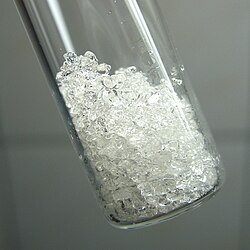
Phenol (also known as carbolic acid, phenolic acid, or benzenol) is an aromatic organic compound with the molecular formula C6H5OH. It is a white crystalline solid that is volatile and can catch fire.
The molecule consists of a phenyl group (−C6H5) bonded to a hydroxy group (−OH). Mildly acidic, it requires careful handling because it can cause chemical burns. It is acutely toxic and is considered a health hazard.
Phenol was first extracted from coal tar, but today is produced on a large scale (about 7 million tonnes a year) from petroleum-derived feedstocks. It is an important industrial commodity as a precursor to many materials and useful compounds, and is a liquid when manufactured. It is primarily used to synthesize plastics and related materials. Phenol and its chemical derivatives are essential for production of polycarbonates, epoxies, explosives such as picric acid, Bakelite, nylon, detergents, herbicides such as phenoxy herbicides, and numerous pharmaceutical drugs.
Phenol is an organic compound appreciably soluble in water, with about 84.2 g dissolving in 1000 ml (0.895 M). Homogeneous mixtures of phenol and water at phenol to water mass ratios of ~2.6 and higher are possible. The sodium salt of phenol, sodium phenoxide, is far more water-soluble. It is a combustible solid (NFPA rating = 2). When heated, phenol produces flammable vapors that are explosive at concentrations of 3 to 10% in air. Carbon dioxide or dry chemical extinguishers should be used to fight phenol fires.
Phenol is a weak acid, with a pH range of 5 to 6. In aqueous solution in the pH range ca. 8 - 12 it is in equilibrium with the phenolate anion C6H5O− (also called phenoxide or carbolate):
Phenol is more acidic than aliphatic alcohols. Its enhanced acidity is attributed to resonance stabilization of phenolate anion. In this way, the negative charge on oxygen is delocalized on to the ortho and para carbon atoms through the pi system. An alternative explanation involves the sigma framework, postulating that the dominant effect is the induction from the more electronegative sp2 hybridised carbons; the comparatively more powerful inductive withdrawal of electron density that is provided by the sp2 system compared to an sp3 system allows for great stabilization of the oxyanion. In support of the second explanation, the pKa of the enol of acetone in water is 10.9, making it only slightly less acidic than phenol (pKa 10.0). Thus, the greater number of resonance structures available to phenoxide compared to acetone enolate seems to contribute little to its stabilization. However, the situation changes when solvation effects are excluded.
In carbon tetrachloride and in alkane solvents, phenol hydrogen bonds with a wide range of Lewis bases such as pyridine, diethyl ether, and diethyl sulfide. The enthalpies of adduct formation and the −OH IR frequency shifts accompanying adduct formation have been compiled. Phenol is classified as a hard acid.
Phenol exhibits keto-enol tautomerism with its unstable keto tautomer cyclohexadienone, but the effect is nearly negligible. The equilibrium constant for enolisation is approximately 10−13, which means only one in every ten trillion molecules is in the keto form at any moment. The small amount of stabilisation gained by exchanging a C=C bond for a C=O bond is more than offset by the large destabilisation resulting from the loss of aromaticity. Phenol therefore exists essentially entirely in the enol form. 4,4' Substituted cyclohexadienone can undergo a dienone–phenol rearrangement in acid conditions and form stable 3,4‐disubstituted phenol.
Phenol
Phenol (also known as carbolic acid, phenolic acid, or benzenol) is an aromatic organic compound with the molecular formula C6H5OH. It is a white crystalline solid that is volatile and can catch fire.
The molecule consists of a phenyl group (−C6H5) bonded to a hydroxy group (−OH). Mildly acidic, it requires careful handling because it can cause chemical burns. It is acutely toxic and is considered a health hazard.
Phenol was first extracted from coal tar, but today is produced on a large scale (about 7 million tonnes a year) from petroleum-derived feedstocks. It is an important industrial commodity as a precursor to many materials and useful compounds, and is a liquid when manufactured. It is primarily used to synthesize plastics and related materials. Phenol and its chemical derivatives are essential for production of polycarbonates, epoxies, explosives such as picric acid, Bakelite, nylon, detergents, herbicides such as phenoxy herbicides, and numerous pharmaceutical drugs.
Phenol is an organic compound appreciably soluble in water, with about 84.2 g dissolving in 1000 ml (0.895 M). Homogeneous mixtures of phenol and water at phenol to water mass ratios of ~2.6 and higher are possible. The sodium salt of phenol, sodium phenoxide, is far more water-soluble. It is a combustible solid (NFPA rating = 2). When heated, phenol produces flammable vapors that are explosive at concentrations of 3 to 10% in air. Carbon dioxide or dry chemical extinguishers should be used to fight phenol fires.
Phenol is a weak acid, with a pH range of 5 to 6. In aqueous solution in the pH range ca. 8 - 12 it is in equilibrium with the phenolate anion C6H5O− (also called phenoxide or carbolate):
Phenol is more acidic than aliphatic alcohols. Its enhanced acidity is attributed to resonance stabilization of phenolate anion. In this way, the negative charge on oxygen is delocalized on to the ortho and para carbon atoms through the pi system. An alternative explanation involves the sigma framework, postulating that the dominant effect is the induction from the more electronegative sp2 hybridised carbons; the comparatively more powerful inductive withdrawal of electron density that is provided by the sp2 system compared to an sp3 system allows for great stabilization of the oxyanion. In support of the second explanation, the pKa of the enol of acetone in water is 10.9, making it only slightly less acidic than phenol (pKa 10.0). Thus, the greater number of resonance structures available to phenoxide compared to acetone enolate seems to contribute little to its stabilization. However, the situation changes when solvation effects are excluded.
In carbon tetrachloride and in alkane solvents, phenol hydrogen bonds with a wide range of Lewis bases such as pyridine, diethyl ether, and diethyl sulfide. The enthalpies of adduct formation and the −OH IR frequency shifts accompanying adduct formation have been compiled. Phenol is classified as a hard acid.
Phenol exhibits keto-enol tautomerism with its unstable keto tautomer cyclohexadienone, but the effect is nearly negligible. The equilibrium constant for enolisation is approximately 10−13, which means only one in every ten trillion molecules is in the keto form at any moment. The small amount of stabilisation gained by exchanging a C=C bond for a C=O bond is more than offset by the large destabilisation resulting from the loss of aromaticity. Phenol therefore exists essentially entirely in the enol form. 4,4' Substituted cyclohexadienone can undergo a dienone–phenol rearrangement in acid conditions and form stable 3,4‐disubstituted phenol.
Recent media
Recent media