
Recent from talks
Card stunt
Knowledge base stats:
Talk channels stats:
Members stats:
Card stunt
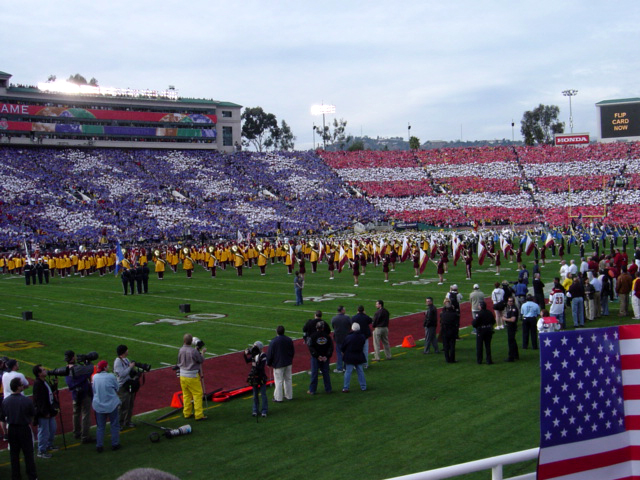
Card stunts are a planned, coordinated sequence of actions performed by an audience, whose members raise cards that, in the aggregate, create a recognizable image. The images they create can range widely and, through careful planning, the same cards can create a number of different images by systematically changing how the cards are held up. Although card stunts are now performed at a variety of events ranging from sports to political rallies, the card stunt is closely associated with American football, particularly college football, as well as football (soccer), where it can form part of a tifo. The North Korean mass games Arirang Festival, however, were the first to extend the card stunt to an art form, using flip-book cards to produce enormous hour-long animated sequences.
Card Stunts created on a smaller scale (50 to 1,000 cards) are used as team-building exercises for corporations, or to promote a new company logo, or recognize a company milestone. These card stunts, known as "billboard card stunts," are created using cards that are held above the card holders' heads. The largest billboard card stunt was created on September 17, 2013, in the desert outside Las Vegas by Kivett Productions. The card stunts were to promote the opening of Britney Spears' new show at the Planet Hollywood Las Vegas Resort & Casino.
In Mexico's Heroic Military Academy, card stunts are done during various occasions, especially on September 13, the anniversary of the Battle of Chapultepec, where a program is made in honor of this great battle.
North Korea's yearly Arirang Festival, also known as the Mass Games, in Pyongyang capitalizes on choreography and card stunt to create sweeping images across the stadium. The festival is famed for the use of this technique as part of the iconographic propaganda art of the regime.
Card stunts (Thai: การแปรอักษร) are regularly performed in certain sporting events in Thailand. They are especially associated with Jaturamitr Samakkee and Chula–Thammasat Traditional Football Match, but are also employed in most school- and university-level sporting events where performances by the seated crowd often play an important part in the competition. In addition to plain colored cards, other objects such as umbrellas, flashlights and reflective surfaces are also used, and special plates with multiple tiles of colored card booklets are used to create detailed aggregate images.
The origin of such performances in Thailand can be traced back to Assumption College, a member of the Jaturamitr, where in 1942, by the instruction of Cherd Sudara, a teacher at the school, differently-uniformed students in the audience arranged to form the school's initials. This developed into dynamic messages by physical movement of the crowd and later the covering and exposure of specific-colored clothing. The Chula–Thammasat Traditional Football Match adopted the card stunt in 1957; in the following years, cardboard cards became the predominant medium for the stunts. As a part of larger events, performances by Chulalongkorn University students were featured in the opening ceremony of the 1974 Asian Games in Tehran, and eight thousand students from the Jaturamitr schools performed during the 1999 FESPIC Games in Bangkok.
The Great Rose Bowl Hoax was a card stunt pulled off by students of California Institute of Technology (CalTech) during the 1961 Rose Bowl.
A 2006 Super Bowl commercial by Budweiser, titled "The Wave", features a fictional card stunt using computer animation. The crowd at the Rose Bowl performs a card stunt which shows a beer bottle being opened and poured around the stadium into a glass and subsequently being consumed one gulp at a time. The crowd finished with a collective "AHHHH".[citation needed]
Hub AI
Card stunt AI simulator
(@Card stunt_simulator)
Card stunt
Card stunts are a planned, coordinated sequence of actions performed by an audience, whose members raise cards that, in the aggregate, create a recognizable image. The images they create can range widely and, through careful planning, the same cards can create a number of different images by systematically changing how the cards are held up. Although card stunts are now performed at a variety of events ranging from sports to political rallies, the card stunt is closely associated with American football, particularly college football, as well as football (soccer), where it can form part of a tifo. The North Korean mass games Arirang Festival, however, were the first to extend the card stunt to an art form, using flip-book cards to produce enormous hour-long animated sequences.
Card Stunts created on a smaller scale (50 to 1,000 cards) are used as team-building exercises for corporations, or to promote a new company logo, or recognize a company milestone. These card stunts, known as "billboard card stunts," are created using cards that are held above the card holders' heads. The largest billboard card stunt was created on September 17, 2013, in the desert outside Las Vegas by Kivett Productions. The card stunts were to promote the opening of Britney Spears' new show at the Planet Hollywood Las Vegas Resort & Casino.
In Mexico's Heroic Military Academy, card stunts are done during various occasions, especially on September 13, the anniversary of the Battle of Chapultepec, where a program is made in honor of this great battle.
North Korea's yearly Arirang Festival, also known as the Mass Games, in Pyongyang capitalizes on choreography and card stunt to create sweeping images across the stadium. The festival is famed for the use of this technique as part of the iconographic propaganda art of the regime.
Card stunts (Thai: การแปรอักษร) are regularly performed in certain sporting events in Thailand. They are especially associated with Jaturamitr Samakkee and Chula–Thammasat Traditional Football Match, but are also employed in most school- and university-level sporting events where performances by the seated crowd often play an important part in the competition. In addition to plain colored cards, other objects such as umbrellas, flashlights and reflective surfaces are also used, and special plates with multiple tiles of colored card booklets are used to create detailed aggregate images.
The origin of such performances in Thailand can be traced back to Assumption College, a member of the Jaturamitr, where in 1942, by the instruction of Cherd Sudara, a teacher at the school, differently-uniformed students in the audience arranged to form the school's initials. This developed into dynamic messages by physical movement of the crowd and later the covering and exposure of specific-colored clothing. The Chula–Thammasat Traditional Football Match adopted the card stunt in 1957; in the following years, cardboard cards became the predominant medium for the stunts. As a part of larger events, performances by Chulalongkorn University students were featured in the opening ceremony of the 1974 Asian Games in Tehran, and eight thousand students from the Jaturamitr schools performed during the 1999 FESPIC Games in Bangkok.
The Great Rose Bowl Hoax was a card stunt pulled off by students of California Institute of Technology (CalTech) during the 1961 Rose Bowl.
A 2006 Super Bowl commercial by Budweiser, titled "The Wave", features a fictional card stunt using computer animation. The crowd at the Rose Bowl performs a card stunt which shows a beer bottle being opened and poured around the stadium into a glass and subsequently being consumed one gulp at a time. The crowd finished with a collective "AHHHH".[citation needed]
Recent media