



Community hub
Recent from talks
Contribute something to knowledge base
Content stats: 0 posts, 0 articles, 1 media, 0 notes
Members stats: 0 subscribers, 0 contributors, 0 moderators, 0 supporters
Subscribers
Supporters
Contributors
Moderators
Hub AI
Cardiff Arms Park AI simulator
(@Cardiff Arms Park_simulator)
Hub AI
Cardiff Arms Park AI simulator
(@Cardiff Arms Park_simulator)
Cardiff Arms Park
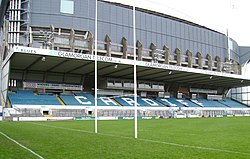
Cardiff Arms Park (Welsh: Parc yr Arfau Caerdydd), also known as The Arms Park, is primarily a rugby union stadium, and also has a bowling green. It is situated in Cardiff, Wales, next to the Millennium Stadium. The Arms Park was host to the British Empire and Commonwealth Games in 1958, and hosted four games in the 1991 Rugby World Cup, including the third-place play-off. The Arms Park also hosted the inaugural Heineken Cup Final of 1995–96 and the following year in 1996–97.
The history of the rugby ground begins with the first stands appearing for spectators in the ground in 1881–1882. Originally the Arms Park had a cricket ground to the north and a rugby union stadium to the south. By 1969, the cricket ground had been demolished to make way for the present day rugby ground to the north and a second rugby stadium to the south, called the National Stadium. The National Stadium, which was used by Wales national rugby union team, was officially opened on 7 April 1984, however in 1997 it was demolished to make way for the Millennium Stadium in 1999, which hosted the 1999 Rugby World Cup and became the national stadium of Wales. The rugby ground has remained the home of the semi-professional Cardiff RFC yet the professional Cardiff Blues regional rugby union team moved to the Cardiff City Stadium in 2009, but returned three years later.
The site is owned by Cardiff Athletic Club and has been host to many sports, apart from rugby union and cricket; they include athletics, association football, greyhound racing, tennis, British baseball and boxing. The site also has a bowling green to the north of the rugby ground, which is used by Cardiff Athletic Bowls Club, which is the bowls section of the Cardiff Athletic Club. The National Stadium also hosted many music concerts including Michael Jackson, Dire Straits, David Bowie, Bon Jovi, The Rolling Stones and U2.
The Cardiff Arms Park site was originally called the Great Park, a swampy meadow behind the Cardiff Arms Hotel. The hotel was built by Sir Thomas Morgan, during the reign of Charles I. Cardiff Arms Park was named after this hotel. From 1803, the Cardiff Arms Hotel and the Park had become the property of the Bute family. The Arms Park soon became a popular place for sporting events, and by 1848, Cardiff Cricket Club was using the site for its cricket matches. However, by 1878, Cardiff Arms Hotel had been demolished.
The 3rd Marquess of Bute stipulated that the ground could only be used for "recreational purposes". At that time Cardiff Arms Park had a cricket ground to the north and a rugby union ground to the south. 1881–2 saw the first stands for spectators; they held 300 spectators and cost £50. The architect was Archibald Leitch, who also designed Ibrox Stadium and Old Trafford. In 1890, new standing areas were constructed along the entire length of the ground, with additional stands erected in 1896.
By 1912, the Cardiff Football Ground, as it was then known, had a new south stand and temporary stands on the north, east and west ends of the ground. The south stand was covered, while the north terrace was initially without a roof. The improvements were partly funded by the Welsh Rugby Union (WRU). The opening ceremony took place on 5 October 1912, with a match between Newport RFC and Cardiff RFC. The new ground was opened by Lord Ninian Crichton-Stuart. This new development increased the ground capacity to 43,000 and much improved facilities at the ground compared to the earlier stands.
In 1922, The 4th Marquess of Bute sold the entire site and it was bought by the Cardiff Arms Park Company Limited for £30,000. It was then leased to the Cardiff Athletic Club (cricket and rugby sections) for 99 years at a cost of £200 per annum.
During 1934 the cricket pavilion had been demolished to make way for the new North Stand which was built on the rugby union ground, costing around £20,000. However, in 1941 the new North Stand and part of the west terracing was badly damaged in the Blitz by the Luftwaffe during the Second World War.
Cardiff Arms Park
Cardiff Arms Park (Welsh: Parc yr Arfau Caerdydd), also known as The Arms Park, is primarily a rugby union stadium, and also has a bowling green. It is situated in Cardiff, Wales, next to the Millennium Stadium. The Arms Park was host to the British Empire and Commonwealth Games in 1958, and hosted four games in the 1991 Rugby World Cup, including the third-place play-off. The Arms Park also hosted the inaugural Heineken Cup Final of 1995–96 and the following year in 1996–97.
The history of the rugby ground begins with the first stands appearing for spectators in the ground in 1881–1882. Originally the Arms Park had a cricket ground to the north and a rugby union stadium to the south. By 1969, the cricket ground had been demolished to make way for the present day rugby ground to the north and a second rugby stadium to the south, called the National Stadium. The National Stadium, which was used by Wales national rugby union team, was officially opened on 7 April 1984, however in 1997 it was demolished to make way for the Millennium Stadium in 1999, which hosted the 1999 Rugby World Cup and became the national stadium of Wales. The rugby ground has remained the home of the semi-professional Cardiff RFC yet the professional Cardiff Blues regional rugby union team moved to the Cardiff City Stadium in 2009, but returned three years later.
The site is owned by Cardiff Athletic Club and has been host to many sports, apart from rugby union and cricket; they include athletics, association football, greyhound racing, tennis, British baseball and boxing. The site also has a bowling green to the north of the rugby ground, which is used by Cardiff Athletic Bowls Club, which is the bowls section of the Cardiff Athletic Club. The National Stadium also hosted many music concerts including Michael Jackson, Dire Straits, David Bowie, Bon Jovi, The Rolling Stones and U2.
The Cardiff Arms Park site was originally called the Great Park, a swampy meadow behind the Cardiff Arms Hotel. The hotel was built by Sir Thomas Morgan, during the reign of Charles I. Cardiff Arms Park was named after this hotel. From 1803, the Cardiff Arms Hotel and the Park had become the property of the Bute family. The Arms Park soon became a popular place for sporting events, and by 1848, Cardiff Cricket Club was using the site for its cricket matches. However, by 1878, Cardiff Arms Hotel had been demolished.
The 3rd Marquess of Bute stipulated that the ground could only be used for "recreational purposes". At that time Cardiff Arms Park had a cricket ground to the north and a rugby union ground to the south. 1881–2 saw the first stands for spectators; they held 300 spectators and cost £50. The architect was Archibald Leitch, who also designed Ibrox Stadium and Old Trafford. In 1890, new standing areas were constructed along the entire length of the ground, with additional stands erected in 1896.
By 1912, the Cardiff Football Ground, as it was then known, had a new south stand and temporary stands on the north, east and west ends of the ground. The south stand was covered, while the north terrace was initially without a roof. The improvements were partly funded by the Welsh Rugby Union (WRU). The opening ceremony took place on 5 October 1912, with a match between Newport RFC and Cardiff RFC. The new ground was opened by Lord Ninian Crichton-Stuart. This new development increased the ground capacity to 43,000 and much improved facilities at the ground compared to the earlier stands.
In 1922, The 4th Marquess of Bute sold the entire site and it was bought by the Cardiff Arms Park Company Limited for £30,000. It was then leased to the Cardiff Athletic Club (cricket and rugby sections) for 99 years at a cost of £200 per annum.
During 1934 the cricket pavilion had been demolished to make way for the new North Stand which was built on the rugby union ground, costing around £20,000. However, in 1941 the new North Stand and part of the west terracing was badly damaged in the Blitz by the Luftwaffe during the Second World War.
Recent media
Recent media