Hubbry Logo
search
logo
Cardo
Cardo
current hub
2205033

Cardo

logo
Community Hub0 Subscribers
Read side by side
from Wikipedia

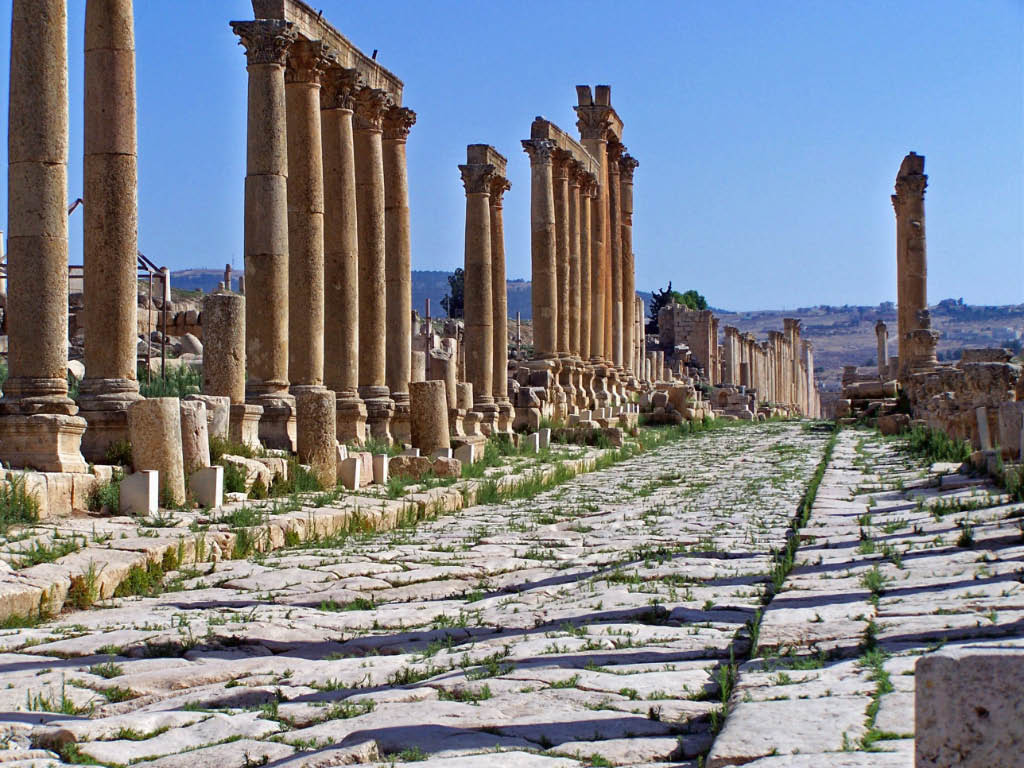
Roman cardo in Jerash, Jordan

A cardo (pl.: cardines) was a north–south street in ancient Roman cities and military camps as an integral component of city planning. The cardo maximus, or most often the cardo,[1] was the main or central north–south-oriented street.

Etymology

[edit]

“Cardo” is the Latin word for "hinge".[2] Being the hinge the turning point of the doors, the word cardo would also be used to designate other “turning points”, like the North Pole of the sky, or the four cardinal directions (quattuor cardines orbis terrarum).[3] Also the “the principal line laid down in surveying land was called cardo",[4] which is also applied to the first street of a city: the street around which the city would be structured.

Most Roman cities also had a decumanus maximus, an east–west street that served as a secondary main street. Due to varying geography, in some cities the decumanus is the main street and the cardo is secondary, but in general the cardo maximus served as the primary street. The forum was normally located at, or close to, the intersection of the decumanus and the cardo.

Examples

[edit]

Apamea, Syria

[edit]
Cardo maximus of Apamea, Syria

The cardo maximus of Apamea, Syria, ran through the centre of the city directly from North to South, linked the principal gates of the city, and was originally surrounded by 1,200 columns with unique spiral fluting, each subsequent column spiralling in the opposite direction. The thoroughfare was about 1.85 kilometres long and 37 metres wide, as it was used for wheeled transport. The great colonnade was erected in the 2nd century and it was still standing until the 12th. The earthquakes of 1157 and 1170 demolished the colonnade. The cardo was lined on both sides with civic and religious buildings.

Cologne, Germany

[edit]
Hohe strasse, in Cologne, Germany, was the cardo maximus of the city in Roman times. (Pictured 1895)

Hohe Strasse and Schildergasse in Cologne, Germany, are examples of streets that have maintained their course and function of cardo and decumanus maximus to this day.

Jerash, Jordan

[edit]

The excavations at Jerash, Jordan, have unearthed the remains of an ancient Roman city on the site, with the main feature of the city being a colonnaded cardo. The original road surface survived.

Remnants of the Cardo of the Old City of Jerusalem

Jerusalem

[edit]
Madaba Map showing the Roman cardo in Jerusalem

During the visit of Hadrian to Judea in the 130s AD, Jerusalem's ruins were surveyed, and Hadrian decided to build a Roman colony in its place, naming it Colonia Aelia Capitolina, after the Roman deities Jupiter, Juno and Minerva (the Capitoline Triad), worshiped at the Capitoline Hill temple in Rome.[5] Like many Roman colonies, Aelia Capitolina was laid out with a Hippodamian grid plan of narrower streets and wider avenues.[6] Notably, the decision was one of the main causes of the Bar Kokhba revolt, which shortly encompassed the region.

The main north–south thoroughfare, the cardo maximus, was originally a paved avenue approximately 22.5 meters wide (roughly the width of a six lane highway) which ran southward from the site of the Damascus Gate, terminating at an unknown point. The southern addition to the cardo, constructed under Justinian in the 6th century AD, extended the road further south to connect the Church of the Holy Sepulchre with the newly built Zion Gate.[7] Along its length, the roadway was divided into three parts: two colonnaded covered walks flanking a 12 meter wide road.[8] The shaded porticoes provided separation of pedestrian traffic from wheeled carts, shelter from the elements, space for small-scale commerce, as well as opportunities for residents and visitors to gather and interact.[9] The central open pavement provided commercial access as well as ritual space. The cardo's most striking visual feature was its colonnade, clearly depicted on the Madaba Map.

Simple bases supported monolithic shafts, spaced 5.77 meters apart.[10] The shafts supported Byzantine-style Corinthian capitals – intricately carved, but more stylized versions of their Classical counterparts. Although this combination of elements was uniform the preserved examples display some variation in the profile and size of the bases, and in the pattern of the capitals.[11] Despite aesthetic differences, the approximate height of the base, column, and capital units of the colonnade was five meters, a height which contributed to the spaciousness of the porticoes.[12] The wall of the cardo's eastern portico featured an arcade that housed various stalls and workshops leased by craftsmen and merchants.[13]

The line of the cardo maximus is still visible on the Jewish Quarter Street, though the original pavement lies several meters below the modern street level. In the 7th century, when Jerusalem fell under Muslim rule, the cardo became an Arab-style marketplace. Remains of the Byzantine cardo were found in the Jewish Quarter excavations beginning in 1969.[14]

In 1971, a plan for preserving the ancient street was submitted by architects Peter Bogod, Esther Krendel and Shlomo Aronson.[15] Their proposal relied heavily on the sixth century Madaba Map, a mosaic map of Jerusalem found in 1897 in Madaba, Jordan. The map clearly showed the Roman cardo as the main artery through the Old City. The architects proposed a covered shopping arcade that would preserve the style of an ancient Roman street using contemporary materials. Their plan was based on the hope that archeologists would find remains of the southern end of the cardo, an extension of the north–south Roman thoroughfare built during the Byzantine era (324–638).

Time was of the essence and mounting pressure to repopulate the Jewish Quarter led to the construction of a superstructure which allowed the residential buildings to be built. At the same time, the archaeologists continued to work below. The project was 180 meters in total and was divided into eight sections to allow for construction teams to move quickly from one section to another. By 1980, 37 housing units and 35 shops were built, incorporating archaeological finds such as a Hasmonean wall from the second century BC and rows of Byzantine columns. The combination of old and new is also visible on the Street of the Jews, where the shops have been set into old vaults and the gallery is covered by an arched roof containing small apertures to allow for natural lighting.

Roman cardo in Beit She'an, Israel

Beit She'an, Israel

[edit]

Beit She'an was one of a group of 10 Hellenistic cities known as Decapolis on the eastern frontier of the Roman Empire in Syria and Judea. It was a self-governed city established by the Romans to promote Roman culture. It was built with a central cardo, temples, theaters, baths and other public buildings, and minted its coins.[16]

Beirut, Lebanon

[edit]

The cardo maximus was the main north–south street of Roman Berytus. A section of the street – 100 meters long or so – was discovered during excavation works, flanked by two rows of limestone pedestals. These pedestals once carried 6-meter-high columns supporting roofed colonnades on either side of the street. A stairway in the eastern colonnade gave access to a large building complex.

The cardo maximus connected the forum to another complex that extended from the present Al-Azariyeh building to Riad Al Solh Square. Archaeological excavations uncovered two successive levels of the street, the oldest dating to the 2nd century CE. The later, wider street was laid out during the 4th century AD. The floors of the colonnades on both levels of the cardo maximus were embellished with mosaic pavements. These were covered, in the 6th century CE, with a thin coat of white lime plaster. Fragments of the floors remained in use until the 19th century. Roman columns were re-used in the foundations of later buildings constructed within the pavement of the cardo, reducing the main street of Roman Berytus into a small alley.[17]

Poreč, Croatia

[edit]

In the seaside resort of Poreč, Croatia, both cardo maximus and decumanus have retained their original names and still serve as the main streets of the historic town centre.

See also

[edit]

References

[edit]

Further reading

[edit]
[edit]
Revisions and contributorsEdit on WikipediaRead on Wikipedia
from Grokipedia
A cardo (plural: cardines; Latin for "hinge") was the principal north–south oriented street in ancient Roman cities and military camps, forming a core axis of their grid-based urban planning system.[1][2] The cardo symbolized the central "heart" or "hinge" around which urban life revolved, typically intersecting the east–west decumanus maximus at or near the city's forum to divide the layout into rectangular blocks known as insulae.[1] In Roman urban design, the cardo maximus—the widest and most prominent variant—facilitated commerce, processions, and daily movement, often lined with colonnades, shops, temples, and basilicas that provided covered walkways and supported economic activity.[1] This orthogonal grid originated in military camps (castra) during the Republic and was exported to colonial foundations and rebuilt cities, exemplifying Rome's emphasis on order, defensibility, and efficiency in expansion across the empire.[2] Notable surviving examples include the 800-meter-long cardo in Gerasa (modern Jerash, Jordan), featuring public structures like the Nymphaeum; the restructured cardo in Jerusalem under Emperor Hadrian, later extended in the Byzantine era for pilgrimage and trade; and the 2-kilometer colonnaded cardo in Apamea, Syria, which underscored its role as a vital cultural and economic artery.[1]

Etymology and Definition

Etymology

The term cardo originates from the Latin noun cardo, cardinis, denoting a "hinge," "pivot," or "axis," particularly the socket or tenon upon which a door or gate turns.[3] This mechanical connotation extended metaphorically to signify a central supporting element, as seen in its usage for the pole of the heavens or earth in astronomical contexts by authors like Varro and Pliny the Elder.[3] The word's semantic evolution tied it to directional fundamentals, giving rise to the adjective cardinalis ("principal" or "chief"), from which the concept of cardinales directiones (cardinal directions) emerged, emphasizing north-south orientation as a pivotal axis.[4] In Roman spatial organization, this axial symbolism underpinned urban and military layouts, where the cardo represented the primary north-south thoroughfare around which grids pivoted.[3] Roman architectural treatises, such as Vitruvius' De Architectura (c. 30–15 BCE), reference axial planning principles through methods like the gnomon for aligning streets with cardinal winds and directions, laying groundwork for the cardo's role as a foundational element, though the precise urban terminology solidified in later Republican and Imperial usage.[5] The term's application to city nomenclature, evolving from everyday mechanical references (e.g., door hinges in Ennius and Vergil) to structured planning by the late Republic, reflects the integration of axial concepts in Roman design.[3]

Definition and Terminology

In Roman urban planning, the cardo refers to a north-south oriented street that served as a principal axis in both cities and military camps, integral to the orthogonal grid system that divided urban spaces into rectangular blocks known as insulae and rural lands into centuriae through the centuriation system. This alignment facilitated efficient organization and movement, with the cardo intersecting perpendicularly with the east-west decumanus to form the foundational framework of Roman settlements.[6] The term cardo generally encompasses any north-south street within this grid, while the cardo maximus specifically denotes the primary, often wider and more prominent version, which typically ran through the center of the settlement and connected key gates or public spaces. Secondary north-south streets branching from the main axis are referred to in the plural as cardines, reflecting their role as parallel divisions in the broader surveying layout. The word cardo derives briefly from the Latin for "hinge," symbolizing its pivotal structuring function.[6] In the context of castra (military camps), the cardo formed the spine of the standardized rectangular plan, enabling rapid construction and defense, with its north-south orientation ideally aligned to cardinal directions. Similarly, in coloniae (settler cities founded by Rome), the cardo structured colonial expansion, where this cardinal alignment was determined through augury—a religious practice by which augurs divined the site's favorability and proper orientation before surveying commenced. This ritual integration ensured the layout's auspiciousness, blending practical engineering with Roman religious traditions.[7]

Historical Origins

Etruscan Influences

The Etruscan civilization, flourishing from the 8th to the 3rd century BCE, developed early forms of orthogonal urban planning that featured prominent north-south axes, predating and influencing Roman adaptations of the cardo. Archaeological evidence from sites such as Marzabotto, an Etruscan colony near Bologna founded around 500 BCE but planned in the late 6th century BCE, reveals a rigid grid layout with a central north-south thoroughfare intersecting perpendicular east-west streets, creating insulae of standardized blocks.[8] This north-south axis, approximately 9 meters wide in comparable plans, aligned buildings and public spaces in a manner that emphasized ritual orientation, reflecting the Etruscans' integration of astronomy and augury into urban design.[9] Etruscan engineers transmitted these planning techniques to early Rome through shared surveying practices, particularly the use of the groma, a cross-shaped instrument for establishing right angles and straight alignments. The groma, rooted in Etruscan augural traditions that relied on celestial observations for divination, enabled the precise layout of perpendicular axes essential to grid systems.[10] Roman sources, such as Varro, attribute the origins of surveying to Etruscan methods, noting how augury dictated the orientation of sacred and civic spaces along north-south lines to harmonize with divine auspices.[10] Key archaeological evidence from Veii, a major Etruscan city conquered by Rome in 396 BCE, demonstrates proto-cardo streets aligned for religious rituals, with axial pathways leading to temples like the Portonaccio sanctuary (c. 510 BCE). These streets, part of an early orthogonal framework spanning the city's plateau, facilitated processions and marked sacred boundaries, underscoring the ritual function of north-south orientations in Etruscan urbanism.[11] Excavations reveal that such alignments at Veii integrated civic and ceremonial elements, with roadways oriented to cardinal directions for prophetic purposes.[9] This Etruscan legacy transitioned into Roman practice around 509 BCE, coinciding with the founding of the Roman Republic and the expulsion of the last Etruscan king, Tarquinius Superbus, yet retaining orthogonal layouts in early republican settlements.[10] The incorporation of Etruscan-derived surveying tools and grid principles laid the groundwork for Rome's standardized urban and military planning, though adapted to imperial scales.[10]

Roman Adoption in Camps and Cities

The Romans introduced the cardo as a central element of temporary military camps, known as castra, around the 4th century BCE, establishing a rudimentary grid system for legionary protection and organization during early Republican campaigns.[12] These initial setups allowed for quick assembly in unfamiliar terrain, with the cardo serving as the primary north-south axis to facilitate movement and command. By approximately 200 BCE, during the Second Punic War, the layout had become standardized, as described by the historian Polybius, enabling rapid deployment for armies of up to 16,800 infantry and enabling efficient fortification within a day.[13] This uniformity reflected the evolution from ad hoc enclosures to precise rectangular grids, often measuring about 2,000 by 1,500 Roman feet, underscoring the cardo's role in embodying Roman military discipline.[12] During the Imperial period, the cardo expanded beyond transient camps into the planning of permanent urban centers, particularly under Augustus' extensive renewal programs starting in 27 BCE, which refounded or established over 20 colonies to consolidate Roman authority.[14] In these initiatives, the cardo symbolized imperial order and civic structure, intersecting the decumanus maximus at the forum to divide cities into orderly quarters, transforming military efficiency into a blueprint for civilian prosperity. A notable example was the refounding of Carthage in 29 BCE as Colonia Julia Concordia Carthago, where the cardo integrated into a comprehensive grid to revive the site as a key provincial hub for grain trade and administration.[14] Variations in the cardo's implementation evolved across eras, with Republican-era camps featuring narrower alignments—such as the via praetoria (cardo equivalent) at around 15 meters—to prioritize defensive compactness and rapid construction for legions on the move.[13] In contrast, Imperial coloniae emphasized monumental scale, with cardines often widened to 20-22 meters, flanked by colonnades and sewers to accommodate growing populations and processional routes.[15] This shift highlighted the transition from utilitarian military needs to symbolic displays of Roman hegemony. The north-south orientation of the cardo was heavily influenced by augural practices, rooted in Etruscan traditions of divination, which required alignment with cardinal directions to ensure favorable auspices during city foundations, as augurs divided the sky into templa along these axes for observing omens.[16] Key historical events further propelled the cardo's adoption in frontier contexts, such as Trajan's Dacian Wars (101-106 CE), which concluded with the conquest of Dacia and the establishment of new colonies to secure the Danube frontier. In these settlements, like Colonia Ulpia Traiana Sarmizegetusa, the cardo maximus—measuring about 11 meters wide—anchored grid-based planning to integrate Roman infrastructure into conquered landscapes, facilitating veteran resettlement and resource extraction while extending imperial control.[17]

Design Principles

Role in the Grid System

In Roman orthogonal urban planning, the cardo maximus served as the primary north-south axis, intersecting perpendicularly with the decumanus maximus at the forum to form a central cross-axis that anchored civic and religious activities. This intersection established the city's geometric core, directing public life toward key institutions and symbolizing the structured order of Roman society.[18][19] The cardo exhibited a hierarchical structure within the grid, functioning as the main spine along which major public buildings such as basilicas and temples were aligned, while secondary cardines provided narrower access to residential and peripheral zones. This organization prioritized efficient circulation for administrative and ceremonial functions along the primary axis, with the main cardo typically wider to accommodate heavier traffic and processions. In major cities, cardo widths (carriageway) commonly ranged from 6 to 10 meters, underscoring their superior status over subsidiary streets measuring 4 to 6 meters; total widths including sidewalks and porticos often exceeded 20 meters for the cardo maximus.[20][21][22] Symbolically, the cardo's alignment with cardinal points facilitated Roman practices of divination, such as augury, where priests traced axes to interpret omens, reinforcing the city's auspicious foundation. This orientation also supported imperial propaganda by integrating the grid into broader ideological frameworks, with the east-west decumanus reserved for triumphal processions to evoke solar and imperial symbolism.[18][19] The planning process emphasized precision, employing the groma—a surveying instrument with plumb lines—to ensure the cardo's perpendicularity to the decumanus, thus establishing the grid's orthogonal integrity from the outset of colonial or urban foundations. This methodical approach allowed for scalable layouts adaptable to terrain while maintaining the cardo's role as a foundational element.[19][21]

Architectural Features

Cardo streets were constructed using durable paving materials such as large polygonal blocks of basalt or limestone slabs, which provided a stable surface for wheeled traffic and pedestrians. These pavements often included central gutters lined with stone to channel rainwater and waste away from the roadway, preventing flooding and maintaining usability. Flanking the carriageway were raised sidewalks, typically 1 to 2 meters wide, elevated above the road level and bounded by curbs to separate foot traffic from vehicles.[23] In prominent examples like the cardo maximus, colonnades and porticos enhanced the architectural profile, featuring rows of marble or limestone columns supporting overhanging roofs that created shaded walkways. As seen in Jerash, these structures, with Corinthian or Ionic capitals, not only offered protection from the sun but also integrated shops beneath the porticos, supporting commercial activities along the street. The columns, often clad in marble, contributed to the monumental appearance while allowing for covered circulation in urban settings.[1][24] Cardo streets frequently incorporated monumental infrastructure, such as triumphal arches marking key intersections, public fountains (nymphaea) for water access, and inscribed milestones or honorary columns denoting distances and imperial dedications. These elements emphasized the street's role as a ceremonial axis. Widths varied by hierarchy: secondary cardines measured around 4 to 7 meters for the carriageway, while main cardo maximus examples reached 12 meters or more for the carriageway, expanding to over 20 meters including flanking porticos.[25][26][22] Adaptations to local topography were essential in non-level sites; in hilly terrain, cardo streets employed stepped sections or retaining walls to navigate elevation changes, ensuring alignment with the overall grid while accommodating slopes. In areas with significant grade variations, vaulted substructures supported the roadway over uneven ground.[27]

Notable Examples

Military Applications

In Roman military camps, or castra, the cardo functioned as the primary north-south axis, serving as the via praetoria that ran from the porta praetoria at the front through the center of the camp. This thoroughfare intersected the east-west via principalis, or decumanus, at the praetorium, the commander's headquarters, creating a standardized grid that divided the enclosure into regular blocks for barracks, stores, and administrative buildings. Legionary castra typically adopted a near-square form measuring approximately 20-30 hectares to accommodate around 5,000-6,000 troops, enabling efficient organization and scalability across the empire.[12][28][29] Notable examples illustrate this layout's application in both permanent and temporary settings. The Saalburg cohort fort in Germany, established in the early 1st century AD along the Limes Germanicus, preserves its reconstructed porta praetoria and aligned gates, which flanked the cardo to control access and provide defensive vantage points. In Britain, the Inchtuthil legionary fortress, built around 83 AD during Agricola's campaigns, exemplifies rapid construction on a 21-hectare site with a clear cardo-decumanus intersection, though it was dismantled shortly after due to strategic shifts. These structures highlight the cardo's role in modular design, allowing legions to erect camps in as little as a few days using pre-assigned unit positions.[30][31][32] Tactically, the cardo enhanced operational efficiency and security by channeling troop movements along predictable lines, permitting swift reinforcements to any perimeter while minimizing internal congestion during alerts. Gates at its endpoints, often double-arched and flanked by towers, integrated with ramparts and ditches to monitor approaches and deter surprise attacks, fostering a disciplined environment that boosted legionary morale and readiness. This alignment supported vigilance, as sentries positioned along the cardo could oversee multiple sectors simultaneously.[12][28] The cardo's prominence evolved from the nightly castrametatio of marching camps—temporary earth-and-timber enclosures built during advances—to more robust permanent forts with stone foundations, reflecting Rome's shift toward prolonged frontier defense from the 1st century AD onward. This progression standardized military engineering across provinces, with the grid layout persisting in later adaptations that informed Byzantine encampments and medieval bastions through shared principles of axial planning and fortified zoning.[12][29]

Provincial Urban Centers

In the Eastern provinces of the Roman Empire, several provincial cities featured prominent cardos that integrated Hellenistic architectural traditions with Roman urban planning, often emphasizing commercial vitality through extensive colonnades. At Apamea in Syria, constructed in the 2nd century AD following an earthquake in 115 AD, the Great Colonnade served as the cardo maximus, extending nearly 2 km north-south with a width of 20.79 meters lined by 9-meter-high limestone columns measuring 90 cm in diameter.[33] In Jerash (ancient Gerasa) in Jordan, the cardo maximus, built in the 1st century AD, measured 800 meters in length and was flanked by over 500 reassembled Corinthian columns, with a northern tetrapylon marking a key intersection for processional routes.[34] Jerusalem's Aelia Capitolina, refounded by Emperor Hadrian in 135 AD after the Bar Kokhba Revolt, included a cardo maximus as its primary north-south axis, 11.5 meters wide and lined with granite and limestone columns supporting covered walkways for shops.[22] Beit She'an (Scythopolis) in Israel preserved a 500-foot colonnaded cardo known as Palladius Street from the Roman period, branching into additional streets like Northern Street and Silvanus Street, all lined with shop stalls that facilitated trade in the Decapolis region.[35] Similarly, in Beirut (Berytus), the cardo maximus from the 2nd century AD featured a 100-meter excavated section with 6-meter-high columns under roofed colonnades that housed markets and connected the forum to major public complexes.[1] Western examples of provincial cardos tended to prioritize functional integration with local geography and infrastructure, reflecting Rome's emphasis on military and administrative efficiency along frontier lines. In Cologne (Colonia Claudia Ara Agrippinensium) along the Rhine River, established in the 1st century AD, the cardo maximus formed a 32-meter-wide north-south thoroughfare with 22-meter sidewalks, directly adjacent to the expansive forum (250 by 200 meters) that anchored civic life and trade in this provincial capital.[36] Poreč in Istria (modern Croatia), founded in the 1st century AD as Colonia Iulia Parentium, incorporated its cardo maximus along what is now Cardo Street, linking the forum to early basilica structures and integrating with the later 6th-century Euphrasian Basilica complex.[37] Trier (Augusta Treverorum) in Germany featured a cardo maximus that intersected the decumanus maximus at the site of the ancient forum baths (Viehmarktthermen), supporting the city's role as a key administrative hub from the 1st century AD onward.[38] Ostia, Italy's ancient port near Rome, extended its cardo maximus into suburban areas to accommodate warehouse districts and trade routes, with the street crossing the decumanus maximus at the central forum in a layout that evolved from the 4th century BC but peaked in Roman imperial use.[39] Many of these cardos benefit from strong preservation, aided by modern excavations that underscore their economic roles. Jerash's cardo, a UNESCO World Heritage Site since 1984, retains original flagstones, wheel ruts, drainage manholes, and side pavements used by vendors, revealing its function as a vibrant trade corridor despite earthquakes and floods over two millennia.[40][41] Excavations at sites like Apamea and Beit She'an have similarly exposed shop-lined porticos, highlighting how these streets served as commercial arteries linking markets to forums and aqueducts.[35] Regional variations in cardo design arose from cultural and environmental contexts, with Eastern examples often wider and more ornate due to Hellenistic influences—such as multi-story colonnades and decorative capitals originating in late Hellenistic Syria—contrasting with the West's more utilitarian approaches focused on straightforward paving and drainage for frontier efficiency.[42] This divergence is evident in the East's emphasis on shaded porticos for pedestrian commerce versus the West's integration with riverine defenses and basilica access.[43]

References

User Avatar
No comments yet.