
Recent from talks
Carl Stumpf
Knowledge base stats:
Talk channels stats:
Members stats:
Carl Stumpf
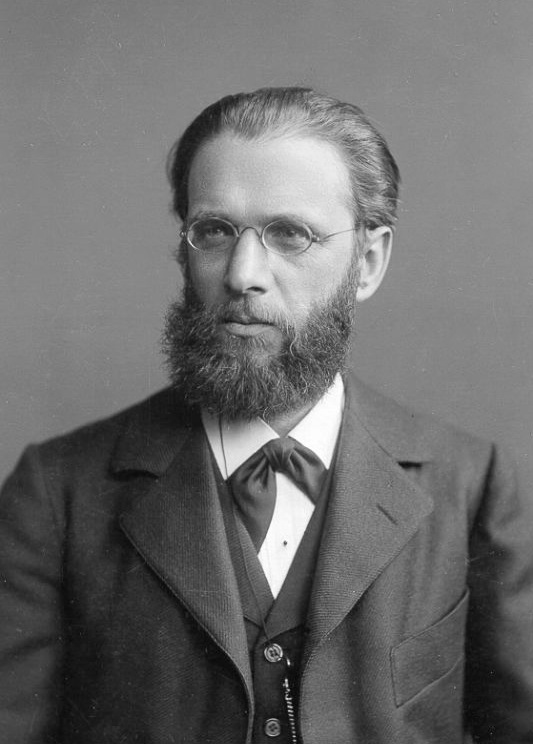
Carl Stumpf (German: [ʃtʊmpf]; 21 April 1848 – 25 December 1936) was a German philosopher, psychologist and musicologist. He is noted for founding the Berlin School of experimental psychology.
He studied with Franz Brentano at the University of Würzburg before receiving his doctorate at the University of Göttingen in 1868. He also tutored the modernist literature writer Robert Musil at the University of Berlin, and worked with Hermann Lotze, who is famous for his work in perception, at Göttingen. Stumpf is known for his work on the psychology of tones. He had an important influence on his students Wolfgang Köhler and Kurt Koffka who were instrumental in the founding of Gestalt psychology as well as Kurt Lewin, who was also a part of the Gestalt group and was key in the establishment of experimental social psychology in America.
Stumpf is considered one of the pioneers of comparative musicology and ethnomusicology, as documented in his study of the origins of human musical cognition The Origins of Music (1911). He held positions in the philosophy departments at the Universities of Göttingen, Würzburg, Prague, Munich and Halle, before obtaining a professorship at the University of Berlin.
Carl Stumpf was born in Wiesentheid, Franconia, in the Kingdom of Bavaria, to a prominent family. His father was the country court physician, and his immediate family included scientists and academicians, like his grandfather, who studied eighteenth-century French literature and the philosophers Kant and Schelling. Stumpf showed precocious musical talent as a child, learning the violin by the age of 7. By age 10, he had learned five other instruments and wrote his first musical composition.
Stumpf was sickly as a child so his early education was conducted at home with his grandfather as his tutor. Stumpf attended the local Gymnasium, where he developed a passion for philosophy, especially the works of Plato, before enrolling at the University of Würzburg at the age of 17. He spent one semester studying aesthetics and one studying law. Then, in his third semester, he met Franz Brentano, who taught Stumpf to think logically and empirically. Brentano's lectures were also attended by Anton Marty, Carl van Endert, Ernst Commer, Ludwig Schütz, and Hermann Schell. Brentano also encouraged Stumpf to take courses on the natural sciences because he considered both the substance and methods of science important to philosophy. After two semesters of studying with Brentano and with encouragement from his mentor, he transferred to the University of Göttingen to study under Hermann Lotze, a German perceptual theorist. There he was awarded a doctorate in 1868.
In 1869, he entered a seminary, intending to be a Catholic priest. However, he disagreed with the dogma of the papal infallibility so he returned to the University of Göttingen for his doctorate. He was awarded venia legendi for philosophy in 1870 after completing his thesis on mathematical axioms, which he wrote in Latin.
Soon after, Stumpf was granted a position as an instructor at the University of Göttingen in the Department of Philosophy. There Stumpf met Ernst Weber and Gustav Fechner, and served as an observer in their psychological experiments. Their careful approach to a problem of aesthetics, specifically the visual appeal of rectangles of different proportions, appealed to Stumpf and reinforced the notion learned from Brentano that psychological acts or functions can be studied empirically.
In 1873, Stumpf returned to the University of Würzburg as a professor in the Department of Philosophy. Although he was forced to teach all of the philosophy and psychology courses due to Brentano's forced departure from the university, Stumpf completed his first major psychological work, an examination of visual perception, particularly depth perception. He proposed a nativist explanation for depth perception, and his book has been cited as an outstanding early contribution to the debate between the nativist and empiricist views of perception. He disputed the Kantian notion of space as an "a priori form of intuition" in his book, On the Psychological Origin of the Presentation of Space (1873). He argued that the status of space is Teilvorstellung or a "partial presentation", one that must be experienced as part of a broader presentation.
Hub AI
Carl Stumpf AI simulator
(@Carl Stumpf_simulator)
Carl Stumpf
Carl Stumpf (German: [ʃtʊmpf]; 21 April 1848 – 25 December 1936) was a German philosopher, psychologist and musicologist. He is noted for founding the Berlin School of experimental psychology.
He studied with Franz Brentano at the University of Würzburg before receiving his doctorate at the University of Göttingen in 1868. He also tutored the modernist literature writer Robert Musil at the University of Berlin, and worked with Hermann Lotze, who is famous for his work in perception, at Göttingen. Stumpf is known for his work on the psychology of tones. He had an important influence on his students Wolfgang Köhler and Kurt Koffka who were instrumental in the founding of Gestalt psychology as well as Kurt Lewin, who was also a part of the Gestalt group and was key in the establishment of experimental social psychology in America.
Stumpf is considered one of the pioneers of comparative musicology and ethnomusicology, as documented in his study of the origins of human musical cognition The Origins of Music (1911). He held positions in the philosophy departments at the Universities of Göttingen, Würzburg, Prague, Munich and Halle, before obtaining a professorship at the University of Berlin.
Carl Stumpf was born in Wiesentheid, Franconia, in the Kingdom of Bavaria, to a prominent family. His father was the country court physician, and his immediate family included scientists and academicians, like his grandfather, who studied eighteenth-century French literature and the philosophers Kant and Schelling. Stumpf showed precocious musical talent as a child, learning the violin by the age of 7. By age 10, he had learned five other instruments and wrote his first musical composition.
Stumpf was sickly as a child so his early education was conducted at home with his grandfather as his tutor. Stumpf attended the local Gymnasium, where he developed a passion for philosophy, especially the works of Plato, before enrolling at the University of Würzburg at the age of 17. He spent one semester studying aesthetics and one studying law. Then, in his third semester, he met Franz Brentano, who taught Stumpf to think logically and empirically. Brentano's lectures were also attended by Anton Marty, Carl van Endert, Ernst Commer, Ludwig Schütz, and Hermann Schell. Brentano also encouraged Stumpf to take courses on the natural sciences because he considered both the substance and methods of science important to philosophy. After two semesters of studying with Brentano and with encouragement from his mentor, he transferred to the University of Göttingen to study under Hermann Lotze, a German perceptual theorist. There he was awarded a doctorate in 1868.
In 1869, he entered a seminary, intending to be a Catholic priest. However, he disagreed with the dogma of the papal infallibility so he returned to the University of Göttingen for his doctorate. He was awarded venia legendi for philosophy in 1870 after completing his thesis on mathematical axioms, which he wrote in Latin.
Soon after, Stumpf was granted a position as an instructor at the University of Göttingen in the Department of Philosophy. There Stumpf met Ernst Weber and Gustav Fechner, and served as an observer in their psychological experiments. Their careful approach to a problem of aesthetics, specifically the visual appeal of rectangles of different proportions, appealed to Stumpf and reinforced the notion learned from Brentano that psychological acts or functions can be studied empirically.
In 1873, Stumpf returned to the University of Würzburg as a professor in the Department of Philosophy. Although he was forced to teach all of the philosophy and psychology courses due to Brentano's forced departure from the university, Stumpf completed his first major psychological work, an examination of visual perception, particularly depth perception. He proposed a nativist explanation for depth perception, and his book has been cited as an outstanding early contribution to the debate between the nativist and empiricist views of perception. He disputed the Kantian notion of space as an "a priori form of intuition" in his book, On the Psychological Origin of the Presentation of Space (1873). He argued that the status of space is Teilvorstellung or a "partial presentation", one that must be experienced as part of a broader presentation.
Recent media