Hubbry Logo
CarnforthCarnforthMain
Open search
Carnforth
Community hub
Carnforth
logo
8 pages, 0 posts
0 subscribers
Be the first to start a discussion here.
Carnforth
Carnforth
from Wikipedia

Carnforth is a market town and civil parish in the City of Lancaster in Lancashire, England, situated at the north-east end of Morecambe Bay. The parish of Carnforth had a population of 5,560 in the 2011 census,[1] an increase from the 5,350 recorded in the 2001 census.[2] The town is situated around 7 miles north of Lancaster, 17 miles south of Kendal, 40 miles east (bisected by Morecambe Bay) of Barrow-in-Furness and 28 miles north-west of Settle. The town is also close to the Cumbria/Lancashire border.

Key Information

Carnforth grew in the 19th century through the presence of the railway and ironworks. Due to the closeness of the coast and the hills, Carnforth is a popular base for walkers and cyclists exploring the area. The River Keer, the West Coast Main Line (WCML), the A6 and the Lancaster Canal pass through the town. The M6 motorway passes just to the east, linked to Carnforth by the A6070 (formerly the A601(M)) which was originally part of the Lancaster bypass before the M6 was extended north.

History

[edit]
Christ Church

The name Carnforth is thought to derive from its old function as a ford of the River Keer on which it is situated. Over time, the descriptive name Keer-ford may have morphed into the modern Carnforth. An alternative explanation is that the name derives from 'Chreneforde' and is Anglo-Saxon in origin, as cited in the Victoria County History of Lancashire.[3] Another explanation is that it derives from the Old English cranford meaning 'crane ford'.[4]

Much of the history of Carnforth revolves around the railway and ironworks. Vast deposits of limestone located locally made Carnforth an ideal place for an ironworks, as limestone is a key component of the smelting process. In 1846, the Carnforth Ironworks Company established a works near to the railway station. In the same year, a recession occurred in the Earl of Dudley ironworks in Worcestershire, which meant there was a surplus of workers. A number of workers moved to the ironworks and lived in the nearby company village of Dudley (now called Millhead). In 1864, the Carnforth Haematite Company took over the works and production was vastly increased due to iron ore that was brought in by rail from the Furness Peninsula. By 1872, steel production became the main focus for the works using the new Bessemer process; this process had failed by 1879.[citation needed]

Iron production continued at the works until 1929, when it eventually closed down. The site was taken over by the War Department, as an ordnance depot and remained as such until the 1960s. From then to the present, the site is now an industrial estate housing several businesses.[5]

Market Street

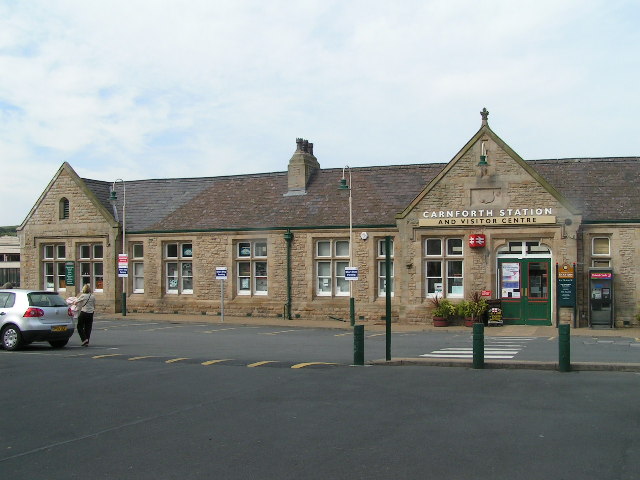
In the 19th century, Carnforth grew from a small village into a railway town when it became the junction of three major railways. Carnforth Motive Power Depot was located to the west of the West Coast Main Line and, until mid-1968, was one of the last to retain an allocation of steam locomotives. The buildings are now occupied by West Coast Railways[6] who still maintain and overhaul steam locos in their premises. The concrete locomotive coaling tower is a rare survivor.

With the closure of Carnforth MPD in 1968, the station's facilities were reduced. The main line platforms were closed in May 1970 and subsequently removed when the line was electrified two years later, although services still run on the Furness line and the Bentham Line.

The Royal Station Hotel

From the 1920s to the 1980s, Morphy's Mill, in Oxford Street, was a major employer of women in Carnforth. Contrary to its name, it was not a mill but a factory making blouses and other garments.[7][8]

Brief Encounter

[edit]

In 1945, Carnforth railway station was used as a location for the David Lean film Brief Encounter, starring Celia Johnson and Trevor Howard. Fans of this film were one of the major factors in the recent refurbishment of the railway station, including construction of a refreshment room to match the studio set used in the film. This reopened in 2021 as the Brief Encounter Refreshment Room Bistro and Bar.[9] There are also exhibitions and a heritage centre, which is now run by the Carnforth Station Trust.[10] The 2018 novel Past Encounters by local writer Deborah Swift is set, in part, in Carnforth during the filming of Brief Encounter.[11]

Gallery of film locations

Governance

[edit]

An electoral ward in the same name exists. This ward is smaller than the parish with a total population of 4,439.[12]

Carnforth is in the parliamentary constituency of Morecambe and Lunesdale, represented since 2024 by Lizzi Collinge of the Labour Party.[13]

Geography

[edit]

The River Keer runs through the north-north-west of the town with the mouth of the river flowing into Morecambe Bay. It forms the parish boundary between Carnforth and Warton. A bridge between Carnforth and Millhead is the lowest road crossing of the river, although there is a footbridge a little further downstream.[14]

Demography

[edit]

The Office for National Statistics recognises an area described as Carnforth Built-up area,[15] defined algorithmically, which includes Carnforth and Warton. It is divided into two parts: Carnforth subdivision,[16] which includes the Millhead area within Warton parish, and Warton subdivision.[17] The ONS definition of a built-up area includes built-up land separated by 200m from another settlement.[18]

2011 Census
Named area Population Area Population density Note
Carnforth civil parish[1] 5,560 6.09 km2 (2.35 sq mi) 910/km2 (2,400/sq mi)
Carnforth ward[19] 4,439 5.33 km2 (2.06 sq mi) 830/km2 (2,100/sq mi) Excludes Crag Bank area
Carnforth Built-up area[15] 7,920 2.33 km2 (0.90 sq mi) 3,400/km2 (8,800/sq mi) Comprises Carnforth and Warton Built-up area subdivisions
Carnforth Built-up area subdivision[16] 6,115 1.75 km2 (0.68 sq mi) 3,480/km2 (9,000/sq mi) Includes Millhead area
Warton Built-up area subdivision[17] 1,805 0.575 km2 (0.222 sq mi) 3,140/km2 (8,100/sq mi) Excludes Millhead area

Health service

[edit]

There is a general practice surgery in the town, with eleven partners and four associate GPs. It has smaller surgeries in Arnside, Bolton-le-Sands, Halton, and Silverdale, to serve patients in outlying villages.[20] It is within the North Lancashire clinical commissioning group and patients are served by the University Hospitals of Morecambe Bay NHS Foundation Trust.

There is also an NHS clinic, adjacent to the GP practice, used for a variety of services.[21][22]

Transport

[edit]
The Lancaster Canal at Carnforth

Carnforth railway station is served by Northern Trains on three lines:[23]

The West Coast Main Line passes through the station, but Avanti West Coast trains do not stop here; passengers must travel south to Lancaster or north to Oxenholme for destinations between London Euston and Glasgow Central.

Bus services in the town are provided by Stagecoach Cumbria and North Lancashire and Kirkby Lonsdale Coaches. Routes connect the town with Lancaster and Morecambe to the south, and to Milnthorpe, Kendal and Keswick in the north.[24] The 555 bus, which connects Lancaster with Keswick, is described as one of the longest and most scenic bus routes in England.[25]

Carnforth is on the A6 road 7 miles (11 km) north of Lancaster.[14] The M6 motorway passes to the east of the town; the A601(M) motorway and the B6254 road connect the town centre to junction 35.

The Lancaster Canal passes through the town; there is a marina for pleasure boats. Historically, the canal connected Lancaster to Kendal, but it is now closed beyond Tewitfield, north of Carnforth.

Both the Lancashire Coastal Way and the Bay Cycle Way skirt the western side of Carnforth, crossing the River Keer by the footbridge north-west of the town.

Media

[edit]

Local TV coverage is provided by BBC North West and ITV Granada. Television signals are received from the Lancaster relay TV transmitter.[26]

Local radio stations are BBC Radio Lancashire, Heart North West, Smooth North West, Greatest Hits Radio Lancashire, and Beyond Radio, a community based station which broadcasts from its studios in Lancaster.[citation needed]

Local newspapers are Lancaster Guardian (formerly The Visitor),[27] The Westmorland Gazette,[28] and Lancashire Evening Post.[29]

Education

[edit]

Primary schools:

  • Carnforth Community Primary School, North Road[30]
  • Christ Church C of E Primary School, North Road[31]
  • Our Lady of Lourdes Catholic Primary School, Kellet Road[32]

Secondary schools:

There is also a public library branch in the town.[33]

Religious sites

[edit]

The Anglican parish church of Christ Church, on Lancaster Road, was built in 1875 with later additions, and is a grade II listed building.[34] It worships in the Anglo-Catholic tradition.[35] It is in the Deanery of Tunstall in the Diocese of Blackburn.[36]

Our Lady of Lourdes Catholic church, on Kellet Road, is a small building in modern romanesque style, which opened in 1967; it replaced a temporary church that had opened in 1926.[37] It is a joint parish with St Mary's Church, Yealand Conyers and St Mary's Church, Bolton-le-Sands, in the Roman Catholic Diocese of Lancaster.[38]

Emmanuel Congregational Church, on Hawk Street, was established in 1884 and is a member of the Congregational Federation.[39]

Carnforth Free Methodist Church was established in 1995. It holds services at Carnforth High School on Kellet road and has a community centre adjacent to the school.[40]

The Salvation Army have a church in Preston Street and also run a charity shop on Market Street.[41]

The Jehovah's Witnesses have a Kingdom Hall on the outskirts of Carnforth at Mill Lane, Warton.[42]

Sport

[edit]

The town is home to Carnforth RUFC rugby union club,[43] Carnforth Rangers football club[44] and Carnforth Cricket Club.[45]

William Cowherd
William Sturgeon, pre 1850

Notable people

[edit]

See also

[edit]

References

[edit]
[edit]
Revisions and contributorsEdit on WikipediaRead on Wikipedia
from Grokipedia
Carnforth is a town and civil parish in the district of , , situated on the south bank of the River Keer near , approximately 6 miles (10 km) north of Lancaster. With a population of 5,521 as recorded in the 2021 census, it serves as a key due to its historic railway junction connecting lines to , the , and northern destinations. The town originated as a small mentioned in the as Chrenefbrde, but experienced rapid growth in the mid-19th century following the arrival of the railways in the 1840s and the establishment of and furnaces in 1864, transforming it from a township of around 300 residents into an industrial center with a population exceeding 3,000 by 1901. Economically, Carnforth features a diverse with low at around 3.2% as of mid-2024 and significant in skilled trades and professional occupations, supported by its role as a with good rail links to nearby cities like and . It is particularly renowned for , the filming location for the 1945 film Brief Encounter, which has preserved much of its 1940s heritage and attracts visitors through sites like the Carnforth Station Heritage Centre and the Brief Encounter Refreshment Room. The town's historic core, designated as a conservation area in 2014, includes Victorian-era buildings and listed structures around Market Street, reflecting its industrial past while maintaining a balance of residential, commercial, and green spaces totaling over 45 hectares.

Geography

Location and Setting

Carnforth is situated approximately 6 miles (10 km) north of Lancaster and approximately 11 miles (18 km) south of , positioned at the key junction of the A6 road and the . This strategic placement enhances its accessibility, with the M6 providing direct links to major routes northward toward and southward through . To the west, the town borders , while to the north it adjoins the foothills of the , creating a transitional landscape between coastal and upland terrains. As a result, Carnforth functions as a vital , facilitating connections between , , and via road and rail networks. Administratively, Carnforth lies within the district of , . Historically, it formed part of the hundred of Lonsdale south of the Sands, reflecting its longstanding ties to the regional administrative framework centered on the River Lune valley. The nearby River Keer and Lancaster Canal contribute to its setting as a canal-side settlement.

Physical Features

Carnforth lies along the River Keer, a 10-kilometer watercourse that originates in the hills near and flows northwest through the region before emptying into at its northeastern extent. The river's estuary forms a key natural boundary, contributing to the area's estuarine landscape characterized by tidal influences and salt marshes. Parallel to the town, the Lancaster Canal extends for approximately 41 miles, providing a historic navigable that follows the gentle contours of the local terrain and enhances the hydrological network without locks in its northern section. The terrain around Carnforth features a gentle westerly descending from an eastern ridge, with the town situated on low-lying ground averaging about 44 meters (144 feet) above , though elevations rise modestly to 144 meters within a 2-kilometer . To the east, the landscape transitions into elevated hills, including formations like Warton Crag, which reach heights exceeding 150 meters and form part of the Arnside and Silverdale . The town's proximity to the coast—within approximately 5 kilometers of Morecambe Bay's edge—exposes it to coastal processes, while the overall includes subtle variations shaped by glacial deposition and underlying geology. The of Carnforth encompasses an area of 6.075 square kilometers, much of which consists of low-lying, flood-prone zones adjacent to the River Keer and the , where tidal surges and heavy rainfall can lead to inundation of marshy and agricultural lands. These environmental characteristics, influenced by the permeable features of the surrounding , underscore the area's vulnerability to surface and flooding, particularly in the western extents near the .

History

Origins and Early Settlement

The name Carnforth is believed to derive from the Old English "crane ford," referring to a river crossing frequented by cranes, as evidenced by its early recording as "Chrenefbrde" in the Domesday Book of 1086. An alternative interpretation links it to the Welsh "caer" meaning fort, situated near a ford on the River Keer, though the Anglo-Saxon origin is more widely supported in historical records. The settlement's position on the south bank of the River Keer, which separates it from Westmorland, underscores this etymological connection to a key crossing point in the landscape. Evidence of early human activity in the area dates back to Roman times, with indications of a possible Roman road alignment running across the Carnforth levels toward the fort at Watercrook, close to the modern A6 route. While no major Roman settlement has been identified directly at Carnforth, the proximity to such infrastructure suggests transient use or minor occupation linked to regional transport networks. By the medieval period, Carnforth formed part of the manor held under the Barons of ; a significant record from 1246 documents Godith de Kerneford releasing a one-fourth share of the manor lands to William de Lancaster III, reflecting feudal land transactions in the region. Following Lancaster's death later that year, the manor was divided among heirs, including the families of Lindsay and Brus, establishing Carnforth's place within the broader ecclesiastical parish of Warton. Prior to the , Carnforth remained a small rural within , centered on with common fields such as Thwaite and Huthwaites used for growing , oats, and root crops on light soils, alongside extensive lands. The in 1801 stood at 219 inhabitants, comprising about 14 percent of the parish total and indicative of a dispersed, farming-based of roughly 40 families as noted in earlier 18th-century surveys. This agrarian focus persisted, with most residents engaged as husbandmen supporting local domestic industries.

Industrial Growth

The arrival of in the transformed Carnforth from a small into an industrial hub, with the establishment of iron production facilities capitalizing on the new transport infrastructure. In 1846, the Carnforth Ironworks Company founded the works adjacent to the newly opened railway station, initially focusing on iron smelting supported by abundant local deposits. The facility utilized imported haematite ore transported by rail from the Furness Peninsula and coke derived from regional coal sources, primarily from Durham, to produce . By 1864, the site was acquired and expanded by the Carnforth Haematite Iron Company, which introduced steelmaking in 1872 using the , marking the peak of operations in the when the works featured up to six blast furnaces and employed around 500 workers. This expansion was facilitated by the railway junction, initially developed by the Lancaster and Carlisle Railway in 1846 and later integrated into the London and North Western Railway network, which enhanced connectivity for raw materials and finished goods. The industrial activity spurred rapid , driving the population from approximately 300 in the 1840s to 3,040 by 1901. The began to decline in the late amid intensifying competition from more efficient production methods elsewhere, leading to the closure of the operations by 1889 while output continued on a reduced scale. The facility fully ceased operations in 1929 due to depleted local supplies and post-World War I economic pressures, after which the site was repurposed by the War Department as an ordnance depot until the .

20th Century Developments

During , the site of the former Carnforth Ironworks, which had closed in 1929, was repurposed by the War Department as an ordnance depot to support . This use continued into the period as an army depot until the 1960s, after which the area transitioned to lighter industrial activities, including use by the Ministry of Works and a brief stint as a scrapyard. By the 1980s, the site had been cleared to establish the Carnforth Industrial Estate, marking a shift toward modern warehousing and smaller-scale that supported local employment without the heavy industry of prior eras. Parallel to these industrial changes, Carnforth experienced significant residential expansion in the mid-, driven by needs and its growing role as a dormitory town for nearby Lancaster and . A small council estate from the early 1900s was substantially enlarged after , with additional developments constructed throughout the late , particularly to the southwest and southeast of the town center, accommodating while maintaining a suburban character. This residential focus complemented the lighter economic base, as the closure of the railway's main line platforms in reduced Carnforth's role as a but preserved its connectivity for commuters. A notable cultural milestone occurred in 1945 when the railway station served as a primary filming location for David Lean's film , with exterior scenes captured there due to its remote and secure setting during wartime restrictions. The station's association with the film endured, inspiring the formation of the Carnforth Station Trust in 1996 to restore the aging facilities; this effort culminated in the opening of the Carnforth Station Heritage Centre in 2003, featuring exhibits on railway history and the movie, alongside the adjacent Brief Encounter Bistro and Bar recreated in period style. The centre attracted around 45,000 visitors annually pre-pandemic but faced closure threats in 2024, ultimately saved by a community group takeover while the bistro continued operations independently. In 2025, the station hosted events marking the 80th anniversary of the film's release, including a 1940s weekend on June 28–29 and special screenings in November; the Heritage Centre announced a temporary closure after December 19, 2025, for refurbishment works. Into the late 20th and early 21st centuries, developments emphasized steady rather than transformative growth, with the industrial estate expanding modestly through sites like Lodge Quarry to support gravel extraction and related light industries tied to regional infrastructure projects such as the . initiatives gained prominence, including the 2020-2031 Carnforth Neighbourhood Plan, which promoted public realm enhancements like pedestrian-friendly Market Street improvements, cycleway expansions along the A6 and canal towpath, and boosts via rail heritage. Local events, such as annual parades and services at the —highlighted by a 2024 centenary re-enactment of its 1924 unveiling—underscored ongoing without major economic upheavals post-2011, constrained by protections and limited business expansion.

Governance

Local Administration

Carnforth's local administration underwent significant changes over the centuries, evolving from a rural within the ancient of Warton to an independent urban district and, ultimately, a under modern structures. Historically, as a in Warton , Carnforth's was tied to and manorial oversight until industrialization prompted separation; Christ Church's in 1875 marked a key step toward autonomy. In 1895, it was constituted as an urban district council with nine members, reflecting its growth as an industrial center. This status persisted until the Local Government Act 1972 reforms abolished the Carnforth Urban District Council in 1974, merging it into the newly formed Lancaster district while establishing a successor . Today, Carnforth operates as a governed by the , the lowest tier of , which was established following the 1974 reforms to represent interests. The council comprises 11 elected councillors, organized into committees such as Town Development & , Finance & Governance, and Property & Environment, which oversee local matters including amenities like allotments, bus shelters, play areas, and centers; consultation on neighborhood applications; and provision of grants for events and organizations. Carnforth falls within the Carnforth & Millhead ward of Lancaster City Council, the district-level authority responsible for broader services such as and , council housing provision and management, and strategic local decisions across the district. This ward had a of 6,044 according to the 2021 Census. The town council collaborates with Lancaster City Council on shared initiatives, such as maintenance and issue resolution, while advocating for residents on district-wide policies.

Parliamentary Representation

Carnforth forms part of the Morecambe and Lunesdale parliamentary constituency in , , which encompasses areas along including the towns of , , and Carnforth, as well as rural parts of the Lune Valley. The constituency was established in 1983 following the third periodic review of Westminster constituencies by the Boundary Commission for England, which reorganized boundaries to reflect population changes and renamed the former Morecambe and Lonsdale seat to incorporate Lunesdale, ensuring more balanced electorates across . Prior to this, from 1950 to 1983, the area including Carnforth was represented under the Morecambe and Lonsdale constituency by Conservative MPs, notably Alfred Hall-Davis (1959–1979) and Mark Lennox-Boyd (1979–1983 and continued in the successor seat until 1997). Since the 2024 general election, Morecambe and Lunesdale has been represented by Lizzi Collinge of the Labour Party, marking a gain from the Conservative Party after 14 years of Conservative control. Collinge secured 19,603 votes (40.8% of the vote share), defeating the former MP David Morris (Conservative) who received 13,788 votes (28.7%), resulting in a of 5,815 for Labour. The saw a of 62.9% among an electorate of 76,424, slightly above the national average, with other candidates including Gina Dowding (, 10,439 votes) and Jack Lenox (Independent, 4,126 votes). Key local issues influencing the campaign included improvements to transport infrastructure, such as addressing potholes, road maintenance, and reliability on routes connecting Carnforth to Lancaster and , as well as housing affordability amid rising demand in coastal and rural areas. Notable in Carnforth's political history is , born in the town in 1931, who served as a Conservative MP for Enfield West (1970–1974) and (1974–1983), rising to prominent roles including for Trade and Conservative Party Chairman before his ennoblement as Baron Parkinson of Carnforth in 1992.

Demography

The population of Carnforth's has experienced substantial growth since the early , largely fueled by industrialization and improved transport links. The 1801 recorded just 219 residents in the parish. By the mid-19th century, the population hovered around 300, but the establishment of and the arrival of the railway spurred rapid expansion, reaching approximately 3,000 by 1900. More recent census data reflects continued but moderating growth into the late , followed by stabilization. The table below summarizes key figures for the :
YearPopulationChange from Previous
20015,350-
20115,560+3.6%
20215,521-0.7%
Sources: (2001 and 2011 censuses via Nomis). (2021 census). The built-up area of Carnforth, encompassing suburban expansion including adjacent parts of Warton, recorded 5,665 residents in 2011 and 5,854 in 2021. By 2021, the density stood at 908.8 inhabitants per km². Following the industrial boom, population growth stabilized after the 1970s, supported by Carnforth's position as a commuter settlement for nearby Lancaster, bolstered by rail and road connections.

Socio-Economic Profile

Carnforth exhibits a predominantly homogeneous ethnic composition, with 97.5% of residents identifying as according to the 2021 census, followed by 1.2% Asian, reflecting limited diversity compared to national averages. The median age in the town stands at 43 years, exceeding the national median of 40, indicative of an aging population structure that influences local service demands and community dynamics. Deprivation levels in Carnforth are relatively low, with the area ranked as the 18,000th least deprived in under the 2019 Index of Multiple Deprivation (IMD), positioning it among more affluent locales nationally. Approximately 15% of households experience fuel poverty, a figure slightly above the average, highlighting vulnerabilities related to energy costs and housing efficiency in this rural-market town setting. Employment patterns underscore Carnforth's role as a with local economic anchors, where 65% of the working-age is economically active as per 2021 data. Key sectors include retail and , bolstered by the town's industrial estate, alongside significant outward , with 75% of workers traveling less than 10 km to their jobs, primarily to nearby Lancaster or via rail connections. This blend supports stable community characteristics, though it ties local prosperity to regional transport and trade networks.

Infrastructure

Transport

Carnforth serves as a key regional transport junction in , , with connectivity provided by rail, , and bus networks that facilitate travel to nearby cities and the . The town's railway station lies on the , as well as the Furness Line and Bentham Line, and is primarily served by for regional services. These include routes to (approximately 1 hour 10 minutes via Oxford Road) and connections onward to Euston (around 2 hours 45 minutes total, typically changing at Preston). Local services link to Lancaster (8 minutes), via the Furness Line, and via the Bentham Line. The station, known for its role in the 1945 film , features heritage facilities including a visitor centre and refreshment room that were enhanced through refurbishments in the early and further updates around to support its cultural significance. Road access is anchored by Junction 35 of the , which connects directly to the A6 via the short A601(M) link north of the town. This configuration supports efficient north-south travel along the historic A6, while the Lancaster Canal towpath offers dedicated cycle paths for recreational and commuter use between Carnforth and Lancaster. Bus services are operated mainly by Cumbria and North , with Route 55 providing frequent links to Lancaster (about 20 minutes) and Route 555 extending to , , , and Keswick (up to 2 hours to Keswick). No major commercial airport is nearby; , handling , is approximately 27 miles (43 km) south.

Health Services

The primary healthcare services in Carnforth are provided by Ash Trees Surgery, a located on Market Street that operates as part of the area. The practice is staffed by 14 GP partners and seven associate GPs, delivering comprehensive including routine consultations, chronic disease management, and preventive health services. It serves over 25,000 registered patients across a diverse rural and semi-urban catchment, as of 2025. To enhance accessibility, Ash Trees Surgery maintains five branch locations in nearby villages, including Arnside, Silverdale, , Bolton-le-Sands, and Halton, allowing residents in surrounding areas to receive local care without traveling to the main Carnforth site. These satellites support extended hours and community-based services, integrated with the NHS App for online bookings and prescriptions. For secondary and specialist hospital care, Carnforth residents rely on the University Hospitals of NHS Foundation Trust, which manages facilities such as the Royal Lancaster Infirmary, located approximately 6 miles away. This trust provides a range of inpatient, outpatient, and emergency services, including diagnostics, surgery, and maternity care, with integrated pathways for referrals from local GPs. Community health in Carnforth reflects broader trends, with 46.4% of residents reporting very good general in the 2021 Census, indicating a focus on preventive and social care initiatives to address vulnerabilities. One notable program is Stepping Stone Projects' Dispersed Housing Service, which offers supported accommodation and floating support for at-risk individuals, including those facing or complex needs; the organization's chair received an MBE in the 2024 King's for services to vulnerable people.

Education

Carnforth provides through three main schools serving children aged 4 to 11. Carnforth Community Primary School, a community school located on North Road, accommodates approximately 82 pupils and emphasizes a supportive for mixed-gender students. Christ Church, , Voluntary Aided Primary School, situated on North Road, enrolls around 118 pupils and integrates Christian values into its for ages 4 to 11. Our Lady of Lourdes Catholic Primary School, an on Kellet Road, serves about 86 pupils aged 3 to 11, with a focus on Roman Catholic . For secondary education, local students typically attend Carnforth High School, an academy converter on Kellet Road that caters to ages 11 to 16 with around 685 pupils. The school received a "Good" rating in its most recent inspection in December 2021, highlighting effective leadership and pupil behavior. Public library services in Carnforth are provided by Carnforth Library, operated by on Lancaster Road, which offers access to digital resources such as e-books and online databases, alongside community events like reading groups and workshops. There are no higher education institutions based locally in Carnforth.

Culture and Society

Media

Carnforth residents primarily receive regional television broadcasts from BBC North West, which covers and provides local news through programmes like North West Tonight. Similarly, serves the area with regional news and programming tailored to the North West of England. For radio, BBC Radio Lancashire offers comprehensive local coverage on 104.5 FM in the Lancaster and area, including news, weather, and features relevant to Carnforth. Beyond Radio, a station broadcasting on 107.5 FM specifically for Carnforth and surrounding areas, focuses on Lancaster district events, music, and local information. In print media, the Lancaster Guardian serves as a key weekly publication delivering news, sports, and features from Carnforth and the broader Lancaster area. The Westmorland Gazette, another weekly newspaper, extends its coverage to North , including stories on Carnforth's community and developments. Online, the Visit portal provides accessible local news and 2024 updates on Carnforth's heritage attractions, such as the station's historical significance.

Religious Sites

Carnforth's religious landscape reflects its 19th-century industrial growth, particularly from and , which drew a diverse population and fostered multiple denominations. The primary Anglican place of worship is Christ Church, a Grade II listed building constructed in 1875 on Lancaster Road to serve the expanding parish previously under Warton. Designed in a Gothic Revival style, it features a , , and later-added tower, accommodating the community's spiritual needs amid rapid . The church maintains an active role in local life, including ties to the adjacent Carnforth Christ Church, Voluntary Aided . For Roman Catholics, Our Lady of Lourdes Church on Kellet Road provides modern facilities, with the current structure opening on 30 July 1967 after a foundation stone laid in 1966 by Bishop Thomas Foley. This Romanesque-style building, designed by architect W. C. Mangan of Preston, replaced a temporary established in 1926 and was built to meet the needs of a growing Catholic community in the period. It forms part of a broader including nearby churches in Bolton-le-Sands and Yealand. Nonconformist traditions are represented by Emmanuel Congregational Church on Hawk Street, founded in 1880 and constructed in 1896 to support the town's burgeoning working-class population. This 19th-century chapel exemplifies the denominational diversity spurred by industrial migration, later affiliating with the in 1972. Methodist worship historically centered on chapels like the Wesleyan Methodist on Lancaster Road, opened in 1870, and the Primitive Methodist chapel founded in 1873, both responding to the influx of laborers and their families. Today, the , established in 1995, continues this legacy through services held at local venues.

Sport

Carnforth boasts a range of local sports clubs that play a central role in , providing opportunities for residents of all ages to participate in team-based and individual activities. Football, , and form the core of organized sports, with clubs emphasizing development, programs, and social events to build local ties. These organizations not only compete in regional leagues but also host matches, training sessions, and community tournaments that draw spectators and volunteers from the town and surrounding areas. Carnforth Rangers FC serves as the town's flagship football club, operating as a non-league outfit in Division One of the . Established with roots in early 20th-century local play, the club fields senior, reserve, and junior teams, promoting inclusivity through its involvement in the Football League and youth leagues like the Lancaster & Service to Youth League. Home games are held at Quarry Park, a venue at the base of Lundsfield Quarry since 1950, featuring a clubhouse, stand, and bar that support matchday hospitality and post-game gatherings. The club's success, including a 2023 League victory via a 3-1 final win over Dalton United, underscores its competitive spirit while fostering community pride through volunteer-led initiatives and family-oriented events. Rugby union is represented by Carnforth RUFC, a longstanding club that competes in regional leagues, such as North Lancashire 2, and maintains active senior and second teams alongside youth development programs. The club cultivates a welcoming atmosphere for players and supporters, with facilities supporting training and social functions that encourage broad participation in the sport. Historical matches, like a closely contested 2006 league encounter against Garstang Blues, highlight the club's enduring presence in local rugby circles, where it contributes to inter-club rivalries and skill-building clinics for juniors. Carnforth Cricket Club, located at Lodge Quarry, anchors the town's summer sports scene with three senior teams, a women's section, and junior programs starting from age 9, including ECB All Stars and Dynamos initiatives. Competing primarily in the Moore and Smalley Shield competitions, the club achieved a milestone in 2023 by winning the Meyler Cup for the first time, defeating opponents in a high-scoring final that showcased local talent. With a legacy spanning over 150 years, the club prioritizes family involvement and coaching, hosting village-style matches and community barbecues to enhance participation and preserve cricket's traditions in Carnforth. Beyond these core sports, residents enjoy through the nearby Bay Horse Golf Society in the adjacent village, which organizes regular outings and matches for amateur players. Cycling thrives via accessible paths like the Lancaster Canal towpath—part of National Cycle Route 6—and the 81-mile Bay Cycle Way, enabling leisurely rides and group events that promote health and exploration of the local landscape.

Notable People

William Cowherd (1763–1816) was an English clergyman born in Carnforth, Lancashire, who founded the Bible Christian Church in in 1809 after breaking from the . He promoted a "vegetable diet" free of meat as a aligned with Christian principles, alongside temperance, which influenced early vegetarian movements and led to the establishment of the Vegetarian Society in 1847. Cowherd's teachings emphasized compassion for animals and health benefits, attracting a congregation of about 500 by his death. William Sturgeon (1783–1850), born in Whittington near , , was a self-taught English and inventor who pioneered . In 1825, he created the first practical by coiling uninsulated wire around an iron core, enabling it to lift weights exceeding nine times its own mass and laying groundwork for electrical devices. Sturgeon later invented the first electromagnetic motor in 1832 and a moving-coil , contributing to advancements in and . Cecil Parkinson (1931–2016), born in Carnforth, Lancashire, was a key figure in British Conservative politics during the Thatcher era. He served as MP for Enfield West from 1974 to 1983 and Hertsmere until 1992, holding senior roles including Secretary of State for Trade and Industry (1983), Energy (1987–1989), and Transport (1989–1990). In 1992, he was elevated to the House of Lords as Baron Parkinson of Carnforth, later chairing the Conservative Party from 1997 to 1998.

References

Add your contribution
Related Hubs
User Avatar
No comments yet.